PATHO MIDTERM EXAM
Question 1
After the baroreceptor reflex is stimulated, the resulting impulse is transmitted from the carotid artery by which sequence of events?
From the vagus nerve to the medulla to incr
...
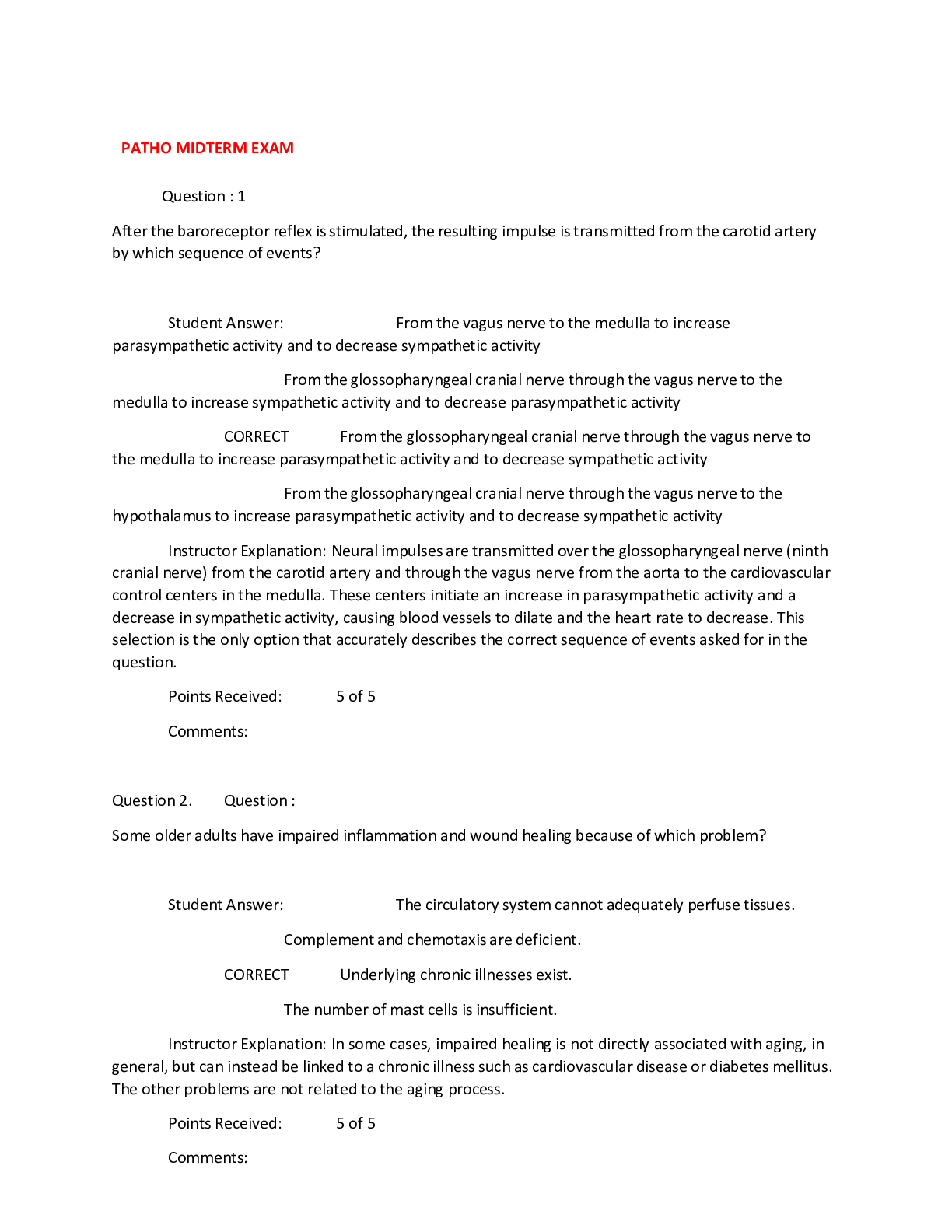
PATHO MIDTERM EXAM
Question 1
After the baroreceptor reflex is stimulated, the resulting impulse is transmitted from the carotid artery by which sequence of events?
From the vagus nerve to the medulla to increase parasympathetic activity and to decrease sympathetic activity
From the glossopharyngeal cranial nerve through the vagus nerve to the medulla to increase sympathetic activity and to decrease parasympathetic activity
From the glossopharyngeal cranial nerve through the vagus nerve to the medulla to increase parasympathetic activity and to decrease sympathetic activity
From the glossopharyngeal cranial nerve through the vagus nerve to the hypothalamus to increase parasympathetic activity and to decrease sympathetic activity
Neural impulses are transmitted over the glossopharyngeal nerve (ninth cranial nerve) from the carotid artery and through the vagus nerve from the aorta to the cardiovascular control centers in the medulla. These centers initiate an increase in parasympathetic activity and a decrease in sympathetic activity, causing blood vessels to dilate and the heart rate to decrease. This selection is the only option that accurately describes the sequence of events asked for in the question.
Question 2. Question
Some older adults have impaired inflammation and wound healing because of which problem?
The circulatory system cannot adequately perfuse tissues.
Complement and chemotaxis are deficient. Underlying chronic illnesses exist.
The number of mast cells is insufficient.
In some cases, impaired healing is not directly associated with aging, in general, but can instead be linked to a chronic illness such as cardiovascular disease or diabetes mellitus. The other problems are not related to the aging process.
Question 3. Question
Phagocytosis involves neutrophils actively attacking, engulfing, and destroying which microorganisms?
Bacteria
Fungi Viruses Yeasts
Invasion is the direct confrontation with an individual’s primary defense mechanisms against only bacteria, which include the complement system, antibodies, and phagocytes, such as neutrophils and macrophages.
Question 4. Question
Which T cells control or limit the immune response to protect the host’s own tissues against an autoimmune response?
Cytotoxic T (Tc) cells Helper T 1 (Th1) cells
Helper T 2 (Th2) cells
Regulatory T (Treg) cells
The Treg cell is the only option whose role is to control or limit the immune response to protect the host’s own tissues against autoimmune reactions.
Question 5. Question
Diagnostic blood work on individuals who perceive themselves to be in a chronic stress state will likely demonstrate
Decreased helper T (Th) lymphocytes Increased erythrocytes
Decreased cytotoxic T (Tc) cells Increased platelets
Illustrating the influence of chronic stress appraisal on the physiologic processes, a meta-analysis of the relationships between stressors and immunity found that a higher perception of stress was associated with reduced Tc-cell cytotoxicity, although not with levels of circulating Th or Tc lymphocytes. Research has substantiates the other options.
Question 6. Question
Active transport occurs across which type of membranes?
Membranes that have a higher concentration of the solute on the outside of the cells
Membranes that are semipermeable to water and small electrically uncharged
molecules
Membranes that have receptors capable of binding with the substances to be transported
Membranes that have a cell membrane that is hydrophobic rather than
hydrophilic
Some molecules are moved into the cell by mechanisms of active transport, which require receptors that are capable of recognizing and binding with the substance to be transported. Diffusion is the movement of a solute molecule from an area of greater solute concentration to an area of lesser solute concentration. Hydrostatic pressure is the mechanical force of water pushing against cellular membranes. Osmosis is the movement of water down a concentration gradient; that is, across a semipermeable membrane from a region of higher water concentration to a lower water concentration
Question 7. Question
Air passage among alveoli is collateral and evenly distributed because of the function of which structures?
Type I alveolar cells Pores of Kohn
Acinus pores Alveolar pores
Tiny passages called pores of Kohn permit some air to pass through the septa from alveolus to alveolus, promoting collateral ventilation and even distribution of air among the alveoli. This selection is the only option that accurately describes the function that allows air passage among alveoli.
Question 8. Question
What enables electrical impulses to travel in a continuous cell-to-cell fashion in myocardial cells?
Sarcolemma sclerotic plaques Intercalated disks
Trabeculae carneae Bachmann bundles
Only intercalated disks, thickened portions of the sarcolemma, enable electrical impulses to spread quickly in a continuous cell-to-cell (syncytial) fashion.
Question 9. Question
The Papanicolaou (Pap) test is used to screen for which cancer?
Ovarian Uterine
Cervical Vaginal
The Pap test, an examination of cervical epithelial scrapings, readily detects early oncogenic human papillomavirus (HPV) infection. The Pap test is not used for screening the other cancer sites listed.
Question 10. Question
Superior vena cava syndrome is a result of a progressive increase of which process?
Inflammation Occlusion
Distention Sclerosis
Superior vena cava syndrome (SVCS) is a progressive occlusion of the superior vena cava (SVC) that leads to venous distention in the upper extremities and head. The remaining options are not associated with this disorder.
Question 11. Question
What medical term is used for a condition that results from pulmonary hypertension, creating chronic pressure overload in the right ventricle?
Hypoxemia Hypoxia
Bronchiectasis
Cor pulmonale
Cor pulmonale develops as pulmonary hypertension and creates chronic pressure overload in the right ventricle similar to that created in the left ventricle by systemic hypertension. None of the other options identify the condition.
Question 12. Question
Which statement supports the hypothesis that intestinal polyps are benign neoplasms and the first stage in the development of colon cancer?
Cancer cells accumulate slower than noncancer cells.
An accumulation of mutations in specific genes is required for the development of cancer.
Tumor invasion and metastasis progress more slowly in the gastrointestinal
tract.
IN Apoptosis is triggered by diverse stimuli, including excessive growth.
Multiple genetic mutations are required for the evolution of full-blown cancer. The remaining options do not address the progression of benign to metastatic tumors.
0 of 5
Question 13. Question
Hypersensitivity is best defined as
A disturbance in the immunologic tolerance of self-antigens An immunologic reaction of one person to the tissue of another person
An altered immunologic response to an antigen that results in disease An undetectable immune response in the presence of antigens
Hypersensitivity is an altered immunologic response to an antigen that results in disease or damage to the host. The other options are not accurate definitions of hypersensitivity.
Question 14. Question
What is the expected electrocardiogram (ECG) pattern when a thrombus in a coronary artery permanently lodges in the vessel and the infarction extends through the myocardium from the endocardium to the epicardium?
Prolonged QT interval
ST elevation myocardial infarction (STEMI) ST depression myocardial infarction (STDMI)
Non-ST elevation myocardial infarction (non-STEMI)
Individuals with this pattern on an ECG usually have significant elevations in the ST segments and are categorized as having STEMI. The other options are not associated with the described pathologic condition.
Question 15. Question
Which statement accurately describes childhood asthma?
An obstructive airway disease characterized by reversible airflow obstruction, bronchial hyperreactivity, and inflammation
A pulmonary disease characterized by severe hypoxemia, decreased pulmonary compliance, and diffuse densities on chest X-ray imaging
A pulmonary disorder involving an abnormal expression of a protein, producing viscous mucus that lines the airways, the pancreas, the sweat ducts, and the vas deferens
An obstructive airway disease characterized by atelectasis and increased pulmonary resistance as a result of a surfactant deficiency
Asthma is an obstructive airway disease characterized by reversible airflow obstruction, bronchial hyperreactivity, and inflammation. This selection is the only option that accurately describes childhood asthma.
Question 16. Question
Most cardiovascular developments occur between which weeks of gestation?
Fourth and seventh weeks Eighth and tenth weeks
Twelfth and fourteenth weeks Fifteenth and seventeenth weeks
Cardiogenesis begins at approximately 3 weeks’ gestation; however, most cardiovascular development occurs between 4 and 7 weeks’ gestation.
Question 17. Question
Which solution is best to use when cleaning a wound that is healing by epithelialization?
Normal saline
Povidone-iodine Hydrogen peroxide Dakin solution
Normal saline is the most innocuous solution that can be used to cleanse or irrigate a wound that is primarily healing by epithelialization and is the only answer for this question.
Question 18. Question
Which risk factor is associated with coronary artery disease (CAD) because of its relationship with the alteration of hepatic lipoprotein?
Diabetes mellitus Hypertension
Obesity
High alcohol consumption
Of the available options, only diabetes mellitus is associated with CAD because of the resulting alteration of hepatic lipoprotein synthesis; it increases triglyceride levels and is involved in low-density lipoprotein oxidation.
Question 19. Question
Current research has determined that chemical-induced cellular injury
Affects the permeability of the plasma membrane Is often the result of the damage caused by reactive free radicals
Is rarely influenced by lipid peroxidation Seldom involves the cell’s organelles
Not all the mechanisms causing chemical-induced membrane destruction are known; however, the only two general mechanisms currently accepted include (1) direct toxicity by combining with a molecular component of the cell membrane or organelles, and (2) reactive free radicals and lipid peroxidation.
Question 20. Question
When are childhood cancers most often diagnosed?
During infancy
At peak times of physical growth IN After diagnosis of a chronic illness
After an acute illness
Childhood cancers are most often diagnosed during peak times of physical growth. No current research supports the other options.
0 of 5
Question 21. Question
The action of platelet-derived growth factor is to stimulate the production of which cells?
Platelets Epidermal cells
Connective tissue cells IN Fibroblast cells
Different types of cells require different factors; for example, platelet- derived growth factor stimulates the production of connective tissue cells. The remaining options do not ly describe the action of platelet-derived growth factor.
0 of 5
Question 22. Question
How does the aging process of the T-cell activity affect older adults?
Poor heat regulation abilities IN Increased risk for bone fractures Tendency to develop various infections
Likelihood of experiencing benign skin lesions
T-cell activity is deficient in older adults, and a shift in the balance of T- cell subsets is observed. These changes may result in increased susceptibility to infection. The other issues are not related to T-cell activity.
0 of 5
Question 23. Question
Which statement is true about phagocytosis?
Phagocytosis is an example of exocytosis.
Phagocytosis is dependent on small vesicles.
Phagocytosis involves the ingestion of bacteria.
Phagocytosis focuses on solute molecules.
In phagocytosis, the large molecular substances are engulfed by the plasma membrane and enter the cell so that they can be isolated and destroyed by lysosomal enzymes. Two types of endocytosis are designated, based on the size of the vesicle formed. Pinocytosis (cell drinking) involves the ingestion of fluids and solute molecules through the formation of small vesicles, and phagocytosis (cell eating) involves the ingestion of large particles, such as bacteria, through formation of large vesicles (also called vacuoles). Phagocytosis in an example of endocytosis, not exocytosis.
Question 24. Question
At the arterial end of capillaries, fluid moves from the intravascular space into the interstitial space because
The interstitial hydrostatic pressure is higher than the capillary hydrostatic pressure.
The capillary hydrostatic pressure is higher than the capillary oncotic
pressure.
The interstitial oncotic pressure is higher than the interstitial hydrostatic
pressure.
The capillary oncotic pressure is lower than the interstitial hydrostatic pressure.
At the arterial end of capillaries, fluid moves from the intravascular space into the interstitial because capillary hydrostatic pressure is higher than the capillary oncotic pressure.
Question 25. Question
What is the mechanism by which the energy produced from carbohydrates, proteins, and lipids is transferred to adenosine triphosphate (ATP)?
Anaerobic glycolysis IN Oxidative cellular metabolism Oxidative phosphorylation
Tricarboxylic acid phosphorylation
Oxidative phosphorylation occurs in the mitochondria and is the mechanism by which the energy produced from carbohydrates, fats, and proteins is transferred to ATP. The other options do not ly identify the mechanism described in the question.
0 of 5
Question 26. Question
What is the primary problem resulting from respiratory distress syndrome (RDS) of the newborn?
Consolidation Pulmonary edema
Atelectasis Bronchiolar plugging
The primary problem is atelectasis, which causes significant hypoxemia and is difficult for the neonate to overcome because a significant negative inspiratory pressure is required to open the alveoli with each breath. None of the other options are considered a primary problem associated with RDS.
Question 27. Question
Which T-lymphocyte phenotype is the key determinant of childhood asthma?
IN CD4 helper T 1 (Th1) lymphocytes CD4 helper T 2 (Th2) lymphocytes
CD8 cytotoxic T (Tc) lymphocytes Memory T lymphocytes
Asthma develops because the Th2 response (in which CD4 helper T cells produce specific cytokines, such as IL-4, IL-5, and IL-13) promotes an atopic and allergic response in the airways. This selection is the only option that accurately identifies the appropriate T-lymphocyte phenotype.
0 of 5
Question 28. Question
What physiologic change occurs during heat exhaustion?
Hemoconcentration occurs because of the loss of salt and water.
IN Cramping of voluntary muscles occurs as a result of salt loss.
Thermoregulation fails because of high core temperatures. Subcutaneous layers are damaged because of high core temperatures.
Heat exhaustion occurs when sufficient salt and water loss results in hemoconcentration. The other options do not accurately describe the physiologic changes that occur during heat exhaustion.
0 of 5
Question 29. Question
Which arterial pH will initiate the formation of ammonium (NH4) from ammonia (NH3), referred to as academia, in the tubular lumen of the kidney?
7.25
IN 7.35
7.55
7.65
Pathophysiologic changes in the concentration of hydrogen ion or base in the blood lead to acid-base imbalances. Acidemia is a state in which the pH of arterial blood is less than 7.35. NH3 is produced from glutamine in the epithelial cell and diffuses to the tubular lumen, where it combines with H+ to form NH4.
0 of 5
Question 30. Question
It is true that natriuretic peptides
Decrease blood pressure and increase sodium and water excretion.
Increase blood pressure and decrease sodium and water excretion. Increase the heart rate and decrease potassium excretion.
Decrease the heart rate and increase potassium excretion.
Natriuretic peptides are hormones that include atrial natriuretic peptide (ANP) produced by the myocardial atria, brain natriuretic peptide (BNP) produced by the myocardial ventricles, and urodilatin within the kidney. Natriuretic peptides decrease blood pressure and increase sodium and water excretion.
Question 31. Question
Interferon-alpha (IFN-α) is secreted from which cells?
Virally infected cells Bacteria-infected cells
Macrophages IN Mast cells
Different kinds of interferons are produced by different types of cells— macrophages are the primary producers of both IFN-α and IFN-β. The other options do not accurately identify cells secreted by IFN-α.
0 of 5
Question 32. Question
Which class of immunoglobulins forms isohemagglutinins?
IN Immunoglobulin A (IgA) Immunoglobulin E (IgE)
Immunoglobulin G (IgG)
IgM
Naturally occurring antibodies, called isohemagglutinins, are immunoglobulins of only the IgM class.
0 of 5
Question 33. Question
What is the skin-related health risk induced by some types of chemotherapy?
Infection
Ultraviolet damage Pain
Erythema
Decreased renewal rates of the epidermal layers in the skin may lead to skin breakdown and dryness, altering the normal barrier protection against infection. Radiation therapy may cause skin erythema (redness). Pain and ultraviolet damage is not related to chemotherapies.
Question 34. Question
Which statement is true for the process of cellular reproduction?
The process often takes months or years to complete.
Cellular reproduction typically has a short interphase.
Two diploid cells, called daughter cells, have been formed. IN The process involves the interaction of male and female cells.
During telophase, the final stage, a new nuclear membrane is formed around each group of 46 chromosomes, the spindle fibers disappear, and the chromosomes begin to uncoil. Cytokinesis causes the cytoplasm to divide into roughly equal parts during this phase. At the end of telophase, two identical diploid cells, called daughter cells, have been formed from the original cell.
0 of 5
Question 35. Question
The action of which hormone helps explain increases in affective anxiety and eating disorders, mood cycles, and vulnerability to autoimmune and inflammatory diseases in women as a result of stimulation of the corticotropin-releasing hormone (CRH) gene promoter and the central norepinephrine system?
Progesterone Cortisol
Estrogen Prolactin
Of the options provided, only estrogen directly stimulates the CRH gene promoter and the central noradrenergic (norepinephrine) system, which may help explain adult women’s slight hypercortisolism, increases in affective anxiety and eating disorders, mood cycles, and vulnerability to autoimmune and inflammatory disease, all of which follow estradiol fluctuations.
Question 36. Question
What pathologic change occurs to the kidney’s glomeruli as a result of hypertension?
Compression of the renal tubules Ischemia of the tubule
IN Increased pressure from within the tubule Obstruction of the renal tubule
In the kidney, vasoconstriction and resultant decreased renal perfusion cause tubular ischemia and preglomerular arteriopathy. This selection is the only option that accurately identifies the pathologic change to the kidney that occurs as a result of hypertension.
0 of 5
Question 37. Question
The acute inflammatory response is characterized by fever that is produced by the hypothalamus being affected by
Endogenous pyrogens Bacterial endotoxin
Antigen-antibody complexes Exogenous pyrogens
Fever-causing cytokines are known as endogenous pyrogens. These pyrogens act directly on the hypothalamus, which is the portion of the brain that controls the body’s thermostat. The other options do not accurately describe the cause of fever related to the effects on the hypothalamus.
Question 38. Question
Which characteristic is the most important determinant of immunogenicity when considering the antigen?
IN Size Foreignness
Complexity Quantity
Foremost among the criteria for immunogenicity is the antigen’s foreignness. A self-antigen that fulfills all of these criteria except foreignness does not normally elicit an immune response. Thus most individuals are tolerant of their own antigens. The immune system has an exquisite ability to distinguish self (self-antigens) from nonself (foreign antigens). The other options are considered when determining immunogenicity.
0 of 5
Question 39. Question
What two types of hearing loss are associated with noise?
Acoustic trauma and noise induced High frequency and low frequency
High frequency and acoustic trauma Noise induced and low frequency
Two types of hearing loss are associated with noise (1) acoustic trauma or instantaneous damage caused by a single sharply rising wave of sound (e.g., gunfire), and (2) noise- induced hearing loss, the more common type, which is the result of prolonged exposure to intense sound (e.g., noise associated with the workplace and leisure-time activities). The remaining options are not related to noise but rather to the amplitude of the sound.
Question 40. Question
The calcium and phosphate balance is influenced by which three substances?
Parathyroid hormone (PTH), vasopressin, and vitamin D
PTH, calcitonin, and vitamin D Thyroid hormone, vasopressin, and vitamin A Thyroid hormone, calcitonin, and vitamin A
Three hormones regulate calcium and phosphate balance PTH, vitamin D, and calcitonin. Vasopressin, thyroid hormone, and vitamin A do not influence calcium and phosphate balance.
[Show More]