MILESTONE QUESTION 1 TO QUESTION 25.
1
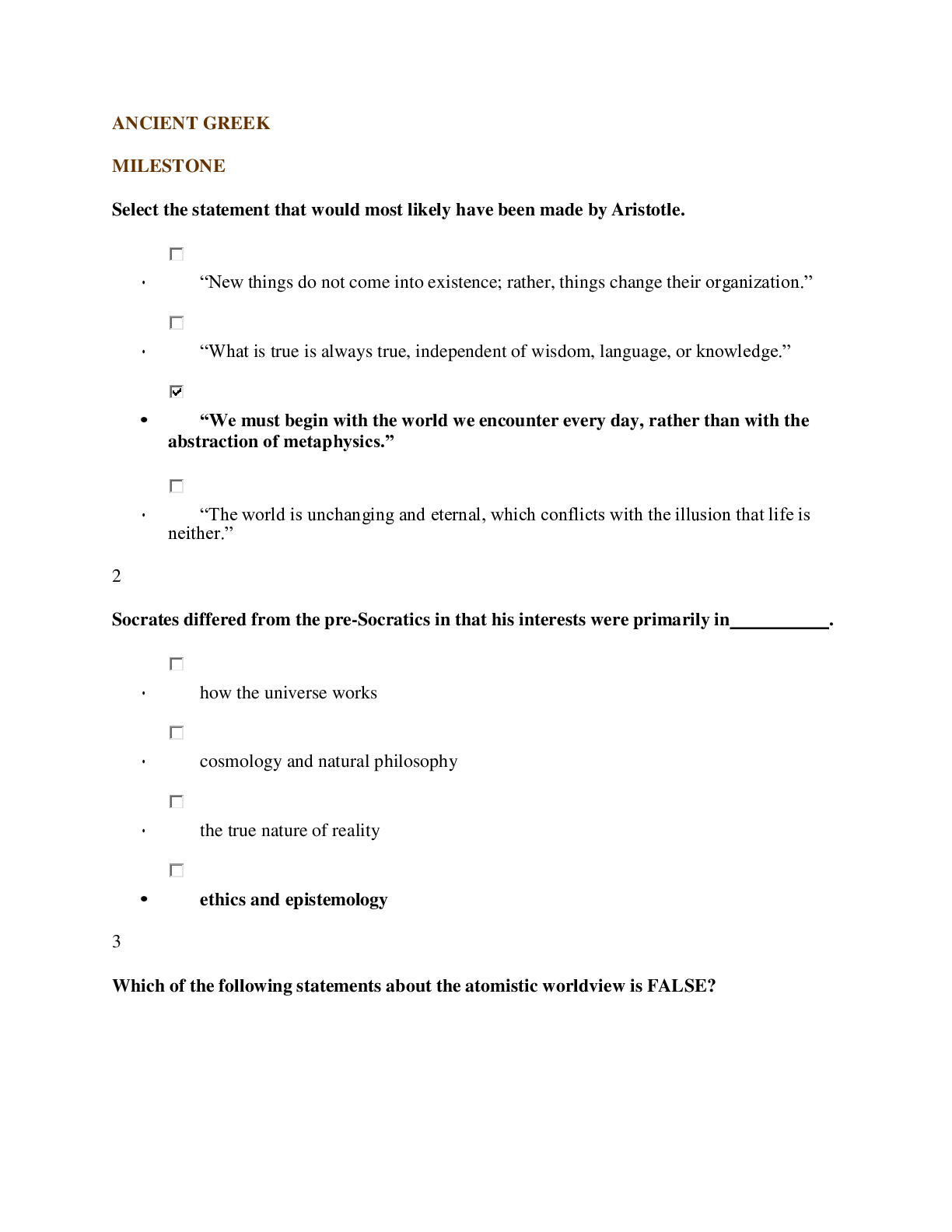
Select the statement that would most likely have been made by Aristotle.
“New things do not come into existence; rather, things change their organization.”
“What is true is
...
MILESTONE QUESTION 1 TO QUESTION 25.
1
Select the statement that would most likely have been made by Aristotle.
“New things do not come into existence; rather, things change their organization.”
“What is true is always true, independent of wisdom, language, or knowledge.”
“We must begin with the world we encounter every day, rather than with the
abstraction of metaphysics.”
“The world is unchanging and eternal, which conflicts with the illusion that life is
neither.”
2
Socrates differed from the pre-Socratics in that his interests were primarily in __________.
how the universe works
cosmology and natural philosophy
the true nature of reality
ethics and epistemology
3
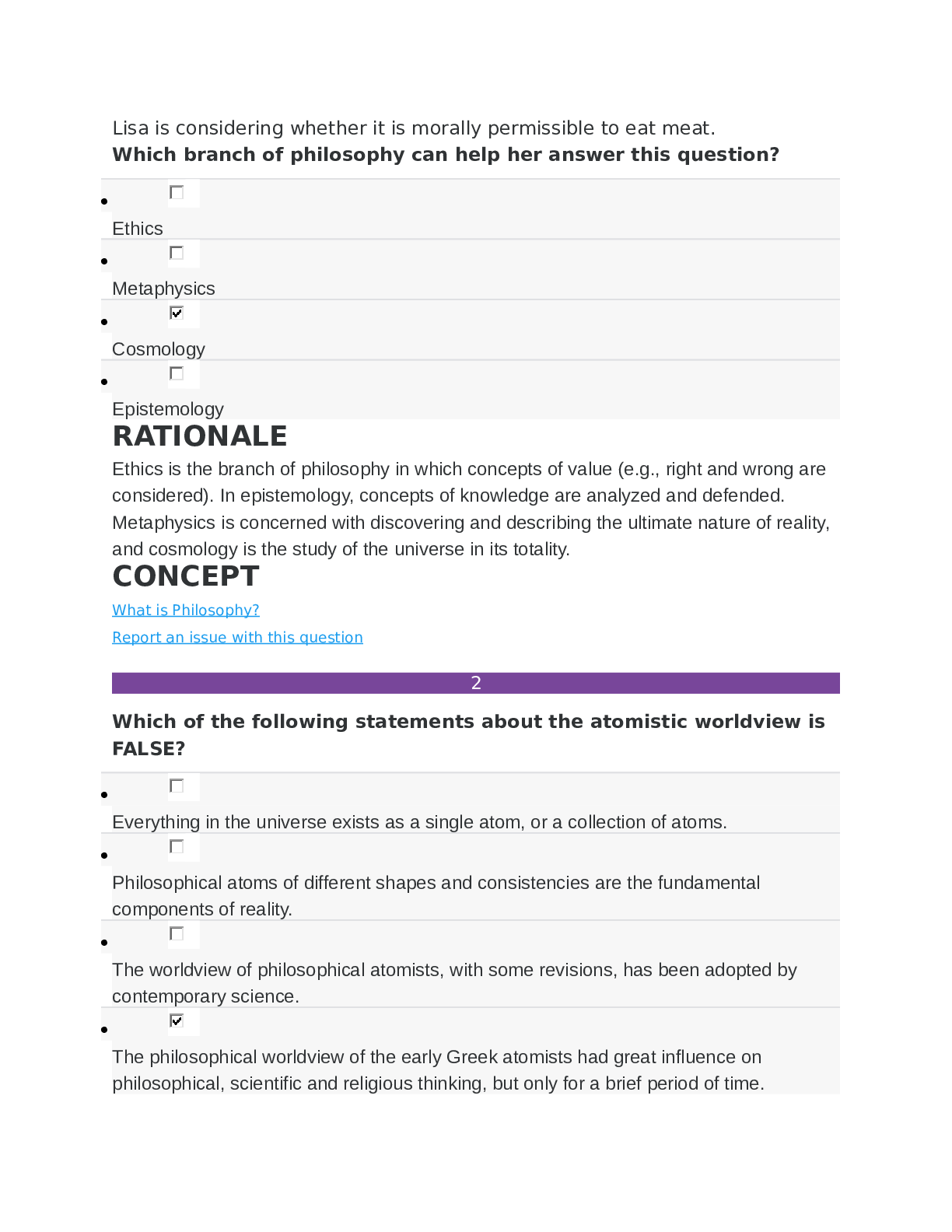
Which of the following statements about the atomistic worldview is FALSE?
Philosophical atoms of different shapes and consistencies are the fundamental
components of reality.
The philosophical worldview of the early Greek atomists had great influence on
philosophical, scientific, and religious thinking, but only for a brief period of time.
The worldview of philosophical atomists, with some revisions, has been adopted by
contemporary science. Everything in the universe exists as a single atom, or a collection of atoms.
4
According to Aristotle’s ethics, virtues should be pursued by __________.
finding a rational mean between two extremes
thinking abstractly
defining what is true
determining the purest form of action
5
Choose the statement that both Plato and Aristotle would agree is true.
“The physical sciences are a source of eternal knowledge."
“Ideals are similar to mathematical objects or entities.”
“The ideals of Beauty and Truth are not of this world.”
“A human being is 'human' because he or she reflects the Form of a Human.”
6
While I have lived in my home, my rent has increased every year.
My salary has remained the same for three years.
Next year, I will probably be in a better financial situation.
Evaluate the argument and select the option that describes it.
Inductive, strong, cogent
Deductive, valid, sound Deductive, invalid, unsound
Inductive, weak, uncogent
7
According to Plato's doctrine of Forms, what makes a rose a rose is that it __________.
serves the purpose of a rose
changes the Form of Rose
reveals what is true about all roses
imitates the genuine Form of Rose
8
In Plato's view, justified true beliefs must be related to his metaphysical notion of
__________, which he called the Forms.
knowledge
wisdom
essence
truth
9
Kenny is a chef who is trying to determine how carefully he should focus on details while doing
his job. He wants to avoid being too detail-oriented because it would be inefficient for him to do
so. However, if he doesn't pay enough attention to details, the quality of the food he prepares will
be inconsistent.
According to Aristotle’s ethics, this is an example of the __________.
Ethics of Virtue Function Argument
Doctrine of the Mean
Doctrine of the Forms
10
Choose the example that best demonstrates a central tenet of Stoicism.
Carlene is devastated when her outdoor party is interrupted by a thunderstorm.
Mr. Donovan insists that he begin each morning with pastry and a cup of sweet tea.
Stephanie is a good nurse because she is skillful and always remains composed.
Bob is such a rabid Cubs fan that it isn’t fun to watch a baseball game with him.
11
Which of the following statements about the metaphysical tenets of Plato’s Doctrine of the
Forms is FALSE?
Forms must exist in order for knowledge to be possible.
There is a cause and effect relationship between Forms and their earthly
counterparts.
The Forms exist in an intellectual realm that is fixed and never-ending.
Perfection in the Forms does not exist in Platonic Heaven.
12
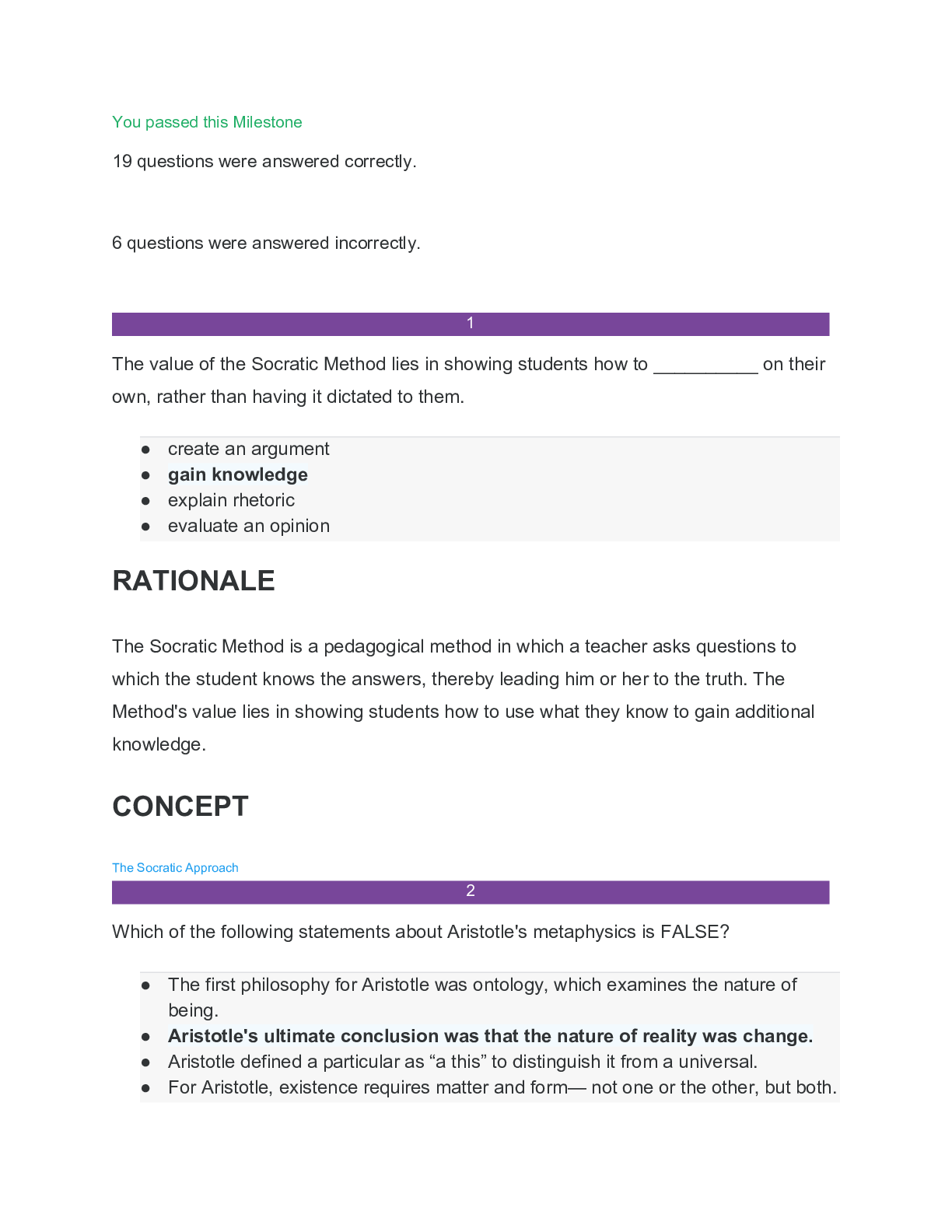
The value of the Socratic Method lies in showing students how to __________ on their own,
rather than having it dictated to them.
create an argument
explain rhetoric gain knowledge
evaluate an opinion
13
Heraclitus developed __________, which stated that all things change over time.
the Philosophical Atom
Parmenidean Theory
the Paradoxes of Zeno
the Doctrine of Flux
14
In the Apology, Socrates states that a good person does what he knows to be right despite
__________.
risking fame and fortune
negative personal consequences
the laws of man
the wisdom of the gods
15
“As a physicist, I see all elements as either connected by love or separated by conflict.”
Which ancient philosopher would most likely have made this statement?
Xenophanes
Pythagoras Empedocles
Anaxagoras
16
Choose the statement that describes a central theme of Parmenidean metaphysics.
Mortal and divine knowledge can be joined.
The opinions of mortals are universally reliable.
The universe consists of one, unchanging entity.
The world is composed of linked opposites.
17
Read the following statement by Socrates:
“In questions of just and unjust, fair and foul, good and evil, which are the subjects of our
present consultation, ought we to follow the opinion of the many and to fear them; or the opinion
of the one man who has understanding?”
Extract Socrates' argument from this text and choose the sentence that accurately reflects
it.
Any man who cares about ethics and wisdom has an obligation to listen to himself
over others.
Absolute justice can only be achieved when the state agrees with the opinion of the
masses.
He who has experienced the administration of justice will do as the majority
commands him to do.
Non-experts have opinions, but the man who is an expert in a field has true
knowledge.
18Water is a __________ condition for staying alive.
Apply conceptual analysis to this statement and choose the answer that correctly describes
the relationship.
both necessary and sufficient
sufficient, not necessary
necessary, not sufficient
neither necessary nor sufficient
19
A Stoic avoids looking for good in external things and recognizes that value __________.
has little to do with ethics
is determined by intrinsic personality traits
lies in our judgment of the world
can be found in every living entity
20
What kind of a thing is an orchid? It is a type of flower. What distinguishes an orchid from other
flowers? The female and male parts of an orchid are fused together.
According to Aristotle, answering both of these questions reveals the __________ of an
orchid.
genus
organization
essence
ontology21
Which branch of philosophy examines the basis and nature of knowledge?
Metaphysics
Cosmology
Epistemology
Ethics
22
When Crito tries to convince Socrates that he must not betray his own life, how does
Socrates respond?
He says that what is right is often misunderstood by mortals and must be left to the
gods.
He says that life would not be worth living if the principle of justice was
violated.
He says that all life has value, but society determines the fate of man.
He says that he is not afraid of dying and knows that his followers will restore his
good name.
23
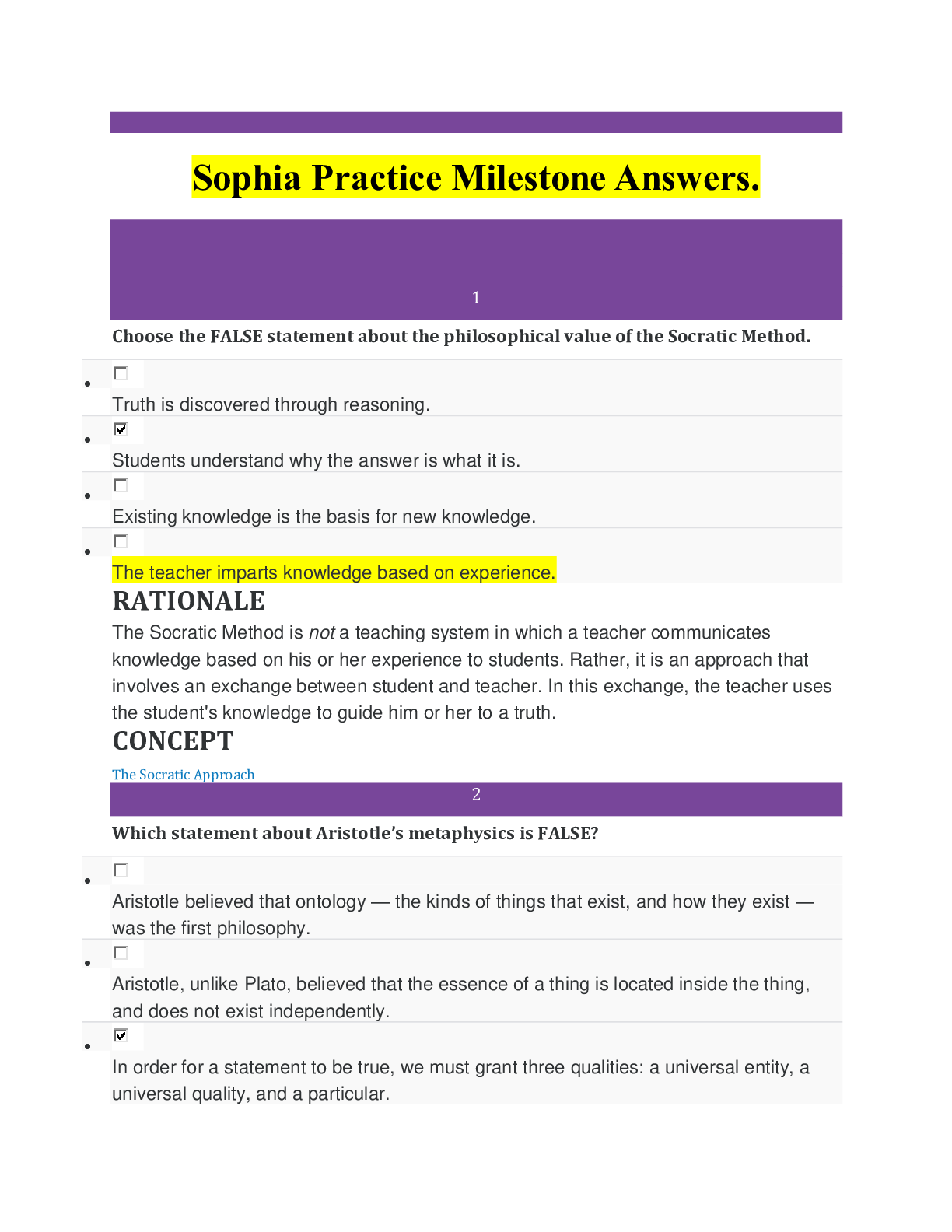
Which of the following statements about Aristotle’s metaphysics is FALSE
Humans have the natural capacity to know many things without divine revelation or
empirical evidence.
The distinction between form and matter is purely conceptual— one does not, and
cannot, exist without the other.
Examining the nature of being, and knowing what kinds of things exist, is a sensible
beginning point for philosophical inquiry. In order for a statement to be true, one must state that an object exists, what the
object is, and the state in which it exists.
24. Karen believes that she has a responsibility to protect the environment.
Choose the statement that is consistent with Karen's belief.
"I only drive my car to work when it is raining or too cold outside.”
“I go to the farmer’s market if I have time to do so on the weekends.”
“I have eliminated all plastic from my day-to-day life.”
“I serve meat to my family only on holidays and special occasions.”
25.In the Phaedo, Socrates makes all of the following claims, EXCEPT:
Valuing what is right more than life is illogical and meaningless.
The philosopher is concerned with the soul and not with the body.
Without a body to impede his or her progress, the philosopher may see things as they
truly are.
Sensory distractions hinder the soul's pursuit of truth and knowledge.
[Show More]