ENGL 1102
greek.doc
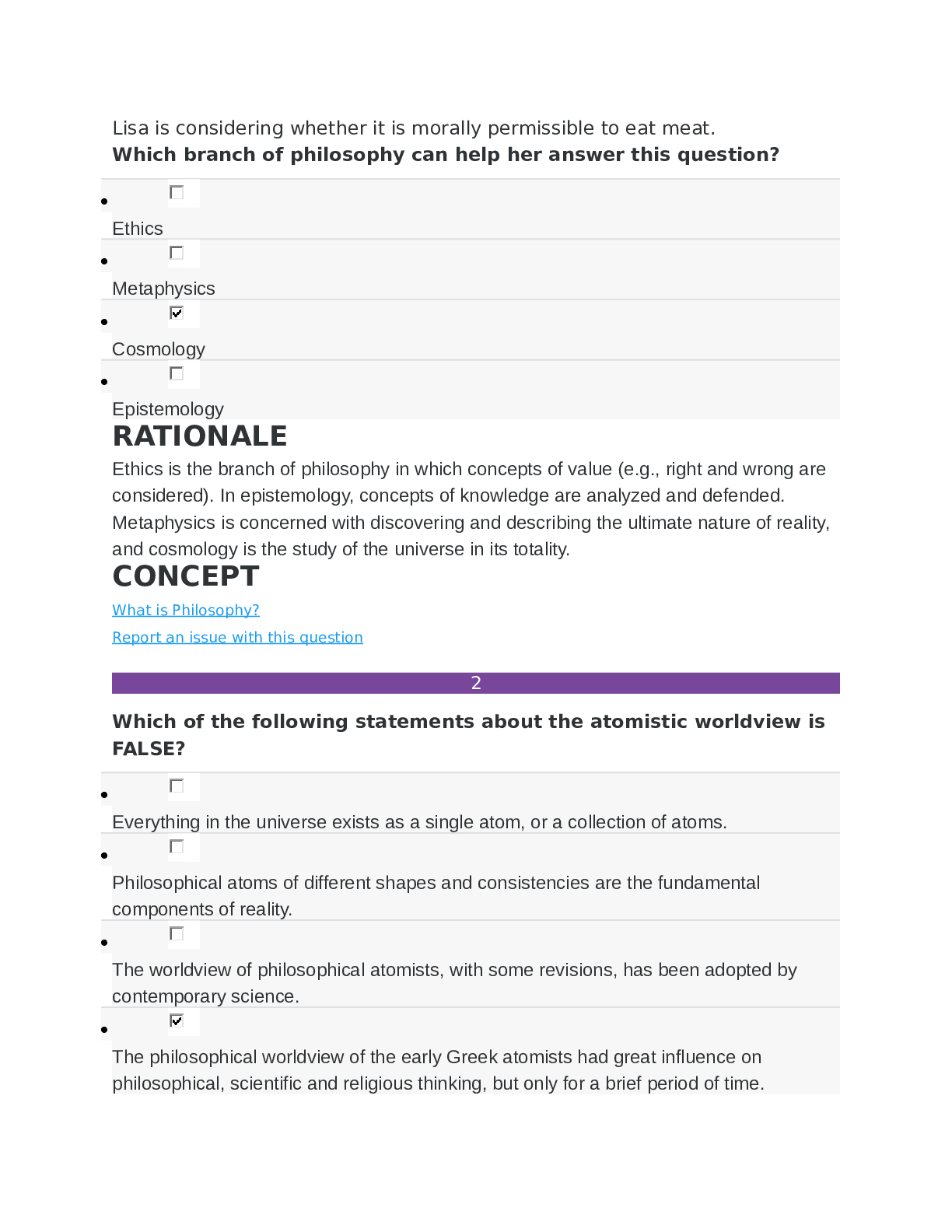
Lisa is considering whether it is morally permissible to eat meat.
Which branch of philosophy can help her answer this question?
Ethics
Metaphysics
Cosmology
Epistemology
RATIONALE
...
ENGL 1102
greek.doc
Lisa is considering whether it is morally permissible to eat meat.
Which branch of philosophy can help her answer this question?
Ethics
Metaphysics
Cosmology
Epistemology
RATIONALE
Ethics is the branch of philosophy in which concepts of value (e.g., right and wrong are
considered). In epistemology, concepts of knowledge are analyzed and defended.
Metaphysics is concerned with discovering and describing the ultimate nature of reality,
and cosmology is the study of the universe in its totality.
CONCEPT
What is Philosophy?
Report an issue with this question
2
Which of the following statements about the atomistic worldview is FALSE?
Everything in the universe exists as a single atom, or a collection of atoms.
Philosophical atoms of different shapes and consistencies are the fundamental
components of reality.
The worldview of philosophical atomists, with some revisions, has been adopted by
contemporary science.
The philosophical worldview of the early Greek atomists had great influence on
philosophical, scientific and religious thinking, but only for a brief period of time.
RATIONALE
The philosophical worldview of the early Greek atomists has continued to have an
impact throughout history. Atomism has been adopted and modified by contemporary
science, and has had a lasting influence on religion and theology.
CONCEPT
The Atomistic Worldview
Report an issue with this question
3
When Crito tries to convince Socrates that he must not betray his own life, how does
Socrates respond?
He says that all life has value, but society determines the fate of man.
He says that what is right is often misunderstood by mortals and must be left to the
gods.
He says that he is not afraid of dying and knows that his followers will restore his good
name.
He says that life would not be worth living if the principle of justice was violated.
RATIONALE
In the Crito, Socrates' friend (Crito) tried to convince him to escape and avoid execution.
Socrates refused to do so, and explained why escape would be wrong. Socrates
asserted that not all life has intrinsic value; only the good life does. Since he believed
that he would violate the principle of justice (established by the Social Contract) by
avoiding death, Socrates refused to avoid it.
CONCEPT
The Crito: The Duties of the Social Contract
Report an issue with this question
4In the Apology, Socrates states that a good person does what he knows to be right
despite __________.
negative personal consequences
the laws of man
the wisdom of the gods
risking fame and fortune
RATIONALE
The Apology is Plato's transcription of the defense Socrates presented at his trial on
charges of "denying the gods" and "corrupting the youth of Athens." In it, Socrates
asserts that he does not fear death, because he has lived as he believed was right. To
Socrates, it is more important to live rightly than to avoid death and other negative
personal consequences.
CONCEPT
The Apology: A Defense of Philosophy
Report an issue with this question
5
Nancy is a cashier at a grocery store. A boy from her school, who she knows is underage,
attempts to buy beer. Nancy hesitates before completing the transaction.
According to Aristotle’s ethics, which question should Nancy ask herself?
What kind of person should I be?
Are there possible consequences of this action that could harm me?
How can I reach a compromise?
Why is this action right, and why is it wrong?
RATIONALE
Aristotelian ethics are primarily concerned with character. As a result, Nancy should ask
herself “What kind of person should I be?” rather than “How should I act?”According to Aristotelian ethics, actions are evaluated based on how they inform your
character. Therefore, Nancy must determine what kind of person she wants to be and
what virtues she wants to cultivate, and then act accordingly.
CONCEPT
Applying Aristotle's Ethics
Report an issue with this question
6
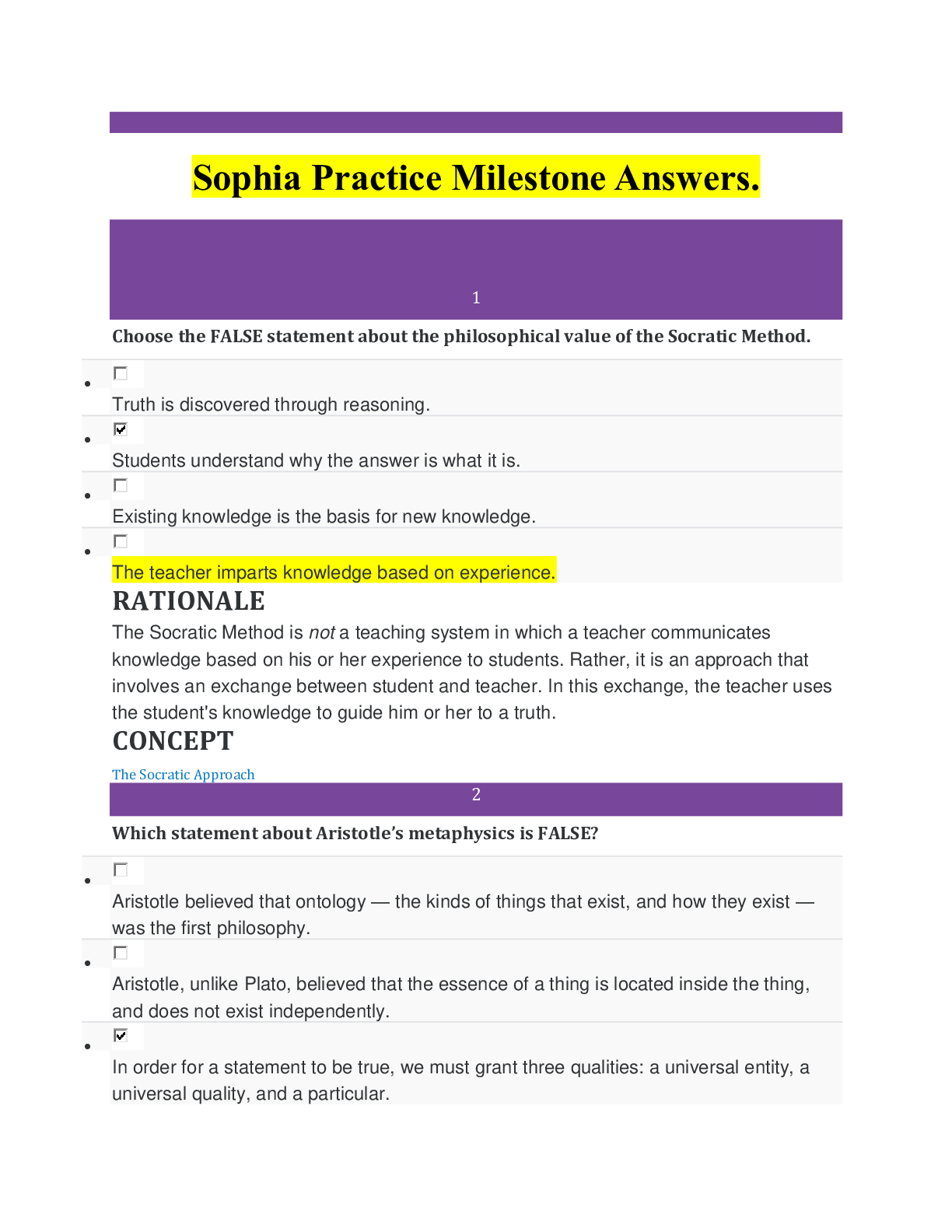
Which of the following statements about Aristotle’s metaphysics is FALSE?
Humans have the natural capacity to know many things without divine revelation or
empirical evidence.
Examining the nature of being, and knowing what kinds of things exist, is a sensible
beginning point for philosophical inquiry.
In order for a statement to be true, one must state that an object exists, what the object
is, and the state in which it exists.
The distinction between form and matter is purely conceptual — one does not, and
cannot, exist without the other.
RATIONALE
Aristotle would agree with all of these statements except the suggestion that we can
have knowledge without empirical evidence. To Aristotle, all knowledge is grounded in
human experience and flows from empirical evidence.
CONCEPT
Aristotle on What There Is
Report an issue with this question
7
Choose the example that best demonstrates a central tenet of Stoicism.
Mr. Donovan insists that he begin each morning with pastry and a cup of sweet tea.
Stephanie is a good nurse because she is skillful and always remains composed.
Bob is such a rabid Cubs fan that it isn’t fun to watch a baseball game with him.
Carlene is devastated when her outdoor party is interrupted by a thunderstorm.
RATIONALE
Stoicism is a philosophy that encourages people to focus only on what they can control
(e.g., their desires, emotions, and reactions). Because Stoicism focuses on eliminating
desires, and emphasizes control of emotions, it leads people to perform their assigned
jobs (or roles) skillfully and dispassionately.
CONCEPT
Stoicism: The Ethics of Dispassion
Report an issue with this question
8
All of the following statements are central themes of Parmenidean metaphysics,
EXCEPT:
Complex phenomena can be explained as having been caused by the gods.
All change is illusory.
This worldview transcends opinion to examine the world as it is.
Reasonable assumptions can lead to paradoxes.
RATIONALE
Parmenides was a Pre-Socratic philosopher. He sought answers to questions about the
universe that did not involve the gods or other supernatural forces. His philosophical
explanations (like those of other Pre-Socratics) was naturalistic. All of the other
statements accurately represent Parmenidean metaphysics.
CONCEPT
Parmenides and the Doctrine of Permanence
Report an issue with this question
9Select the statement upon which Plato and Aristotle would disagree.
Truth is important above all else.
Reasoning and logic are key to finding truth.
Essences exist and are genuine entities.
Essences exist independently of the world.
RATIONALE
Plato and Aristotle agree on all of these points except for the statement that essences
exist independently of the world. This was Plato's belief, but Aristotle believed that
essences exist only within worldly objects, and nowhere else.
CONCEPT
Plato vs. Aristotle: The Mathematician or the Biologist
Report an issue with this question
10
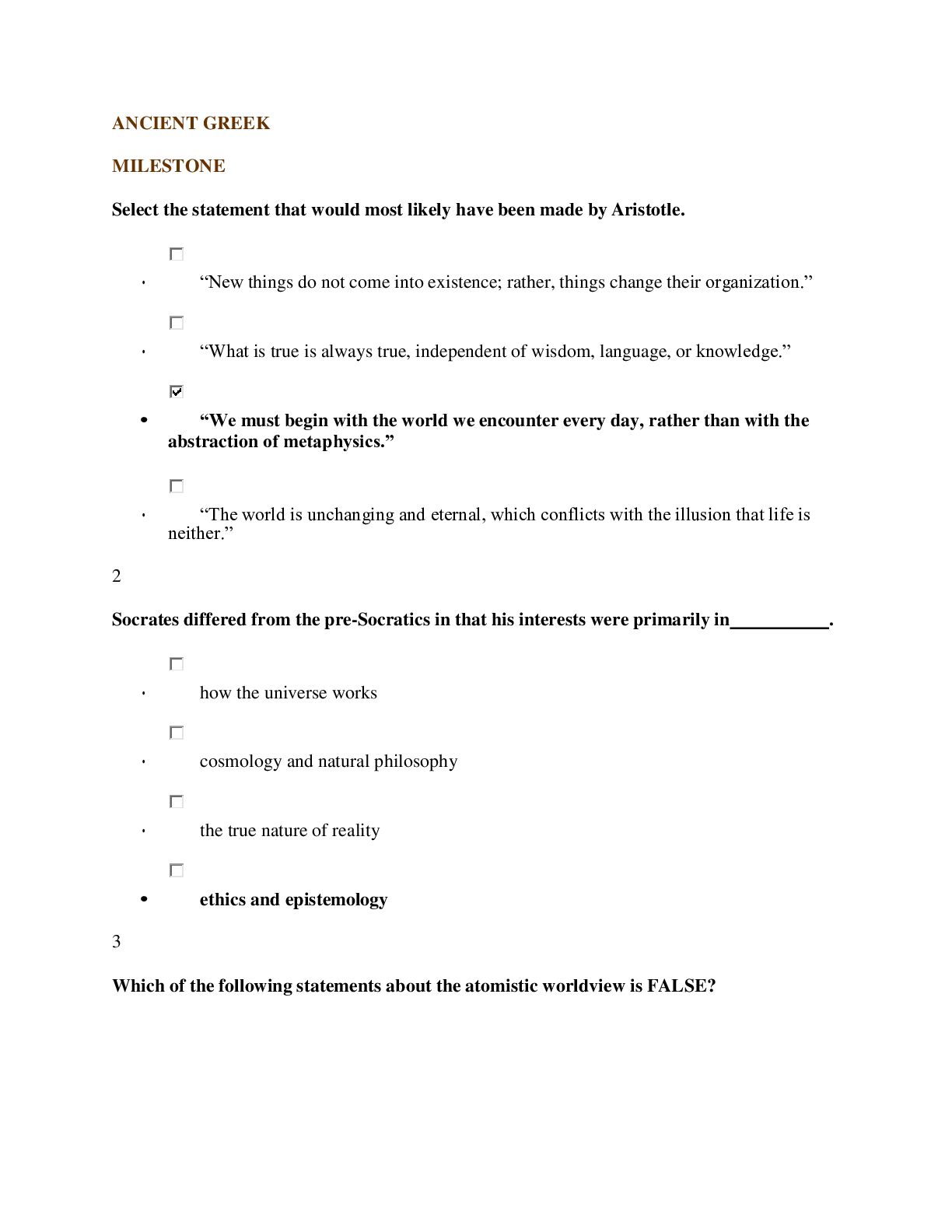
Socrates differed from the pre-Socratics in that his interests were primarily in
__________.
ethics and epistemology
cosmology and natural philosophy
the true nature of reality
how the universe works
RATIONALE
The focus of Socrates' philosophy was different from that of the Pre-Socratic
philosophers. He investigated questions involving ethics and epistemology. The PreSocratic philosophers had focused on natural philosophy and cosmology.
CONCEPT
Socrates: The Father of Western PhilosophyReport an issue with this question
11
Kendra believes that women have a right to choose to have an abortion.
Select the statement that is consistent with Kendra's belief.
“Every woman should be a mother; it is our function and purpose as human beings.”
"The man should have an equal say in whether or not a woman ends her pregnancy.”
“Some women use abortion as a form of birth control, which is wrong.”
“I voted for this presidential candidate because she supports a woman's right to have an
abortion.”
RATIONALE
To live philosophically, a person must examine his or her beliefs to ground them in
knowledge, and then act according to those beliefs. By voting for a presidential
candidate who supports a woman's right to have an abortion, Kendra displays a
consistent philosophical worldview.
CONCEPT
Philosophical Analysis as a Way of Life
Report an issue with this question
12
What kind of a thing is an orchid? It is a type of flower. What distinguishes an orchid from
other flowers? The female and male parts of an orchid are fused together.
According to Aristotle, answering both of these questions reveals the __________ of an
orchid.
essence
genus
organization
ontology
RATIONALE
According to Aristotle, we can discover and describe essences by identifying
a genus and a differentia. The genus (in this example, a flower) tells us what kind of
thing an orchid is. The differentia tells us what sets an orchid apart from other things of
the same kind.
CONCEPT
Aristotle on What There Is
Report an issue with this question
13
In the Phaedo, Socrates makes all of the following claims, EXCEPT:
Without a body to impede his or her progress, the philosopher may see things as they
truly are.
The philosopher is concerned with the soul and not with the body.
Sensory distractions hinder the soul's pursuit of truth and knowledge.
Valuing what is right more than life is illogical and meaningless.
RATIONALE
The Phaedo is a conversation between Socrates and his students about death. It takes
place just before his execution. During this conversation, Socrates demonstrates why
philosophers should not fear death, which he defines as the end of the life of the body,
but not of the soul. He believes that there is no value in preserving the life of the body if
preservation comes at the expense of the soul's pursuit of wisdom (i.e., what is right).
CONCEPT
The Phaedo: The Death of Socrates
Report an issue with this question
14
Select the statement that would most likely have been made by Aristotle.
“New things do not come into existence; rather, things change their organization.”
“The world is unchanging and eternal, which conflicts with the illusion that life is neither.”
“What is true is always true, independent of wisdom, language, or knowledge.”
“We must begin with the world we encounter every day, rather than with the abstraction
of metaphysics.”
RATIONALE
The statement that "We must begin with the world we encounter every day" reflects
Aristotle's philosophical approach. To Aristotle, all knowledge is grounded in human
experience, and flows from empirical evidence. The statements which involve change
are reflective of Parmenides and the Atomists. The statement about truth existing
independent of wisdom, language, or knowledge is reflective of Plato's philosophy.
CONCEPT
Aristotle: The Dissection of Reality
Report an issue with this question
15
Which of the following is the most important tenet of Stoicism?
To understand that reality is either good or bad
To resist playing a role
To feed our desires
To let go of what we cannot control
RATIONALE
Stoicism is a philosophy that encourages us to focus only on what we can control (e.g.,
our desires, emotions, judgments, and reactions). We should not be upset by things that
are beyond our control. Stoicism encourages us to reduce desire and to view reality as
neither good nor bad.
CONCEPT
Stoicism: The Ethics of DispassionReport an issue with this question
16
You skipped this question and it was marked incorrect.
Read the following statement by Socrates:
“And he attains to the purest knowledge of them who goes to each with the mind alone, not
introducing or intruding in the act of thought sight or any other sense together with reason,
but with the very light of the mind in her own clearness searches into the very truth of
each; he who has got rid, as far as he can, of eyes and ears and, so to speak, of the whole
body, these being in his opinion distracting elements which when they infect the soul
hinder her from acquiring truth and knowledge . . .”
Outline Socrates' argument in this text and choose the sentence that accurately
reflects it.
Death prevents the philosopher from finding the answers he most wants to know.
It is the mind, not the senses, that can know the essence of a thing.
Life has no intrinsic value; only a good life, well-lived, has value for the gods.
The physical body and the soul are both necessary in order to find truth.
RATIONALE
In this selection from the Phaedo, Socrates argues that the philosopher is not
concerned with the world of the senses, but with the soul. When Socrates says "And he
attains to the purest knowledge of them who goes to each with the mind alone," he
asserts that pure knowledge is readily acquired by the mind when it is separated from
the body. The senses (e.g., eyes and ears) are a distraction that "hinder her from
acquiring truth and knowledge . . .” Therefore, death (which Socrates views as the end
of the life of the body, not of the soul) enables the philosopher to find the answers he or
she seeks.
CONCEPT
The Apology — Socrates' Arguments
Report an issue with this question
17“It is my belief that everything in the cosmos is made of water.”
Which ancient philosopher would most likely have made this statement?
Empedocles
Pythagoras
Thales
Protagoras
RATIONALE
Thales was the Pre-Socratic philosopher who believed that everything in the cosmos
was made of water. Thales and his pupils, Anaximander and Anaximenes, sought to
discover the nature of the cosmos.
CONCEPT
Cosmology and the First Philosophers
Report an issue with this question
18
Heraclitus developed __________, which maintained that the world is composed of
objects and their counterparts, all of which are connected to one another.
the Unity of Opposites
Heraclitean paradoxes
Heraclitean metaphysics
the Doctrine of Flux
RATIONALE
Heraclitus developed the principle called the Unity of Opposites. It maintains that the
world is composed of opposites, and that opposites are linked in a system of
connections. This principle is one part of Heraclitean metaphysics.
CONCEPTHeraclitus and the Doctrine of Impermanence
Report an issue with this question
19
All of the following are central tenets of Aristotle’s ethics, EXCEPT:
Knowing the essence of a thing can justify a belief.
An action is evaluated based on how it informs character.
Something is good when it excels at its function.
Any virtue can become a vice.
RATIONALE
Aristotelian ethics are concerned with topics which include determining what makes
actions good or bad, and how to define virtue. According to Aristotelian ethics, it is
important to know the essence of a thing, not because it can justify a belief, but because
it determines function which, in turn, determines virtue or excellence.
CONCEPT
Aristotle's Highest Good
Report an issue with this question
20
For Plato and his Doctrine of Forms, a person can determine whether an act is
courageous if he or she can __________.
clearly understand the value of courage
explain what courage means in the real world
accurately describe the form of courage
imagine an unambiguously courageous action
RATIONALEAccording to Plato, the Forms are the basis of our knowledge of reality. All worldly
objects participate in (i.e., imitate) their corresponding Form that exists in Platonic
Heaven. We can determine whether an act is courageous if we know, and can describe,
the Form of Courage.
CONCEPT
Applying Plato's Metaphysics
Report an issue with this question
21
The philosophical value of the Socratic Method is described in all of the following
statements, EXCEPT:
The Socratic Method guides students to understanding rather than requiring them to
memorize facts.
Students learn from interacting with each other, and the teacher facilitates this process.
Students answer questions to which they know the answers, and are led by the teacher
to new truths.
The emphasis is on finding truth, not on “winning” an argument.
RATIONALE
The Socratic Method does not facilitate learning through students' interaction with one
another. Rather, it is an exchange between student and teacher, in which the teacher
uses the student's knowledge to guide him or her to truth.
CONCEPT
The Socratic Approach
Report an issue with this question
22
Which of the following statements about the metaphysical tenets of Plato’s Doctrine
of the Forms is FALSE?
The Forms exist in an intellectual realm that is fixed and never ending.
Forms must exist in order for knowledge to be possible.
There is a cause and effect relationship between Forms and their earthly counterparts.
Perfection in the Forms does not exist in Platonic Heaven.
RATIONALE
All of the statements about aspects of Plato's metaphysics are true, except for the
suggestion that perfect Forms do not exist in Platonic Heaven. This statement describes
Aristotle's metaphysics, not Plato's. Platonic Heaven is where Plato believed Forms, or
perfect metaphysical entities, exist.
CONCEPT
Plato Forms: The Foundations of Being
Report an issue with this question
23
All teachers are robots.
Cynthia is a teacher.
Therefore, Cynthia is a robot.
Evaluate the argument and select the option that describes it.
Deductive, valid, unsound
Deductive, invalid, sound
Inductive, weak, uncogent
Inductive, strong, cogent
RATIONALE
Because the inferential claim in this example is one of logical certainty, and is about
definition and form rather than cause and effect, this is a deductive argument. Since a
case in which the premises are true and the conclusion is false cannot exist, thisargument is valid. However, this argument is unsound because the first premise is false:
Not all teachers are robots.
CONCEPT
Evaluating an Argument in Action
Report an issue with this question
24
Being a good parent is a __________ condition for having a child.
Apply conceptual analysis to this statement and choose the answer that correctly
describes the relationship.
necessary, not sufficient
neither necessary nor sufficient
both necessary and sufficient
sufficient, not necessary
RATIONALE
Being a good parent is not a necessary condition, or logical requirement, for having a
child because there are people who have children who aren't good parents. In order to
be a parent, a person must have a child. That makes being a good parent a sufficient,
but not a necessary condition for having a child.
CONCEPT
Plato: An academic approach to concepts
Report an issue with this question
25
In Plato's view, justified true beliefs must be related to his metaphysical notion of
__________, which he called the Forms.
wisdom
essence
knowledge
truth
RATIONALE
Plato's Forms are also referred to as "essences." An essence is that which makes an
object what it truly is. Essences provide the basis for knowledge (i.e., justified true
belief). For example, we can know what "goodness" truly is because a real thing that is
the essence of goodness, called the Form of Goodness, exists.
CONCEPT
Plato Forms: The Objects of Knowledge
Report an issue with this question
© 2019 SOPHIA Learning, LLC. SOPHIA is a registered trademar
[Show More]