Conceptual Framework and Accounting Standards Q&A (4)
1. Which of the following statements is correct?
a. A provision is recognized only when it represents a present obligation.
b. An event or transaction whose outflo
...
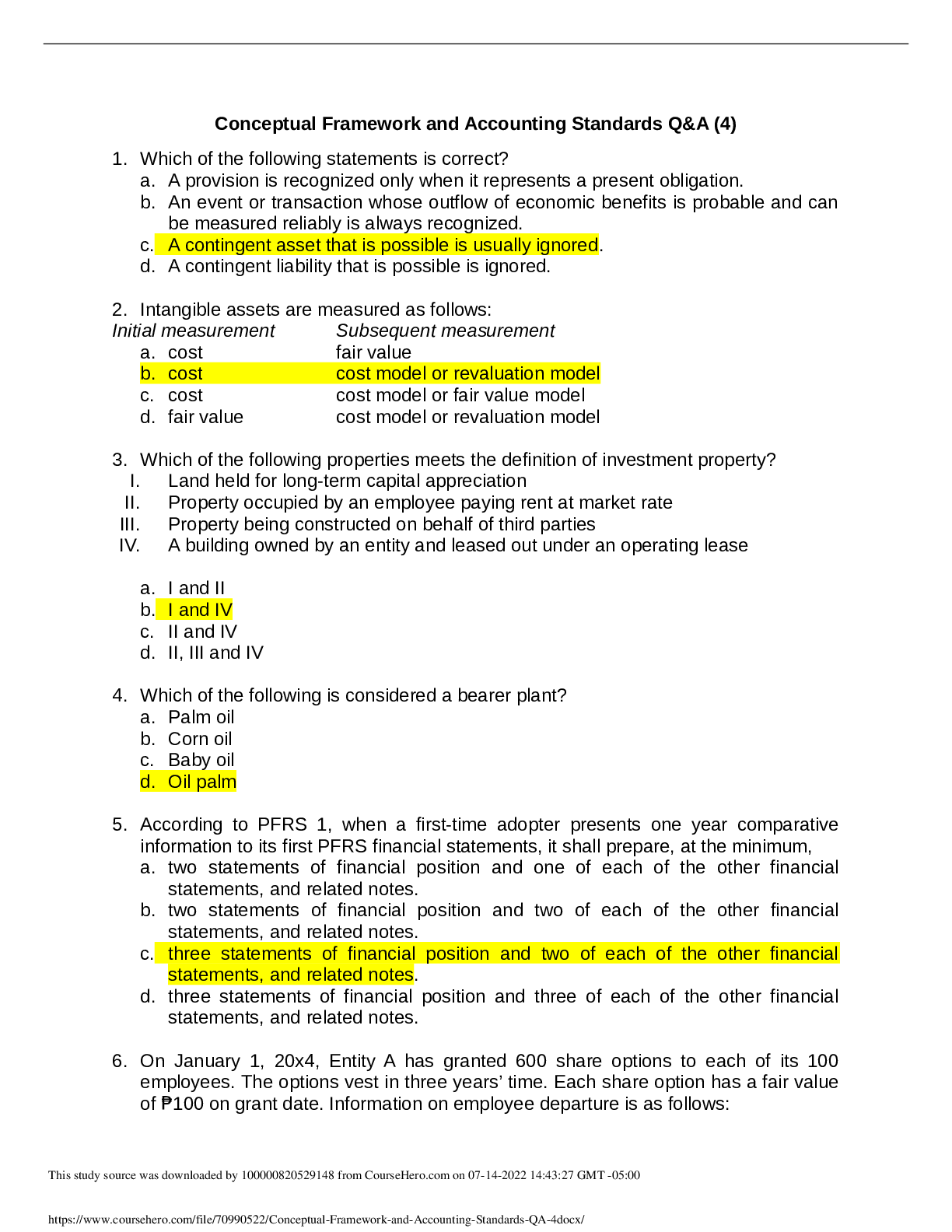
Conceptual Framework and Accounting Standards Q&A (4)
1. Which of the following statements is correct?
a. A provision is recognized only when it represents a present obligation.
b. An event or transaction whose outflow of economic benefits is probable and can
be measured reliably is always recognized.
c. A contingent asset that is possible is usually ignored.
d. A contingent liability that is possible is ignored.
2. Intangible assets are measured as follows:
Initial measurement Subsequent measurement
a. cost fair value
b. cost cost model or revaluation model
c. cost cost model or fair value model
d. fair value cost model or revaluation model
3. Which of the following properties meets the definition of investment property?
I. Land held for long-term capital appreciation
II. Property occupied by an employee paying rent at market rate
III. Property being constructed on behalf of third parties
IV. A building owned by an entity and leased out under an operating lease
a. I and II
b. I and IV
c. II and IV
d. II, III and IV
4. Which of the following is considered a bearer plant?
a. Palm oil
b. Corn oil
c. Baby oil
d. Oil palm
5. According to PFRS 1, when a first-time adopter presents one year comparative
information to its first PFRS financial statements, it shall prepare, at the minimum,
a. two statements of financial position and one of each of the other financial
statements, and related notes.
b. two statements of financial position and two of each of the other financial
statements, and related notes.
c. three statements of financial position and two of each of the other financial
statements, and related notes.
d. three statements of financial position and three of each of the other financial
statements, and related notes.
6. On January 1, 20x4, Entity A has granted 600 share options to each of its 100
employees. The options vest in three years’ time. Each share option has a fair value
of 100 on grant date. Information on employee departure is as follows: ₱
This study source was downloaded by 100000820529148 from CourseHero.com on 07-14-2022 14:43:27 GMT -05:00
https://www.coursehero.com/file/70990522/Conceptual-Framework-and-Accounting-Standards-QA-4docx/
• January 1, 20x4: estimate of employees leaving the entity during the vesting period
– 4%
• December 31, 20x4: revision of estimate of employees leaving to 5% before vesting
date
• December 31, 20x5: revision of estimate of employees leaving to 6% before vesting
date
• December 31, 20x6: actual employees leaving 5%
How much is the salaries expense in 20x4?
a. 6,000,000
b. 1,900,000
c. 2,000,000
d. 1,920,000
B (600 x 100 x 100) x 95% x 1/3 = 1,900,000
7. On January 1, 20x1, ABC Co. acquired 75% interest in XYZ, Inc. for 2,500,000 ₱
cash. ABC Co. incurred transaction costs of 250,000 for legal, accounting and ₱
consultancy fees in negotiating the business combination. ABC Co. elected to
measure NCI at the NCI’s proportionate share in XYZ, Inc.’s identifiable net assets.
The carrying amounts and fair values of XYZ’s assets and liabilities at the acquisition
date were as follows:
Assets Carrying amounts Fair values
Cash in bank 25,000 25,000
Accounts receivable 425,000 300,000
Inventory 1,300,000 875,000
Equipment – net 2,500,000 2,750,000
Goodwill 250,000 50,000
Total assets 4,500,000 4,000,000
Liabilities
Payables 1,000,000 1,000,000
How much is the goodwill (gain on a bargain purchase)?
a. 140,000
b. 278,500
c. 287,500
d. 264,500
Solution:
Fair value of identifiable assets acquired excluding
goodwill (4,000,000 total assets – 50,000 goodwill) 3,950,000
Less: Fair value of liabilities assumed (1,000,000)
Fair value of identifiable net assets acquired 2,950,000
Fair value of identifiable net assets acquired 2,950,000
This study source was downloaded by 100000820529148 from CourseHero.com on 07-14-2022 14:43:27 GMT -05:00
https://www.coursehero.com/file/70990522/Conceptual-Framework-and-Accounting-Standards-QA-4docx/
Multiply by: Non-controlling interest (100% - 75%) 25%
NCI’s proportionate share in identifiable net assets 737,500
Goodwill (Negative goodwill) is computed as follows:
Consideration transferred 2,500,000
NCI in the acquiree 737,500
Previously held equity interest in the acquiree -
Total 3,237,500
Less: Fair value of identifiable net assets acquired (2,950,000)
Goodwill 287,500
The 250,000 transaction costs are ₱ expensed. Acquisition-related costs do not
affect the measurement of goodwill.
8. According to PFRS 5, assets held for sale are measured at
a. fair value.
b. fair value less costs to sell.
c. carrying amount.
d. lower of b and c
9. After recognition, exploration and evaluation assets are accounted for under the
a. cost model
b. fair value model
c. revaluation model
d. a or c
10.Entity A acquires a legal right to search for mineral resources in a specific area.
What PFRS should Entity A apply in accounting for the costs it incurs on its
exploration and evaluation activities?
a. PAS 26
b. PFRS 4
c. PFRS 5
d. PFRS 6
11.Which of the following properly describes credit risk?
a. The possibility that Entity A will not be able to settle its financial liabilities when
they become due.
b. The possibility that Entity A will incur loss on its foreign-currency denominated
financial instruments when there is an adverse change in foreign exchange rates.
c. The possibility that Entity A cannot collect on its receivables.
d. The possibility that Entity A will be required to pay higher interest on its variablerate loan when market interest rates increase.
12.Andrix Domingo’s Sari-sari Store has a sign that reads “Your credit is good but I
need cash.” What type of risk is Mr. Andrix trying to avoid by putting up that sign?
This study source was downloaded by 100000820529148 from CourseHero.com on 07-14-2022 14:43:27 GMT -05:00
https://www.coursehero.com/file/70990522/Conceptual-Framework-and-Accounting-Standards-QA-4docx/
a. credit risk
b. market risk
c. liquidity risk
d. store risk
13.Which of the following is not among the quantitative thresholds under PFRS 8?
a. At least 10% of total revenues (external and internal)
b. At least 10% of the higher of total profits of segments reporting profits and total
losses of segments reporting losses, in absolute amount.
c. At least 10% of total assets (inclusive of intersegment receivables).
d. At least 10% of total revenues (external only)
14.Rex Banggawan Co. acquires investment in stocks of Darrell Joe Asuncion. The
investment will be held for trading and it gives Rex neither significant influence nor
control over Darrell. Rex will most likely measure the investment
a. at fair value through profit or loss.
b. using the equity method.
c. at amortized cost.
d. at historical cost
15.According to PFRS 10, which of the following is not an element of control?
a. power
b. exposure, or rights, to variable returns
c. major holdings
d. ability to affect return.
16.Which of the following is a peculiar characteristic of a joint arrangement?
a. significant influence
b. joint control
c. control
d. joint venture
17.This PFRS provides a single framework for measuring the fair value of an asset,
liability or equity when other PFRSs require or permit measurement at fair value or
fair value less costs to sell. It also prescribes the disclosures related to fair value
measurement.
a. PFRS 3
b. PAS 1
c. PFRS 9
d. PFRS 13
18.Entity A’s assets have a carrying amount of 100,000 before year-end adjustments. ₱
The PFRSs require these assets to be measured at fair value at each reporting date.
Location is a characteristic of the assets. Information at year-end is as follows:
Active Market #1 Active Market #2
Quoted price Quoted price
This study source was downloaded by 100000820529148 from CourseHero.com on 07-14-2022 14:43:27 GMT -05:00
https://www.coursehero.com/file/70990522/Conceptual-Framework-and-Accounting-Standards-QA-4docx/
₱130,000 ₱135,000
Transport costs
10,000
Transport costs
12,000
Costs to sell
2,000
Costs to sell
3,000
If neither Active Market #1 nor Active Market #2 is the principal market, how much is the
fair value?
a. 135,000 c. 120,000
b. 132,000 d. 123,000
Solution:
The “most advantageous market” is determined as follows:
Active Market
#1
Active Market
#2
Quoted price
130,000
135,000
Transport costs
(10,000)
(12,000)
Costs to sell
(2,000)
(3,000)
Net sale
proceeds
118,000
120,000
The fair value is computed as follows:
135,000 price in active market #2 – 12,000 transport costs = 123,000
19.Arrange the following steps of revenue recognition in accordance with PFRS 15.
I. Identify the performance obligations in the contract
II. Recognize revenue when (or as) the entity satisfies a performance obligation
III. Determine the transaction price
IV. Identify the contract with the customer
V. Allocate the transaction price to the performance obligations in the contract
a. IV, I, III, V, II c. III, IV, I, V, II
b. IV, I, V, III, II d. IV, III, I, V, II
This study source was downloaded by 100000820529148 from CourseHero.com on 07-14-2022 14:43:27 GMT -05:00
https://www.coursehero.com/file/70990522/Conceptual-Framework-and-Accounting-Standards-QA-4docx/
Powered by TCPDF (www.tcpdf.org)
[Show More]

.png)