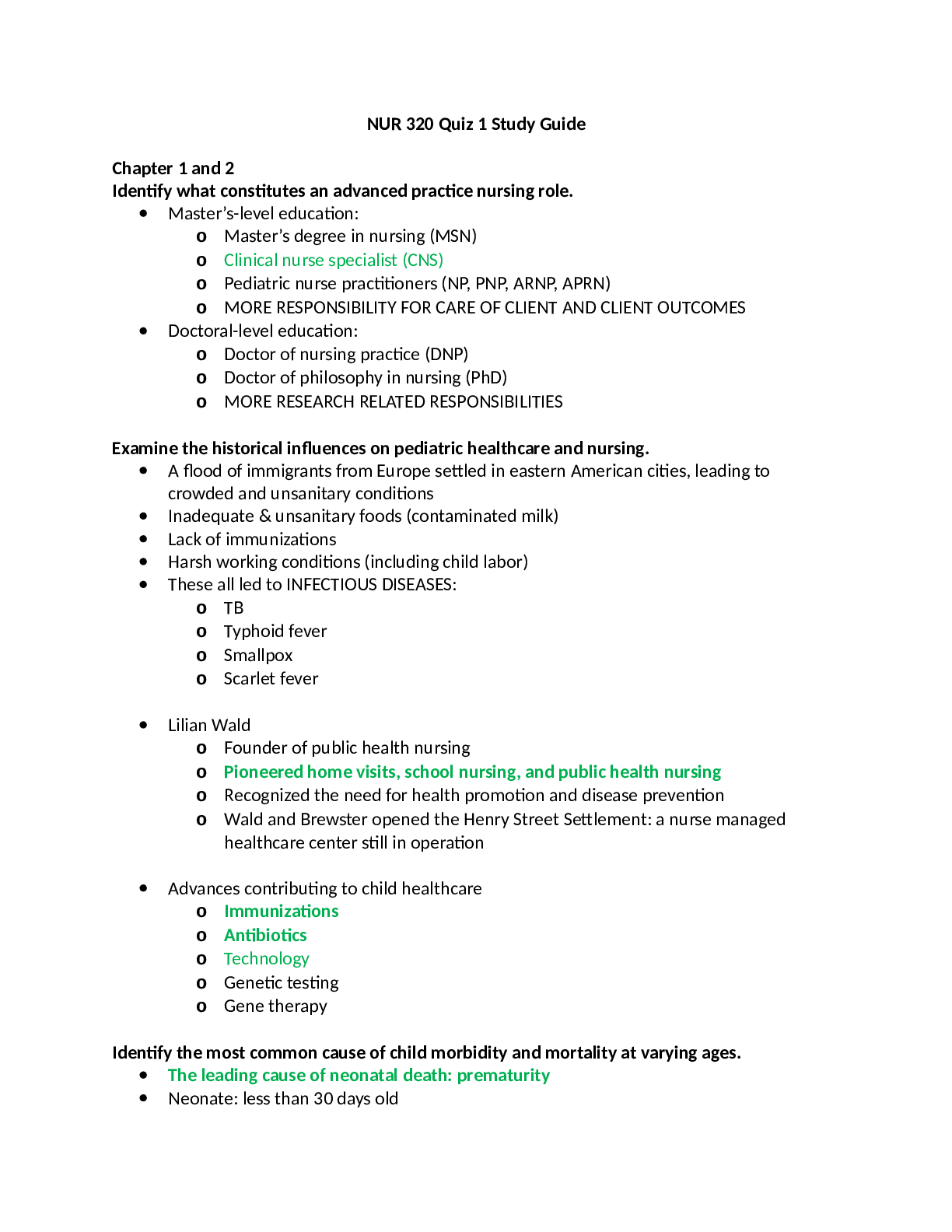
Identify what constitutes an advanced practice nursing role.
Master’s-level education:
o Master’s degree in nursing (MSN)
o Clinical nurse specialist (CNS)
o Pediatric nurse practitioners (NP, PNP, ARNP, APRN)
o M
...
Identify what constitutes an advanced practice nursing role.
Master’s-level education:
o Master’s degree in nursing (MSN)
o Clinical nurse specialist (CNS)
o Pediatric nurse practitioners (NP, PNP, ARNP, APRN)
o MORE RESPONSIBILITY FOR CARE OF CLIENT AND CLIENT OUTCOMES
Doctoral-level education:
o Doctor of nursing practice (DNP)
o Doctor of philosophy in nursing (PhD)
o MORE RESEARCH RELATED RESPONSIBILITIES
Examine the historical influences on pediatric healthcare and nursing.
A flood of immigrants from Europe settled in eastern American cities, leading to
crowded and unsanitary conditions
Inadequate & unsanitary foods (contaminated milk)
Lack of immunizations
Harsh working conditions (including child labor)
These all led to INFECTIOUS DISEASES:
o TB
o Typhoid fever
o Smallpox
o Scarlet fever
Lilian Wald
o Founder of public health nursing
o Pioneered home visits, school nursing, and public health nursing
o Recognized the need for health promotion and disease prevention
o Wald and Brewster opened the Henry Street Settlement: a nurse managed
healthcare center still in operation
Advances contributing to child healthcare
o Immunizations
o Antibiotics
o Technology
o Genetic testing
o Gene therapy
Identify the most common cause of child morbidity and mortality at varying ages.
The leading cause of neonatal death: prematurity
Neonate: less than 30 days old
Most common cause of death for children 1 to 19 years: unintentional injury
(accidents)
Between 30 days and 1 year, the leading cause of death is SIDS
The second leading cause of death of kids is suicide
The third leading cause of death of kids is homicide
Nursing Role in Injury Prevention
Education about causes of injury and death
Anticipatory guidance (teaching) for parents and caregivers
The child’s developmental level partially determines the types of injury most likely to
occur
Identify strategies to include pediatric patient safety in the healthcare setting.
Children are at greater risk for medical errors
Med errors are three times greater than adults
Strategies to reduce pediatric medication error:
o Do not rely on memory; verify medication dosages and their calculations
o Medications with a sound-alike medication should be reviewed to make sure the
correct medication has been prescribed for the patient’s condition
o Every prescription should include the child’s weight and age as well as the
calculated dose and mg/kg dose. The dosage form (vial, tablet, or ampule)
should not be used on the prescription, as medication preparations and
concentrations may vary by pharmaceutical company
o A zero should not be used after a whole number (e.g. 5.0 could be misread as 50
which can potentially result in a 10-fold dosage increase)
o Abbreviations for medications and frequency of administration should not be
used
o Handwritten prescription information should be written in legible printed letters
to prevent confusion with other drugs having similar names
o The administration rate for all intravenous medications should be specified
o Unit dose dispensing systems should be used
Describe practices that appropriately reflect Family Centered Care.
Collaboration
o The family is acknowledged as the constant in the child’s life and a partner in the
child’s health care
o The family, child, and health professionals work together in the best interest of
the child and the family. Over time, the child assumes a partnership role in his or
her health care.
Information Sharing
o Communication occurs in an open, unbiased manner and is ongoing.
Dignity
Respect
[Show More]