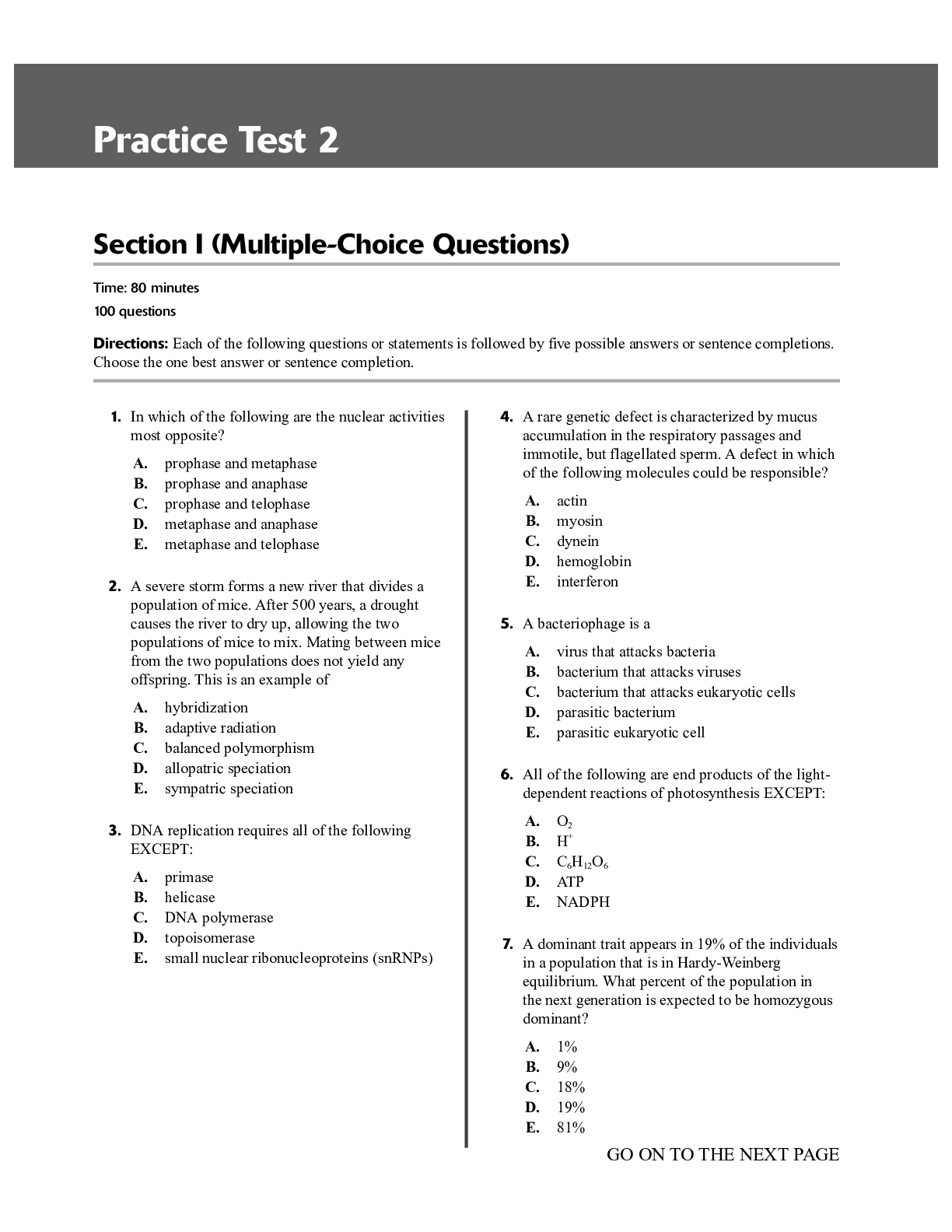
1. In which of the following are the nuclear activities
most opposite?
A. prophase and metaphase
B. prophase and anaphase
C. prophase and telophase
D. metaphase and anaphase
E. metaphase and telophase
2. A severe
...
1. In which of the following are the nuclear activities
most opposite?
A. prophase and metaphase
B. prophase and anaphase
C. prophase and telophase
D. metaphase and anaphase
E. metaphase and telophase
2. A severe storm forms a new river that divides a
population of mice. After 500 years, a drought
causes the river to dry up, allowing the two
populations of mice to mix. Mating between mice
from the two populations does not yield any
offspring. This is an example of
A. hybridization
B. adaptive radiation
C. balanced polymorphism
D. allopatric speciation
E. sympatric speciation
3. DNA replication requires all of the following
EXCEPT:
A. primase
B. helicase
C. DNA polymerase
D. topoisomerase
E. small nuclear ribonucleoproteins (snRNPs)
4. A rare genetic defect is characterized by mucus
accumulation in the respiratory passages and
immotile, but flagellated sperm. A defect in which
of the following molecules could be responsible?
A. actin
B. myosin
C. dynein
D. hemoglobin
E. interferon
5. A bacteriophage is a
A. virus that attacks bacteria
B. bacterium that attacks viruses
C. bacterium that attacks eukaryotic cells
D. parasitic bacterium
E. parasitic eukaryotic cell
6. All of the following are end products of the lightdependent reactions of photosynthesis EXCEPT:
A. O2
B. H+
C. C6H12O6
D. ATP
E. NADPH
7. A dominant trait appears in 19% of the individuals
in a population that is in Hardy-Weinberg
equilibrium. What percent of the population in
the next generation is expected to be homozygous
dominant?
A. 1%
B. 9%
C. 18%
D. 19%
E. 81%
GO ON TO THE NEXT PAGE
��@�������DI���RYE����������������1.��1BHF����
8. Elongation of cells in shoot tips of plants is
promoted by
A. abscisic acid
B. carotene
C. cytokinin
D. ethylene
E. auxin
9. The endosymbiotic theory for the origin of
eukaryotes is supported by all of the following
[Show More]