Advanced Theoretical Perspectives of Nursing  >  TEST BANKS  >  Test Bank & Instructor’s Manual for Theories of Personality, 11th Edition by Duane P. Schultz (All)

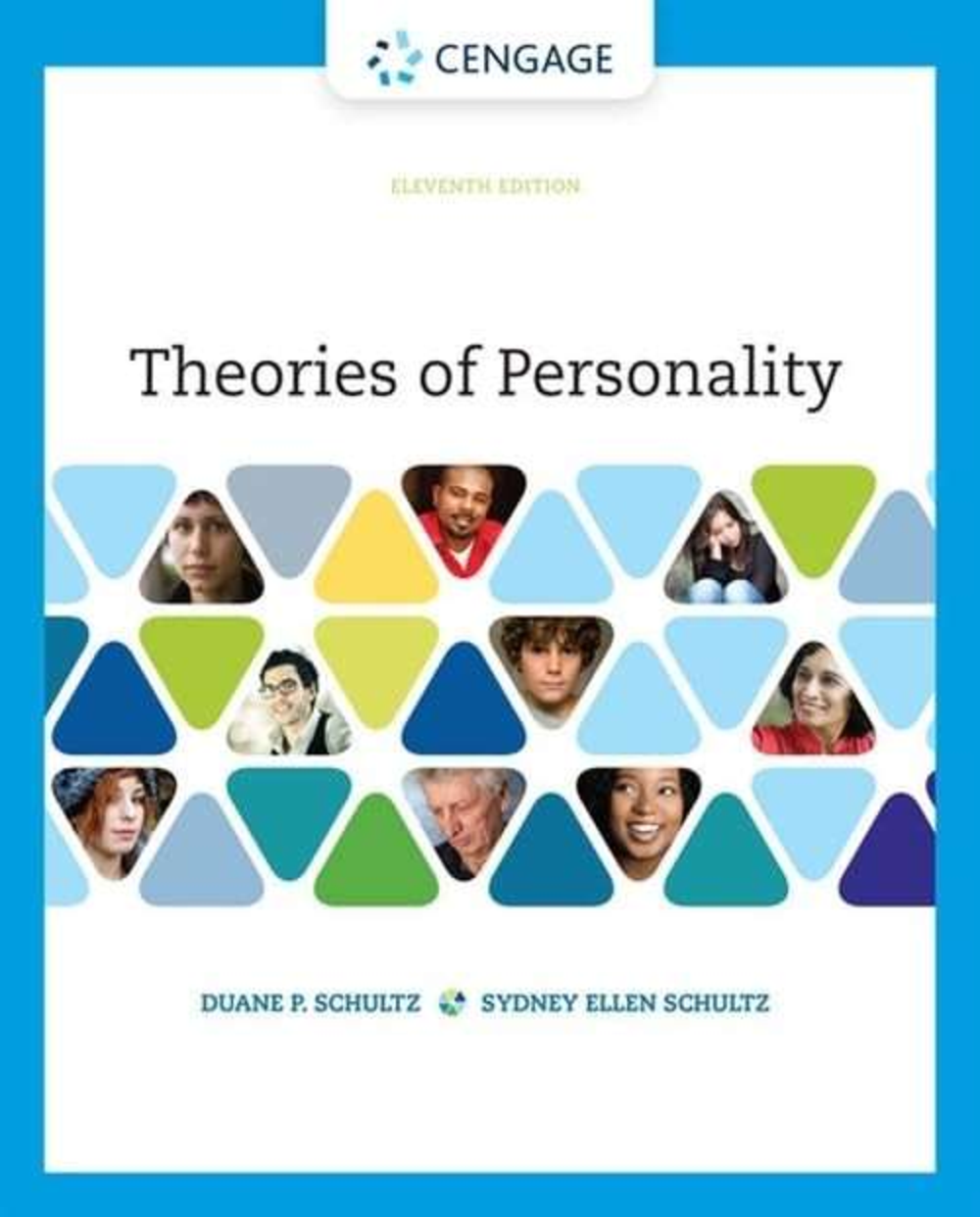
Test Bank & Instructor’s Manual for Theories of Personality, 11th Edition by Duane P. Schultz

Document Content and Description Below

Test Bank & Instructor’s Manual for Theories of Personality, 11th Edition by Duane P. Schultz Chapter 1—Personality: What It Is and Why You Should Care MULTIPLE CHOICE 1. We research theories of p ... ersonality to: a. establish one of them as superior amongst all. b. describe their use for real-world problems. c. show how personality theories are superior to any other theories. d. generalize that all people are the same across cultures. ANS: B PTS: 1 A-HEAD: Take a Look at the Word REF: 2 FEEDBACK: We discuss research conducted on these theories of personality to describe their use for real-world problems of diagnosis and therapy. It's important to recognize that personality theorists from the last century rarely considered the importance of ethnic and cultural differences. 2. Which of the following is true about personality? a. Personality is a characteristic exhibited by only a few people. b. Personality can limit or expand the choices one has in life. c. Personality is characterized by most psychologists as either terrific or terrible. d. Personality remains constant in all circumstances. ANS: B PTS: 1 A-HEAD: Take a Look at the Word REF: 2 FEEDBACK: Your personality can limit or expand your options and choices in life, prevent you from sharing certain experiences, or enable you to take full advantage of them. It restricts, constrains, and holds back some people and opens up the world of new opportunities to others. 3. Which of the following statements can be used to sum up personality? a. Personality is how we perceive ourselves and also how others perceive us. b. Personality shows that we are deterministic, mechanical, and do not change throughout our lives. c. Personality is entirely the reflection of fantasies and past recollections of repressed memories. d. Personality is entirely based on how we were treated during our childhood years. ANS: A PTS: 1 A-HEAD: Take a Look at the Word REF: 4 FEEDBACK: One psychologist suggested that we can get a very good idea of the meaning of personality if we examine our intentions—what we mean—whenever we use the word I. Our personality can also be defined in terms of the impression we make on others—that is, what we appear to be. 4. Around 1500, the Latin word persona was used to refer to: a. a person's mechanistic behavior. c. a mask used by actors in a play. b. predictable and automatic responses. d. a robe worn by noblemen. ANS: C PTS: 1 A-HEAD: Take a Look at the Word REF: 4 FEEDBACK: The word personality goes back to about the year 1500 and derives from the Latin word persona, which refers to a mask used by actors in a play. It's easy to see how persona came to refer to our outward appearance, the public face we display to the people around us. 5. Identify a true statement about an individual's personality. a. It can be stable and predictable. c. It is based on personal traits and behavior. b. It is generally resistant to sudden changes. d. All of these are correct. ANS: D PTS: 1 A-HEAD: Take a Look at the Word REF: 5 FEEDBACK: We assume that personality is relatively stable and predictable. Sometimes our personality can vary with the situation. Yet although it is not rigid, it is generally resistant to sudden changes. 6. The personality of an individual is . a. completely based on self-perception c. a unique cluster of characteristics b. unstable and unpredictable d. determined at birth and stays unchanged ANS: C PTS: 1 A-HEAD: Take a Look at the Word REF: 6 FEEDBACK: Personality is an enduring and unique cluster of characteristics that may change in response to different situations. We see similarities among people, yet we sense that each of us possesses special properties that distinguish us from all others. 7. Which of the following is true of people using social networking sites, such as Facebook? a. They tend to portray an idealized self-image of themselves. b. They feel they are able to express their true selves. c. They have a tendency to present themselves as much more emotionally stable. d. All of these are correct. ANS: D PTS: 1 A-HEAD: Personality and the Social Media REF: 6 FEEDBACK: Increasingly, many of us display another face, not in person, but through the Internet on social networking Web sites such as Facebook. Some research suggests that most people are honest about their online faces. A recent large-scale study in Germany found that many people have a tendency to present themselves online as being much more emotionally stable than they really are (Blumer & Doring, 2012). [Show More]

Last updated: 2 weeks ago

Preview 5 out of 479 pages

Buy Now

Instant download

We Accept:

Payment methods accepted on Scholarfriends (We Accept)
Loading document previews for Test Bank & Instructor’s Manual for Theories of Personality, 11th Edition by Duane P. Schultz

Loading document previews ...

Buy this document to get the full access instantly

Instant Download Access after purchase

Buy Now

Instant download

We Accept:

Payment methods accepted on Scholarfriends (We Accept)

Reviews( 0 )

$7.50

Buy Now

We Accept:

Payment methods accepted on Scholarfriends (We Accept)

Instant download

Can't find what you want? Try our AI powered Search

55
0

Document information


Connected school, study & course


About the document


Uploaded On

Dec 05, 2025

Number of pages

479

Written in

All

Seller


Profile illustration for TEST & SOLUTIONS
TEST & SOLUTIONS

Member since 4 months

4 Documents Sold

Additional information

This document has been written for:

Uploaded

Dec 05, 2025

Downloads

 0

Views

 55

More From TEST & SOLUTIONS

View all TEST & SOLUTIONS's documents »

Recommended For You

Get more on TEST BANKS »

$7.50
What is Scholarfriends

Scholarfriends.com Online Platform by Browsegrades Inc. 651N South Broad St, Middletown DE. United States.

We are here to help

We're available through e-mail, Twitter, Facebook, and live chat.
 FAQ
 Questions? Leave a message!

Follow us on
 Twitter

Copyright © Scholarfriends · High quality services·