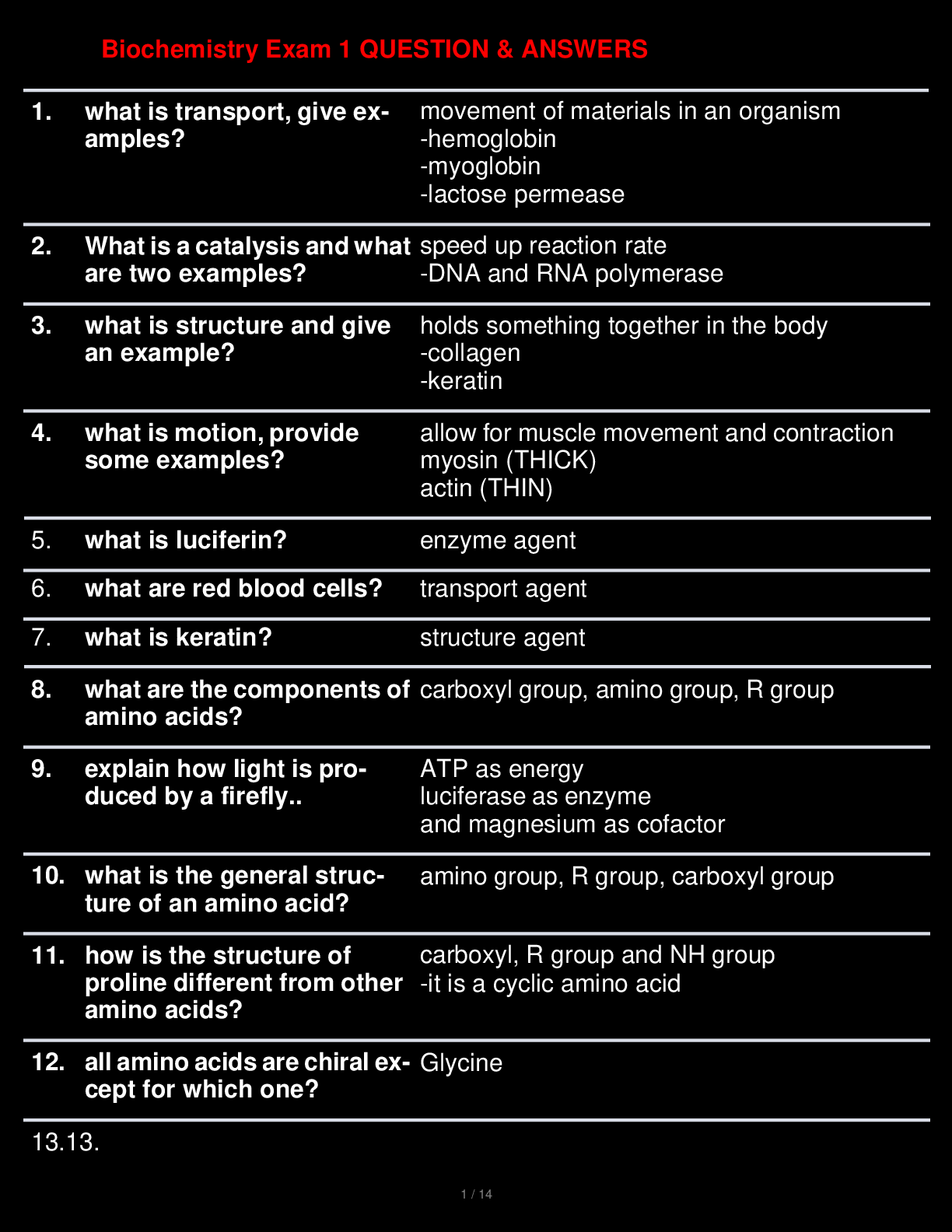
1. what is transport, give ex- amples?
2. What is a catalysis and what are two examples?
3. what is structure and give an example?
4. what is motion, provide some examples?
movement of materials in an organi
...
1. what is transport, give ex- amples?
2. What is a catalysis and what are two examples?
3. what is structure and give an example?
4. what is motion, provide some examples?
movement of materials in an organism
-hemoglobin
-myoglobin
-lactose permease
speed up reaction rate
-DNA and RNA polymerase
holds something together in the body
-collagen
-keratin
allow for muscle movement and contraction myosin (THICK)
actin (THIN)
5. what is luciferin? enzyme agent
6. what are red blood cells? transport agent
7. what is keratin? structure agent
8. what are the components of amino acids?
9. explain how light is pro- duced by a firefly..
10. what is the general struc- ture of an amino acid?
11. how is the structure of proline different from other amino acids?
12. all amino acids are chiral ex- cept for which one?
carboxyl group, amino group, R group
ATP as energy luciferase as enzyme
and magnesium as cofactor
amino group, R group, carboxyl group
carboxyl, R group and NH group
-it is a cyclic amino acid Glycine
13. 13.
what are the five basic groups of amino acids?
14. what is the smallest amino acid?
15. what is the largest amino acid?
16. what are some examples of nonpolar, aliphatic R groups?
17. what are some examples of nonpolar, aromatic R groups?
18. what are some examples of polar, uncharged R groups?
19. what do aromatic R groups and aliphatic R groups have in common?
20. what do uncharged, posi- tively charged and negative- ly charged R groups have in common?
21. what are some examples of positively charged R groups?
22. what are some examples of negatively charged R groups?
-nonpolar, aliphatic (7)
-nonpolar, aromatic (3)
-polar, uncharged (5)
-polar, positively charged (3)
-polar, negatively charged (2) Glycine
Tryptophan
glycine, alanine, proline, valine, leucine, isoleucine, and methionine (GAP VILM)
phenylalanine, tyrosine, and tryptophan (PTT)
serine, threonine, cysteine, asparagine, gluta- mine (CATS G)
they are both nonpolar and hydrophobic
they are polar, soluble in water
lysine, arginine, and histidine (LAH)
aspartate and glutamate (AG)
23. what is the difference in
cysteine reduced and oxi- dized reduced- hydrogen bonds with sulfur
oxidized- no hydrogen bonds with sulfur
24. what are ampholytes? A compound that has both acidic and basic
groups
25. what is the average mole- 138 da
cular weight of an amino
acids?
26. how to name a peptide... start from the amino terminus to carboxyl-ter-
minus
27. what is PI value? how do isoelectric point
you find it? pI=pKa1+pKa2 / 2
28. what are peptides? small condensation products of amino acids
29. what is lost during the for- water
mation of peptides?
[Show More]


![Preview of AORN PERIOP 101 FINAL EXAM 2026 QUESTIONS AND VERIFIED ANSWERS [LATEST UPDATE]](https://browseimages.nyc3.digitaloceanspaces.com/paper-images/2026/04/07/sGJvJ3aH2026-04-07-04-5869d464cbba16f.png)