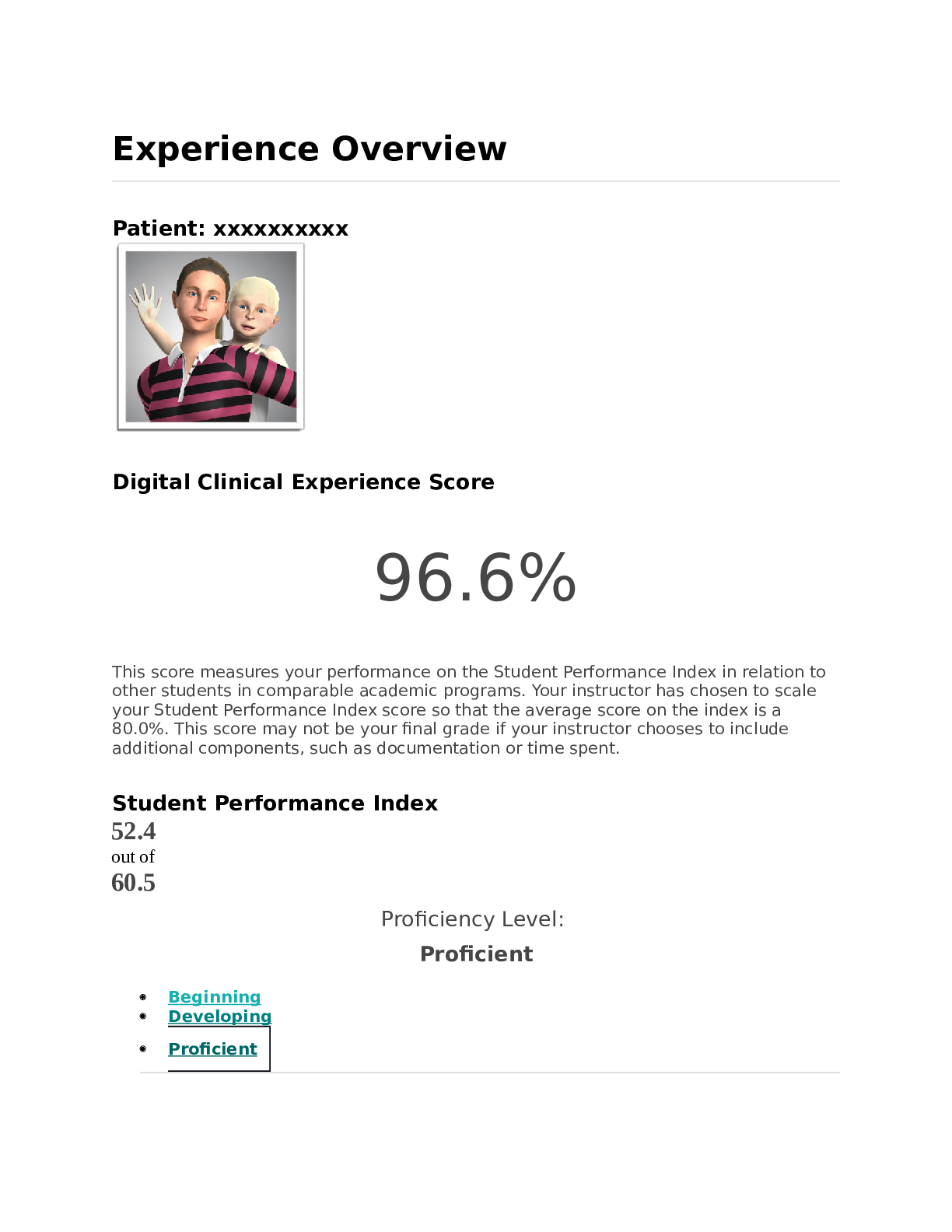
NR 602 Week 3 iHuman SOAP SOAP Note Template Completed
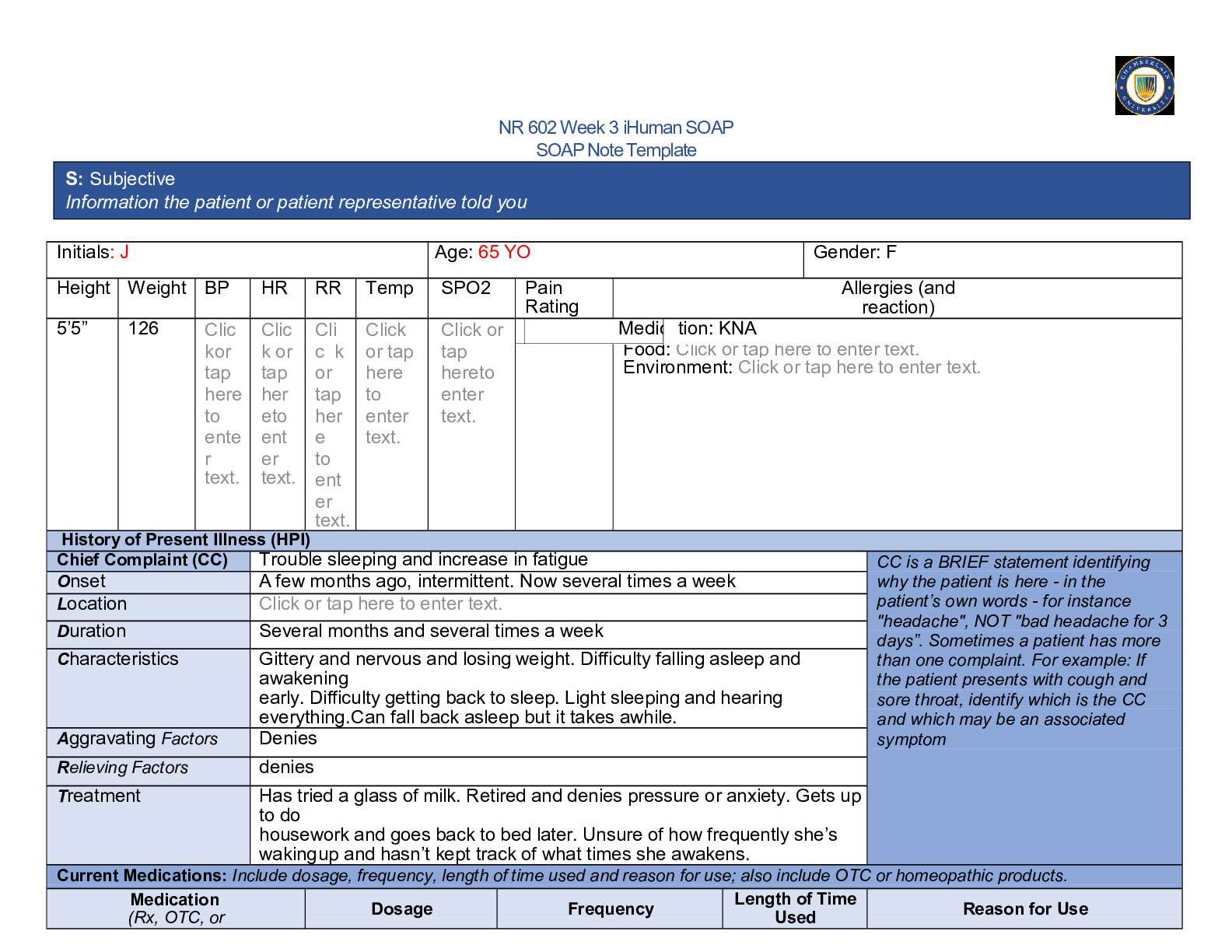
NR 602 Week 3 iHuman SOAP
SOAPNoteTemplate
Initials: J Age: 65 YO Gender: F
Height Weight BP HR RR Temp SPO2 Pain
Rating
Allergies (and
reaction)
5’5” 126
...
NR 602 Week 3 iHuman SOAP SOAP Note Template Completed
NR 602 Week 3 iHuman SOAP
SOAPNoteTemplate
Initials: J Age: 65 YO Gender: F
Height Weight BP HR RR Temp SPO2 Pain
Rating
Allergies (and
reaction)
5’5” 126 Clic
kor
tap
here
to
ente
r
text.
Clic
k or
tap
her
eto
ent
er
text.
Cli
c k
or
tap
her
e
to
ent
er
text.
Click
or tap
here
to
enter
text.
Click or
tap
hereto
enter
text.
Medication: KNA
Food: Click or tap here to enter text.
Environment: Click or tap here to enter text.
History of Present Illness (HPI)
Chief Complaint (CC) Trouble sleeping and increase in fatigue CC is a BRIEF statement identifying
why the patient is here - in the
patient’s own words - for instance
"headache", NOT "bad headache for 3
days”. Sometimes a patient has more
than one complaint. For example: If
the patient presents with cough and
sore throat, identify which is the CC
and which may be an associated
symptom
Onset A few months ago, intermittent. Now several times a week
Location Click or tap here to enter text.
Duration Several months and several times a week
Characteristics Gittery and nervous and losing weight. Difficulty falling asleep and
awakening
early. Difficulty getting back to sleep. Light sleeping and hearing
everything.Can fall back asleep but it takes awhile.
Aggravating Factors Denies
Relieving Factors denies
Treatment Has tried a glass of milk. Retired and denies pressure or anxiety. Gets up
to do
housework and goes back to bed later. Unsure of how frequently she’s
wakingup and hasn’t kept track of what times she awakens.
Current Medications: Include dosage, frequency, length of time used and reason for use; also include OTC or homeopathic products.
Medication
(Rx, OTC, or Dosage Frequency Length Used of Time Reason for Use
S: Subjective
Information the patient or patient representative told youHomeopathic)
Multivitamin daily Click or tap here to
enter text.
Click or tap here to enter
text.
Click or tap
here
to enter text.
Click or tap here to enter text.
Calcium daily Click or tap here to Click or tap here to enter Click or tap
here
Click or tap here to enter text.enter text. text. to enter text.
Metamucil daily Click or tap here
toenter text.
Click or tap here to
entertext.
Click or tap
hereto enter
text.
Click or tap here to enter text.
Click or tap here to enter text. Click or tap here to
enter text.
Click or tap here to enter
text.
Click or tap
here
to enter text.
Click or tap here to enter text.
Click or tap here to enter text. Click or tap here
toenter text.
Click or tap here to
entertext.
Click or tap
hereto enter
text.
Click or tap here to enter text.
Past Medical History (PMHx) – Includes but not limited to immunization status (note date of last tetanus for all adults), past major illnesses,
hospitalizations, and surgeries. Depending on the CC, more info may be needed.
Denies current or past medical problems. Occasional headaches. Occasional GERD. Chronic constipation. Hospitalized during the birth
of her twochildren. Childhood illnesses: mumps, measles, rubella
Immunizations: tetanus within the last 10 years, varicella
Social History (Soc Hx) - Includes but not limited to occupation and major hobbies, family status, tobacco and alcohol use, and any other pertinent
data. Include health promotion such as use seat belts all the time or working smoke detectors in the house.
Mother of two children. Normal American Diet Exercises – plays tennis on weekends. Colonscopy at age 58 normal. Yearly
mammograms all negative with dense breast tissue. Non-smoker (smoked occasionally in college). Drinks alcohol socially (1-2x per
month; goes out with girlfriends). Denies recreational drug use. Married, monogamous, no history of STDS or herpes. Retired high
school science teacher.
Family History (Fam Hx) - Includes but not limited to illnesses with possible genetic predisposition, contagious or chronic illnesses. Reason for
death of any deceased first degree relatives should be included. Include parents, grandparents, siblings, and children. Include grandchildren if
pertinent.Father: deceased at 90 from pneumonia, history of asthma and osteoarthritis
Mother: died in hit and run car accident at age 71.
Maternal grandmother: deceased and died of a stroke, history of being “nervous” and was told it was her
thyroidMaternal grandfather: died in war, no medical problems
Paternal grandmother: died of breast cancer
Paternal grandfather: died of prostate
cancerNo siblingsReview of Systems (ROS): Address all body systems that may help rule in or out a differential diagnosis Check the box next to each positive
symptom and provide additional details.
Constitutional
If patient denies all
symptoms for this
system,check here: ☐
Skin
If patient denies
all
symptoms for this
system, check here:
☐
HEENT
If patient denies all symptoms for this system, check
here: ☐
☒Fatigue Click or tap
hereto enter text.
☐ Weakness Click or
taphere to enter text.
☐ Fever/Chills Click or
taphere to enter text.
☐ Weight Gain denies
☒Weight Loss Click or
taphere to enter text.
☒Trouble Sleeping Click
ortap here to enter text.
☐ Night Sweats denies
☐ Other:
Click or tap here to enter
text.
☐ Itching Click or
taphere to enter
text.
☐ Rashes Click or
taphere to enter
text.
☒Nail Changes
Clickor tap here to
enter text.
☐ Skin Color
ChangesClick or
tap here to enter
text.
☒Other:
Hair
thinning
☐ Diplopia Click or
taphere to enter
text.
☐ Eye Pain Click or
taphere to enter text.
☐ Eye redness Click
ortap here to enter
text.
☐ Vision changes Click
ortap here to enter
text.
☐ Photophobia Click
ortap here to enter
text.
☐ Eye discharge Click
ortap here to enter
text.
☐ Earache Click or tap
hereto enter text.
☐ Tinnitus Click or tap
hereto enter text.
☐ Epistaxis Click or
taphere to enter text.
☐ Vertigo Click or tap
hereto enter text.
☐ Hearing Changes
Clickor tap here to
enter text.
☐ Hoarseness Click or tap
hereto enter text.
☐ Oral Ulcers Click or tap
hereto enter text.
☐ Sore Throat Click or tap
hereto enter text.
☐ Congestion Click or tap
hereto enter text.
☐ Rhinorrhea Click or tap
hereto enter text.
☐ Other:
Click or tap here to enter text.Respiratory
If patient denies all symptoms for
thissystem, check here: ☐
Neuro
If patient denies all
symptomsfor this system,
check here:
☐
Cardiac and Peripheral Vascular
If patient denies all symptoms for this system, check
here: ☐
☐ Cough Click or tap here to enter
text.
☐ Syncope or
Lightheadedness Click or
tap
☐ Chest pain Click or tap here to
entertext.
☒Palpitations over the
pastfew years☐ Hemoptysis Click or tap here to
enter text.
☐ Dyspnea Click or tap here to
entertext.
☐ Wheezing Click or tap here to
entertext.
☐ Pain on Inspiration Click or tap
hereto enter text.
☐ Sputum Production
☐ Other: Click or tap here to
entertext.
here to enter text.
☒Headache Click or tap
hereto enter text.
☐ Numbness Click or tap
hereto enter text.
☐ Tingling Click or tap here
toenter text.
☐ Sensation Changes
☐ Speech Deficits Click or
taphere to enter text.
☐ Other: Click or tap here
toenter text.
☒SOB breathing harder and
heartbeats faster with
☒Exercise Intolerance exhausted
withweekly tennis
☐ Orthopnea Click or tap here to
entertext.
☐ Edema Click or tap here to enter
text.
☐ Murmurs Click or tap here to
entertext.
☒Faintness struggles
withheat
☐ Claudications Click or
taphere to enter text.
☐ PND Click or tap here
toenter text.
☐ Other: Click or tap here
toenter text.
MSK
If patient denies all symptoms
forthis system, check here: ☒
GI
If patient denies all symptoms for
thissystem, check here: ☒
GU
If patient denies all
symptoms for this system,
check here: ☒
PSYCH
If patient denies all
symptoms for this system,
check here: ☐
☐ Pain Click or tap here to
entertext.
☐ Stiffness Click or tap here
toenter text.
☐ Crepitus Click or tap here to
entertext.
☐ Swelling Click or tap here to
entertext.
☐ Limited ROM
☐ Redness Click or tap here
toenter text.
☐ Misalignment Click or tap
here toenter text.
☐ Other: Click or tap here to
entertext.
☐ Nausea/Vomiting Click or tap
here toenter text.
☐ Dysphasia Click or tap here to
entertext.
☐ Diarrhea Click or tap here to
entertext.
☐ Appetite Change Click or tap
here toenter text.
☐ Heartburn Click or tap here to
entertext.
☐ Blood in Stool Click or tap
here toenter text.
☐ Abdominal Pain Click or tap
here toenter text.
☐ Excessive Flatus Click or tap
here toenter text.
☐ Urgency Click or tap here
toenter text.
☐ Dysuria Click or tap here
toenter text.
☐ Burning Click or tap here
toenter text.
☐ Hematuria Click or tap
hereto enter text.
☐ Polyuria Click or tap here
toenter text.
☐ Nocturia Click or tap here
toenter text.
☐ Incontinence Click or
taphere to enter text.
☐ Other: Click or tap here
toenter text.
☐ Stress Click or tap here
toenter text.
☐ Anxiety Click or tap here
toenter text.
☐ Depression Click or tap
hereto enter text.
☐ Suicidal/Homicidal
IdeationClick or tap here to
enter text.
☐ Memory Deficits Click or
taphere to enter text.
☐ Mood Changes Click or
taphere to enter text.
☐ Trouble Concentrating
Clickor tap here to enter
text.
☐ Other: Click or tap heretoenter text.☐ Food Intolerance Click or tap
here toenter text.
☐ Rectal Bleeding Click or tap
here toenter text.
☐ Other:
GYN
If patient denies all symptoms for
thissystem, check here: ☒
Hematology/Lymphatics
If patient denies all symptoms for this system,
check here: ☒
Endocrine
If patient denies all symptoms for this system,
check here: ☐
☐ Rash Click or tap here to enter text.
☐ Discharge Click or tap here to enter
text.
☐ Itching Click or tap here to enter text.
☐ Irregular Menses Click or tap
here toenter text.
☐ Dysmenorrhea Click or tap here to
entertext.
☐ Foul Odor Click or tap here to enter
text.
☐ Amenorrhea Click or tap here to
entertext.
☐ LMP: Click or tap here to enter text.
☐ Contraception Click or tap here to
entertext.
☐ Other:Click or tap here to enter text.
☐ Anemia Click or tap here to enter text.
☐ Easy bruising/bleeding Click or tap
here toenter text.
☐ Past Transfusions Click or tap here to
entertext.
☐ Enlarged/Tender lymph node(s) Click or
taphere to enter text.
☐ Blood or lymph disorder Click or tap
here toenter text.
☐ Other Click or tap here to enter text.
☐ Abnormal growth Click or tap here to
entertext.
☐ Increased appetite Click or tap here to
entertext.
☐ Increased thirst denies
☐ Thyroid disorder Click or tap here to enter
text.
☐ Heat/cold intolerance heat intolerant
☐ Excessive sweating Click or tap here to
entertext.
☐ Diabetes Click or tap here to enter text.
☐ Other Click or tap here to enter text.O: Objective
Information gathered during the physical examination by inspection, palpation, auscultation, and percussion. If unable to assess a
body system, write “Unable to assess”. Document pertinent positive and negative assessment findings. Pertinent positive are the
“abnormal” findings and pertinent “negative” are the expected normal findings. Separate the assessment findings accordingly and be
detailed.Body System Positive Findings Negative Findings
General
Pleasant 65-year-old female appropriately dressed and
appropriateresponses to questions
Click or tap here to enter text.
Skin
HEENT
Warm and dry. Palms moist. No obvious skin lesions seen.
Normalskin turgor. Hair is dry but typical for age. Normal
thickness and distribution pattern for patient gender.
Eyebrows: sparse; missing lateral aspect. No swelling of
extremities or deformities. No cyanosis, clubbing or edema.
Eyes: no erythema or swelling; positive for lid retraction and
mild lidlag; no proptosis. Conjunctivae: pink, no discharge.
Sclerae: anicteric. Orbital area: no edema, redness,
tenderness or lesions noted. Lateral outside third of eyebrow
is missing bilaterally. Neck has no visible scars, deformities
or other lesions and trachea is midline. Thyroid is soft, 45gm
in size. Isthmus ropey, easily palpable, slight bilateral
asymmetry R>L, no nodules palpated.
Thyroid moves with swallowing and no nodules are felt.
Click or tap here to enter text.
Click or tap here to enter text.
Respiratory
Neuro
Chest is symmetrical and the anterior-posterior diameter is
normal.The excursion with respiration is symmetrical and
there are no abnormal retractions or use of accessory
muscles. No distention, scars, masses or rashes.
No fasiculations. Slightly coarse tremor in extended hand.
Hyperreflexia of biceps and brachioradialis tendons.
Click or tap here to enter text.
Click or tap here to enter text.
Cardiovascular
PMI is in the 5th intercostal space at the mid-clavicular line.
RRR.
Click or tap here to enter text.
Musculoskeletal
Normal muscle bulk and
tone.
Click or tap here to enter text.Gastrointestinal
Abdomen is flat and symmetric with no scars, deformities,
striae orlesions. Hyperactive bowel sounds.
Click or tap here to enter text.2. Click or tap h
A: Assessment
Medical Diagnoses. Provide 3 differential diagnoses (DDx) which may provide an etiology for the CC. The first diagnosis (presumptive diagnosis)
is the diagnosis with the highest priority. Provide the ICD-10 code and pertinent findings to support eachdiagnosis.
Diagnosis ICD-10 Code Pertinent Findings
Click or tap here to enter text. Click or tap here to enter text.
Click or tap here to enter text. Click or tap here to enter text.
Problem List
1. Click or tap here to enter text. 6. Click or tap here to enter text. 11. Click or tap here to enter text.
ere to enter text. 7. Click or tap here to enter text. 12. Click or tap here to enter text.
3. Click or tap here to enter text. 8. Click or tap here to enter text. 13. Click or tap here to enter text.
4. Click or tap here to enter text. 9. Click or tap here to enter text. 14. Click or tap here to enter text.
5. Click or tap here to enter text. 10. Click or tap here to enter text. 15. Click or tap here to enter text.Click or tap here to enter text. Click or tap here to enter text.P: Plan
Address all 5 parts of the comprehensive treatment plan. If you do not wish to order an intervention for any part of the treatment plan, write
“None at this time” but do not leave any heading blank. No intervention is self-evident. Provide a rationale and evidence-based in-text citation for
each intervention.
Diagnostics: List tests you will order this visit
Test Rationale/Citatio
n
Click or tap here to enter text. Click or tap here to enter text.
Click or tap here to enter text. Click or tap here to enter text.
Click or tap here to enter text. Click or tap here to enter text.
Click or tap here to enter text. Click or tap here to enter text.Click or tap here to enter text. Click or tap here to enter text.
Medications: List medications/treatments including OTC drugs you will order and “continue meds” if pertinent.
Dru
g
Dosag
e
[Show More]