What type of substance abuse programs would be most appropriate for him?
The most appropriate program for him with the history of a relapse after a 28 day stay at a rehab
is medication-assisted treatment programs that
...
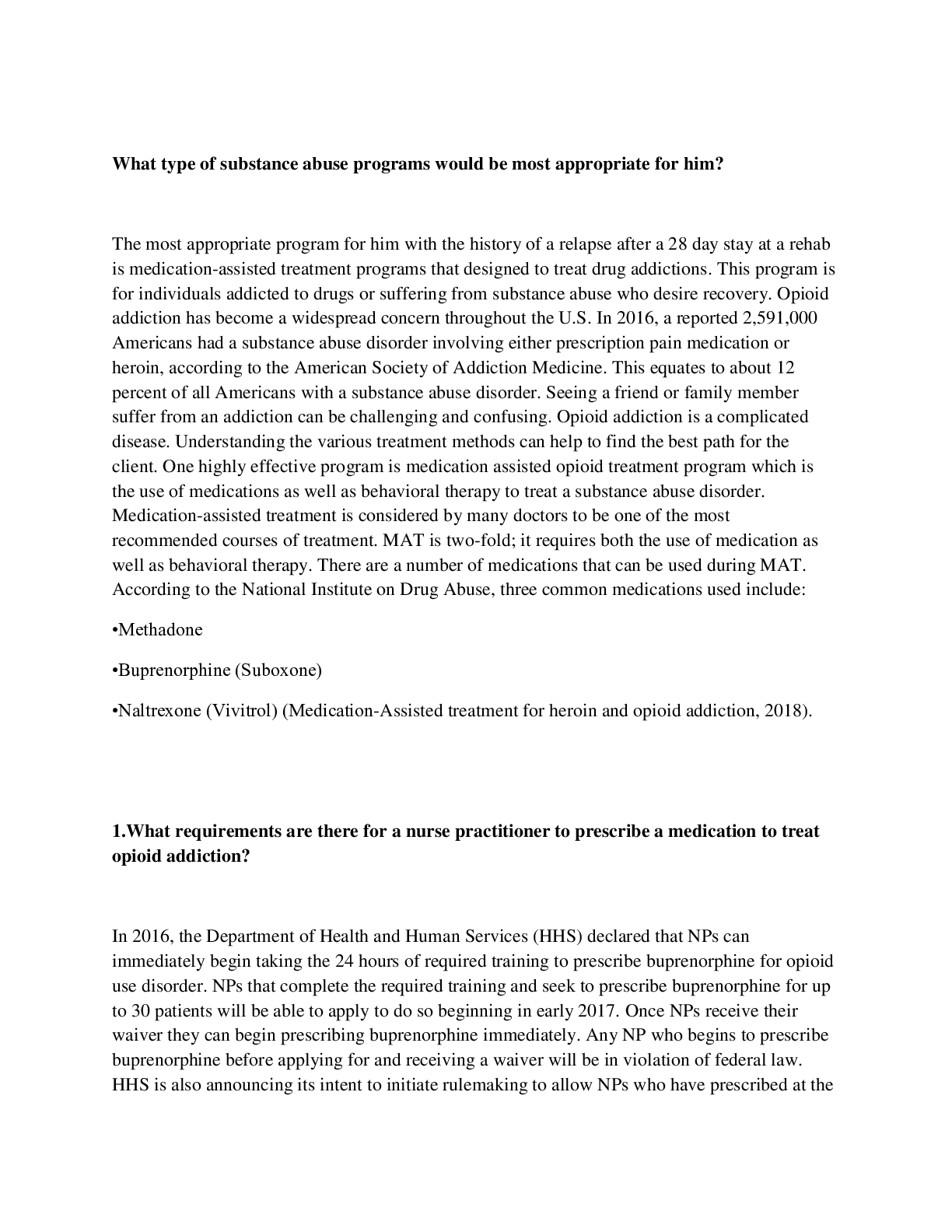
What type of substance abuse programs would be most appropriate for him?
The most appropriate program for him with the history of a relapse after a 28 day stay at a rehab
is medication-assisted treatment programs that designed to treat drug addictions. This program is
for individuals addicted to drugs or suffering from substance abuse who desire recovery. Opioid
addiction has become a widespread concern throughout the U.S. In 2016, a reported 2,591,000
Americans had a substance abuse disorder involving either prescription pain medication or
heroin, according to the American Society of Addiction Medicine. This equates to about 12
percent of all Americans with a substance abuse disorder. Seeing a friend or family member
suffer from an addiction can be challenging and confusing. Opioid addiction is a complicated
disease. Understanding the various treatment methods can help to find the best path for the
client. One highly effective program is medication assisted opioid treatment program which is
the use of medications as well as behavioral therapy to treat a substance abuse disorder.
Medication-assisted treatment is considered by many doctors to be one of the most
recommended courses of treatment. MAT is two-fold; it requires both the use of medication as
well as behavioral therapy. There are a number of medications that can be used during MAT.
According to the National Institute on Drug Abuse, three common medications used include:
•Methadone
•Buprenorphine (Suboxone)
•Naltrexone (Vivitrol) (Medication-Assisted treatment for heroin and opioid addiction, 2018).
1.What requirements are there for a nurse practitioner to prescribe a medication to treat
opioid addiction?
In 2016, the Department of Health and Human Services (HHS) declared that NPs can
immediately begin taking the 24 hours of required training to prescribe buprenorphine for opioid
use disorder. NPs that complete the required training and seek to prescribe buprenorphine for up
to 30 patients will be able to apply to do so beginning in early 2017. Once NPs receive their
waiver they can begin prescribing buprenorphine immediately. Any NP who begins to prescribe
buprenorphine before applying for and receiving a waiver will be in violation of federal law.
HHS is also announcing its intent to initiate rulemaking to allow NPs who have prescribed at the30 patient limits for one year, to apply for a waiver to prescribe buprenorphine for up to 100
patients (Nurse Practitioners, 2018).
1.What are the requirements for a patient who is enrolled in a medication assisted opioid
treatment program?
Medication assisted opioid treatment program carefully guides each patient through an
individualized opioid addiction treatment program to end their dependence on opioids, which
requires the patient to strictly adhere to all steps of the process.
•Patient must be in mild-to-moderate opioid drug withdrawal (5 on a scale of 1-10, with 10 being
the worst) before initial appointment at medication assisted opioid treatment program.
•Patient must refrain from opioid use for at least 12-24 hours prior to initial appointment at
medication assisted opioid treatment program.
•Patient must refrain from ingesting pain pills for at least 24 hours prior to initial appointment at
medication assisted opioid treatment program.
•Patient must refrain from using non-prescribed or “street” buprenorphine (Suboxone®) for at
least 24-36 hours prior to initial appointment at medication assisted opioid treatment program
(Opioid Addiction Treatment Program, 2013).
Oklahoma State Laws on Prescribing Schedule II Drugs
Under the United States Controlled Substances Act, all illegal drugs, prescription medications,
and certain chemicals and substances are classified into one of five categories based on their
potential for abuse as well as their accepted medical uses. These categories are referred to as
schedules. Many states, including Oklahoma, have adopted the same drug scheduling system
used by the Drug Enforcement Agency (DEA). Schedule II drugs are considered to have a high
abuse potential with some accepted medical uses under strict supervision; examples include
cocaine, opium, and opiates such as morphine, codeine and other similar painkillers. In
Oklahoma, a physician cannot issue multiple prescriptions to a patient for the same drug. The
DEA allows this but the Oklahoma Bureau of Narcotics and Dangerous Drugs does not have a
corresponding law or rule that allows it in Oklahoma. It is illegal for a prescriber to postdate a
prescription. All CDS prescriptions must be dated and signed on the day when issued. If a
prescriber does not want the patient to fill it that day, then they can put instructions on the
prescription as to the date when it can be filled. The date to be filled should not exceed 30 days
from the date written for CII prescriptions. The Oklahoma State Board of Pharmacy remindshospital pharmacists that Advance Practice Registered Nurses (APRN) are not allowed to
prescribe C-II's, even under physician protocols in a hospital (Oklahoma State laws on
prescribing schedule II drugs, 2018).
References
Medication-Assisted treatment for heroin and opioid addiction. (2018). Opioid Treatment.net.
Retrieved from https://www.opioidtreatment.net/medication-assisted-treatment
Nurse Practitioners and Physician Assistants prescribing buprenorphine. (2018). American
Society of Addiction Medicine. Retrieved from https://www.asam.org/resources/practiceresources/nurse-practitioners-and-physician-assistants-prescribing-buprenorphin
Oklahoma State laws on prescribing schedule II drugs . (2018). Oklahoma State Board of
Pharmacy. Retrieved from https://www.ok.gov/pharmacy/News /
Opioid Addiction Treatment Program. (2013). Addiction Outreach Clinic. Retrieved from
https://www.addictionoc.com/opioid-addiction-treatment-program
[Show More]


.png)






.png)
.png)