SAUNDERS COMPREHENSIVE REVIEW FOR NCLEX ONE
Document Content and Description Below
SAUNDERS COMPREHENSIVE REVIEW FOR NCLEX ONE
1) The nurse is providing discharge instructions to a Chinese American
client regarding prescribed dietary modifications. During the teaching
session, the client continuou
...
SAUNDERS COMPREHENSIVE REVIEW FOR NCLEX ONE
1) The nurse is providing discharge instructions to a Chinese American
client regarding prescribed dietary modifications. During the teaching
session, the client continuously turns away from the nurse. The nurse
should implement which best action?
Answers-Continue with the
instructions, verifying client
understanding.
1) A critically ill Hispanic client tells the nurse through an
interpreter that she is Roman Catholic and firmly believes
in the rituals and traditions of the Catholic faith. Based
on the client's statements, which actions by the nurse
demonstrate cultural sensitivity and spiritual
support? Select all that apply.(1,2,5)
Answers-Ensures that a close
relative stays with
the client
Makes a referral for a Catholic
priest to visit the client
Offers to provide a means for
praying the rosary if the client
wishes.
2) Which clients have a high risk of obesity and diabetes
mellitus? Select all that apply.(1,2,4,5)
Latino American Man
Native American man
Hispanic American man
African American woman
3) The nurse is preparing a plan of care for a client, and is
asking the client about religious preferences. The nurse
considers the client's religious preferences as being
characteristic of a Jehovah's Witness if which client
statement is made?
I cannot have any food containing
or Prepared with blood."
4) The ambulatory care nurse is discussing preoperative
procedures with a Japanese American client who is scheduled
for surgery the following week. During the discussion, the
client continually smiles and nods the head. How should the
nurse interpret this nonverbal behavior? Answers-Reflecting a cultural value
5) When communicating with a client who speaks a different
language, which best practice should the nurse implement?
Arrange for an interpreter to
translate.
6) The nurse educator is providing in-service education to the
nursing staff regarding transcultural nursing care; a staff
member asks the nurse educator to provide an example of the
concept of acculturation. The nurse educator should make
which most appropriate response?
Answers-"A person who moves from
China to the United States (U.S.)
and learns about and adapts ato the
culture in the U.S."
7) An Asin American client is experiencing a fever. The nurse
plans care so that the client can self-treat the disorder
using which method?
Foods considered to be yin
8) Which meal tray should the nurse deliver to a client of
Orthodox Judaism faith who follows a kosher diet?
Sweet and sour chicken with rice
and vegetables, mixed fruit, juice.
9) Which is the best nursing intervention regarding
complementary and alternative medicine?
Educating the client about
therapies that he or she is using
or is interested in using
10) An antihypertensive medication has been prescribed for
a client with hypertension. The client tells the clinic
nurse that he would like to take an herbal substance to help
lower his blood pressure. The nurse should take which
action? Encourage the client to discuss the
use of an herbal substance with the
health care provider (HCP).
11) The nurse educator asks a student to list the 5 main
categories of complementary and alternative medicine (CAM),
developed by the National Center for Complementary and
Alternative Medicine. Which statement, if made by the
nursing student, indicates a need for further
teaching regarding CAM categories?
"Magnetic therapy and massage
therapy are a focus of CAM."
12) The nurse hears a client calling out for help, hurries
down the hallway to the client's room, and finds the client
lying on the floor. The nurse performs an assessment,
assists the client back to bed, notifies the health care
provider of the incident, and completes an incident report.
Which statement should the nurse document on the incident
report?
The client was found lying on the
floor.
13) A client is brought to the emergency department by
emergency medical services (EMS) after being hit by a car.
The name of the client is unknown, and the client has
sustained a severe head injury and multiple fractures and is
unconscious. An emergency craniotomy is required. Regarding
informed consent for the surgical procedure, which is
the best action?
Transport the victim to the
operating room for surgery.
14) The nurse has just assisted a client back to bed after
a fall. The nurse and health care provider have assessed the
client and have determined that the client is not injured.
After completing the incident report, the nurse should
implement which action next? Reassess the client.
15) The nurse arrives at work and is told to report (float)
to the intensive care unit (ICU) for the day because the ICU
is understaffed and needs additional nurses to care for the
clients. The nurse has never worked in the ICU. The nurse
should take which best action?
Clarify with the team leader to
make a safe ICU client assignment.
16) The nurse who works on the night shift enters the
medication room and finds a co-worker with a tourniquet
wrapped around the upper arm. The co-worker is about to
insert a needle, attached to a syringe containing a clear
liquid, into the antecubital area. Which is the most
appropriate action by the nurse?
Call the nursing supervisor.
17) A hospitalized client tells the nurse that an
instructional directive is being prepared and that the
lawyer will be bringing the document to the hospital today
for witness signatures. The client asks the nurse for
assistance in obtaining a witness to the will. Which is
the most appropriate response to the client?
"I will call the nursing supervisor
to seek assistance regarding your
request."
19) The nurse has made an error in a narrative documentation
of an assessment finding on a client and obtains the
client's record to correct the error. The nurse should take
which actions to correct the error? Select all that apply.
Document the correct information
and end with the nurse's signature
and title.
Draw 1 line through the error,
initialing and dating it.20) Which identifies accurate nursing documentation
notations? Select all that apply.
The client slept through the night.
Abdominal wound dressing is dry and
intact without drainage.
The client's left lower medial leg
wound is 3 cm in length without
redness, drainage, or edema.
21) A nursing instructor delivers a lecture to nursing
students regarding the issue of client's rights and asks a
nursing student to identify a situation that represents an
example of invasion of client privacy. Which situation, if
identified by the student, indicates an understanding of a
violation of this client right?
Observing care provided to the
client without the client's
permission
22) Nursing staff members are sitting in the lounge taking
their morning break. An unlicensed assistive personnel (UAP)
tells the group that she thinks that the unit secretary has
acquired immunodeficiency syndrome (AIDS) and proceeds to
tell the nursing staff that the secretary probably
contracted the disease from her husband, who is supposedly a
drug addict. The registered nurse should inform the UAP that
making this accusation has violated which legal tort?
Slander
23) An 87-year-old woman is brought to the emergency
department for treatment of a fractured arm. On physical
assessment, the nurse notes old and new ecchymotic areas on
the client's chest and legs and asks the client how the
bruises were sustained. The client, although reluctant,
tells the nurse in confidence that her son frequently hits
her if supper is not prepared on time when he arrives home
from work. Which is the most appropriate nursing response? As a nurse, I am legally bound to
report abuse. I will stay with
you while you give the report and
help find a safe place for you to
stay."
24) The nurse calls the heath care provider (HCP) regarding
a new medication prescription because the dosage prescribed
is higher than the recommended dosage. The nurse is unable
to locate the HCP, and the medication is due to be
administered. Which action should the nurse take?
Contact the nursing supervisor.
25) The nurse employed in a hospital is waiting to receive
a report from the laboratory via the facsimile (fax)
machine. The fax machine activates and the nurse expects the
report, but instead receives a sexually oriented photograph.
Which is the most appropriate initial nursing action?
Call the nursing supervisor and
report the incident.
26) The nurse is assigned to care for four clients. In
planning client rounds, which client should the nurse
assess first?
A client with asthma who
requested a breathing treatment
during the previous shift
27) The nurse employed in an emergency department is
assigned to triage clients coming to the emergency
department for treatment on the evening shift. The nurse
should assign priority to which client?
A client with chest pain who
states that he just ate pizza
that was made with a very spicy
sauce
28) A nursing graduate is attending an agency orientation
regarding the nursing model of practice implemented in the
health care facility. The nurse is told that the nursingmodel is a team nursing approach. The nurse determines that
which scenario is characteristic of the team-based model of
nursing practice?
An RN leads 2 licensed practical
nurses (LPNs) and 3 UAPs in
providing care to a group of 12
clients.
29) The nurse has received the assignment for the day
shift. After making initial rounds and checking all of the
assigned clients, which client should the nurse plan to care
for first?
A client with a white blood cell
count of 14,000 mm3 (14.0 × 10⁹/L)
and a temperature of 101°F
(38.4°C)
30) The nurse is giving a bed bath to an assigned client
when an unlicensed assistive personnel (UAP) enters the
client's room and tells the nurse that another assigned
client is in pain and needs pain medication. Which is
the most appropriate nursing action?
Cover the client, raise the
side rails, tell the client that
you will return shortly, and
administer the pain medication
to the other client.
31) The nurse manager has implemented a change in the
method of the nursing delivery system from functional to
team nursing. An unlicensed assistive personnel (UAP) is
resistant to the change and is not taking an active part in
facilitating the process of change. Which is
the best approach in dealing with the UAP?
Confront the UAP to encourage
verbalization of feelings
regarding the change.32) The registered nurse is planning the client assignments
for the day. Which is the most appropriate assignment for an
unlicensed assistive personnel (UAP)?
A client who requires urine
specimen collections
33) The nurse manager is discussing the facility protocol
in the event of a tornado with the staff. Which instructions
should the nurse manager include in the discussion? Select
all that apply.
Move beds away from windows.
Close window shades and
curtains.
Place blankets over clients who
are confined to bed.
34) The nurse employed in a long-term care facility is
planning assignments for the clients on a nursing unit. The
nurse needs to assign four clients and has a licensed
practical (vocational) nurse and 3 unlicensed assistive
personnel (UAPs) on a nursing team. Which client would the
nurse most appropriately assign to the licensed practical
(vocational) nurse?
A client requiring abdominal
wound irrigations and dressing
changes every 3 hours
35) The charge nurse is planning the assignment for the
day. Which factors should the nurse remain mindful of when
planning the assignment? Select all that apply.
The acuity level of the clients
Client needs and workers' needs
and abilities
36) The nurse is caring for a client with heart failure. On
assessment, the nurse notes that the client is dyspneic, and
crackles are audible on auscultation. What additionalmanifestations would the nurse expect to note in this client
if excess fluid volume is present?
An increase in blood pressure
and increased respirations
37) The nurse is preparing to care for a client with a
potassium deficit. The nurse reviews the client's record and
determines that the client is at risk for developing the
potassium deficit because of which situation?
Requires nasogastric suction
38) The nurse reviews a client's electrolyte laboratory
report and notes that the potassium level is 2.5 mEq/L (2.5
mmol/L). Which patterns should the nurse watch for on the
electrocardiogram (ECG) as a result of the laboratory
value? Select all that apply.
U waves
Inverted T waves
Depressed ST segment
39) Potassium chloride intravenously is prescribed for a
client with hypokalemia. Which actions should the nurse take
to plan for preparation and administration of the
potassium? Select all that apply.
Obtain an intravenous (IV)
infusion pump.
Monitor urine output during
administration.
Monitor the IV site for signs
of infiltration or phlebitis.
Ensure that the medication is
diluted in the appropriate
volume of fluid. Ensure that the bag is labeled
so that it reads the volume of
potassium in the solution.
40) The nurse provides instructions to a client with a low
potassium level about the foods that are high in potassium
and tells the client to consume which foods? Select all that
apply.
Raisins
Potatoes
Cantaloupe
Strawberries
41) The nurse is reviewing laboratory results and notes
that a client's serum sodium level is 150 mEq/L (150
mmol/L). The nurse reports the serum sodium level to the
health care provider (HCP) and the HCP prescribes dietary
instructions based on the sodium level. Which acceptable
food items does the nurse instruct the client to
consume? Select all that apply.
Peas
Nuts
Cauliflower
42) The nurse is assessing a client with a suspected
diagnosis of hypocalcemia. Which clinical manifestation
would the nurse expect to note in the client?
Twitching
43) The nurse is caring for a client with hypocalcemia.
Which patterns would the nurse watch for on the
electrocardiogram as a result of the laboratory
value? Select all that apply.
Prolonged QT interval
Prolonged ST segment44) The nurse reviews the electrolyte results of an
assigned client and notes that the potassium level is 5.7
mEq/L (5.7 mmol/L). Which patterns would the nurse watch for
on the cardiac monitor as a result of the laboratory
value? Select all that apply.
Tall peaked T waves
Widened QRS complexes
45) Which client is at risk for the development of a sodium
level at 130 mEq/L (130 mmol/L)?
The client who is taking
diuretics
46) The nurse is caring for a client with heart failure who
is receiving high doses of a diuretic. On assessment, the
nurse notes that the client has flat neck veins, generalized
muscle weakness, and diminished deep tendon reflexes. The
nurse suspects hyponatremia. What additional signs would the
nurse expect to note in a client with hyponatremia?
Hyperactive bowel sounds
47) The nurse reviews a client's laboratory report and
notes that the client's serum phosphorus (phosphate) level
is 1.8 mg/dL (0.45 mmol/L). Which condition most
likely caused this serum phosphorus level?
Malnutrition
48) The nurse is reading a health care provider's (HCP's)
progress notes in the client's record and reads that the HCP
has documented "insensible fluid loss of approximately 800
mL daily." The nurse makes a notation that insensible fluid
loss occurs through which type of excretion?
Integumentary output
49) The nurse is assigned to care for a group of clients.
On review of the clients' medical records, the nurse
determines that which client is most likely at risk for a
fluid volume deficit? A client with an ileostomy
50) The nurse caring for a client who has been receiving
intravenous (IV) diuretics suspects that the client is
experiencing a fluid volume deficit. Which assessment
finding would the nurse note in a client with this
condition?
Weight loss and poor skin
turgor
51) On review of the clients' medical records, the nurse
determines that which client is at risk for fluid volume
excess?
The client with kidney disease
and a 12-year history of
diabetes mellitus
52) Which client is at risk for the development of a
potassium level of 5.5mEq/L (5.5 mmol/L)?
The client who has sustained a
traumatic burn
53) The nurse reviews the arterial blood gas results of a
client and notes the following: pH 7.45, Paco2 of 30 mm Hg
(30 mm Hg), and HCO3– of 20 mEq/L (20 mmol/L). The nurse
analyzes these results as indicating which condition?
Respiratory alkalosis,
compensated
54) The nurse is caring for a client with a nasogastric
tube that is attached to low suction. The nurse monitors the
client for manifestations of which disorder that the client
is at risk for?
Metabolic alkalosis
55) A client with a 3-day history of nausea and vomiting
presents to the emergency department. The client is
hypoventilating and has a respiratory rate of 10
breaths/minute. The electrocardiogram (ECG) monitor displays
tachycardia, with a heart rate of 120 beats/minute. Arterial
blood gases are drawn and the nurse reviews the results,
expecting to note which finding?
An increased pH and an
increased HCO3–56) The nurse is caring for a client having respiratory
distress related to an anxiety attack. Recent arterial blood
gas values are pH = 7.53, Pao2 = 72 mm Hg (72 mm Hg),
Paco2 = 32 mmHg (32 mm Hg), and HCO3– = 28 mEq/L (28 mmol/L).
Which conclusion about the client should the nurse make?
The client is probably
hyperventilating.
57) The nurse is caring for a client with diabetic
ketoacidosis and documents that the client is experiencing
Kussmaul's respirations. Which patterns did the nurse
observe? Select all that apply.
Respirations that are
increased in rate
Respirations that are
abnormally deep
58) A client who is found unresponsive has arterial blood
gases drawn and the results indicate the following: pH is
7.12, Paco2 is 90 mm Hg (90 mm Hg), and HCO3– is 22 mEq/L (22
mmol/L). The nurse interprets the results as indicating
which condition?
Respiratory acidosis without
compensation
59) The nurse notes that a client's arterial blood gas
(ABG) results reveal a pH of 7.50 and a Paco2 of 30 mm Hg
(30 mm Hg). The nurse monitors the client for which clinical
manifestations associated with these ABG results? Select all
that apply.
Nausea
Confusion
Tachycardia
Lightheadedness
60) The nurse reviews the blood gas results of a client
with atelectasis. The nurse analyzes the results and
determines that the client is experiencing respiratory
acidosis. Which result validates the nurse's findings?
pH 7.25, Paco2 50 mm Hg (50 mm
Hg)61) The nurse is caring for a client who is on a mechanical
ventilator. Blood gas results indicate a pH of 7.50 and a
Paco2 of 30 mm Hg (30 mm Hg). The nurse has determined that
the client is experiencing respiratory alkalosis. Which
laboratory value would most likely be noted in this
condition?
Potassium level of 3.0 mEq/L
(3.0 mmol/L)
62) The nurse is caring for a client with several broken
ribs. The client is most likely to experience what type of
acid-base imbalance?
Respiratory acidosis from
inadequate ventilation
63) A client with atrial fibrillation who is receiving
maintenance therapy of warfarin sodium has a prothrombin
time (PT) of 35 seconds and an international normalized
ratio (INR) of 3.5. On the basis of these laboratory values,
the nurse anticipates which prescription?
Holding the next dose of
warfarin
64) A staff nurse is precepting a new graduate nurse and
the new graduate is assigned to care for a client with
chronic pain. Which statement, if made by the new graduate
nurse, indicates the need for further teaching regarding
pain management?
"I will be sure to cue in to
any indicators that the client
may be exaggerating their
pain."
65) A client has been admitted to the hospital for urinary
tract infection and dehydration. The nurse determines that
the client has received adequate volume replacement if the
blood urea nitrogen (BUN) level drops to which value?
15 mg/dL (5.25 mmol/L)
66) The nurse is explaining the appropriate methods for
measuring an accurate temperature to an unlicensed assistive
personnel (UAP). Which method, if noted by the UAP as being
an appropriate method, indicates the need for further
teaching?
Taking an oral temperature for
a client with a cough and
nasal congestion
67) A client is receiving a continuous intravenous infusion
of heparin sodium to treat deep vein thrombosis. Theclient's activated partial thromboplastin time (aPTT) is 65
seconds. The nurse anticipates that which action is needed?
68) A client with a history of cardiac disease is due for a
morning dose of furosemide. Which serum potassium level, if
noted in the client's laboratory report, should be reported
before administering the dose of furosemide?
Leaving the rate of the
heparin infusion as is
69) A client with a history of cardiac disease is due for a
morning dose of furosemide. Which serum potassium level, if
noted in the client's laboratory report, should be reported
before administering the dose of furosemide?
3.2 mEq/L (3.2 mmol/L)
70) Several laboratory tests are prescribed for a client,
and the nurse reviews the results of the tests. Which
laboratory test results should the nurse report? Select all
that apply.
Platelets 35,000 mm3 (35 ×
109/L)
Sodium 150 mEq/L (150 mmol/L)
Segmented neutrophils 40%
(0.40)
White blood cells, 3000
mm3 (3.0 × 10⁹/L)
71) The nurse is caring for a client who takes ibuprofen
for pain. The nurse is gathering information on the client's
medication history, and determines it is necessary to
contact the health care provider (HCP) if the client is also
taking which medications? Select all that apply.
Warfarin
Glimepiride
Amlodipine
72) A client with diabetes mellitus has a glycosylated
hemoglobin A1c level of 9%. On the basis of this test
result, the nurse plans to teach the client about the need
for which measure?
Preventing and recognizing
hyperglycemia
73) The nurse is caring for a client with a diagnosis of
cancer who is immunosuppressed. The nurse would consider
implementing neutropenic precautions if the client's white
blood cell count was which value?
2000 mm3 (2.0 × 10⁹/L)
74) A client brought to the emergency department states
that he has accidentally been taking 2 times his prescribed
dose of warfarin for the past week. After noting that theclient has no evidence of obvious bleeding, the nurse plans
to take which action?
Draw a sample for prothrombin
time (PT) and international
normalized ratio (INR).
75) The nurse is caring for a postoperative client who is
receiving demand-dose hydromorphone via a patient-controlled
analgesia (PCA) pump for pain control. The nurse enters the
client's room and finds the client drowsy and records the
following vital signs: temperature 97.2°F (36.2°C) orally,
pulse 52 beats per minute, blood pressure 101/58 mm Hg,
respiratory rate 11 breaths per minute, and SpO2 of 93% on 3
liters of oxygen via nasal cannula. Which action should the
nurse take next?
Attempt to arouse the client.
76) An adult female client has a hemoglobin level of 10.8
g/dL (108 mmol/L). The nurse interprets that this result
is most likely caused by which condition noted in the
client's history?
Iron deficiency anemia
77) A client with a history of gastrointestinal bleeding
has a platelet count of 300,000 mm3 (300 × 109/L). The nurse
should take which action after seeing the laboratory
results?
Place the normal report in the
client's medical record.
78) The nurse is teaching a client who has iron deficiency
anemia about foods she should include in the diet. The nurse
determines that the client understands the dietary
modifications if which items are selected from the menu?
Oranges and dark green leafy
vegetables
79) The nurse is planning to teach a client with
malabsorption syndrome about the necessity of following a
low-fat diet. The nurse develops a list of high-fat foods to
avoid and should include which food items on the
list? Select all that apply.
Margarine
Cream cheese
Luncheon meats80) The nurse instructs a client with chronic kidney
disease who is receiving hemodialysis about dietary
modifications. The nurse determines that the client
understands these dietary modifications if the client
selects which items from the dietary menu?
Cream of wheat, blueberries,
coffee
81) The nurse is conducting a dietary assessment on a
client who is on a vegan diet. The nurse provides dietary
teaching and should focus on foods high in which vitamin
that may be lacking in a vegan diet?
Vitamin B12
82) A client with hypertension has been told to maintain a
diet low in sodium. The nurse who is teaching this client
about foods that are allowed should include which food item
in a list provided to the client?
Summer squash
83) A postoperative client has been placed on a clear
liquid diet. The nurse should provide the client with which
items that are allowed to be consumed on this diet? Select
all that apply.
Broth
Coffee
Gelatin
84) The nurse is instructing a client with hypertension on
the importance of choosing foods low in sodium. The nurse
should teach the client to limit intake of which food?
Smoked sausage
85) A client who is recovering from surgery has been
advanced from a clear liquid diet to a full liquid diet. The
client is looking forward to the diet change because he has
been "bored" with the clear liquid diet. The nurse should
offer which full liquid item to the client?
Custard
86) A client is recovering from abdominal surgery and has a
large abdominal wound. The nurse should encourage the client
to eat which food item that is naturally high in vitamin C
to promote wound healing?
Oranges
87) The nurse is caring for a client with cirrhosis of the
liver. To minimize the effects of the disorder, the nurse
teaches the client about foods that are high in thiamine.
The nurse determines that the client hasthe best understanding of the dietary measures to follow if
the client states an intention to increase the intake of
which food?
Legumes
88) A client is being weaned from parenteral nutrition (PN)
and is expected to begin taking solid food today. The
ongoing solution rate has been 100 mL/hour. The nurse
anticipates that which prescription regarding the PN
solution will accompany the diet prescription?
Decrease PN rate to 50
mL/hour.
89) The nurse is preparing to change the parenteral
nutrition (PN) solution bag and tubing. The client's central
venous line is located in the right subclavian vein. The
nurse asks the client to take which essential action during
the tubing change?
Take a deep breath, hold it,
and bear down.
90) A client with parenteral nutrition (PN) infusing has
disconnected the tubing from the central line catheter. The
nurse assesses the client and suspects an air embolism. The
nurse should immediately place the client in which position?
On the left side, with the
head lower than the feet
91) Which nursing action is essential prior to initiating a
new prescription for 500 mL of fat emulsion (lipids) to
infuse at 50 mL/hour?
Determine whether the client
has an allergy to eggs.
92) The nurse monitors the client receiving parenteral
nutrition (PN) for complications of the therapy and should
assess the client for which manifestations of hyperglycemia?
Weakness, thirst, and
increased urine output
93) The nurse is changing the central line dressing of a
client receiving parenteral nutrition (PN) and notes that
the catheter insertion site appears reddened. The nurse
should next assess which item?
Client's temperature
94) The nurse is preparing to hang fat emulsion (lipids)
and notes that fat globules are visible at the top of the
solution. The nurse should take which action?
Obtain a different bottle of
solution.95) A client receiving parenteral nutrition (PN) suddenly
develops a fever. The nurse notifies the health care
provider (HCP), and the HCP initially prescribes that the
solution and tubing be changed. What should the nurse do
with the discontinued materials?
Prepare to send them to the
laboratory for culture.
96) A client has been discharged to home on parenteral
nutrition (PN). With each visit, the home care nurse should
assess which parameter most closely in monitoring this
therapy?
Temperature and weight
97) The nurse, caring for a group of adult clients on an
acute care medical-surgical nursing unit, determines that
which clients would be the most likely candidates for
parenteral nutrition (PN)? Select all that apply.
A client with extensive burns
A client with cancer who is
septic
A client with severe
exacerbation of Crohn's
disease
A client with persistent
nausea and vomiting from
chemotherapy
98) The nurse is preparing to hang the first bag of
parenteral nutrition (PN) solution via the central line of
an assigned client. The nurse should obtain which most
essential piece of equipment before hanging the solution?
Electronic infusion pump
99) The nurse is making initial rounds at the beginning of
the shift and notes that the parenteral nutrition (PN) bag
of an assigned client is empty. Which solution should the
nurse hang until another PN solution is mixed and delivered
to the nursing unit?
10% dextrose in water
100) The nurse is monitoring the status of a client's fat
emulsion (lipid) infusion and notes that the infusion is 1
hour behind. Which action should the nurse take?
Ensure that the fat emulsion
infusion rate is infusing at
the prescribed rate
101) A client receiving parenteral nutrition (PN) in the
home setting has a weight gain of 5 lb in 1 week. The nurse
should next assess the client for the presence of which
condition? Crackles on auscultation of
the lungs
102) The nurse is caring for a restless client who is
beginning nutritional therapy with parenteral nutrition
(PN). The nurse should plan to ensure that which action is
taken to prevent the client from sustaining injury?
Secure all connections in the
PN system.
103) A client receiving parenteral nutrition (PN) complains
of a headache. The nurse notes that the client has an
increased blood pressure, bounding pulse, jugular vein
distention, and crackles bilaterally. The nurse determines
that the client is experiencing which complication of PN
therapy?
Hypervolemia
104) A client had a 1000-mL bag of 5% dextrose in 0.9%
sodium chloride hung at 1500. The nurse making rounds at
1545 finds that the client is complaining of a pounding
headache and is dyspneic, experiencing chills, and
apprehensive, with an increased pulse rate. The intravenous
(IV) bag has 400 mL remaining. The nurse should take which
action first?
Slow the IV infusion.
105) The nurse has a prescription to hang a 1000-mL
intravenous (IV) bag of 5% dextrose in water with 20 mEq of
potassium chloride. The nurse also needs to hang an IV
infusion of piperacillin/tazobactam. The client has one IV
site. The nurse should plan to take which action first?
Check compatibility of the
medication and IV fluids.
106) The nurse is completing a time tape for a 1000-mL
intravenous (IV) bag that is scheduled to infuse over 8
hours. The nurse has just placed the 1100 marking at the
500-mL level. The nurse would place the mark for 1200 at
which numerical level (mL) on the time tape? Fill in the
blank.
375ml
107) The nurse is making initial rounds on the nursing unit
to assess the condition of assigned clients. Which
assessment findings are consistent with infiltration? Select
all that apply.
Pallor and coolness
Numbness and pain
Edema and blanched skin108) The nurse is inserting an intravenous (IV) line into a
client's vein. After the initial stick, the nurse would
continue to advance the catheter in which situation?
Blood return shows in the
backflash chamber of the
catheter.
109) The nurse is assessing a client's peripheral
intravenous (IV) site after completion of a vancomycin
infusion and notes that the area is reddened, warm, painful,
and slightly edematous proximal to the insertion point of
the IV catheter. At this time, which action by the nurse
is best?
Remove the IV site and restart
at another site.
110) The nurse is preparing a continuous intravenous (IV)
infusion at the medication cart. As the nurse goes to insert
the spike end of the IV tubing into the IV bag, the tubing
drops and the spike end hits the top of the medication cart.
The nurse should take which action?
Obtain new IV tubing
111) A health care provider has written a prescription to
discontinue an intravenous (IV) line. The nurse should
obtain which item from the unit supply area for applying
pressure to the site after removing the IV catheter?
Sterile 2 × 2 gauze
112) A client rings the call light and complains of pain at
the site of an intravenous (IV) infusion. The nurse assesses
the site and determines that phlebitis has developed. The
nurse should take which actions in the care of this
client? Select all that apply.
Remove the IV catheter at that
site.
Apply warm moist packs to the
site.
Notify the health care
provider (HCP).
Document the occurrence,
actions taken, and the
client's response.
113) A client involved in a motor vehicle crash presents to
the emergency department with severe internal bleeding. The
client is severely hypotensive and unresponsive. The nurse
anticipates that which intravenous (IV) solution will most
likely be prescribed for this client? 5% dextrose in lactated
Ringer's solution
114) he nurse provides a list of instructions to a client
being discharged to home with a peripherally inserted
central catheter (PICC). The nurse determines that the
client needs further instructions if the client made which
statement?
"I need to restrict my
activity while this catheter
is in place."
115) A client has just undergone insertion of a central
venous catheter at the bedside under ultrasound. The nurse
would be sure to check which results before initiating the
flow rate of the client's intravenous (IV) solution at 100
mL/hour?
Chest radiology results
116) Intravenous (IV) fluids have been infusing at 100
mL/hour via a central line catheter in the right internal
jugular for approximately 24 hours to increase urine output
and maintain the client's blood pressure. Upon entering the
client's room, the nurse notes that the client is breathing
rapidly and coughing. For which additional signs of a
complication should the nurse assess based on the previously
known data?
Crackles in the lungs
117) Packed red blood cells have been prescribed for a
female client with a hemoglobin level of 7.6 g/dL (76
mmol/L) and a hematocrit level of 30% (0.30). The nurse
takes the client's temperature before hanging the blood
transfusion and records 100.6°F (38.1°C) orally. Which
action should the nurse take?
Delay hanging the blood and
notify the health care
provider (HCP).
118) he nurse has received a prescription to transfuse a
client with a unit of packed red blood cells. Before
explaining the procedure to the client, the nurse should ask
which initial question?
"Have you ever had a
transfusion before?"
119) A client receiving a transfusion of packed red blood
cells (PRBCs) begins to vomit. The client's blood pressure
is 90/50 mm Hg from a baseline of 125/78 mm Hg. The client's
temperature is 100.8°F (38.2°C) orally from a baseline of
99.2°F (37.3°C) orally. The nurse determines that the clientmay be experiencing which complication of a blood
transfusion?
Septicemia
120) The nurse determines that a client is having a
transfusion reaction. After the nurse stops the transfusion,
which action should be taken next?
Run normal saline at a keepvein-open rate.
121) The nurse has just received a unit of packed red blood
cells from the blood bank for transfusion to an assigned
client. The nurse is careful to select tubing especially
made for blood products, knowing that this tubing is
manufactured with which item? Click on the image to indicate
your answer.
Correct Answer Indication:
122) A client has received a transfusion of platelets. The
nurse evaluates that the client is benefiting most from this
therapy if the client exhibits which finding?
Decreased oozing of blood from
puncture sites and gums
123) A client has received a transfusion of platelets. The
nurse evaluates that the client is benefiting most from this
therapy if the client exhibits which finding?
Decreased oozing of blood from
puncture sites and gums
124) The nurse has obtained a unit of blood from the blood
bank and has checked the blood bag properly with another
nurse. Just before beginning the transfusion, the nurse
should assess which priority item?
Vital signs
125) The nurse has just received a prescription to transfuse
a unit of packed red blood cells for an assigned client.
What action should the nurse take next?
Check to be sure that consent
for the transfusion has been
signed.
126) Following infusion of a unit of packed red blood cells,
the client has developed new onset of tachycardia, boundingpulses, crackles, and wheezes. Which action should the nurse
implement first?
Place the client in high
Fowler's position.
127) The nurse, listening to the morning report, learns that
an assigned client received a unit of granulocytes the
previous evening. The nurse makes a note to assess the
results of which daily serum laboratory studies to assess
the effectiveness of the transfusion?
White blood cell count
128) A client is brought to the emergency department having
experienced blood loss related to an arterial laceration.
Which blood component should the nurse expect the health
care provider to prescribe?
Fresh-frozen plasma
129) The nurse who is about to begin a blood transfusion
knows that blood cells start to deteriorate after a certain
period of time. The nurse takes which actions in order to
prevent a complication of the blood transfusion as it
relates to deterioration of blood cells? Select all that
apply.
Checks the expiration date
Hangs the blood within the
specified time frame per agency
policy
130) A client requiring surgery is anxious about the
possible need for a blood transfusion during or after the
procedure. The nurse suggests to the client to take which
actions to reduce the risk of possible transfusion
complications? Select all that apply.
Ask a family member to donate
blood ahead of time.
Give an autologous blood
donation before the surgery.
131) A client with severe blood loss resulting from multiple
trauma requires rapid transfusion of several units of blood.
The nurse asks another health team member to obtain whichdevice for use during the transfusion procedure to help
reduce the risk of cardiac dysrhythmias?
Blood-warming device
132) A client has a prescription to receive a unit of packed
red blood cells. The nurse should obtain which intravenous
(IV) solution from the IV storage area to hang with the
blood product at the client's bedside?
0.9% sodium chloride
133) The nurse is caring for a client who is receiving a
blood transfusion and is complaining of a cough. The nurse
checks the client's vital signs, which include temperature
of 97.2°F (36.2°C), pulse of 108 beats per minute, blood
pressure of 152/76 mm Hg, respiratory rate of 24 breaths per
minute, and an oxygen saturation level of 95% on room air.
The client denies pain at this time. Based on this
information, what initial action should the nurse take?
Compare current data to
baseline data.
134) A Spanish-speaking client arrives at the triage desk in
the emergency department and states to the nurse, "No speak
English, need interpreter." Which is the best action for the
nurse to take?
Page an interpreter from the
hospital's interpreter
services.
135) The nurse is performing a neurological assessment on a
client and elicits a positive Romberg's sign. The nurse
makes this determination based on which observation?
A significant sway when the
client stands erect with feet
together, arms at the side,
and the eyes closed
136) The nurse notes documentation that a client is
exhibiting Cheyne-Stokes respirations. On assessment of the
client, the nurse should expect to note which finding?
Rhythmic respirations with
periods of apnea137) A client diagnosed with conductive hearing loss asks
the nurse to explain the cause of the hearing problem. The
nurse plans to explain to the client that this condition is
caused by which problem?
A physical obstruction to the
transmission of sound waves
138) While performing a cardiac assessment on a client with
an incompetent heart valve, the nurse auscultates a murmur.
The nurse documents the finding and describes the sound as
which?
A blowing or swooshing noise
139) The nurse is testing the extraocular movements in a
client to assess for muscle weakness in the eyes. The nurse
should implement which assessment technique to assess for
muscle weakness in the eye?
Test the 6 cardinal positions
of gaze.
140) The nurse is instructing a client how to perform a
testicular self-examination (TSE). The nurse should explain
that which is the best time to perform this exam?
After a shower or bath
141) The nurse is assessing a client for meningeal
irritation and elicits a positive Brudzinski's sign. Which
finding did the nurse observe?
The client passively flexes
the hip and knee in response
to neck flexion and reports
pain in the vertebral column.
142) A client with a diagnosis of asthma is admitted to the
hospital with respiratory distress. Which type of
adventitious lung sounds should the nurse expect to hear
when performing a respiratory assessment on this client?
Wheezes
143) The clinic nurse prepares to perform a focused
assessment on a client who is complaining of symptoms of a
cold, a cough, and lung congestion. Which should the nurse
include for this type of assessment? Select all that apply. Auscultating lung sounds
Obtaining the client's
temperature
Obtaining information about
the client's respirations
144) The nurse is preparing to initiate an intravenous (IV)
line containing a high dose of potassium chloride and plans
to use an IV infusion pump. The nurse brings the pump to the
bedside, prepares to plug the pump cord into the wall, and
notes that no receptacle is available in the wall socket.
The nurse should take which action?
Contact the electrical
maintenance department for
assistance.
145) The nurse obtains a prescription from a health care
provider to restrain a client and instructs an unlicensed
assistive personnel (UAP) to apply the safety device to the
client. Which observation of unsafe application of the
safety device would indicate that further instruction is
required by the UAP?
Safely securing the safety
device straps to the side
rails
146) The community health nurse is providing a teaching
session about anthrax to members of the community and asks
the participants about the methods of transmission. Which
answers by the participants would indicate that teaching was
effective? Select all that apply.
Inhalation of bacterial spores
Through a cut or abrasion in
the skin
Ingestion of contaminated
undercooked meat
147) The nurse is giving a report to an unlicensed assistive
personnel (UAP) who will be caring for a client who has hand
restraints (safety devices). The nurse instructs the UAP tocheck the skin integrity of the restrained hands how
frequently?
Every 30 minutes
148) The nurse is reviewing a plan of care for a client with
an internal radiation implant. Which intervention, if noted
in the plan, indicates the need for revision of the plan?
Placing the client in a
semiprivate room at the end of
the hallway
149) Contact precautions are initiated for a client with a
health care–associated (nosocomial) infection caused by
methicillin-resistant Staphylococcus aureus. The nurse
prepares to provide colostomy care and should obtain which
protective items to perform this procedure?
Gloves, gown, goggles, and a
mask or face shield
150) The nurse enters a client's room and finds that the
wastebasket is on fire. The nurse immediately assists the
client out of the room. What is the next nursing action?
Activate the fire alarm.
151) A mother calls a neighbor who is a nurse and tells the
nurse that her 3-year-old child has just ingested liquid
furniture polish. The nurse would direct the mother to take
which immediate action?
Call the Poison Control
Center.
152) The emergency department (ED) nurse receives a
telephone call and is informed that a tornado has hit a
local residential area and that numerous casualties have
occurred. The victims will be brought to the ED. The nurse
should take which initial action?
Activate the emergency
response plan.
153) The nurse is caring for a client with meningitis and
implements which transmission-based precautions for this
client? Private room or cohort client
154) The nurse working in the emergency department (ED) is
assessing a client who recently returned from Liberia and
presented complaining of a fever at home, fatigue, muscle
pain, and abdominal pain. Which action should the nurse take
next?
Isolate the client in a
private room.
155) A health care provider's prescription reads 1000 mL of
normal saline (NS) to infuse over 12 hours. The drop factor
is 15 drops (gtt)/1 mL. The nurse prepares to set the flow
rate at how many drops per minute? Fill in the blank. Record
your answer to the nearest whole number.
21 drops per minute
156) A health care provider's prescription reads to
administer an intravenous (IV) dose of 400,000 units of
penicillin G benzathine. The label on the 10-mL ampule sent
from the pharmacy reads penicillin G benzathine, 300,000
units/mL. The nurse prepares how much medication to
administer the correct dose? Fill in the blank. Record your
answer using 1 decimal place.
1.3 mL
157) A health care provider's prescription reads potassium
chloride 30 mEq to be added to 1000 mL normal saline (NS)
and to be administered over a 10-hour period. The label on
the medication bottle reads 40 mEq/20 mL. The nurse prepares
how many milliliters of potassium chloride to administer the
correct dose of medication? Fill in the blank.
15 mL
158) A health care provider's prescription reads clindamycin
phosphate 0.3 g in 50 mL normal saline (NS) to be
administered intravenously over 30 minutes. The medication
label reads clindamycin phosphate 900 mg in 6 mL. The nurse
prepares how many milliliters of the medication to
administer the correct dose? Fill in the blank.
2 mL
159) A health care provider's prescription reads phenytoin
0.2 g orally twice daily. The medication label states thateach capsule is 100 mg. The nurse prepares how many
capsule(s) to administer 1 dose? Fill in the blank.
2 capsule(s)
160) A health care provider prescribes 1000 mL of normal
saline 0.9% to infuse over 8 hours. The drop factor is 15
drops (gtt)/1 mL. The nurse sets the flow rate at how many
drops per minute? Fill in the blank. Record your answer to
the nearest whole number.
31 drops per minute
161) A health care provider prescribes heparin sodium, 1300
units/hour by continuous intravenous (IV) infusion. The
pharmacy prepares the medication and delivers an IV bag
labeled heparin sodium 20,000 units/250 mL D5W. An infusion
pump must be used to administer the medication. The nurse
sets the infusion pump at how many milliliters per hour to
deliver 1300 units/hour? Fill in the blank. Record your
answer to the nearest whole number.
16 mL per hour
162) A health care provider prescribes 3000 mL of D5W to be
administered over a 24-hour period. The nurse determines
that how many milliliters per hour will be administered to
the client? Fill in the blank.
125 mL per hour
163) Gentamicin sulfate, 80 mg in 100 mL normal saline (NS),
is to be administered over 30 minutes. The drop factor is 10
drops (gtt)/1 mL. The nurse sets the flow rate at how many
drops per minute? Fill in the blank. Record your answer to
the nearest whole number.
33 drops per minute
164) A health care provider's prescription reads
levothyroxine, 150 mcg orally daily. The medication label
reads levothyroxine, 0.1 mg/tablet. The nurse administers
how many tablet(s) to the client? Fill in the blank.
1.5 tablet(s)
165) Cefuroxime sodium, 1 g in 50 mL normal saline (NS), is
to be administered over 30 minutes. The drop factor is 15drops (gtt)/1 mL. The nurse sets the flow rate at how many
drops per minute? Fill in the blank.
25 drops per minute
166) A health care provider prescribes 1000 mL D5W to infuse
at a rate of 125 mL/hour. The nurse determines that it will
take how many hours for 1 L to infuse? Fill in the blank.
8 hour(s)
167) A health care provider prescribes 1 unit of packed red
blood cells to infuse over 4 hours. The unit of blood
contains 250 mL. The drop factor is 10 drops (gtt)/1 mL. The
nurse prepares to set the flow rate at how many drops per
minute? Fill in the blank. Record your answer to the nearest
whole number.
10 gtt/min
168) A health care provider's prescription reads morphine
sulfate, 8 mg stat. The medication ampule reads morphine
sulfate, 10 mg/mL. The nurse prepares how many milliliters
to administer the correct dose? Fill in the blank.
0.8 mL
169) A health care provider prescribes regular insulin, 8
units/hour by continuous intravenous (IV) infusion. The
pharmacy prepares the medication and then delivers an IV bag
labeled 100 units of regular insulin in 100 mL normal saline
(NS). An infusion pump must be used to administer the
medication. The nurse sets the infusion pump at how many
milliliters per hour to deliver 8 units/hour? Fill in the
blank.
0.8 mL/hour
170) The nurse has just reassessed the condition of a
postoperative client who was admitted 1 hour ago to the
surgical unit. The nurse plans to monitor which parameter
most carefully during the next hour?
Urinary output of 20 mL/hour
171) The nurse is teaching a client about coughing and deepbreathing techniques to prevent postoperative complications.
Which statement is most appropriate for the nurse to make to
the client at this time as it relates to these techniques? "Use of an incentive
spirometer will help prevent
pneumonia."
172) The nurse is creating a plan of care for a client
scheduled for surgery. The nurse should include which
activity in the nursing care plan for the client on the day
of surgery?
Have the client void
immediately before going into
surgery.
173) A client with a gastric ulcer is scheduled for surgery.
The client cannot sign the operative consent form because of
sedation from opioid analgesics that have been administered.
The nurse should take which most appropriate action in the
care of this client?
Obtain a telephone consent
from a family member,
following agency policy.
174) A preoperative client expresses anxiety to the nurse
about upcoming surgery. Which response by the nurse is most
likely to stimulate further discussion between the client
and the nurse
"Can you share with me what
you've been told about your
surgery?"
175) The nurse is conducting preoperative teaching with a
client about the use of an incentive spirometer. The nurse
should include which piece of information in discussions
with the client?
The best results are achieved
when sitting up or with the
head of the bed elevated 45 to
90 degrees.
176) The nurse has conducted preoperative teaching for a
client scheduled for surgery in 1 week. The client has a
history of arthritis and has been taking acetylsalicylic
acid. The nurse determines that the client needs additional
teaching if the client makes which statement? "I need to continue to take
the aspirin until the day of
surgery."
177) The nurse assesses a client's surgical incision for
signs of infection. Which finding by the nurse would be
interpreted as a normal finding at the surgical site?
Serous drainage
178) The nurse is monitoring the status of a postoperative
client in the immediate postoperative period. The nurse
would become most concerned with which sign that could
indicate an evolving complication?
Increasing restlessness
179) A client who has had abdominal surgery complains of
feeling as though "something gave way" in the incisional
site. The nurse removes the dressing and notes the presence
of a loop of bowel protruding through the incision. Which
interventions should the nurse take? Select all that apply.
Contact the surgeon.
Instruct the client to remain
quiet.
Prepare the client for wound
closure.
Document the findings and
actions taken.
180) A client who has undergone preadmission testing has had
blood drawn for serum laboratory studies, including a
complete blood count, coagulation studies, and electrolytes
and creatinine levels. Which laboratory result should be
reported to the surgeon's office by the nurse, knowing that
it could cause surgery to be postponed?
Hemoglobin, 8.0 g/dL (80
mmol/L)
181) The nurse receives a telephone call from the
postanesthesia care unit stating that a client is being
transferred to the surgical unit. The nurse plans to take
which action first on arrival of the client? Assess the patency of the
airway.
182) The nurse is reviewing a surgeon's prescription sheet
for a preoperative client that states that the client must
be nothing by mouth (NPO) after midnight. The nurse should
call the surgeon to clarify that which medication should be
given to the client and not withheld?
Prednisone
183) A client is being prepared for a thoracentesis. The
nurse should assist the client to which position for the
procedure?
Lying in bed on the unaffected
side
184) The nurse is caring for a client following a
craniotomy, in which a large tumor was removed from the left
side. In which position can the nurse safely place the
client? Click on the image to indicate your answer.
Correct Answer Indication: ✓
185) The nurse creates a plan of care for a client with deep
vein thrombosis. Which client position or activity in the
plan should be included?
Bed rest with elevation of the
affected extremity
186) The nurse is caring for a client who is 1 day
postoperative for a total hip replacement. Which is the best
position in which the nurse should place the client?
On the nonoperative side with
the legs abducted
187) The nurse is providing instructions to a client and the
family regarding home care after right eye cataract removal.
Which statement by the client would indicate an
understanding of the instructions?
"I should sleep on my left
side."188) The nurse is administering a cleansing enema to a
client with a fecal impaction. Before administering the
enema, the nurse should place the client in which position?
Left Sims' position
189) A client has just returned to a nursing unit after an
above-knee amputation of the right leg. The nurse should
place the client in which position?
Supine, with the residual limb
supported with pillows
190) The nurse is caring for a client with a severe burn who
is scheduled for an autograft to be placed on the lower
extremity. The nurse creates a postoperative plan of care
for the client and should include which intervention in the
plan?
Elevate and immobilize the
grafted extremity.
191) The nurse is preparing to care for a client who has
returned to the nursing unit following cardiac
catheterization performed through the femoral vessel. The
nurse checks the health care provider's (HCP's) prescription
and plans to allow which client position or activity
following the procedure?
Bed rest with head elevation
no greater than 30 degrees
192) The nurse is preparing to insert a nasogastric tube
into a client. The nurse should place the client in which
position for insertion?
High Fowler's
193) The nurse is preparing to administer medication using a
client's nasogastric tube. Which actions should the nurse
take before administering the medication? Select all that
apply.
Check the residual volume.
Aspirate the stomach contents.
Turn off the suction to the
nasogastric tube. Test the stomach contents for
a pH indicating acidity.
194) The nurse is preparing to administer medication through
a nasogastric tube that is connected to suction. To
administer the medication, the nurse should take which
action?
Clamp the nasogastric tube for
30 to 60 minutes following
administration of the
medication.
195) The nurse is assessing for correct placement of a
nasogastric tube. The nurse aspirates the stomach contents,
checks the gastric pH, and notes a pH of 7.35. Based on this
information, which action should the nurse take at this
time?
Call the health care provider
to request a prescription for
a chest radiograph.
196) The nurse caring for a client with a chest tube turns
the client to the side and the chest tube accidentally
disconnects from the water seal chamber. Which initial
action should the nurse take?
Place the tube in a bottle of
sterile water.
197) The registered nurse is preparing to insert a
nasogastric tube in an adult client. To determine the
accurate measurement of the length of the tube to be
inserted, the nurse should take which action?
Place the tube at the tip of
the nose and measure by
extending the tube to the
earlobe and then down to the
xiphoid process.
198) The nurse is assessing the functioning of a chest tube
drainage system in a client who has just returned from the
recovery room following a thoracotomy with wedge resection.
Which are the expected assessment findings? Select all that
apply. Drainage system maintained
below the client's chest
50 mL of drainage in the
drainage collection chamber
Occlusive dressing in place
over the chest tube insertion
site
Fluctuation of water in the
tube in the water seal chamber
during inhalation and
exhalation
199) The nurse is assisting a health care provider with the
removal of a chest tube. The nurse should instruct the
client to take which action?
Perform the Valsalva maneuver.
200) While changing the tapes on a newly inserted
tracheostomy tube, the client coughs and the tube is
dislodged. Which is the initial nursing action?
Grasp the retention sutures to
spread the opening.
201) The nurse is caring for a client immediately after
removal of the endotracheal tube. The nurse should report
which sign immediately if experienced by the client?
Stridor
202) The nurse checks for residual before administering a
bolus tube feeding to a client with a nasogastric tube and
obtains a residual amount of 150 mL. What is the most
appropriate action for the nurse to take?
Hold the feeding and reinstill
the residual amount.
203) The nurse caring for a client with a pneumothorax and
who has had a chest tube inserted notes continuous gentle
bubbling in the water seal chamber. What action is most
appropriate? Check for an air leak, because
the bubbling should be
intermittent.
204) The nurse is inserting a nasogastric tube in an adult
client. During the procedure, the client begins to cough and
has difficulty breathing. What is the most appropriate
action?
Pull back on the tube and wait
until the respiratory distress
subsides.
205) The clinic nurse is preparing to explain the concepts
of Kohlberg's theory of moral development with a parent. The
nurse should tell the parent that which factor motivates
good and bad actions for the child at the preconventional
level?
Punishment and reward
206) The maternity nurse is providing instructions to a new
mother regarding the psychosocial development of the newborn
infant. Using Erikson's psychosocial development theory, the
nurse instructs the mother to take which measure?
Allow the newborn infant to
signal a need.
207) The nurse notes that a 6-year-old child does not
recognize that objects exist even when the objects are
outside of the visual field. Based on this observation,
which action should the nurse take?
Report the observation to the
health care provider.
208) A nursing student is presenting a clinical conference
to peers regarding Freud's psychosexual stages of
development, specifically the anal stage. The student
explains to the group that which characteristic relates to
this stage of development?
This stage is associated with
toilet training.
209) The nurse is describing Piaget's cognitive
developmental theory to pediatric nursing staff. The nurseshould tell that staff that which child behavior is
characteristic of the formal operations stage?
The child has the ability to
think abstractly.
210) The mother of an 8-year-old child tells the clinic
nurse that she is concerned about the child because the
child seems to be more attentive to friends than anything
else. Using Erikson's psychosocial development theory, the
nurse should make which response?
"At this age, the child is
developing his own
personality."
211) The nurse educator is preparing to conduct a teaching
session for the nursing staff regarding the theories of
growth and development and plans to discuss Kohlberg's
theory of moral development. What information should the
nurse include in the session? Select all that apply.
Moral development progresses
in relationship to cognitive
development.
A person's ability to make
moral judgments develops over
a period of time.
The theory provides a
framework for understanding
how individuals determine a
moral code to guide their
behavior.
In stage 2 (instrumentalrelativist orientation), the
child conforms to rules to
obtain rewards or have favors
returned.
212) A parent of a 3-year-old tells a clinic nurse that the
child is rebelling constantly and having temper tantrums.
Using Erikson's psychosocial development theory, which
instructions should the nurse provide to the parent? Select
all that apply. Set limits on the child's
behavior.
Provide a simple explanation
of why the behavior is
unacceptable.
213) A 4-year-old child diagnosed with leukemia is
hospitalized for chemotherapy. The child is fearful of the
hospitalization. Which nursing intervention should be
implemented to alleviate the child's fears?
Encourage the child's parents
to stay with the child.
214) A 16-year-old client is admitted to the hospital for
acute appendicitis and an appendectomy is performed. Which
nursing intervention is most appropriate to facilitate
normal growth and development postoperatively?
Allow the client to interact
with others in his or her
(adolescent) same age group.
215) Which car safety device should be used for a child who
is 8 years old and 4 feet tall?
Booster seat
216) The nurse assesses the vital signs of a 12-month-old
infant with a respiratory infection and notes that the
respiratory rate is 35 breaths/minute. On the basis of this
finding, which action is most appropriate?
Document the findings.
217) The nurse is monitoring a 3-month-old infant for signs
of increased intracranial pressure. On palpation of the
fontanels, the nurse notes that the anterior fontanel is
soft and flat. On the basis of this finding, which nursing
action is most appropriate?
Document the finding.
218) The nurse is evaluating the developmental level of a 2-
year-old. Which does the nurse expect to observe in this
child?
Uses a cup to drink219) A 2-year-old child is treated in the emergency
department for a burn to the chest and abdomen. The child
sustained the burn by grabbing a cup of hot coffee that was
left on the kitchen counter. The nurse reviews safety
principles with the parents before discharge. Which
statement by the parents indicates an understanding of
measures to provide safety in the home?
"We will be sure not to leave
hot liquids unattended."
220) A mother arrives at a clinic with her toddler and tells
the nurse that she has a difficult time getting the child to
go to bed at night. What measure is most appropriate for the
nurse to suggest to the mother?
Inform the child of bedtime a
few minutes before it is time
for bed.
221) The mother of a 3-year-old is concerned because her
child still is insisting on a bottle at nap time and at
bedtime. Which is the most appropriate suggestion to the
mother?
Allow the bottle if it
contains water.
222) The nurse is preparing to care for a 5-year-old who has
been placed in traction following a fracture of the femur.
The nurse plans care, knowing that which is the most
appropriate activity for this child?
Crayons and a coloring book
223) The mother of a 3-year-old asks a clinic nurse about
appropriate and safe toys for the child. The nurse should
tell the mother that the most appropriate toy for a 3-yearold is which?
A wagon
224) Which interventions are appropriate for the care of an
infant? Select all that apply.
Provide swaddling.
Hang mobiles with black and
white contrast designs. Caress the infant while
bathing or during diaper
changes.
225) The nurse is preparing to care for a dying client, and
several family members are at the client's bedside. Which
therapeutic techniques should the nurse use when
communicating with the family? Select all that apply.
Encourage expression of
feelings, concerns, and fears.
Touch and hold the client's or
family member's hand if
appropriate.
Be honest and let the client
and family know they will not
be abandoned by the nurse.
226) The nurse is providing medication instructions to an
older client who is taking digoxin daily. The nurse explains
to the client that decreased lean body mass and decreased
glomerular filtration rate, which are age-related body
changes, could place the client at risk for which
complication with medication therapy?
Increased risk for digoxin
toxicity
227) The nurse is caring for an older client in a long-term
care facility. Which action contributes to encouraging
autonomy in the client?
Allowing the client to choose
social activities
228) The home care nurse is visiting an older client whose
spouse died 6 months ago. Which behaviors by the client
indicates effective coping? Select all that apply.
Looking at old snapshots of
family
Participating in a senior
citizens program
Visiting the spouse's grave
once a month Decorating a wall with the
spouse's pictures and awards
received
229) The nurse is providing instructions to the unlicensed
assistive personnel (UAP) regarding care of an older client
with hearing loss. What should the nurse tell the UAP about
older clients with hearing loss?
They respond to low-pitched
tones.
230) The nurse is providing an educational session to new
employees, and the topic is abuse of the older client. The
nurse helps the employees to identify which client as most
typically a victim of abuse?
A woman who has advanced
Parkinson's disease
231) The nurse is performing an assessment on an older
client who is having difficulty sleeping at night. Which
statement by the client indicates the need for further
teaching regarding measures to improve sleep?
"I drink hot chocolate before
bedtime."
232) The visiting nurse observes that the older male client
is confined by his daughter-in-law to his room. When the
nurse suggests that he walk to the den and join the family,
he says, "I'm in everyone's way; my daughter-in-law needs me
to stay here." Which is the most important action for the
nurse to take?
Suggest appropriate resources
to the client and daughter-inlaw, such as respite care and
a senior citizens center.
233) The nurse is performing an assessment on an older adult
client. Which assessment data would indicate a potential
complication associated with the skin?
Crusting
234) The home health nurse is visiting a client for the
first time. While assessing the client's medication history,
it is noted that there are 19 prescriptions and severalover-the-counter medications that the client has been
taking. Which intervention should the nurse take first?
Determine whether there are
medication duplications.
235) The long-term care nurse is performing assessments on
several of the residents. Which are normal age-related
physiological changes the nurse should expect to note?
Select all that apply.
Decline in visual acuity
Increased susceptibility to
urinary tract infections
Increased incidence of
awakening after sleep onset
236) The nurse is preparing to teach a prenatal class about
fetal circulation. Which statements should be included in
the teaching plan? Select all that apply.
"The ductus arteriosus allows
blood to bypass the fetal
lungs."
"One vein carries oxygenated
blood from the placenta to the
fetus."
"Two arteries carry
deoxygenated blood and waste
products away from the fetus
to the placenta."
237) The nursing instructor asks the student to describe
fetal circulation, specifically the ductus venosus. Which
statement by the student indicates an understanding of the
ductus venosus?
"It connects the umbilical
vein to the inferior vena
cava."
238) A pregnant client tells the clinic nurse that she wants
to know the sex of her baby as soon as it can be determined.
The nurse informs the client that she should be able to find
out the sex at 12 weeks' gestation because of which factor? The appearance of the fetal
external genitalia
239) The nurse is performing an assessment on a client who
is at 38 weeks' gestation and notes that the fetal heart
rate (FHR) is 174 beats/minute. On the basis of this
finding, what is the priority nursing action?
Notify the health care
provider (HCP).
240) The nurse is conducting a prenatal class on the female
reproductive system. When a client in the class asks why the
fertilized ovum stays in the fallopian tube for 3 days, what
is the nurse's best response?
"It promotes the fertilized
ovum's normal implantation in
the top portion of the
uterus."
241) The nursing instructor asks a nursing student to
explain the characteristics of the amniotic fluid. The
student responds correctly by explaining which as
characteristics of amniotic fluid? Select all that apply.
Allows for fetal movement
Surrounds, cushions, and
protects the fetus
Maintains the body temperature
of the fetus
Can be used to measure fetal
kidney function
242) A couple comes to the family planning clinic and asks
about sterilization procedures. Which question by the nurse
should determine whether this method of family planning
would be most appropriate?
"Do you plan to have any other
children?"
243) The nurse should make which statement to a pregnant
client found to have a gynecoid pelvis? "Your type of pelvis is the
most favorable for labor and
birth."
244) Which purposes of placental functioning should the
nurse include in a prenatal class? Select all that apply.
It is the way the baby gets
food and oxygen.
It provides an exchange of
nutrients and waste products
between the mother and
developing fetus.
245) A 55-year-old male client confides in the nurse that he
is concerned about his sexual function. What is the nurse's
best response?
"Please share with me more
about your concerns."
246) The nurse is providing instructions to a pregnant
client who is scheduled for an amniocentesis. What
instruction should the nurse provide?
An informed consent needs to
be signed before the
procedure.
247) A pregnant client in the first trimester calls the
nurse at a health care clinic and reports that she has
noticed a thin, colorless vaginal drainage. The nurse should
make which statement to the client?
"The vaginal discharge may be
bothersome, but is a normal
occurrence."
248) A nonstress test is performed on a client who is
pregnant, and the results of the test indicate nonreactive
findings. The health care provider prescribes a contraction
stress test, and the results are documented as negative. How
should the nurse document this finding?
A normal test result
249) A rubella titer result of a 1-day postpartum client is
less than 1:8, and a rubella virus vaccine is prescribed tobe administered before discharge. The nurse provides which
information to the client about the vaccine? Select all that
apply.
Pregnancy needs to be avoided
for 1 to 3 months.
The vaccine is administered by
the subcutaneous route.
Exposure to immunosuppressed
individuals needs to be
avoided.
A hypersensitivity reaction
can occur if the client has an
allergy to eggs.
250) The nurse in a health care clinic is instructing a
pregnant client how to perform "kick counts." Which
statement by the client indicates a need for further
instruction?
"I need to lie flat on my back
to perform the procedure."
251) The nurse is performing an assessment of a pregnant
client who is at 28 weeks of gestation. The nurse measures
the fundal height in centimeters and notes that the fundal
height is 30 cm. How should the nurse interpret this
finding?
The client is measuring normal
for gestational age.
252) The nurse is performing an assessment on a client who
suspects that she is pregnant and is checking the client for
probable signs of pregnancy. The nurse should assess for
which probable signs of pregnancy? Select all that apply.
Ballottement
Chadwick's sign
Uterine enlargement
Positive pregnancy test
253) A pregnant client is seen for a regular prenatal visit
and tells the nurse that she is experiencing irregularcontractions. The nurse determines that she is experiencing
Braxton Hicks contractions. On the basis of this finding,
which nursing action is appropriate?
Inform the client that these
contractions are common and
may occur throughout the
pregnancy.
254) A client arrives at the clinic for the first prenatal
assessment. She tells the nurse that the first day of her
last normal menstrual period was October 19, 2018. Using
Nägele's rule, which expected date of delivery should the
nurse document in the client's chart?
July 26, 2019
255) The nurse is collecting data during an admission
assessment of a client who is pregnant with twins. The
client has a healthy 5-year-old child who was delivered at
38 weeks and tells the nurse that she does not have a
history of any type of abortion or fetal demise. Using
GTPAL, what should the nurse document in the client's chart?
G = 2, T = 1, P = 0, A = 0, L
= 1
256) The nurse is providing instructions to a pregnant
client with human immunodeficiency virus (HIV) infection
regarding care to the newborn after delivery. The client
asks the nurse about the feeding options that are available.
Which response should the nurse make to the client?
"You will need to bottle-feed
your newborn."
257) The home care nurse visits a pregnant client who has a
diagnosis of mild preeclampsia. Which assessment finding
indicates a worsening of the preeclampsia and the need to
notify the health care provider (HCP)?
The client complains of a
headache and blurred vision.
258) A stillborn baby was delivered in the birthing suite a
few hours ago. After the delivery, the family remained
together, holding and touching the baby. Which statement by
the nurse would assist the family in their period of grief? "What can I do for you?"
259) The nurse implements a teaching plan for a pregnant
client who is newly diagnosed with gestational diabetes
mellitus. Which statement made by the client indicates a
need for further teaching?
"I should avoid exercise
because of the negative
effects on insulin
production."
260) The nurse is performing an assessment on a pregnant
client in the last trimester with a diagnosis of severe
preeclampsia. The nurse reviews the assessment findings and
determines that which finding is most closely associated
with a complication of this diagnosis?
Evidence of bleeding, such as
in the gums, petechiae, and
purpura
261) The nurse in a maternity unit is reviewing the clients'
records. Which clients should the nurse identify as being at
the most risk for developing disseminated intravascular
coagulation (DIC)? Select all that apply.
A gravida II who has just been
diagnosed with dead fetus
syndrome
A primigravida at 29 weeks of
gestation who was recently
diagnosed with severe
preeclampsia
262) The home care nurse is monitoring a pregnant client
with gestational hypertension who is at risk for
preeclampsia. At each home care visit, the nurse assesses
the client for which classic signs of preeclampsia? Select
all that apply.
Proteinuria
Hypertension
263) The nurse is assessing a pregnant client with type 1
diabetes mellitus about her understanding regarding changinginsulin needs during pregnancy. The nurse determines that
further teaching is needed if the client makes which
statement?
"I will need to increase my
insulin dosage during the
first 3 months of pregnancy."
264) A pregnant client reports to a health care clinic,
complaining of loss of appetite, weight loss, and fatigue.
After assessment of the client, tuberculosis is suspected. A
sputum culture is obtained and identifies Mycobacterium
tuberculosis. Which instruction should the nurse include in
the client's teaching plan?
Isoniazid plus rifampin will
be required for 9 months.
265) The nurse is providing instructions to a pregnant
client with a history of cardiac disease regarding
appropriate dietary measures. Which statement, if made by
the client, indicates an understanding of the information
provided by the nurse?
"I should drink adequate
fluids and increase my intake
of high-fiber foods."
266) The clinic nurse is performing a psychosocial
assessment of a client who has been told that she is
pregnant. Which assessment findings indicate to the nurse
that the client is at risk for contracting human
immunodeficiency virus (HIV)? Select all that apply.
The client has a history of
intravenous drug use.
The client has a history of
sexually transmitted
infections.
267) The nurse in a maternity unit is providing emotional
support to a client and her significant other who are
preparing to be discharged from the hospital after the birth
of a dead fetus. Which statement made by the client
indicates a component of the normal grieving process? "We want to attend a support
group."
268) The nurse evaluates the ability of a hepatitis B–
positive mother to provide safe bottle-feeding to her
newborn during postpartum hospitalization. Which maternal
action best exemplifies the mother's knowledge of potential
disease transmission to the newborn?
The mother washes and dries
her hands before and after
self-care of the perineum and
asks for a pair of gloves
before feeding.
269) A client in the first trimester of pregnancy arrives at
a health care clinic and reports that she has been
experiencing vaginal bleeding. A threatened abortion is
suspected, and the nurse instructs the client regarding
management of care. Which statement made by the client
indicates a need for further instruction?
"I will maintain strict bed
rest throughout the remainder
of the pregnancy."
270) The nurse is planning to admit a pregnant client who is
obese. In planning care for this client, which potential
client needs should the nurse anticipate? Select all that
apply.
Routine administration of
subcutaneous heparin may be
prescribed.
An overbed lift may be
necessary if the client
requires a cesarean section.
Thromboembolism stockings or
sequential compression devices
may be prescribed.
271) The nurse is caring for a client in labor. Which
assessment findings indicate to the nurse that the client is
beginning the second stage of labor? Select all that apply. The cervix is dilated
completely.
The spontaneous urge to push
is initiated from perineal
pressure.
272) The nurse in the labor room is caring for a client in
the active stage of the first phase of labor. The nurse is
assessing the fetal patterns and notes a late deceleration
on the monitor strip. What is the most appropriate nursing
action?
Administer oxygen via face
mask.
273) The nurse is performing an assessment of a client who
is scheduled for a cesarean delivery at 39 weeks of
gestation. Which assessment finding indicates the need to
contact the health care provider (HCP)?
Fetal heart rate of 180
beats/minute
274) The nurse is reviewing the record of a client in the
labor room and notes that the health care provider has
documented that the fetal presenting part is at the –1
station. This documented finding indicates that the fetal
presenting part is located at which area? Click on the image
to indicate your answer.
Indication: ✓
275) A client arrives at a birthing center in active labor.
Following examination, it is determined that her membranes
are still intact and she is at a –2 station. The health care
provider prepares to perform an amniotomy. What will the
nurse relay to the client as the most likely outcomes of the
amniotomy? Select all that apply.
Increased efficiency of
contractions
The need for frequent fetal
heart rate monitoring to
detect the presence of a
prolapsed cord276) The nurse is monitoring a client in labor. The nurse
suspects umbilical cord compression if which is noted on the
external monitor tracing during a contraction?
Variable decelerations
277) A client in labor is transported to the delivery room
and prepared for a cesarean delivery. After the client is
transferred to the delivery room table, the nurse should
place the client in which position?
Supine position with a wedge
under the right hip
278) The nurse is monitoring a client in active labor and
notes that the client is having contractions every 3 minutes
that last 45 seconds. The nurse notes that the fetal heart
rate between contractions is 100 beats/minute. Which nursing
action is most appropriate?
Notify the health care
provider (HCP).
279) The nurse is caring for a client in labor and is
monitoring the fetal heart rate patterns. The nurse notes
the presence of episodic accelerations on the electronic
fetal monitor tracing. Which action is most appropriate?
Document the findings and tell
the mother that the pattern on
the monitor indicates fetal
well-being.
280) The nurse is admitting a pregnant client to the labor
room and attaches an external electronic fetal monitor to
the client's abdomen. After attachment of the electronic
fetal monitor, what is the next nursing action?
Assess the baseline fetal
heart rate.
281) The nurse is reviewing true and false labor signs with
a multiparous client. The nurse determines that the client
understands the signs of true labor if she makes which
statement?
"My contractions will increase
in duration and intensity."282) Which assessment following an amniotomy should be
conducted first?
Fetal heart rate pattern
283) The nurse has been working with a laboring client and
notes that she has been pushing effectively for 1 hour. What
is the client's primary physiological need at this time?
Rest between contractions
284) The nurse is assisting a client undergoing induction of
labor at 41 weeks of gestation. The client's contractions
are moderate and occurring every 2 to 3 minutes, with a
duration of 60 seconds. An internal fetal heart rate monitor
is in place. The baseline fetal heart rate has been 120 to
122 beats/minute for the past hour. What is the priority
nursing action?
Discontinue the infusion of
oxytocin.
285) The nurse is assessing a pregnant client in the second
trimester of pregnancy who was admitted to the maternity
unit with a suspected diagnosis of abruptio placentae. Which
assessment finding should the nurse expect to note if this
condition is present?
Uterine tenderness
286) The maternity nurse is preparing for the admission of a
client in the third trimester of pregnancy who is
experiencing vaginal bleeding and has a suspected diagnosis
of placenta previa. The nurse reviews the health care
provider's prescriptions and should question which
prescription?
Obtain equipment for a manual
pelvic examination.
287) An ultrasound is performed on a client at term
gestation who is experiencing moderate vaginal bleeding. The
results of the ultrasound indicate that abruptio placentae
is present. On the basis of these findings, the nurse should
prepare the client for which anticipated prescription?
Delivery of the fetus288) The nurse is performing an assessment on a client who
has just been told that a pregnancy test is positive. Which
assessment finding indicates that the client is at risk for
preterm labor?
The client has a history of
cardiac disease.
289) The nurse is monitoring a client who is in the active
stage of labor. The nurse documents that the client is
experiencing labor dystocia. The nurse determines that which
risk factors in the client's history placed her at risk for
this complication? Select all that apply.
Age 54
Body mass index of 28
Previous difficulty with
fertility
290) The nurse in a birthing room is monitoring a client
with dysfunctional labor for signs of fetal or maternal
compromise. Which assessment finding should alert the nurse
to a compromise?
Persistent nonreassuring fetal
heart rate
291) The nurse in a labor room is preparing to care for a
client with hypertonic uterine contractions. The nurse is
told that the client is experiencing uncoordinated
contractions that are erratic in their frequency, duration,
and intensity. What is the priority nursing action?
Provide pain relief measures.
292) The nurse is reviewing the health care provider's
(HCP's) prescriptions for a client admitted for premature
rupture of the membranes. Gestational age of the fetus is
determined to be 37 weeks. Which prescription should the
nurse question?
Perform a vaginal examination
every shift.
293) The nurse has created a plan of care for a client
experiencing dystocia and includes several nursing actions
in the plan of care. What is the priority nursing action? Monitoring the fetal heart
rate
294) Fetal distress is occurring with a laboring client. As
the nurse prepares the client for a cesarean birth, what is
the most important nursing action?
Administer oxygen, 8 to 10
L/minute, via face mask.
295) The nurse in the postpartum unit is caring for a client
who has just delivered a newborn infant following a
pregnancy with placenta previa. The nurse reviews the plan
of care and prepares to monitor the client for which risk
associated with placenta previa?
Hemorrhage
296) The nurse is performing an assessment on a client
diagnosed with placenta previa. Which assessment findings
should the nurse expect to note? Select all that apply.
Bright red vaginal bleeding
Soft, relaxed, nontender
uterus
Fundal height may be greater
than expected for gestational
age
297) The nurse in a labor room is performing a vaginal
assessment on a pregnant client in labor. The nurse notes
the presence of the umbilical cord protruding from the
vagina. What is the first nursing action with this finding?
Place the client in
Trendelenburg's position.
298) The postpartum nurse is taking the vital signs of a
client who delivered a healthy newborn 4 hours ago. The
nurse notes that the client's temperature is 100.2°F
(37.8°C). What is the priority nursing action?
Increase hydration by
encouraging oral fluids.
299) The nurse is assessing a client who is 6 hours
postpartum after delivering a full-term healthy newborn. Theclient complains to the nurse of feelings of faintness and
dizziness. Which nursing action is most appropriate?
Instruct the client to request
help when getting out of bed.
300) The postpartum nurse is providing instructions to a
client after birth of a healthy newborn. Which time frame
should the nurse relay to the client regarding the return of
bowel function?
3 days postpartum
301) The nurse is planning care for a postpartum client who
had a vaginal delivery 2 hours ago. The client required an
episiotomy and has several hemorrhoids. What is the priority
nursing consideration for this client?
Client pain level
302) The nurse is providing postpartum instructions to a
client who will be breast-feeding her newborn. The nurse
determines that the client has understood the instructions
if she makes which statements? Select all that apply.
"I should wear a bra that
provides support."
"Drinking alcohol can affect
my milk supply."
"The use of caffeine can
decrease my milk supply."
"I plan on having bottled
water available in the
refrigerator so I can get
additional fluids easily."
303) The nurse is teaching a postpartum client about breastfeeding. Which instruction should the nurse include?
The diet should include
additional fluids.
304) The nurse is preparing to assess the uterine fundus of
a client in the immediate postpartum period. After locating
the fundus, the nurse notes that the uterus feels soft and
boggy. Which nursing intervention is appropriate? Massage the fundus until it is
firm.
305) The nurse is caring for four 1-day postpartum clients.
Which client assessment requires the need for follow-up?
The client with lochia that is
red and has a foul-smelling
odor
306) When performing a postpartum assessment on a client,
the nurse notes the presence of clots in the lochia. The
nurse examines the clots and notes that they are larger than
1 cm. Which nursing action is most appropriate?
Notify the health care
provider (HCP).
307) The nurse is monitoring the amount of lochia drainage
in a client who is 2 hours postpartum and notes that the
client has saturated a perineal pad in 15 minutes. How
should the nurse respond to this finding initially?
Contact the health care
provider (HCP) and inform the
HCP of this finding.
308) The nurse has provided discharge instructions to a
client who delivered a healthy newborn by cesarean delivery.
Which statement made by the client indicates a need for
further instruction?
"I will begin abdominal
exercises immediately."
309) After a precipitous delivery, the nurse notes that the
new mother is passive and touches her newborn infant only
briefly with her fingertips. What should the nurse do to
help the woman process the delivery?
Support the mother in her
reaction to the newborn
infant.
310) The nurse is monitoring a client in the immediate
postpartum period for signs of hemorrhage. Which sign, if
noted, would be an early sign of excessive blood loss? An increase in the pulse rate
from 88 to 102 beats/minute
311) The nurse is preparing a list of self-care instructions
for a postpartum client who was diagnosed with mastitis.
Which instructions should be included on the list? Select
all that apply.
Wear a supportive bra.
Rest during the acute phase.
Maintain a fluid intake of at
least 3000 mL/day.
Continue to breast-feed if the
breasts are not too sore.
312) The nurse is providing instructions about measures to
prevent postpartum mastitis to a client who is breastfeeding her newborn. Which client statement would indicate a
need for further instruction?
"I should wash my nipples
daily with soap and water."
313) The postpartum nurse is assessing a client who
delivered a healthy infant by cesarean section for signs and
symptoms of superficial venous thrombosis. Which sign should
the nurse note if superficial venous thrombosis were
present?
Enlarged, hardened veins
314) A client in a postpartum unit complains of sudden sharp
chest pain and dyspnea. The nurse notes that the client is
tachycardic and the respiratory rate is elevated. The nurse
suspects a pulmonary embolism. Which should be the initial
nursing action?
Administer oxygen, 8 to 10
L/minute, by face mask.
315) The nurse is assessing a client in the fourth stage of
labor and notes that the fundus is firm, but that bleeding
is excessive. Which should be the initial nursing action?
Notify the health care
provider (HCP).316) The nurse is preparing to care for four assigned
clients. Which client is at most risk for hemorrhage?
A multiparous client who
delivered a large baby after
oxytocin induction
317) A postpartum client is diagnosed with cystitis. The
nurse should plan for which priority action in the care of
the client?
Encouraging fluid intake
318) The nurse is monitoring a postpartum client who
received epidural anesthesia for delivery for the presence
of a vulvar hematoma. Which assessment finding would best
indicate the presence of a hematoma?
Changes in vital signs
319) The nurse is creating a plan of care for a postpartum
client with a small vulvar hematoma. The nurse should
include which specific action during the first 12 hours
after delivery?
Prepare an ice pack for
application to the area.
320) On assessment of a postpartum client, the nurse notes
that the uterus feels soft and boggy. The nurse should take
which initial action?
Massage the fundus until it is
firm.
321) The nurse assisted with the birth of a newborn. Which
nursing action is most effective in preventing heat loss by
evaporation?
Drying the infant with a warm
blanket
322) The mother of a newborn calls the clinic and reports
that when cleaning the umbilical cord, she noticed that the
cord was moist and that discharge was present. What is the
most appropriate nursing instruction for this mother?
Bring the infant to the
clinic.323) The nurse in a neonatal intensive care unit (NICU)
receives a telephone call to prepare for the admission of a
43-week gestation newborn with Apgar scores of 1 and 4. In
planning for admission of this newborn, what is the nurse's
highest priority?
Connect the resuscitation bag
to the oxygen outlet.
324) The nurse is assessing a newborn after circumcision and
notes that the circumcised area is red with a small amount
of bloody drainage. Which nursing action is most
appropriate?
Document the findings.
325) The nurse in a newborn nursery is monitoring a preterm
newborn for respiratory distress syndrome. Which assessment
findings should alert the nurse to the possibility of this
syndrome? Select all that apply.
Cyanosis
Tachypnea
Retractions
Audible grunts
326) The postpartum nurse is providing instructions to the
mother of a newborn with hyperbilirubinemia who is being
breast-fed. The nurse should provide which instruction to
the mother?
Continue to breast-feed every
2 to 4 hours.
327) The nurse is assessing a newborn who was born to a
mother who is addicted to drugs. Which findings should the
nurse expect to note during the assessment of this newborn?
Select all that apply.
Irritability
Constant crying
Difficult to comfort
328) The nurse notes hypotonia, irritability, and a poor
sucking reflex in a full-term newborn on admission to thenursery. The nurse suspects fetal alcohol syndrome and is
aware that which additional sign would be consistent with
this syndrome?
Abnormal palmar creases
329) The nurse is creating a plan of care for a newborn
diagnosed with fetal alcohol syndrome. The nurse should
include which priority intervention in the plan of care?
Monitor the newborn's response
to feedings and weight gain
pattern.
330) The nurse administers erythromycin ointment (0.5%) to
the eyes of a newborn and the mother asks the nurse why this
is performed. Which explanation is best for the nurse to
provide about neonatal eye prophylaxis?
Prevents an infection called
ophthalmia neonatorum from
occurring after birth in a
newborn born to a woman with
an untreated gonococcal
infection.
331) The nurse is preparing to care for a newborn receiving
phototherapy. Which interventions should be included in the
plan of care? Select all that apply.
Monitor skin temperature
closely.
Reposition the newborn every 2
hours.
Cover the newborn's eyes with
eye shields or patches.
332) The nurse creates a plan of care for a woman with human
immunodeficiency virus (HIV) infection and her newborn. The
nurse should include which intervention in the plan of care?
Maintaining standard
precautions at all times while
caring for the newborn333) The nurse is planning care for a newborn of a mother
with diabetes mellitus. What is the priority nursing
consideration for this newborn?
Maintaining safety because of
low blood glucose levels
334) Which statement reflects a new mother's understanding
of the teaching about the prevention of newborn abduction?
"I will ask the nurse to
attend to my infant if I am
napping and my husband is not
here."
335) The nurse prepares to administer a phytonadione
(vitamin K) injection to a newborn, and the mother asks the
nurse why her infant needs the injection. What best response
should the nurse provide?
"Newborns are deficient in
vitamin K, and this injection
prevents your newborn from
bleeding."
336) The nurse is monitoring a client who is receiving
oxytocin to induce labor. Which assessment findings should
cause the nurse to immediately discontinue the oxytocin
infusion? Select all that apply.
Uterine hyperstimulation
Late decelerations of the fetal
heart rate
337) A pregnant client is receiving magnesium sulfate for
the management of preeclampsia. The nurse determines that
the client is experiencing toxicity from the medication if
which findings are noted on assessment? Select all that
apply.
Respirations of 10
breaths/minute
Urine output of 20 mL in an
hour
338) The nurse asks a nursing student to describe the
procedure for administering erythromycin ointment to theeyes of a newborn. Which student statement indicates that
further teaching is needed about administration of the eye
medication?
"I will flush the eyes after
instilling the ointment."
339) A client in preterm labor (31 weeks) who is dilated to
4 cm has been started on magnesium sulfate and contractions
have stopped. If the client's labor can be inhibited for the
next 48 hours, the nurse anticipates a prescription for
which medication?
Betamethasone
340) Methylergonovine is prescribed for a woman to treat
postpartum hemorrhage. Before administration of
methylergonovine, what is the priority assessment?
Blood pressure
341) The nurse is preparing to administer exogenous
surfactant to a premature infant who has respiratory
distress syndrome. The nurse prepares to administer the
medication by which route?
Intratracheal
342) An opioid analgesic is administered to a client in
labor. The nurse assigned to care for the client ensures
that which medication is readily accessible should
respiratory depression occur?
Naloxone
343) Rho(D) immune globulin is prescribed for a client after
delivery and the nurse provides information to the client
about the purpose of the medication. The nurse determines
that the woman understands the purpose if the woman states
that it will protect her next baby from which condition?
Being affected by Rh
incompatibility
344) Methylergonovine is prescribed for a client with
postpartum hemorrhage. Before administering the medication,
the nurse should contact the health care provider who
prescribed the medication if which condition is documented
in the client's medical history? Peripheral vascular disease
345) The nurse is monitoring a client in preterm labor who
is receiving intravenous magnesium sulfate. The nurse should
monitor for which adverse effects of this medication? Select
all that apply.
Flushing
Depressed respirations
Extreme muscle weakness
346) The nurse is monitoring a child with burns during
treatment for burn shock. Which assessment provides the most
accurate guide to determine the adequacy of fluid
resuscitation?
Adequacy of capillary filling
347) The mother of a 3-year-old child arrives at a clinic
and tells the nurse that the child has been scratching the
skin continuously and has developed a rash. The nurse
assesses the child and suspects the presence of scabies. The
nurse bases this suspicion on which finding noted on
assessment of the child's skin?
Fine grayish red lines
348) Permethrin is prescribed for a child with a diagnosis
of scabies. The nurse should give which instruction to the
parents regarding the use of this treatment?
Apply the lotion to cool, dry
skin at least 30 minutes after
bathing.
349) The school nurse has provided an instructional session
about impetigo to parents of the children attending the
school. Which statement, if made by a parent, indicates a
need for further instruction?
"Lesions most often are
located on the arms and chest."
350) The clinic nurse is reviewing the health care
provider's prescription for a child who has been diagnosed
with scabies. Lindane has been prescribed for the child. Thenurse questions the prescription if which is noted in the
child's record?
The child is 18 months old.
351) A topical corticosteroid is prescribed by the health
care provider for a child with atopic dermatitis (eczema).
Which instruction should the nurse give the parent about
applying the cream?
Apply a thin layer of cream
and rub it into the area
thoroughly.
352) The school nurse is performing pediculosis capitis
(head lice) assessments. Which assessment finding indicates
that a child has a "positive" head check?
White sacs attached to the
hair shafts in the occipital
area
353) The nurse caring for a child who sustained a burn
injury plans care based on which pediatric considerations
associated with this injury? Select all that apply.
A delay in growth may occur
after a burn injury.
An immature immune system
presents an increased risk of
infection for infants and young
children.
Infants and young children are
at increased risk for protein
and calorie deficiency because
they have smaller muscle mass
and less body fat than adults.
354) The nurse analyzes the laboratory results of a child
with hemophilia. The nurse understands that which result
will most likely be abnormal in this child?
Partial thromboplastin time
355) The nurse is providing home care instructions to the
parents of a 10-year-old child with hemophilia. Which sport
activity should the nurse suggest for this child? Swimming
356) The nursing student is presenting a clinical conference
and discusses the cause of β-thalassemia. The nursing
student informs the group that a child at greatest risk of
developing this disorder is which of these?
A child of Mediterranean
descent
357) A child with β-thalassemia is receiving long-term blood
transfusion therapy for the treatment of the disorder.
Chelation therapy is prescribed as a result of too much iron
from the transfusions. Which medication should the nurse
anticipate to be prescribed?
Deferoxamine
358) The clinic nurse instructs parents of a child with
sickle cell anemia about the precipitating factors related
to sickle cell crisis. Which, if identified by the parents
as a precipitating factor, indicates the need for further
instruction?
Fluid overload
359) A 10-year-old child with hemophilia A has slipped on
the ice and bumped his knee. The nurse should prepare to
administer which prescription?
Intravenous infusion of factor
VIII
360) The nurse is instructing the parents of a child with
iron deficiency anemia regarding the administration of a
liquid oral iron supplement. Which instruction should the
nurse tell the parents?
Administer the iron through a
straw.
361) Laboratory studies are performed for a child suspected
to have iron deficiency anemia. The nurse reviews the
laboratory results, knowing that which result indicates this
type of anemia? Red blood cells that are
microcytic and hypochromic
362) The nurse is reviewing a health care provider's
prescriptions for a child with sickle cell anemia who was
admitted to the hospital for the treatment of vaso-occlusive
crisis. Which prescriptions documented in the child's record
should the nurse question? Select all that apply.
Restrict fluid intake
363) Give meperidine, 25 mg intravenously, every 4 hours for
pain.
364) The nurse is conducting staff in-service training on
von Willebrand's disease. Which should the nurse include as
characteristics of von Willebrand's disease? Select all that
apply.
Easy bruising occurs.
Gum bleeding occurs.
It is a hereditary bleeding
disorder.
Treatment and care are similar
to that for hemophilia
The disorder causes platelets
to adhere to damaged
endothelium.
365) The nurse is monitoring a child for bleeding after
surgery for removal of a brain tumor. The nurse checks the
head dressing for the presence of blood and notes a
colorless drainage on the back of the dressing. Which
intervention should the nurse perform immediately?
Notify the health care
provider (HCP).
366) A child undergoes surgical removal of a brain tumor.
During the postoperative period, the nurse notes that the
child is restless, the pulse rate is elevated, and the blood
pressure has decreased significantly from the baseline
value. The nurse suspects that the child is in shock. Which
is the most appropriate nursing action? Notify the health care
provider (HCP).
367) The mother of a 4-year-old child tells the pediatric
nurse that the child's abdomen seems to be swollen. During
further assessment, the mother tells the nurse that the
child is eating well and that the activity level of the
child is unchanged. The nurse, suspecting the possibility of
Wilms' tumor, should avoid which during the physical
assessment?
Palpating the abdomen for a
mass
368) The nurse provides a teaching session to the nursing
staff regarding osteosarcoma. Which statement by a member of
the nursing staff indicates a need for information?
"The child does not experience
pain at the primary tumor site."
369) The nurse analyzes the laboratory values of a child
with leukemia who is receiving chemotherapy. The nurse notes
that the platelet count is 19,500 mm3 (19.5 × 10⁹/L). On the
basis of this laboratory result, which intervention should
the nurse include in the plan of care?
Initiate bleeding precautions.
370) The nurse is monitoring a 3-year-old child for signs
and symptoms of increased intracranial pressure (ICP) after
a craniotomy. The nurse plans to monitor for which early
sign or symptom of increased ICP?
Vomiting
371) A 4-year-old child is admitted to the hospital for
abdominal pain. The mother reports that the child has been
pale and excessively tired and is bruising easily. On
physical examination, lymphadenopathy and hepatosplenomegaly
are noted. Diagnostic studies are being performed because
acute lymphocytic leukemia is suspected. The nurse
determines that which laboratory result confirms the
diagnosis?
Bone marrow biopsy showing
blast cells372) A 6-year-old child with leukemia is hospitalized and is
receiving combination chemotherapy. Laboratory results
indicate that the child is neutropenic, and protective
isolation procedures are initiated. The grandmother of the
child visits and brings a fresh bouquet of flowers picked
from her garden, and asks the nurse for a vase for the
flowers. Which response should the nurse provide to the
grandmother?
"The flowers from your garden
are beautiful, but should not be
placed in the child's room at
this time."
373) A diagnosis of Hodgkin's disease is suspected in a 12-
year-old child. Several diagnostic studies are performed to
determine the presence of this disease. Which diagnostic
test result will confirm the diagnosis of Hodgkin's disease?
The presence of Reed-Sternberg
cells in the lymph nodes
374) Which specific nursing interventions are implemented in
the care of a child with leukemia who is at risk for
infection? Select all that apply.
Reduce exposure to
environmental organisms.
Use strict aseptic technique
for all procedures.
Ensure that anyone entering
the child's room wears a mask.
375) The nurse is performing an assessment on a 10-year-old
child suspected to have Hodgkin's disease. Which assessment
findings are specifically characteristic of this disease?
Select all that apply.
Abdominal pain
Painless, firm, and movable
adenopathy in the cervical area
376) A school-age child with type 1 diabetes mellitus has
soccer practice and the school nurse provides instructionsregarding how to prevent hypoglycemia during practice. Which
should the school nurse tell the child to do?
Eat a small box of raisins or
drink a cup of orange juice
before soccer practice.
377) The mother of a 6-year-old child who has type 1
diabetes mellitus calls a clinic nurse and tells the nurse
that the child has been sick. The mother reports that she
checked the child's urine and it was positive for ketones.
The nurse should instruct the mother to take which action?
Encourage the child to drink
liquids.
378) A health care provider prescribes an intravenous (IV)
solution of 5% dextrose and half-normal saline (0.45%) with
40 mEq of potassium chloride for a child with hypotonic
dehydration. The nurse performs which priority assessment
before administering this IV prescription?
Checks the amount of urine
output
379) An adolescent client with type 1 diabetes mellitus is
admitted to the emergency department for treatment of
diabetic ketoacidosis. Which assessment findings should the
nurse expect to note?
Fruity breath odor and
decreasing level of
consciousness
380) A mother brings her 3-week-old infant to a clinic for a
phenylketonuria rescreening blood test. The test indicates a
serum phenylalanine level of 1 mg/dL (60.5 mcmol/L). The
nurse reviews this result and makes which interpretation?
It is negative.
381) A child with type 1 diabetes mellitus is brought to the
emergency department by the mother, who states that the
child has been complaining of abdominal pain and has been
lethargic. Diabetic ketoacidosis is diagnosed. Anticipating
the plan of care, the nurse prepares to administer which
type of intravenous (IV) infusion?
Normal saline infusion382) The nurse has just administered ibuprofen to a child
with a temperature of 102°F (38.8°C). The nurse should also
take which action?
Remove excess clothing and
blankets from the child.
383) A child has fluid volume deficit. The nurse performs an
assessment and determines that the child is improving and
the deficit is resolving if which finding is noted?
Capillary refill is less than
2 seconds.
384) The nurse should implement which interventions for a
child older than 2 years with type 1 diabetes mellitus who
has a blood glucose level of 60 mg/dL (3.4 mmol/L)? Select
all that apply.
Prepare to administer glucagon
subcutaneously if
unconsciousness occurs.
Give the child a teaspoon of
honey.
385) The clinic nurse reviews the record of an infant and
notes that the health care provider has documented a
diagnosis of suspected Hirschsprung's disease. The nurse
reviews the assessment findings documented in the record,
knowing that which sign most likely led the mother to seek
health care for the infant?
Foul-smelling ribbon-like
stools
386) An infant has just returned to the nursing unit after
surgical repair of a cleft lip on the right side. The nurse
should place the infant in which best position at this time?
Left lateral position
387) The nurse reviews the record of a newborn infant and
notes that a diagnosis of esophageal atresia with
tracheoesophageal fistula is suspected. The nurse expects to
note which most likely sign of this condition documented in
the record?
Choking with feedings388) The nurse provides feeding instructions to a parent of
an infant diagnosed with gastroesophageal reflux disease.
Which instruction should the nurse give to the parent to
assist in reducing the episodes of emesis?
Thicken the feedings by adding
rice cereal to the formula.
389) A child is hospitalized because of persistent vomiting.
The nurse should monitor the child closely for which
problem?
Metabolic alkalosis
390) The nurse is caring for a newborn with a suspected
diagnosis of imperforate anus. The nurse monitors the
infant, knowing that which is a clinical manifestation
associated with this disorder?
Failure to pass meconium stool
in the first 24 hours after
birth
391) The nurse admits a child to the hospital with a
diagnosis of pyloric stenosis. On assessment, which data
would the nurse expect to obtain when asking the parent
about the child's symptoms?
Projectile vomiting
392) The nurse provides home care instructions to the
parents of a child with celiac disease. The nurse should
teach the parents to include which food item in the child's
diet?
Rice
393) The nurse is preparing to care for a child with a
diagnosis of intussusception. The nurse reviews the child's
record and expects to note which sign of this disorder
documented?
Bright red blood and mucus in
the stools
394) Which interventions should the nurse include when
creating a care plan for a child with hepatitis? Select all
that apply. Providing a low-fat, wellbalanced diet
Teaching the child effective
hand-washing techniques
Instructing the parents to
avoid administering medications
unless prescribed
395) After a tonsillectomy, a child begins to vomit bright
red blood. The nurse should take which initial action?
Turn the child to the side.
396) The mother of a 6-year-old child arrives at a clinic
because the child has been experiencing itchy, red, and
swollen eyes. The nurse notes a discharge from the eyes and
sends a culture to the laboratory for analysis. Chlamydial
conjunctivitis is diagnosed. On the basis of this diagnosis,
the nurse determines that which requires further
investigation?
Possible sexual abuse
397) The nurse prepares a teaching plan for the mother of a
child diagnosed with bacterial conjunctivitis. Which, if
stated by the mother, indicates a need for further teaching?
"It is okay to share towels
and washcloths."
398) The nurse is reviewing the laboratory results for a
child scheduled for a tonsillectomy. The nurse determines
that which laboratory value is most significant to review?
Prothrombin time
399) The nurse is preparing to care for a child after a
tonsillectomy. The nurse documents on the plan of care to
place the child in which position?
Side-lying
400) After a tonsillectomy, the nurse reviews the health
care provider's (HCP's) postoperative prescriptions. Which
prescription should the nurse question?
Suction every 2 hours.401) The nurse is caring for a child after a tonsillectomy.
The nurse monitors the child, knowing that which finding
indicates the child is bleeding?
Frequent swallowing
402) Antibiotics are prescribed for a child with otitis
media who underwent a myringotomy with insertion of
tympanostomy tubes. The nurse provides discharge
instructions to the parents regarding the administration of
the antibiotics. Which statement, if made by the parents,
indicates understanding of the instructions provided?
"Administer the antibiotics
until they are gone."
403) The day care nurse is observing a 2-year-old child and
suspects that the child may have strabismus. Which
observation made by the nurse indicates the presence of this
condition?
The child consistently tilts
the head to see.
404) A child has been diagnosed with acute otitis media of
the right ear. Which interventions should the nurse include
in the plan of care? Select all that apply.
Provide a soft diet
Administer ibuprofen for fever
every 4 hours as prescribed and
as needed.
Instruct the parents about the
need to administer the
prescribed antibiotics for the
full course of therapy.
405) A 10-year-old child with asthma is treated for acute
exacerbation in the emergency department. The nurse caring
for the child should monitor for which sign, knowing that it
indicates a worsening of the condition?
Decreased wheezing
406) The mother of an 8-year-old child being treated for
right lower lobe pneumonia at home calls the clinic nurse.
The mother tells the nurse that the child complains ofdiscomfort on the right side and that ibuprofen is not
effective. Which instruction should the nurse provide to the
mother?
Encourage the child to lie on
the right side
407) A new parent expresses concern to the nurse regarding
sudden infant death syndrome (SIDS). She asks the nurse how
to position her new infant for sleep. In which position
should the nurse tell the parent to place the infant?
Back rather than on the
stomach
408) The clinic nurse is providing instructions to a parent
of a child with cystic fibrosis regarding the immunization
schedule for the child. Which statement should the nurse
make to the parent?
"The child will receive the
recommended basic series of
immunizations along with a
yearly influenza vaccination."
409) The emergency department nurse is caring for a child
diagnosed with epiglottitis. In assessing the child, the
nurse should monitor for which indication that the child may
be experiencing airway obstruction?
The child is leaning forward,
with the chin thrust out.
410) A child with laryngotracheobronchitis (croup) is placed
in a cool mist tent. The mother becomes concerned because
the child is frightened, consistently crying and trying to
climb out of the tent. Which is the most appropriate nursing
action?
Let the mother hold the child
and direct the cool mist over
the child's face.
411) The clinic nurse reads the results of a tuberculin skin
test (TST) on a 3-year-old child. The results indicate an
area of induration measuring 10 mm. The nurse should
interpret these results as which finding?
Positive412) The mother of a hospitalized 2-year-old child with
viral laryngotracheobronchitis (croup) asks the nurse why
the health care provider did not prescribe antibiotics.
Which response should the nurse make?
"Antibiotics are not indicated
unless a bacterial infection is
present
413) The nurse is caring for an infant with bronchiolitis,
and diagnostic tests have confirmed respiratory syncytial
virus (RSV). On the basis of this finding, which is the most
appropriate nursing action?
Move the infant to a room with
another child with RSV.
414) The nurse is preparing for the admission of an infant
with a diagnosis of bronchiolitis caused by respiratory
syncytial virus (RSV). Which interventions should the nurse
include in the plan of care? Select all that apply.
Place the infant in a private
room.
Ensure that nurses caring for
the infant with RSV do not care
for other high-risk children.
415) The nurse is monitoring an infant with congenital heart
disease closely for signs of heart failure (HF). The nurse
should assess the infant for which early sign of HF?
Tachycardia
416) The nurse reviews the laboratory results for a child
with a suspected diagnosis of rheumatic fever, knowing that
which laboratory study would assist in confirming the
diagnosis?
Anti–streptolysin O titer
417) On assessment of a child admitted with a diagnosis of
acute-stage Kawasaki disease, the nurse expects to note
which clinical manifestation of the acute stage of the
disease?
Conjunctival hyperemia418) The nurse provides home care instructions to the
parents of a child with heart failure regarding the
procedure for administration of digoxin. Which statement
made by the parent indicates the need for further
instruction?
"If my child vomits after
medication administration, I
will repeat the dose."
419) The nurse is closely monitoring the intake and output
of an infant with heart failure who is receiving diuretic
therapy. The nurse should use which most appropriate method
to assess the urine output?
Weighing the diapers
420) The clinic nurse reviews the record of a child just
seen by a health care provider and diagnosed with suspected
aortic stenosis. The nurse expects to note documentation of
which clinical manifestation specifically found in this
disorder?
Exercise intolerance
421) The nurse has provided home care instructions to the
parents of a child who is being discharged after cardiac
surgery. Which statement made by the parents indicates a
need for further instruction?
"I can apply lotion or powder
to the incision if it is itchy."
422) A child with rheumatic fever will be arriving to the
nursing unit for admission. On admission assessment, the
nurse should ask the parents which question to elicit
assessment information specific to the development of
rheumatic fever?
"Did the child have a sore
throat or fever within the last
2 months?"
423) A health care provider has prescribed oxygen as needed
for an infant with heart failure. In which situation should
the nurse administer the oxygen to the infant?
When drawing blood for
electrolyte level testing424) Assessment findings of an infant admitted to the
hospital reveal a machinery-like murmur on auscultation of
the heart and signs of heart failure. The nurse reviews
congenital cardiac anomalies and identifies the infant's
condition as which disorder? Refer to the figure (circled
area) to determine the condition.
View Figure
Patent ductus arteriosus
425) The nurse reviews the record of a child who is
suspected to have glomerulonephritis. Which statement by the
child's parent should the nurse expect that is associated
with this diagnosis?
"I noticed his urine was the
color of coca-cola lately."
426) The nurse performing an admission assessment on a 2-
year-old child who has been diagnosed with nephrotic
syndrome notes that which most common characteristic is
associated with this syndrome?
Generalized edema
427) The nurse is planning care for a child with hemolyticuremic syndrome who has been anuric and will be receiving
peritoneal dialysis treatment. The nurse should plan to
implement which measure?
Restrict fluids as prescribed.
428) A 7-year-old child is seen in a clinic, and the health
care provider documents a diagnosis of primary nocturnal
enuresis. The nurse should provide which information to the
parents?
Primary nocturnal enuresis is
usually outgrown without
therapeutic intervention.
429) The nurse provided discharge instructions to the
parents of a 2-year-old child who had an orchiopexy to
correct cryptorchidism. Which statement by the parents
indicates the need for further instruction?
"I'll let him decide when to
return to his play activities."430) The nurse is reviewing a treatment plan with the
parents of a newborn with hypospadias. Which statement by
the parents indicates their understanding of the plan?
"Circumcision has been delayed
to save tissue for surgical
repair."
431) The nurse is caring for an infant with a diagnosis of
bladder exstrophy. To protect the exposed bladder tissue,
the nurse should plan which intervention?
Cover the bladder with a
nonadhering plastic wrap.
432) Which question should the nurse ask the parents of a
child suspected of having glomerulonephritis?
"Has the child had a sore
throat or a throat infection in
the last few weeks?"
433) The nurse collects a urine specimen preoperatively from
a child with epispadias who is scheduled for surgical
repair. When analyzing the results of the urinalysis, which
should the nurse most likely expect to note?
Bacteriuria
434) The nurse is performing an assessment on a child
admitted to the hospital with a probable diagnosis of
nephrotic syndrome. Which assessment findings should the
nurse expect to observe? Select all that apply.
Pallor
Edema
Anorexia
Proteinuria
435) The parents of a child recently diagnosed with cerebral
palsy ask the nurse about the limitations of the disorder.
The nurse responds by explaining that the limitations occur
as a result of which pathophysiological process?
A chronic disability
characterized by impaired muscle
movement and posture436) The nurse notes documentation that a child is
exhibiting an inability to flex the leg when the thigh is
flexed anteriorly at the hip. Which condition does the nurse
suspect?
Meningitis
437) A mother arrives at the emergency department with her
5-year-old child and states that the child fell off a bunk
bed. A head injury is suspected. The nurse checks the
child's airway status and assesses the child for early and
late signs of increased intracranial pressure (ICP). Which
is a late sign of increased ICP?
Bradycardia
438) The nurse is assigned to care for an 8-year-old child
with a diagnosis of a basilar skull fracture. The nurse
reviews the health care provider's (HCP's) prescriptions and
should contact the HCP to question which prescription?
Nasotracheal suction as needed
439) The nurse is reviewing the record of a child with
increased intracranial pressure and notes that the child has
exhibited signs of decerebrate posturing. On assessment of
the child, the nurse expects to note which characteristic of
this type of posturing?
Rigid extension and pronation
of the arms and legs
440) A child is diagnosed with Reye's syndrome. The nurse
creates a nursing care plan for the child and should include
which intervention in the plan?
Providing a quiet atmosphere
with dimmed lighting
441) The nurse develops a plan of care for a child at risk
for tonic-clonic seizures. In the plan of care, the nurse
identifies seizure precautions and documents that which
item(s) need to be placed at the child's bedside?
Suctioning equipment and
oxygen442) A lumbar puncture is performed on a child suspected to
have bacterial meningitis, and cerebrospinal fluid (CSF) is
obtained for analysis. The nurse reviews the results of the
CSF analysis and determines that which results would verify
the diagnosis?
Cloudy CSF, elevated protein,
and decreased glucose levels
443) The nurse is planning care for a child with acute
bacterial meningitis. Based on the mode of transmission of
this infection, which precautionary intervention should be
included in the plan of care?
Maintain respiratory isolation
precautions for at least 24
hours after the initiation of
antibiotics.
444) An infant with a diagnosis of hydrocephalus is
scheduled for surgery. Which is the priority nursing
intervention in the preoperative period?
Reposition the infant
frequently.
445) The nurse is creating a plan of care for a child who is
at risk for seizures. Which interventions apply if the child
has a seizure? Select all that apply.
Time the seizure
Stay with the child.
Move furniture away from the
child.
446) A child has a right femur fracture caused by a motor
vehicle crash and is placed in skin traction temporarily
until surgery can be performed. During assessment, the nurse
notes that the dorsalis pedis pulse is absent on the right
foot. Which action should the nurse take?
Notify the health care
provider (HCP).
447) A child is placed in skeletal traction for treatment of
a fractured femur. The nurse creates a plan of care and
should include which intervention? Check the health care
provider's (HCP's) prescriptions
for the amount of weight to be
applied.
448) A 4-year-old child sustains a fall at home. After an xray examination, the child is determined to have a fractured
arm and a plaster cast is applied. The nurse provides
instructions to the parents regarding care for the child's
cast. Which statement by the parents indicates a need for
further instruction?
"I can use lotion or powder
around the cast edges to relieve
itching."
449) The parents of a child with juvenile idiopathic
arthritis call the clinic nurse because the child is
experiencing a painful exacerbation of the disease. The
parents ask the nurse if the child can perform range-ofmotion exercises at this time. The nurse should make which
response?
"Have the child perform simple
isometric exercises during this
time."
450) A child who has undergone spinal fusion for scoliosis
complains of abdominal discomfort and begins to have
episodes of vomiting. On further assessment, the nurse notes
abdominal distention. On the basis of these findings, the
nurse should take which action?
Notify the health care
provider (HCP).
451) The nurse is providing instructions to the parents of a
child with scoliosis regarding the use of a brace. Which
statement by the parents indicates a need for further
instruction?
"I should apply lotion under
the brace to prevent skin
breakdown."
452) The nurse is assisting a health care provider (HCP)
examining a 3-week-old infant with developmental dysplasiaof the hip. What test or sign should the nurse expect the
HCP to assess?
Ortolani's maneuver
453) A 1-month-old infant is seen in a clinic and is
diagnosed with developmental dysplasia of the hip. On
assessment, the nurse understands that which finding should
be noted in this condition?
Limited range of motion in the
affected hip
454) Parents bring their 2-week-old infant to a clinic for
treatment after a diagnosis of clubfoot made at birth. Which
statement by the parents indicates a need for further
teaching regarding this disorder?
"I need to bring my infant
back to the clinic in 1 month
for a new cast."
455) The nurse prepares a list of home care instructions
for the parents of a child who has a plaster cast applied to
the left forearm. Which instructions should be included on
the list? Select all that apply.
Keep small toys and sharp
objects away from the cast.
Elevate the extremity on
pillows for the first 24 to 48
hours after casting to prevent
swelling.
Contact the health care
provider (HCP) if the child
complains of numbness or
tingling in the extremity.
456) An infant of a mother infected with human
immunodeficiency virus (HIV) is seen in the clinic each
month and is being monitored for symptoms indicative of HIV
infection. With knowledge of the most common opportunistic
infection of children infected with HIV, the nurse assesses
the infant for which sign? Cough
457) The nurse provides home care instructions to the parent
of a child with acquired immunodeficiency syndrome (AIDS).
Which statement by the parent indicates the need for further
teaching?
"I can send my child to day
care if he has a fever, as long
as it is a low-grade fever."
458) The clinic nurse is instructing the parent of a child
with human immunodeficiency virus (HIV) infection regarding
immunizations. The nurse should provide which instruction to
the parent?
The inactivated influenza
vaccine will be given yearly.
459) A health care provider prescribes laboratory studies
for an infant of a woman positive for human immunodeficiency
virus (HIV). The nurse anticipates that which laboratory
study will be prescribed for the infant?
p24 antigen assay
460) The mother with human immunodeficiency virus (HIV)
infection brings her 10-month-old infant to the clinic for a
routine checkup. The health care provider has documented
that the infant is asymptomatic for HIV infection. After the
checkup, the mother tells the nurse that she is so pleased
that the infant will not get HIV infection. The nurse should
make which most appropriate response to the mother?
"Most children infected with
HIV develop symptoms within the
first 9 months of life, and some
become symptomatic sometime
before they are 3 years old."
461) A 6-year-old child with human immunodeficiency virus
(HIV) infection has been admitted to the hospital for pain
management. The child asks the nurse if the pain will ever
go away. The nurse should make which best response to the
child?
"I know it must hurt, but if
you tell me when it does, I willtry to make it hurt a little
less."
462) The nurse is caring for a 4-year-old child with human
immunodeficiency virus (HIV) infection. The nurse should
expect which statement that is aligned with the psychosocial
expectations of this age?
"I know it hurts to die."
463) The home care nurse provides instructions regarding
basic infection control to the parent of an infant with
human immunodeficiency virus (HIV) infection. Which
statement, if made by the parent, indicates the need for
further instruction?
"I will clean up any spills
from the diaper with diluted
alcohol."
464) Which home care instructions should the nurse provide
to the parent of a child with acquired immunodeficiency
syndrome (AIDS)? Select all that apply.
Monitor the child's weight.
Frequent hand washing is
important.
The child should avoid exposure
to other illnesses.
Clean up body fluid spills with
bleach solution (10:1 ratio of
water to bleach).
465) The nurse provides home care instructions to the
parents of a child hospitalized with pertussis who is in the
convalescent stage and is being prepared for discharge.
Which statement by a parent indicates a need for further
instruction?
"We need to maintain droplet
precautions and a quiet
environment for at least 2
weeks."
466) An infant receives a diphtheria, tetanus, and acellular
pertussis (DTaP) immunization at a well-baby clinic. Theparent returns home and calls the clinic to report that the
infant has developed swelling and redness at the site of
injection. Which intervention should the nurse suggest to
the parent?
Apply a cold pack to the
injection site.
467) A child is receiving a series of the hepatitis B
vaccine and arrives at the clinic with his parent for the
second dose. Before administering the vaccine, the nurse
should ask the child and parent about a history of a severe
allergy to which substance?
A previous dose of hepatitis B
vaccine or component
468) A parent brings her 4-month-old infant to a well-baby
clinic for immunizations. The child is up to date with the
immunization schedule. The nurse should prepare to
administer which immunizations to this infant?
DTaP, Hib, IPV, pneumococcal
vaccine (PCV), rotavirus
vaccine (RV)
469) The clinic nurse is assessing a child who is scheduled
to receive a live virus vaccine (immunization). What are the
general contraindications associated with receiving a live
virus vaccine? Select all that apply.
The child had a previous
anaphylactic reaction to the
vaccine.
The child has a disorder that
caused a severely deficient
immune system.
470) The nurse is providing medication instructions to a
parent. Which statement by the parent indicates a need for
further instruction?
"I should mix the medication in
the baby food and give it when
I feed my child."
471) A health care provider's prescription reads "ampicillin
sodium 125 mg IV every 6 hours." The medication label reads"when reconstituted with 7.4 mL of bacteriostatic water, the
final concentration is 1 g/7.4 mL." The nurse prepares to
draw up how many milliliters to administer 1 dose?
0.925 mL
472) A pediatric client with ventricular septal defect
repair is placed on a maintenance dosage of digoxin. The
dosage is 8 mcg/kg/day, and the client's weight is 7.2 kg.
The health care provider (HCP) prescribes the digoxin to be
given twice daily. The nurse prepares how many mcg of
digoxin to administer to the client at each dose?
28.8 mcg
473) Sulfisoxazole, 1 g orally twice daily, is prescribed
for an adolescent with a urinary tract infection. The
medication label reads "500-mg tablets." The nurse has
determined that the dosage prescribed is safe. The nurse
administers how many tablets per dose to the adolescent?
2 tablets
474) Penicillin G procaine, 1,000,000 units IM
(intramuscularly), is prescribed for a child with an
infection. The medication label reads "1,200,000 units per 2
mL." The nurse has determined that the dose prescribed is
safe. The nurse administers how many milliliters per dose to
the child?
1.7 mL
475) The nurse prepares to administer an intramuscular
injection to a 4-month-old infant. The nurse selects which
best site to administer the injection?
Vastus lateralis
476) Atropine sulfate, 0.6 mg intramuscularly, is prescribed
for a child preoperatively. The nurse has determined that
the dose prescribed is safe and prepares to administer how
many milliliters to the child? Fill in the blank (refer to
figure).
View Figure
1.5 mL477) The nurse is conducting a session about the principles
of first aid and is discussing the interventions for a
snakebite to an extremity. The nurse should inform those
attending the session that the first priority intervention
in the event of this occurrence is which action?
Move the victim to a safe area
away from the snake and
encourage the victim to rest.
478) A client calls the emergency department and tells the
nurse that he came directly into contact with poison ivy
shrubs. The client tells the nurse that he cannot see
anything on the skin and asks the nurse what to do. The
nurse should make which response?
"Take a shower immediately,
lathering and rinsing several
times."
479) A client is being admitted to the hospital for
treatment of acute cellulitis of the lower left leg. During
the admission assessment, the nurse expects to note which
finding?
A skin infection of the dermis
and underlying hypodermis
480) The clinic nurse assesses the skin of a client with
psoriasis after the client has used a new topical treatment
for 2 months. The nurse identifies which characteristics as
improvement in the manifestations of psoriasis? Select all
that apply.
Thinner and decrease in number
of reddish papules
Scarce amount of silvery-white
scaly patches on the arms
481) The clinic nurse notes that the health care provider
has documented a diagnosis of herpes zoster (shingles) in
the client's chart. Based on an understanding of the cause
of this disorder, the nurse determines that this definitive
diagnosis was made by which diagnostic test?
Positive culture results482) A client returns to the clinic for follow-up treatment
following a skin biopsy of a suspicious lesion performed 1
week ago. The biopsy report indicates that the lesion is a
melanoma. The nurse understands that melanoma has which
characteristics? Select all that apply.
Lesion is highly metastatic.
Lesion is a nevus that has
changes in color.
483) When assessing a lesion diagnosed as basal cell
carcinoma, the nurse most likely expects to note which
findings? Select all that apply.
A pearly papule with a central
crater and a waxy border
Location in the bald spot atop
the head that is exposed to
outdoor sunlight
484) A client arriving at the emergency department has
experienced frostbite to the right hand. Which finding would
the nurse note on assessment of the client's hand?
A white color to the skin,
which is insensitive to touch
485) The evening nurse reviews the nursing documentation in
a client's chart and notes that the day nurse has documented
that the client has a stage II pressure ulcer in the sacral
area. Which finding would the nurse expect to note on
assessment of the client's sacral area?
Partial-thickness skin loss of
the dermis
486) An adult client was burned in an explosion. The burn
initially affected the client's entire face (anterior half
of the head) and the upper half of the anterior torso, and
there were circumferential burns to the lower half of both
arms. The client's clothes caught on fire, and the client
ran, causing subsequent burn injuries to the posterior
surface of the head and the upper half of the posterior
torso. Using the rule of nines, what would be the extent of
the burn injury? 36%
487) The nurse is preparing to care for a burn client
scheduled for an escharotomy procedure being performed for a
third-degree circumferential arm burn. The nurse understands
that which finding is the anticipated therapeutic outcome of
the escharotomy?
Return of distal pulses
488) A client is undergoing fluid replacement after being
burned on 20% of her body 12 hours ago. The nursing
assessment reveals a blood pressure of 90/50 mm Hg, a pulse
rate of 110 beats/minute, and a urine output of 20 mL over
the past hour. The nurse reports the findings to the health
care provider (HCP) and anticipates which prescription?
Increasing the amount of
intravenous (IV) lactated
Ringer's solution administered
per hour
489) A client is brought to the emergency department with
partial-thickness burns to his face, neck, arms, and chest
after trying to put out a car fire. The nurse should
implement which nursing actions for this client? Select all
that apply.
Assess for airway patency.
Administer oxygen as
prescribed.
Elevate extremities if no
fractures are present.
490) The nurse is caring for a client who sustained
superficial partial-thickness burns on the anterior lower
legs and anterior thorax. Which finding does the nurse
expect to note during the resuscitation/emergent phase of
the burn injury?
Elevated hematocrit levels
491) The nurse manager is planning the clinical assignments
for the day. Which staff members cannot be assigned to care
for a client with herpes zoster? Select all that apply. The nurse who never had
chickenpox
The nurse who never received
the varicella-zoster vaccine
492) A client arrives at the emergency department following
a burn injury that occurred in the basement at home, and an
inhalation injury is suspected. What would the nurse
anticipate to be prescribed for the client?
100% oxygen via a tightfitting, nonrebreather face
mask
493) The nurse is administering fluids intravenously as
prescribed to a client who sustained superficial partialthickness burn injuries of the back and legs. In evaluating
the adequacy of fluid resuscitation, the nurse understands
that which assessment would provide the most reliable
indicator for determining the adequacy?
Urine output
494) The nurse manager is observing a new nursing graduate
caring for a burn client in protective isolation. The nurse
manager intervenes if the new nursing graduate planned to
implement which unsafe component of protective isolation
technique?
Wearing gloves and a gown only
when giving direct care to the
client
495) The nurse is caring for a client following an autograft
and grafting to a burn wound on the right knee. What would
the nurse anticipate to be prescribed for the client?
Immobilization of the affected
leg
496) The nurse is caring for a client who suffered an
inhalation injury from a wood stove. The carbon monoxide
blood report reveals a level of 12%. Based on this level,
the nurse would anticipate noting which sign in the client?
Flushing497) Salicylic acid is prescribed for a client with a
diagnosis of psoriasis. The nurse monitors the client,
knowing that which finding indicates the presence of
systemic toxicity from this medication?
Tinnitus
498) The health education nurse provides instructions to a
group of clients regarding measures that will assist in
preventing skin cancer. Which instructions should the nurse
provide? Select all that apply
Use sunscreen when
participating in outdoor
activities.
Wear a hat, opaque clothing,
and sunglasses when in the sun.
Examine your body monthly for
any lesions that may be
suspicious.
499) Silver sulfadiazine is prescribed for a client with a
burn injury. Which laboratory finding requires the need for
follow-up by the nurse?
White blood cell count of 3000
mm3 (3.0 × 10⁹/L)
500) A burn client is receiving treatments of topical
mafenide acetate to the site of injury. The nurse monitors
the client, knowing that which finding indicates that a
systemic effect has occurred?
Hyperventilation
501) Isotretinoin is prescribed for a client with severe
acne. Before the administration of this medication, the
nurse anticipates that which laboratory test will be
prescribed?
Triglyceride level
502) A client with severe acne is seen in the clinic and the
health care provider (HCP) prescribes isotretinoin. The
nurse reviews the client's medication record and would
contact the HCP if the client is also taking which
medication? Vitamin A
503) The nurse is applying a topical corticosteroid to a
client with eczema. The nurse should apply the medication to
which body area? Select all that apply.
Back
Soles of the feet
Palms of the hands
504) The clinic nurse is performing an admission assessment
on a client and notes that the client is taking azelaic
acid. The nurse determines that which client complaint may
be associated with use of this medication?
Itching
505) Silver sulfadiazine is prescribed for a client with a
partial-thickness burn and the nurse provides teaching about
the medication. Which statement made by the client indicates
a need for further teaching about the treatments?
"The medication is likely to
cause stinging every time it is
applied."
506) The camp nurse asks the children preparing to swim in
the lake if they have applied sunscreen. The nurse reminds
the children that chemical sunscreens are most effective
when applied at which times?
At least 30 minutes before
exposure to the sun
507) The nurse is reviewing the laboratory results of a
client diagnosed with multiple myeloma. Which would the
nurse expect to note specifically in this disorder?
Increased calcium level
508) The nurse is creating a plan of care for the client
with multiple myeloma and includes which priority
intervention in the plan?
Encouraging fluids509) When caring for a client with an internal radiation
implant, the nurse should observe which principles? Select
all that apply.
Keeping pregnant women out of
the client's room
Placing the client
in a private room
with a private bath
Wearing a lead
shield when
providing direct
client care
510) While giving care to a client with an internal cervical
radiation implant, the nurse finds the implant in the bed.
The nurse should take which initial action?
Pick up the implant with longhandled forceps and place it in
a lead container.
511) The nurse should plan to implement which intervention
in the care of a client experiencing neutropenia as a result
of chemotherapy?
Teach the client and family
about the need for hand
hygiene.
512) The home health care nurse is caring for a client with
cancer who is complaining of acute pain. The most
appropriate determination of the client's pain should
include which assessment?
The client's pain rating
513) The nurse is caring for a client who is postoperative
following a pelvic exenteration and the health care provider
changes the client's diet from NPO (nothing by mouth) status
to clear liquids. The nurse should check which priority item
before administering the diet?
Bowel sounds514) A client is admitted to the hospital with a suspected
diagnosis of Hodgkin's disease. Which assessment finding
would the nurse expect to note specifically in the client?
Enlarged lymph nodes
515) During the admission assessment of a client with
advanced ovarian cancer, the nurse recognizes which
manifestation as typical of the disease?
Abdominal distention
516) The nurse is caring for a client with lung cancer and
bone metastasis. What signs and symptoms would the nurse
recognize as indications of a possible oncological
emergency? Select all that apply.
Facial edema in the morning
Serum calcium level of 12
mg/dL (3.0 mmol/L)
Numbness and tingling of the
lower extremities
517) A client who has been receiving radiation therapy for
bladder cancer tells the nurse that it feels as if she is
voiding through the vagina. The nurse interprets that the
client may be experiencing which condition?
The development of a
vesicovaginal fistula
518) The nurse is instructing a client to perform a
testicular self-examination (TSE). The nurse should provide
the client with which information about the procedure?
That the best time for the
examination is after a shower
519) The nurse is conducting a history and monitoring
laboratory values on a client with multiple myeloma. What
assessment findings should the nurse expect to note? Select
all that apply.
Pathological fracture
Urinalysis positive for
nitrites Serum creatinine level of 2.0
mg/dL (176.6 mcmol/L)
520) A gastrectomy is performed on a client with gastric
cancer. In the immediate postoperative period, the nurse
notes bloody drainage from the nasogastric tube. The nurse
should take which most appropriate action?
Continue to monitor the
drainage.
521) The nurse is teaching a client about the risk factors
associated with colorectal cancer. The nurse determines that
further teaching is necessary related to colorectal cancer
if the client identifies which item as an associated risk
factor?
Age younger than 50 years
522) The nurse is assessing the perineal wound in a client
who has returned from the operating room following an
abdominal perineal resection and notes serosanguineous
drainage from the wound. Which nursing intervention is most
appropriate?
Change the dressing as
prescribed.
523) The nurse is assessing the colostomy of a client who
has had an abdominal perineal resection for a bowel tumor.
Which assessment finding indicates that the colostomy is
beginning to function?
The passage of flatus
524) The nurse is reviewing the history of a client with
bladder cancer. The nurse expects to note documentation of
which most common sign or symptom of this type of cancer?
Hematuria
525) The nurse is assessing a client who has a new
ureterostomy. Which statement by the client indicates the
need for more education about urinary stoma care?
"I empty the urinary
collection bag when it is twothirds full."526) A client with carcinoma of the lung develops syndrome
of inappropriate antidiuretic hormone (SIADH) as a
complication of the cancer. The nurse anticipates that the
health care provider will request which prescriptions?
Select all that apply.
Radiation
Chemotherapy
Serum sodium level
determination
Medication that is
antagonistic to antidiuretic
hormone
527) The nurse is monitoring a client for signs and symptoms
related to superior vena cava syndrome. Which is an early
sign of this oncological emergency?
Periorbital edema
528) The nurse manager is teaching the nursing staff about
signs and symptoms related to hypercalcemia in a client with
metastatic prostate cancer, and tells the staff that which
is a late sign or symptom of this oncological emergency?
Electrocardiographic changes
529) As part of chemotherapy education, the nurse teaches a
female client about the risk for bleeding and self-care
during the period of greatest bone marrow suppression (the
nadir). The nurse understands that further teaching is
needed if the client makes which statement?
"I'm going to take aspirin for
my headache as soon as I get
home."
530) The community health nurse is instructing a group of
young female clients about breast self-examination. The
nurse should instruct the clients to perform the examination
at which time?
1 week after menstruation
begins531) A client is diagnosed as having a bowel tumor. The
nurse should monitor the client for which complications of
this type of tumor? Select all that apply.
Peritonitis
Hemorrhage
Fistula formation
Bowel perforation
532) The nurse is caring for a client following a
mastectomy. Which nursing intervention would assist in
preventing lymphedema of the affected arm?
Elevating the affected arm on
a pillow above heart level
533) Chemotherapy dosage is frequently based on total body
surface area (BSA), so it is important for the nurse to
perform which assessment before administering chemotherapy?
Measure the client's current
weight and height.
534) A client with squamous cell carcinoma of the larynx is
receiving bleomycin intravenously. The nurse caring for the
client anticipates that which diagnostic study will be
prescribed?
Pulmonary function studies
535) A client with acute myelocytic leukemia is being
treated with busulfan. Which laboratory value would the
nurse specifically monitor during treatment with this
medication?
Uric acid level
536) A client with small cell lung cancer is being treated
with etoposide. The nurse monitors the client during
administration, knowing that which adverse effect is
specifically associated with this medication?
Orthostatic hypotension
537) A clinic nurse prepares a teaching plan for a client
receiving an antineoplastic medication. When implementingthe plan, the nurse should make which statement to the
client?
"You need to consult with the
health care provider (HCP)
before receiving immunizations."
538) A client with ovarian cancer is being treated with
vincristine. The nurse monitors the client, knowing that
which manifestation indicates an adverse effect specific to
this medication?
Peripheral neuropathy
539) The nurse is reviewing the history and physical
examination of a client who will be receiving asparaginase,
an antineoplastic agent. The nurse contacts the health care
provider before administering the medication if which
disorder is documented in the client's history?
Pancreatitis
540) Tamoxifen citrate is prescribed for a client with
metastatic breast carcinoma. The client asks the nurse if
her family member with bladder cancer can also take this
medication. The nurse most appropriately responds by making
which statement?
"This medication can be taken
to prevent and treat clients
with breast cancer."
541) A client with metastatic breast cancer is receiving
tamoxifen. The nurse specifically monitors which laboratory
value while the client is taking this medication?
Calcium level
542) Megestrol acetate, an antineoplastic medication, is
prescribed for a client with metastatic endometrial
carcinoma. The nurse reviews the client's history and should
contact the health care provider if which diagnosis is
documented in the client's history?
Venous thromboembolism
543) The nurse is monitoring the intravenous (IV) infusion
of an antineoplastic medication. During the infusion, the
client complains of pain at the insertion site. Oninspection of the site, the nurse notes redness and swelling
and that the infusion of the medication has slowed in rate.
The nurse suspects extravasation and should take which
actions? Select all that apply.
Stop the infusion.
Notify the health care
provider (HCP).
Prepare to apply ice or heat
to the site.
Prepare to administer a
prescribed antidote into the
site.
544) The nurse is analyzing the laboratory results of a
client with leukemia who has received a regimen of
chemotherapy. Which laboratory value would the nurse
specifically note as a result of the massive cell
destruction that occurred from the chemotherapy?
Increased uric acid level
545) The nurse is providing medication instructions to a
client with breast cancer who is receiving cyclophosphamide.
The nurse should tell the client to take which action?
Increase fluid intake to 2000
to 3000 mL daily.
546) A client with non–Hodgkin's lymphoma is receiving
daunorubicin. Which finding would indicate to the nurse that
the client is experiencing an adverse effect related to the
medication?
Crackles on auscultation of
the lungs
547) The nurse is monitoring the laboratory results of a
client receiving an antineoplastic medication by the
intravenous route. The nurse plans to initiate bleeding
precautions if which laboratory result is noted?
A platelet count of 50,000 mm3
(50 × 109/L)548) A client is brought to the emergency department in an
unresponsive state, and a diagnosis of hyperosmolar
hyperglycemic syndrome is made. The nurse would immediately
prepare to initiate which anticipated health care provider's
prescription?
Intravenous infusion of normal
saline
549) An external insulin pump is prescribed for a client
with diabetes mellitus. When the client asks the nurse about
the functioning of the pump, the nurse bases the response on
which information about the pump?
It administers a small
continuous dose of shortduration insulin subcutaneously.
The client can self-administer
an additional bolus dose from
the pump before each meal.
550) A client with a diagnosis of diabetic ketoacidosis
(DKA) is being treated in the emergency department. Which
findings support this diagnosis? Select all that apply.
Comatose state
Deep, rapid breathing
Elevated blood glucose level
551) The nurse teaches a client with diabetes mellitus about
differentiating between hypoglycemia and ketoacidosis. The
client demonstrates an understanding of the teaching by
stating that a form of glucose should be taken if which
symptom or symptoms develop? Select all that apply.
Shakiness
Palpitations
Lightheadedness
552) A client with diabetes mellitus demonstrates acute
anxiety when admitted to the hospital for the treatment of
hyperglycemia. What is the appropriate intervention to
decrease the client's anxiety? Convey empathy, trust, and
respect toward the client.
553) The nurse provides instructions to a client newly
diagnosed with type 1 diabetes mellitus. The nurse
recognizes accurate understanding of measures to prevent
diabetic ketoacidosis when the client makes which statement?
"I will notify my health care
provider (HCP) if my blood
glucose level is higher than 250
mg/dL (14.2 mmol/L)."
554) A client is admitted to a hospital with a diagnosis of
diabetic ketoacidosis (DKA). The initial blood glucose level
is 950 mg/dL (54.2 mmol/L). A continuous intravenous (IV)
infusion of short-acting insulin is initiated, along with IV
rehydration with normal saline. The serum glucose level is
now decreased to 240 mg/dL (13.7 mmol/L). The nurse would
next prepare to administer which medication?
IV fluids containing dextrose
555) The nurse is monitoring a client newly diagnosed with
diabetes mellitus for signs of complications. Which sign or
symptom, if exhibited in the client, indicates that the
client is at risk for chronic complications of diabetes if
the blood glucose is not adequately managed?
Polyuria
556) The nurse is preparing a plan of care for a client with
diabetes mellitus who has hyperglycemia. The nurse places
priority on which client problem?
Inadequate fluid volume
557) The home health nurse visits a client with a diagnosis
of type 1 diabetes mellitus. The client relates a history of
vomiting and diarrhea and tells the nurse that no food has
been consumed for the last 24 hours. Which additional
statement by the client indicates a need for further
teaching?
"I need to stop my insulin."558) The nurse is caring for a client after hypophysectomy
and notes clear nasal drainage from the client's nostril.
The nurse should take which initial action?
Test the drainage for glucose.
559) The nurse is admitting a client who is diagnosed with
syndrome of inappropriate antidiuretic hormone secretion
(SIADH) and has serum sodium of 118 mEq/L (118 mmol/L).
Which health care provider prescriptions should the nurse
anticipate receiving? Select all that apply.
Initiate an infusion of 3%
NaCl.
Restrict fluids to 800 mL over
24 hours
Administer a vasopressin
antagonist as prescribed.
560) A client is admitted to an emergency department, and a
diagnosis of myxedema coma is made. Which action should the
nurse prepare to carry out initially?
Maintain a patent airway.
561) The nurse is caring for a client admitted to the
emergency department with diabetic ketoacidosis (DKA). In
the acute phase, the nurse plans for which priority
intervention?
Administer short-duration
insulin intravenously.
562) A client with type 1 diabetes mellitus calls the nurse
to report recurrent episodes of hypoglycemia with
exercising. Which statement by the client indicates an
adequate understanding of the peak action of NPH insulin and
exercise
"The best time for me to
exercise is after breakfast."
563) The nurse is completing an assessment on a client who
is being admitted for a diagnostic workup for primary
hyperparathyroidism. Which client complaint would be
characteristic of this disorder? Select all that apply. Polyuria
Bone pain
564) The nurse is teaching a client with hyperparathyroidism
how to manage the condition at home. Which response by the
client indicates the need for additional teaching?
"I should limit my fluids to 1
liter per day."
565) client with a diagnosis of Addisonian crisis is being
admitted to the intensive care unit. Which findings will the
interprofessional health care team focus on? Select all that
apply.
Hypotension
Hyperkalemia
566) The nurse is monitoring a client who was diagnosed with
type 1 diabetes mellitus and is being treated with NPH and
regular insulin. Which manifestations would alert the nurse
to the presence of a possible hypoglycemic reaction? Select
all that apply.
Tremors
Irritability
Nervousness
567) The nurse is performing an assessment on a client with
pheochromocytoma. Which assessment data would indicate a
potential complication associated with this disorder?
A heart rate that is 90
beats/minute and irregular
568) The nurse is monitoring a client diagnosed with
acromegaly who was treated with transsphenoidal
hypophysectomy and is recovering in the intensive care unit.
Which findings should alert the nurse to the presence of a
possible postoperative complication? Select all that apply.
Leukocytosis
Urinary output of 800 mL/hour Clear drainage on nasal
dripper pad
569) The nurse performs a physical assessment on a client
with type 2 diabetes mellitus. Findings include a fasting
blood glucose level of 120 mg/dL (6.8 mmol/L), temperature
of 101°F (38.3°C), pulse of 102 beats/minute, respirations
of 22 breaths/minute, and blood pressure of 142/72 mm Hg.
Which finding would be the priority concern to the nurse?
Temperature
570) The nurse is preparing a client with a new diagnosis of
hypothyroidism for discharge. The nurse determines that the
client understands discharge instructions if the client
states that which signs and symptoms are associated with
this diagnosis? Select all that apply.
Feeling cold
Loss of body hair
Persistent lethargy
Puffiness of the face
571) A client has just been admitted to the nursing unit
following thyroidectomy. Which assessment is the priority
for this client?
Respiratory distress
572) A client has been diagnosed with hyperthyroidism. The
nurse monitors for which signs and symptoms indicating a
complication of this disorder? Select all that apply.
Fever
Nausea
Tremors
Confusion
573) The nurse is teaching a client how to mix regular
insulin and NPH insulin in the same syringe. Which action,
if performed by the client, indicates the need for further
teaching? Withdraws the NPH insulin
first
574) The home care nurse visits a client recently diagnosed
with diabetes mellitus who is taking Humulin NPH insulin
daily. The client asks the nurse how to store the unopened
vials of insulin. The nurse should tell the client to take
which action?
Refrigerate the insulin.
575) Glimepiride is prescribed for a client with diabetes
mellitus. The nurse instructs the client that which food
items are most acceptable to consume while taking this
medication? Select all that apply.
Red meats
Whole-grain cereals
Carbonated beverages
576) The nurse is providing discharge teaching for a client
newly diagnosed with type 2 diabetes mellitus who has been
prescribed metformin. Which client statement indicates the
need for further teaching?
"I need to constantly watch
for signs of low blood sugar."
577) The health care provider (HCP) prescribes exenatide for
a client with type 1 diabetes mellitus who takes insulin.
The nurse should plan to take which most appropriate
intervention?
Withhold the medication and
call the HCP, questioning the
prescription for the client.
578) A client is taking Humulin NPH insulin and regular
insulin every morning. The nurse should provide which
instructions to the client? Select all that apply.
Hypoglycemia may be
experienced before dinnertime.
The insulin should be
administered at room
temperature.579) The home health care nurse is visiting a client who was
recently diagnosed with type 2 diabetes mellitus. The client
is prescribed repaglinide and metformin. The nurse should
provide which instructions to the client? Select all that
apply.
Diarrhea may occur secondary
to the metformin
The repaglinide is not taken
if a meal is skipped.
The repaglinide is taken 30
minutes before eating.
A simple sugar food item is
carried and used to treat mild
hypoglycemia episodes.
580) The nurse is teaching the client about his prescribed
prednisone. Which statement, if made by the client,
indicates that further teaching is necessary?
"I can take aspirin or my
antihistamine if I need it."
581) A client with hyperthyroidism has been given
methimazole. Which nursing considerations are associated
with this medication? Select all that apply.
Administer methimazole with
food.
Assess the client for
unexplained bruising or
bleeding.
Instruct the client to report
side and adverse effects such as
sore throat, fever, or
headaches.
582) The nurse is monitoring a client receiving
levothyroxine sodium for hypothyroidism. Which findings
indicate the presence of a side effect associated with this
medication? Select all that apply. Insomnia
Weight loss
Mild heat intolerance
583) The nurse provides instructions to a client who is
taking levothyroxine. The nurse should tell the client to
take the medication in which way?
On an empty stomach
584) The nurse should tell the client, who is taking
levothyroxine, to notify the health care provider (HCP) if
which problem occurs?
Tremors
585) The nurse is providing instructions to the client newly
diagnosed with diabetes mellitus who has been prescribed
pramlintide. Which instruction should the nurse include in
the discharge teaching?
"Take your prescribed pills 1
hour before or 2 hours after the
injection."
586) The nurse teaches the client, who is newly diagnosed
with diabetes insipidus, about the prescribed intranasal
desmopressin. Which statements by the client indicate
understanding? Select all that apply.
"I should decrease my oral
fluids when I start this
medication."
"I should report headache and
drowsiness to my health care
provider since these symptoms
could be related to my
desmopressin."
587) A daily dose of prednisone is prescribed for a client.
The nurse provides instructions to the client regarding
administration of the medication and should instruct the
client that which time is best to take this medication?
Early morning588) The client with hyperparathyroidism is taking
alendronate. Which statements by the client indicate
understanding of the proper way to take this medication?
Select all that apply.
"I should sit up for at least
30 minutes after taking this
medication."
"I should take this medication
first thing in the morning on an
empty stomach."
589) A client with diabetes mellitus visits a health care
clinic. The client's diabetes mellitus previously had been
well controlled with glyburide daily, but recently the
fasting blood glucose level has been 180 to 200 mg/dL (10.2
to 11.4 mmol/L). Which medication, if added to the client's
regimen, may have contributed to the hyperglycemia?
Prednisone
590) The nurse is monitoring a client admitted to the
hospital with a diagnosis of appendicitis who is scheduled
for surgery in 2 hours. The client begins to complain of
increased abdominal pain and begins to vomit. On assessment,
the nurse notes that the abdomen is distended and bowel
sounds are diminished. Which is the most appropriate nursing
intervention?
Notify the health care
provider (HCP).
591) A client admitted to the hospital with a suspected
diagnosis of acute pancreatitis is being assessed by the
nurse. Which assessment findings would be consistent with
acute pancreatitis? Select all that apply.
Gray-blue color at the flank
Abdominal guarding and
tenderness
Left upper quadrant pain with
radiation to the back
592) The nurse is assessing a client who is experiencing an
acute episode of cholecystitis. Which of these clinicalmanifestations support this diagnosis? Select all that
apply.
Fever
Complaints of indigestion
Pain in the upper right
quadrant after a fatty meal
593) A client is diagnosed with viral hepatitis, complaining
of "no appetite" and "losing my taste for food." What
instruction should the nurse give the client to provide
adequate nutrition?
Increase intake of fluids,
including juices.
594) A client has developed hepatitis A after eating
contaminated oysters. The nurse assesses the client for
which expected assessment finding?
Malaise
595) A client has just had a hemorrhoidectomy. Which nursing
interventions are appropriate for this client? Select all
that apply.
Administer stool softeners as
prescribed.
Encourage a high-fiber diet to
promote bowel movements without
straining.
Apply cold packs to the analrectal area over the dressing
until the packing is removed.
596) The nurse is planning to teach a client with
gastroesophageal reflux disease (GERD) about substances to
avoid. Which items should the nurse include on this list?
Select all that apply.
Coffee
Chocolate
Peppermint Fried chicken
597) A client has undergone esophagogastroduodenoscopy. The
nurse should place highest priority on which item as part of
the client's care plan?
Assessing for the return of
the gag reflex
598) The nurse has taught the client about an upcoming
endoscopic retrograde cholangiopancreatography (ERCP)
procedure. The nurse determines that the client needs
further information if the client makes which statement?
"I'm glad I don't have to lie
still for this procedure."
599) The health care provider has determined that a client
has contracted hepatitis A based on flulike symptoms and
jaundice. Which statement made by the client supports this
medical diagnosis?
"I ate shellfish about 2 weeks
ago at a local restaurant."
600) The nurse is providing dietary teaching for a client
with a diagnosis of chronic gastritis. The nurse instructs
the client to include which foods rich in vitamin B12 in the
diet? Select all that apply.
Nuts
Liver
Lentils
601) The nurse is assessing a client 24 hours following a
cholecystectomy. The nurse notes that the T-tube has drained
750 mL of green-brown drainage since the surgery. Which
nursing intervention is most appropriate?
Document the findings.
602) The nurse is monitoring a client with a diagnosis of
peptic ulcer. Which assessment finding would most likely
indicate perforation of the ulcer?
A rigid, boardlike abdomen
603) The nurse is caring for a client following a
gastrojejunostomy (Billroth II procedure). Whichpostoperative prescription should the nurse question and
verify?
Irrigating the nasogastric
tube
604) The nurse is providing discharge instructions to a
client following gastrectomy and should instruct the client
to take which measure to assist in preventing dumping
syndrome?
Limit the fluids taken with
meals.
605) The nurse is reviewing the prescription for a client
admitted to the hospital with a diagnosis of acute
pancreatitis. Which interventions would the nurse expect to
be prescribed for the client? Select all that apply.
Maintain NPO (nothing by mouth) status.
Encourage coughing and deep
breathing.
Give hydromorphone
intravenously as prescribed for
pain.
606) The nurse is providing discharge teaching for a client
with newly diagnosed Crohn's disease about dietary measures
to implement during exacerbation episodes. Which statement
made by the client indicates a need for further instruction?
"I should increase the fiber
in my diet."
607) The nurse is reviewing the record of a client with a
diagnosis of cirrhosis and notes that there is documentation
of the presence of asterixis. How should the nurse assess
for its presence?
Ask the client to extend the
arms.
608) The nurse is reviewing the laboratory results for a
client with cirrhosis and notes that the ammonia level is 85
mcg/dL (51 mcmol/L). Which dietary selection does the nurse
suggest to the client? Pasta with sauce
609) The nurse is doing an admission assessment on a client
with a history of duodenal ulcer. To determine whether the
problem is currently active, the nurse should assess the
client for which sign(s)/symptom(s) of duodenal ulcer?
Pain relieved by food intake
610) A client with hiatal hernia chronically experiences
heartburn following meals. The nurse should plan to teach
the client to avoid which action because it is
contraindicated with a hiatal hernia?
Lying recumbent following
meals
611) The nurse is providing care for a client with a recent
transverse colostomy. Which observation requires immediate
notification of the health care provider?
Purple discoloration of the
stoma
612) A client had a new colostomy created 2 days earlier and
is beginning to pass malodorous flatus from the stoma. What
is the correct interpretation by the nurse?
This is a normal, expected
event
613) A client has just had surgery to create an ileostomy.
The nurse assesses the client in the immediate postoperative
period for which most frequent complication of this type of
surgery?
Fluid and electrolyte
imbalance
614) The nurse provides instructions to a client about
measures to treat inflammatory bowel syndrome (IBS). Which
statement by the client indicates a need for further
teaching?
"I need to limit my intake of
dietary fiber."615) The nurse is monitoring a client for the early signs
and symptoms of dumping syndrome. Which findings indicate
this occurrence?
Sweating and pallor
616) A client with Crohn's disease is scheduled to receive
an infusion of infliximab. What intervention by the nurse
will determine the effectiveness of treatment?
Checking the frequency and
consistency of bowel movements
617) A client has an as needed prescription for loperamide
hydrochloride. For which condition should the nurse
administer this medication?
An episode of diarrhea
618) A client has an as needed prescription for ondansetron.
For which condition(s) should the nurse administer this
medication?
Nausea and vomiting
619) A client has begun medication therapy with
pancrelipase. The nurse evaluates that the medication is
having the optimal intended benefit if which effect is
observed?
Reduction of steatorrhea
620) An older client recently has been taking cimetidine.
The nurse monitors the client for which most frequent
central nervous system side effect of this medication?
Confusion
621) A client with a gastric ulcer has a prescription for
sucralfate 1 gram by mouth 4 times daily. The nurse should
schedule the medication for which times?
One hour before meals and at
bedtime
622) A client who uses nonsteroidal antiinflammatory drugs
(NSAIDs) has been taking misoprostol. The nurse determines
that the misoprostol is having the intended therapeutic
effect if which finding is noted? Relief of epigastric pain
623) A client has been taking omeprazole for 4 weeks. The
ambulatory care nurse evaluates that the client is receiving
the optimal intended effect of the medication if the client
reports the absence of which symptom?
Heartburn
624) A client with a peptic ulcer is diagnosed with a
Helicobacter pylori infection. The nurse is teaching the
client about the medications prescribed, including
clarithromycin, esomeprazole, and amoxicillin. Which
statement by the client indicates the best understanding of
the medication regimen?
"The medications will kill the
bacteria and stop the acid
production."
625) A client has a new prescription for metoclopramide. On
review of the chart, the nurse identifies that this
medication can be safely administered with which condition?
Vomiting following cancer
chemotherapy
626) The nurse determines the client needs further
instruction on cimetidine if which statements were made?
Select all that apply.
"I will take the cimetidine
with my meals."
I'll know the medication is
working if my diarrhea stops."
"Taking the cimetidine with an
antacid will increase its
effectiveness."
627) The nurse has given instructions to a client who has
just been prescribed cholestyramine. Which statement by the
client indicates a need for further instruction?
"This medication should only
be taken with water."628) The emergency department nurse is assessing a client
who has sustained a blunt injury to the chest wall. Which
finding indicates the presence of a pneumothorax in this
client?
Diminished breath sounds
629) The nurse is caring for a client hospitalized with
acute exacerbation of chronic obstructive pulmonary disease.
Which findings would the nurse expect to note on assessment
of this client? Select all that apply.
A hyperinflated chest noted on
the chest x-ray
Decreased oxygen saturation
with mild exercise
630) The nurse instructs a client to use the pursed-lip
method of breathing and evaluates the teaching by asking the
client about the purpose of this type of breathing. The
nurse determines that the client understands if the client
states that the primary purpose of pursed-lip breathing is
to promote which outcome?
Promote carbon dioxide
elimination.
631) The nurse is preparing a list of home care instructions
for a client who has been hospitalized and treated for
tuberculosis. Which instructions should the nurse include on
the list? Select all that apply.
Activities should be resumed
gradually.
A sputum culture is needed
every 2 to 4 weeks once
medication therapy is initiated.
Respiratory isolation is not
necessary because family members
already have been exposed.
Cover the mouth and nose when
coughing or sneezing and put
used tissues in plastic bags.632) The nurse is caring for a client after a bronchoscopy
and biopsy. Which finding, if noted in the client, should be
reported immediately to the health care provider?
Bronchospasm
633) The nurse is preparing to suction a client via a
tracheostomy tube. The nurse should plan to limit the
suctioning time to a maximum of which time period?
10 seconds
634) The nurse is suctioning a client via an endotracheal
tube. During the suctioning procedure, the nurse notes on
the monitor that the heart rate is decreasing. Which nursing
intervention is appropriate?
Stop the procedure and
reoxygenate the client.
635) The nurse is assessing the respiratory status of a
client who has suffered a fractured rib. The nurse should
expect to note which finding?
Pain, especially with
inspiration
636) A client with a chest injury has suffered flail chest.
The nurse assesses the client for which most distinctive
sign of flail chest?
Paradoxical chest movement
637) A client has been admitted with chest trauma after a
motor vehicle crash and has undergone subsequent intubation.
The nurse checks the client when the high-pressure alarm on
the ventilator sounds, and notes that the client has absence
of breath sounds in the right upper lobe of the lung. The
nurse immediately assesses for other signs of which
condition?
Right pneumothorax
638) The nurse is assessing a client with multiple trauma
who is at risk for developing acute respiratory distress
syndrome. The nurse should assess for which earliest sign of
acute respiratory distress syndrome?
Increased respiratory rate639) The nurse is discussing the techniques of chest
physiotherapy and postural drainage (respiratory treatments)
to a client having expectoration problems because of chronic
thick, tenacious mucus production in the lower airway. The
nurse explains that after the client is positioned for
postural drainage the nurse will perform which action to
help loosen secretions?
Percussion and vibration
640) The nurse has conducted discharge teaching with a
client diagnosed with tuberculosis who has been receiving
medication for 2 weeks. The nurse determines that the client
has understood the information if the client makes which
statement?
"I should not be contagious
after 2 to 3 weeks of medication
therapy."
641) The nurse is preparing to give a bed bath to an
immobilized client with tuberculosis. The nurse should wear
which items when performing this care?
Particulate respirator, gown,
and gloves
642) A client has experienced pulmonary embolism. The nurse
should assess for which symptom, which is most commonly
reported?
Chest pain that occurs
suddenly
643) A client who is human immunodeficiency virus (HIV)–
positive has had a tuberculin skin test (TST). The nurse
notes a 7-mm area of induration at the site of the skin test
and interprets the result as which finding?
Positive
644) A client with acquired immunodeficiency syndrome (AIDS)
has histoplasmosis. The nurse should assess the client for
which expected finding?
Dyspnea
645) The nurse is giving discharge instructions to a client
with pulmonary sarcoidosis. The nurse concludes that theclient understands the information if the client indicates
to report which early sign of exacerbation?
Shortness of breath
646) The nurse is taking the history of a client with
occupational lung disease (silicosis). The nurse should
assess whether the client wears which item during periods of
exposure to silica particles?
Mask
647) An oxygen delivery system is prescribed for a client
with chronic obstructive pulmonary disease to deliver a
precise oxygen concentration. Which oxygen delivery system
would the nurse prepare for the client?
Venturi mask
648) The nurse is instructing a hospitalized client with a
diagnosis of emphysema about measures that will enhance the
effectiveness of breathing during dyspneic periods. Which
position should the nurse instruct the client to assume?
Sitting up and leaning on an
overbed table
649) The community health nurse is conducting an educational
session with community members regarding the signs and
symptoms associated with tuberculosis. The nurse informs the
participants that tuberculosis is considered as a diagnosis
if which signs and symptoms are present? Select all that
apply.
Dyspnea
Night sweats
A bloody, productive cough
A cough with the expectoration
of mucoid sputum
650) The nurse performs an admission assessment on a client
with a diagnosis of tuberculosis. The nurse should check the
results of which diagnostic test that will confirm this
diagnosis?
Sputum culture651) The low-pressure alarm sounds on a ventilator. The
nurse assesses the client and then attempts to determine the
cause of the alarm. If unsuccessful in determining the cause
of the alarm, the nurse should take what initial action?
Ventilate the client manually.
652) A client has a prescription to take guaifenesin. The
nurse determines that the client understands the proper
administration of this medication if the client states that
he or she will perform which action?
Take the tablet with a full
glass of water.
653) The nurse is preparing to administer a dose of naloxone
intravenously to a client with an opioid overdose. Which
supportive medical equipment should the nurse plan to have
at the client's bedside if needed?
Resuscitation equipment
654) The nurse teaches a client about the effects of
diphenhydramine, which has been prescribed as a cough
suppressant. The nurse determines that the client needs
further instruction if the client makes which statement?
"I will take the medication on
an empty stomach."
655) A cromolyn sodium inhaler is prescribed for a client
with allergic asthma. The nurse provides instructions
regarding the adverse effects of this medication and should
tell the client that which undesirable effect is associated
with this medication?
Bronchospasm
656) Terbutaline is prescribed for a client with bronchitis.
The nurse checks the client's medical history for which
disorder in which the medication should be used with
caution?
Diabetes mellitus
657) Zafirlukast is prescribed for a client with bronchial
asthma. Which laboratory test does the nurse expect to be
prescribed before the administration of this medication? Liver function tests
658) A client has been taking isoniazid for 2 months. The
client complains to the nurse about numbness, paresthesias,
and tingling in the extremities. The nurse interprets that
the client is experiencing which problem?
Peripheral neuritis
659) A client is to begin a 6-month course of therapy with
isoniazid. The nurse should plan to teach the client to take
which action?
Report yellow eyes or skin
immediately.
660) A client has been started on long-term therapy with
rifampin. The nurse should provide which information to the
client about the medication?
Causes orange discoloration of
sweat, tears, urine, and feces
661) The nurse has given a client taking ethambutol
information about the medication. The nurse determines that
the client understands the instructions if the client states
that he or she will immediately report which finding?
Difficulty in discriminating
the color red from green
662) A client with tuberculosis is being started on
antituberculosis therapy with isoniazid. Before giving the
client the first dose, the nurse should ensure that which
baseline study has been completed?
Liver enzyme levels
663) The nurse has a prescription to give a client
salmeterol, 2 puffs, and beclomethasone dipropionate, 2
puffs, by metered-dose inhaler. The nurse should administer
the medication using which procedure?
Salmeterol first and then the
beclomethasone
664) Rifabutin is prescribed for a client with active
Mycobacterium avium complex (MAC) disease and tuberculosis.For which side and adverse effects of the medication should
the nurse monitor? Select all that apply.
Signs of hepatitis
Flulike syndrome
Low neutrophil count
Ocular pain or blurred vision
665) A client has begun therapy with theophylline. The nurse
should plan to teach the client to limit the intake of which
items while taking this medication?
Coffee, cola, and chocolate
666) The nurse has just administered the first dose of
omalizumab to a client. Which statement by the client would
alert the nurse that the client may be experiencing a lifethreatening effect?
"My lips and tongue are
swollen."
667) The nurse is caring for a client with a diagnosis of
influenza who first began to experience symptoms yesterday.
Antiviral therapy is prescribed and the nurse provides
instructions to the client about the therapy. Which
statement by the client indicates an understanding of the
instructions?
"I must take the medication
exactly as prescribed."
668) A client is admitted to the emergency department with
chest pain that is consistent with myocardial infarction
based on elevated troponin levels. Heart sounds are normal
and vital signs are noted on the client's chart. The nurse
should alert the health care provider because these changes
are most consistent with which complication? Refer to chart
below.
Cardiogenic shock
669) A client admitted to the hospital with chest pain and a
history of type 2 diabetes mellitus is scheduled for cardiac
catheterization. Which medication would need to be withheldfor 24 hours before the procedure and for 48 hours after the
procedure?
Metformin
670) A client in sinus bradycardia, with a heart rate of 45
beats/minute, complains of dizziness and has a blood
pressure of 82/60 mm Hg. Which prescription should the nurse
anticipate will be prescribed?
Prepare for transcutaneous
pacing.
671) The nurse in a medical unit is caring for a client with
heart failure. The client suddenly develops extreme dyspnea,
tachycardia, and lung crackles and the nurse suspects
pulmonary edema. The nurse immediately asks another nurse to
contact the health care provider and prepares to implement
which priority interventions? Select all that apply.
Administering oxygen
Inserting a Foley catheter
Administering furosemide
Administering morphine sulfate
intravenously
672) A client with myocardial infarction suddenly becomes
tachycardic, shows signs of air hunger, and begins coughing
frothy, pink-tinged sputum. Which finding would the nurse
anticipate when auscultating the client's breath sounds?
Crackles
673) A client with myocardial infarction is developing
cardiogenic shock. Because of the risk of myocardial
ischemia, what condition should the nurse carefully assess
the client for?
Ventricular dysrhythmias
674) A client who had cardiac surgery 24 hours ago has had a
urine output averaging 20 mL/hour for 2 hours. The client
received a single bolus of 500 mL of intravenous fluid.
Urine output for the subsequent hour was 25 mL. Daily
laboratory results indicate that the blood urea nitrogen
level is 45 mg/dL (16 mmol/L) and the serum creatinine levelis 2.2 mg/dL (194 mcmol/L). On the basis of these findings,
the nurse would anticipate that the client is at risk for
which problem?
Acute kidney injury
675) The nurse is reviewing an electrocardiogram rhythm
strip. The P waves and QRS complexes are regular. The PR
interval is 0.16 seconds, and QRS complexes measure 0.06
seconds. The overall heart rate is 64 beats/minute. Which
action should the nurse take?
Continue to monitor for any
rhythm change.
676) A client is wearing a continuous cardiac monitor, which
begins to sound its alarm. The nurse sees no
electrocardiographic complexes on the screen. Which is the
priority nursing action?
Check the client's status and
lead placement.
677) The nurse is watching the cardiac monitor and notices
that the rhythm suddenly changes. There are no P waves, the
QRS complexes are wide, and the ventricular rate is regular
but more than 140 beats/minute. The nurse determines that
the client is experiencing which dysrhythmia?
Ventricular tachycardia
678) A client has frequent bursts of ventricular tachycardia
on the cardiac monitor. What should the nurse be most
concerned about with this dysrhythmia?
It can develop into
ventricular fibrillation at any
time.
679) A client is having frequent premature ventricular
contractions. The nurse should place priority on assessment
of which item?
Blood pressure and oxygen
saturation
680) The client has developed atrial fibrillation, with a
ventricular rate of 150 beats/minute. The nurse shouldassess the client for which associated signs and/or
symptoms?
Hypotension and dizziness
681) The nurse is watching the cardiac monitor, and a
client's rhythm suddenly changes. There are no P waves;
instead, there are fibrillatory waves before each QRS
complex. How should the nurse correctly interpret the
client's heart rhythm?
Atrial fibrillation
682) The nurse is assisting to defibrillate a client in
ventricular fibrillation. After placing the pad on the
client's chest and before discharge, which intervention is a
priority?
Confirm that the rhythm is
actually ventricular
fibrillation.
683) A client in ventricular fibrillation is about to be
defibrillated. To convert this rhythm effectively, the
monophasic defibrillator machine should be set at which
energy level (in joules, J) for the first delivery?
360 J
684) The nurse should evaluate that defibrillation of a
client was most successful if which observation was made?
Arousable, sinus rhythm, blood
pressure (BP) 116/72 mm Hg
685) The nurse is evaluating a client's response to
cardioversion. Which assessment would be the priority
Status of airway
686) The nurse is caring for a client who has just had
implantation of an automatic internal cardioverterdefibrillator. The nurse should assess which item based on
priority?
Activation status of the
device, heart rate cutoff, and
number of shocks it is
programmed to deliver687) A client's electrocardiogram strip shows atrial and
ventricular rates of 110 beats/minute. The PR interval is
0.14 seconds, the QRS complex measures 0.08 seconds, and the
PP and RR intervals are regular. How should the nurse
correctly interpret this rhythm?
Sinus tachycardia
688) The nurse is assessing the neurovascular status of a
client who returned to the surgical nursing unit 4 hours ago
after undergoing aortoiliac bypass graft. The affected leg
is warm, and the nurse notes redness and edema. The pedal
pulse is palpable and unchanged from admission. How should
the nurse correctly interpret the client's neurovascular
status?
The neurovascular status is
normal because of increased
blood flow through the leg.
689) The nurse is evaluating the condition of a client after
pericardiocentesis performed to treat cardiac tamponade.
Which observation would indicate that the procedure was
effective?
A rise in blood pressure
690) The nurse is caring for a client who had a resection of
an abdominal aortic aneurysm yesterday. The client has an
intravenous (IV) infusion at a rate of 150 mL/hour,
unchanged for the last 10 hours. The client's urine output
for the last 3 hours has been 90, 50, and 28 mL (28 mL is
most recent). The client's blood urea nitrogen level is 35
mg/dL (12.6 mmol/L) and the serum creatinine level is 1.8
mg/dL (159 mcmol/L), measured this morning. Which nursing
action is the priority?
Call the health care provider
(HCP).
691) A client with variant angina is scheduled to receive an
oral calcium channel blocker twice daily. Which statement by
the client indicates the need for further teaching?
My spouse told me that since I
have developed this problem, we
are going to stop walking in the
mall every morning."692) The nurse notes that a client with sinus rhythm has a
premature ventricular contraction that falls on the T wave
of the preceding beat. The client's rhythm suddenly changes
to one with no P waves, no definable QRS complexes, and
coarse wavy lines of varying amplitude. How should the nurse
correctly interpret this rhythm?
Ventricular fibrillation
693) A client with atrial fibrillation is receiving a
continuous heparin infusion at 1000 units/hour. The nurse
determines that the client is receiving the therapeutic
effect based on which results?
Activated partial
thromboplastin time of 60
seconds
694) The nurse provides discharge instructions to a client
who is taking warfarin sodium. Which statement, by the
client, reflects the need for further teaching?
"I will take coated aspirin
for my headaches because it will
coat my stomach."
695) A client who is receiving digoxin daily has a serum
potassium level of 3 mEq/L (3 mmol/L) and is complaining of
anorexia. The health care provider prescribes a serum
digoxin level to be done. The nurse checks the results and
should expect to note which level that is outside of the
therapeutic range?
1.0 ng/mL
696) A client is being treated with procainamide for a
cardiac dysrhythmia. Following intravenous administration of
the medication, the client complains of dizziness. What
intervention should the nurse take first?
Auscultate the client's apical
pulse and obtain a blood
pressure.
697) The nurse is monitoring a client who is taking
propranolol. Which assessment finding indicates a potential
adverse complication associated with this medication? The development of audible
expiratory wheezes
698) A client with a clot in the right atrium is receiving a
heparin sodium infusion at 1000 units/hour and warfarin
sodium 7.5 mg at 5:00 p.m. daily. The morning laboratory
results are as follows: activated partial thromboplastin
time (aPTT), 32 seconds; international normalized ratio
(INR), 1.3. The nurse should take which action based on the
client's laboratory results?
Collaborate with the HCP to
obtain a prescription to
increase the heparin infusion
and administer the warfarin
sodium as prescribed.
699) A client is diagnosed with an ST segment elevation
myocardial infarction (STEMI) and is receiving a tissue
plasminogen activator, alteplase. Which action is a priority
nursing intervention?
`Monitor for signs of
bleeding.
700) The nurse is planning to administer hydrochlorothiazide
to a client. The nurse should monitor for which adverse
effects related to the administration of this medication?
Hypokalemia, hyperglycemia,
sulfa allergy
701) The home health care nurse is visiting a client with
elevated triglyceride levels and a serum cholesterol level
of 398 mg/dL (10 mmol/L). The client is taking
cholestyramine and the nurse teaches the client about the
medication. Which statement, by the client, indicates the
need for further teaching?
"I'll continue my nicotinic
acid from the health food
store."
702) The nurse is monitoring a client who is taking digoxin
for adverse effects. Which findings are characteristic of
digoxin toxicity? Select all that apply.
Diarrhea Blurred vision
Nausea and vomiting
703) Prior to administering a client's daily dose of
digoxin, the nurse reviews the client's laboratory data and
notes the following results: serum calcium, 9.8 mg/dL (2.45
mmol/L); serum magnesium, 1.0 mEq/L (0.5 mmol/L); serum
potassium, 4.1 mEq/L (4.1 mmol/L); serum creatinine, 0.9
mg/dL (79.5 mcmol/L). Which result should alert the nurse
that the client is at risk for digoxin toxicity?
Serum magnesium level
704) A client being treated for heart failure is
administered intravenous bumetanide. Which outcome indicates
that the medication has achieved the expected effect?
Urine output increases from 10
mL/hour to greater than 50 mL
hourly.
705) Intravenous heparin therapy is prescribed for a client.
While implementing this prescription, the nurse ensures that
which medication is available on the nursing unit?
Protamine sulfate
706) A client receiving thrombolytic therapy with a
continuous infusion of alteplase suddenly becomes extremely
anxious and complains of itching. The nurse hears stridor
and notes generalized urticaria and hypotension. Which
nursing action is the priority?
Stop the infusion and call for
the Rapid Response Team (RRT).
707) The nurse should report which assessment finding to the
health care provider (HCP) before initiating thrombolytic
therapy in a client with pulmonary embolism?
Blood pressure of 198/110 mm
Hg
708) A client is prescribed nicotinic acid for
hyperlipidemia and the nurse provides instructions to the
client about the medication. Which statement by the client
indicates an understanding of the instructions? "Ibuprofen IB taken 30 minutes
before the nicotinic acid should
decrease the flushing."
709) A client with acute kidney injury has a serum potassium
level of 7.0 mEq/L (7.0 mmol/L). The nurse should plan which
actions as a priority? Select all that apply.
Place the client on a cardiac
monitor.
Notify the health care
provider (HCP).
Review the client's
medications to determine if any
contain or retain potassium.
710) A client being hemodialyzed suddenly becomes short of
breath and complains of chest pain. The client is
tachycardic, pale, and anxious and the nurse suspects air
embolism. What are the priority nursing actions? Select all
that apply.
Administer oxygen to the
client.
Notify the health care
provider (HCP) and Rapid
Response Team.
Stop dialysis, and turn the
client on the left side with
head lower than feet.
711) A client arrives at the emergency department with
complaints of low abdominal pain and hematuria. The client
is afebrile. The nurse next assesses the client to determine
a history of which condition?
Trauma to the bladder or
abdomen
712) The nurse discusses plans for future treatment options
with a client with symptomatic polycystic kidney disease.
Which treatment should be included in this discussion?
Select all that apply.
Hemodialysis Kidney transplant
Bilateral nephrectomy
713) A client is admitted to the emergency department
following a fall from a horse and the health care provider
(HCP) prescribes insertion of a urinary catheter. While
preparing for the procedure, the nurse notes blood at the
urinary meatus. The nurse should take which action?
Notify the HCP before
performing the catheterization.
714) The nurse is assessing the patency of a client's left
arm arteriovenous fistula prior to initiating hemodialysis.
Which finding indicates that the fistula is patent?
Palpation of a thrill over the
fistula
715) A male client has a tentative diagnosis of urethritis.
The nurse should assess the client for which manifestation
of the disorder?
Dysuria and penile discharge
716) The nurse is assessing a client with epididymitis. The
nurse anticipates which findings on physical examination?
Fever, nausea, vomiting, and
painful scrotal edema
717) A client complains of fever, perineal pain, and urinary
urgency, frequency, and dysuria. To assess whether the
client's problem is related to bacterial prostatitis, the
nurse reviews the results of the prostate examination for
which characteristic of this disorder?
Tender, indurated prostate
gland that is warm to the touch
718) The nurse is collecting data from a client. Which
symptom described by the client is characteristic of an
early symptom of benign prostatic hyperplasia?
Decreased force in the stream
of urine
719) The nurse monitoring a client receiving peritoneal
dialysis notes that the client's outflow is less than theinflow. Which actions should the nurse take? Select all that
apply.
Check the level of the
drainage bag.
Reposition the client to his
or her side.
Place the client in good body
alignment.
Check the peritoneal dialysis
system for kinks.
720) A hemodialysis client with a left arm fistula is at
risk for arterial steal syndrome. The nurse should assess
for which manifestations of this complication?
Pallor, diminished pulse, and
pain in the left hand
721) The nurse is reviewing a client's record and notes that
the health care provider has documented that the client has
chronic renal disease. On review of the laboratory results,
the nurse most likely would expect to note which finding?
Elevated creatinine level
722) A client with chronic kidney disease returns to the
nursing unit following a hemodialysis treatment. On
assessment, the nurse notes that the client's temperature is
38.5°C (101.2°F). Which nursing action is most appropriate?
Notify the health care
provider.
723) The nurse is performing an assessment on a client who
has returned from the dialysis unit following hemodialysis.
The client is complaining of headache and nausea and is
extremely restless. Which is the priority nursing action?
Notify the health care
provider (HCP).
724) A client with severe back pain and hematuria is found
to have hydronephrosis due to urolithiasis. The nurse
anticipates which treatment will be done to relieve the
obstruction? Select all that apply. Insertion of a nephrostomy
tube
Placement of a ureteral stent
with ureteroscopy
725) The nurse is instructing a client with diabetes
mellitus about peritoneal dialysis. The nurse tells the
client that it is important to maintain the prescribed dwell
time for the dialysis because of the risk of which
complication?
Hyperglycemia
726) A week after kidney transplantation, a client develops
a temperature of 101°F (38.3°C), the blood pressure is
elevated, and there is tenderness over the transplanted
kidney. The serum creatinine is rising and urine output is
decreased. The x-ray indicates that the transplanted kidney
is enlarged. Based on these assessment findings, the nurse
anticipates which treatment?
Increased immunosuppression
therapy
727) A client is admitted to the hospital with a diagnosis
of benign prostatic hyperplasia, and a transurethral
resection of the prostate is performed. Four hours after
surgery, the nurse takes the client's vital signs and
empties the urinary drainage bag. Which assessment finding
indicates the need to notify the health care provider (HCP)?
Blood pressure, 100/50 mm Hg;
pulse, 130 beats/minute
728) The client newly diagnosed with chronic kidney disease
recently has begun hemodialysis. Knowing that the client is
at risk for disequilibrium syndrome, the nurse should assess
the client during dialysis for which associated
manifestations?
Headache, deteriorating level
of consciousness, and twitching
729) A client who has a cold is seen in the emergency
department with an inability to void. Because the client has
a history of benign prostatic hyperplasia, the nursedetermines that the client should be questioned about the
use of which medication?
Decongestants
730) Nitrofurantoin is prescribed for a client with a
urinary tract infection. The client contacts the nurse and
reports a cough, chills, fever, and difficulty breathing.
The nurse should make which interpretation about the
client's complaints?
The client is experiencing a
pulmonary reaction requiring
cessation of the medication.
731) The nurse is providing discharge instructions to a
client receiving trimethoprim-sulfamethoxazole. Which
instruction should be included in the list?
Drink 8 to 10 glasses of water
per day.
732) Trimethoprim-sulfamethoxazole is prescribed for a
client. The nurse should instruct the client to report which
symptom if it develops during the course of this medication
therapy?
Sore throat
733) Phenazopyridine is prescribed for a client with a
urinary tract infection. The nurse evaluates that the
medication is effective based on which observation?
Urination is not painful.
734) Bethanechol chloride is prescribed for a client with
urinary retention. Which disorder would be a
contraindication to the administration of this medication?
Urinary strictures
735) The nurse, who is administering bethanechol chloride,
is monitoring for cholinergic overdose associated with the
medication. The nurse should check the client for which sign
of overdose?
Bradycardia736) Oxybutynin chloride is prescribed for a client with
urge incontinence. Which sign would indicate a possible
toxic effect related to this medication?
Restlessness
737) Following kidney transplantation, cyclosporine is
prescribed for a client. Which laboratory result would
indicate an adverse effect from the use of this medication?
Blood urea nitrogen level of
25 mg/dL (8.8 mmol/L)
738) The nurse is providing dietary instructions to a client
who has been prescribed cyclosporine. Which food item should
the nurse instruct the client to exclude from the diet?
Grapefruit juice
739) Tacrolimus is prescribed for a client who underwent a
kidney transplant. Which instruction should the nurse
include when teaching the client about this medication?
Take the oral medication every
12 hours at the same times every
day.
740) The nurse is reviewing the laboratory results for a
client receiving tacrolimus. Which laboratory result would
indicate to the nurse that the client is experiencing an
adverse effect of the medication?
Fasting blood glucose of 200
mg/dL (11.1 mmol/L
741) The nurse receives a call from a client concerned about
eliminating brown-colored urine after taking nitrofurantoin
for a urinary tract infection. The nurse should make which
appropriate response?
"Continue taking the
medication; the brown urine
occurs and is not harmful."
742) A client with chronic kidney disease is receiving
epoetin alfa. Which laboratory result would indicate a
therapeutic effect of the medication?
Hematocrit of 33% (0.33)743) A client with a urinary tract infection is receiving
ciprofloxacin by the intravenous (IV) route. The nurse
appropriately administers the medication by performing which
action?
Infusing slowly over 60
minutes
744) During the early postoperative period, a client who has
undergone a cataract extraction complains of nausea and
severe eye pain over the operative site. What should be the
initial nursing action?
Call the health care provider
(HCP).
745) The nurse is developing a teaching plan for a client
with glaucoma. Which instruction should the nurse include in
the plan of care?
Eye medications will need to
be administered for life.
746) The nurse is performing an admission assessment on a
client with a diagnosis of detached retina. Which sign or
symptom is associated with this eye disorder?
A sense of a curtain falling
across the field of vision
747) The nurse is performing an otoscopic examination on a
client with mastoiditis. On examination of the tympanic
membrane, which finding should the nurse expect to observe?
A red, dull, thick, and
immobile tympanic membrane
748) A client is diagnosed with a disorder involving the
inner ear. Which is the most common client complaint
associated with a disorder involving this part of the ear?
Tinnitus
749) The nurse is performing an assessment on a client with
a suspected diagnosis of cataract. Which clinical
manifestation should the nurse expect to note in the early
stages of cataract formation?
Blurred vision750) A client arrives in the emergency department following
an automobile crash. The client's forehead hit the steering
wheel and a hyphema is diagnosed. The nurse should place the
client in which position?
A semi Fowler's position
751) The client sustains a contusion of the eyeball
following a traumatic injury with a blunt object. Which
intervention should be initiated immediately?
Apply ice to the affected eye
752) A client arrives in the emergency department with a
penetrating eye injury from wood chips that occurred while
cutting wood. The nurse assesses the eye and notes a piece
of wood protruding from the eye. What is the initial nursing
action?
Perform visual acuity tests.
753) The nurse is caring for a client following enucleation
and notes the presence of bright red drainage on the
dressing. Which most appropriate action should the nurse
take at this time?
Notify the health care
provider (HCP).
754) A woman was working in her garden. She accidentally
sprayed insecticide into her right eye. She calls the
emergency department, frantic and screaming for help. The
nurse should instruct the woman to take which immediate
action?
Irrigate the eyes with water.
755) The nurse is preparing a teaching plan for a client who
had a cataract extraction with intraocular implantation.
Which home care measures should the nurse include in the
plan? Select all that apply.
Avoid activities that require
bending over.
Take acetaminophen for minor
eye discomfort. Place an eye shield on the
surgical eye at bedtime.
Contact the surgeon if a
decrease in visual acuity
occurs.
756) Tonometry is performed on a client with a suspected
diagnosis of glaucoma. The nurse looks at the documented
test results and notes an intraocular pressure (IOP) value
of 23. What should be the nurse's initial action?
Note the time of day the test
was done.
757) The nurse is caring for a client following craniotomy
for removal of an acoustic neuroma. Assessment of which
cranial nerve would identify a complication specifically
associated with this surgery?
Cranial nerve VII, facial
nerve
758) The nurse notes that the health care provider has
documented a diagnosis of presbycusis on a client's chart.
Based on this information, what action should the nurse
take?
Speak at normal tone and
pitch, slowly and clearly.
759) A client with Ménière's disease is experiencing severe
vertigo. Which instruction should the nurse give to the
client to assist in controlling the vertigo?
Avoid sudden head movements.
760) The nurse is preparing to test the visual acuity of a
client, using a Snellen chart. Which identifies the accurate
procedure for this visual acuity test?
The right eye is tested,
followed by the left eye, and
then both eyes are tested.
761) A client's vision is tested with a Snellen chart. The
results of the tests are documented as 20/60. What action
should the nurse implement based on this finding? Instruct the client that he or
she may need glasses when
driving.
762) The nurse is caring for a hearing-impaired client.
Which approach will facilitate communication?
Speak at a normal volume.
763) Betaxolol hydrochloride eye drops have been prescribed
for a client with glaucoma. Which nursing action is most
appropriate related to monitoring for side and adverse
effects of this medication?
Monitoring blood pressure
764) The nurse is preparing to administer eye drops. Which
interventions should the nurse take to administer the drops?
Select all that apply.
Wash hands.
Put gloves on.
Place the drop in the
conjunctival sac
Pull the lower lid down
against the cheekbone.
765) The nurse prepares a client for ear irrigation as
prescribed by the health care provider. Which action should
the nurse take when performing the procedure?
Warm the irrigating solution
to 98.6°F (37.0°C) .
766) The nurse is providing instructions to a client who
will be self-administering eye drops. To minimize systemic
absorption of the eye drops, the nurse should instruct the
client to take which action?
Occlude the nasolacrimal duct
with a finger after instilling
the drops.
767) A client is prescribed an eye drop and an eye ointment
for the right eye. How should the nurse best administer the
medications? Administer the eye drop first,
followed by the eye ointment.
768) Which medication, if prescribed for the client with
glaucoma, should the nurse question?
Atropine sulfate
769) A miotic medication has been prescribed for the client
with glaucoma and the client asks the nurse about the
purpose of the medication. Which response should the nurse
provide to the client?
"The medication causes the
pupil to constrict and will
lower the pressure in
770) A client was just admitted to the hospital to rule out
a gastrointestinal (GI) bleed. The client has brought
several bottles of medications prescribed by different
specialists. During the admission assessment, the client
states, "Lately, I have been hearing some roaring sounds in
my ears, especially when I am alone." Which medication would
the nurse identify as the cause of the client's complaint?
the eye."
Acetylsalicylic acid
771) In preparation for cataract surgery, the nurse is to
administer cyclopentolate eye drops at 0900 for surgery that
is scheduled for 0915. What initial action should the nurse
take in relation to the characteristics of the medication
action?
Consult the surgeon, as there
is not sufficient time for the
dilative effects to occur.
772) The nurse is assessing the motor and sensory function
of an unconscious client. The nurse should use which
technique to test the client's peripheral response to pain?
Nail bed pressure
773) The nurse is caring for the client with increased
intracranial pressure. The nurse would note which trend in
vital signs if the intracranial pressure is rising? Increasing temperature,
decreasing pulse, decreasing
respirations, increasing blood
pressure
774) A client recovering from a head injury is participating
in care. The nurse determines that the client understands
measures to prevent elevations in intracranial pressure if
the nurse observes the client doing which activity?
Exhaling during repositioning.
775) A client has clear fluid leaking from the nose
following a basilar skull fracture. Which finding would
alert the nurse that cerebrospinal fluid is present?
Fluid separates into
concentric rings and tests
positive for glucose.
776) A client with a spinal cord injury is prone to
experiencing autonomic dysreflexia. The nurse should include
which measures in the plan of care to minimize the risk of
occurrence? Select all that apply.
Preventing unnecessary
pressure on the lower limbs
Keeping the linens wrinklefree under the client
Turning and repositioning the
client at least every 2 hours
777) The nurse is evaluating the neurological signs of a
client in spinal shock following spinal cord injury. Which
observation indicates that spinal shock persists?
Flaccid paralysis
778) The nurse is caring for a client who begins to
experience seizure activity while in bed. Which actions
should the nurse take? Select all that apply.
Loosening restrictive clothing
Removing the pillow and
raising padded side rails Positioning the client to the
side, if possible, with the head
flexed forward
779) The nurse is assigned to care for a client with
complete right-sided hemiparesis from a stroke (brain
attack). Which characteristics are associated with this
condition? Select all that apply.
The client is aphasic.
The client has weakness on the
right side of the body.
The client has weakness on the
right side of the face and
tongue.
780) The nurse has instructed the family of a client with
stroke (brain attack) who has homonymous hemianopsia about
measures to help the client overcome the deficit. Which
statement suggests that the family understands the measures
to use when caring for the client?
"We need to remind him to turn
his head to scan the lost visual
field."
781) The nurse is assessing the adaptation of a client to
changes in functional status after a stroke (brain attack).
Which observation indicates to the nurse that the client is
adapting most successfully?
Consistently uses adaptive
equipment in dressing self
782) The nurse is teaching a client with myasthenia gravis
about the prevention of myasthenic and cholinergic crises.
Which client activity suggests that teaching is most
effective?
Taking medications as
scheduled
783) The nurse is instructing a client with Parkinson's
disease about preventing falls. Which client statement
reflects a need for further teaching? "I don't need to use my walker
to get to the bathroom."
784) The nurse has given suggestions to a client with
trigeminal neuralgia about strategies to minimize episodes
of pain. The nurse determines that the client needs further
teaching if the client makes which statement?
"I'll try to eat my food
either very warm or very cold."
785) The client is admitted to the hospital with a diagnosis
of Guillain-Barré syndrome. Which past medical history
finding makes the client most at risk for this disease?
Respiratory or
gastrointestinal infection
during the previous month
786) A client with Guillain-Barré syndrome has ascending
paralysis and is intubated and receiving mechanical
ventilation. Which strategy should the nurse incorporate in
the plan of care to help the client cope with this illness?
Providing information, giving
positive feedback, and
encouraging relaxation
787) A client has a neurological deficit involving the
limbic system. On assessment, which finding is specific to
this type of deficit?
Affect is flat, with periods
of emotional lability
788) The nurse is instituting seizure precautions for a
client who is being admitted from the emergency department.
Which measures should the nurse include in planning for the
client's safety? Select all that apply.
Padding the side rails of the
bed
Placing an airway at the
bedside
Placing oxygen and suction
equipment at the bedside Flushing the intravenous
catheter to ensure that the site
is patent
789) The nurse is evaluating the status of a client who had
a craniotomy 3 days ago. Which assessment finding would
indicate that the client is developing meningitis as a
complication of surgery?
A positive Brudzinski's sign
790) The nurse has completed discharge instructions for a
client with application of a halo device. Which statement
indicates that the client needs further clarification of the
instructions?
"I will drive only during the
daytime."
791) The nurse is admitting a client with Guillain-Barré
syndrome to the nursing unit. The client has ascending
paralysis to the level of the waist. Knowing the
complications of the disorder, the nurse should bring which
most essential items into the client's room?
Electrocardiographic
monitoring electrodes and
intubation tray
792) Carbidopa-levodopa is prescribed for a client with
Parkinson's disease. The nurse monitors the client for side
and adverse effects of the medication. Which finding
indicates that the client is experiencing an adverse effect?
Impaired voluntary movements
793) The home health nurse visits a client who is taking
phenytoin for control of seizures. During the assessment,
the nurse notes that the client is taking birth control
pills. Which information should the nurse include in the
teaching plan?
There is the potential of
decreased effectiveness of birth
control pills while taking
phenytoin.
794) The nurse is caring for a client in the emergency
department who has been diagnosed with Bell's palsy. Theclient has been taking acetaminophen, and acetaminophen
overdose is suspected. Which antidote should the nurse
prepare for administration if prescribed?
Acetylcysteine
795) Meperidine has been prescribed for a client to treat
pain. Which side and adverse effects should the nurse
monitor for? Select all that apply.
Tremors
Drowsiness
Hypotension
796) A client is taking the prescribed dose of phenytoin to
control seizures. Results of a phenytoin blood level study
reveal a level of 35 mcg/mL (140 mcmol/L). Which finding
would be expected as a result of this laboratory result?
Slurred speech
797) The client arrives at the emergency department
complaining of back spasms. The client states, "I have been
taking 2 to 3 aspirin every 4 hours for the last week, and
it hasn't helped my back." Since acetylsalicylic acid
intoxication is suspected, the nurse should assess the
client for which manifestation?
Tinnitus
798) A client with trigeminal neuralgia is being treated
with carbamazepine, 400 mg orally daily. Which value
indicates that the client is experiencing an adverse effect
to the medication?
White blood cell count, 3000
mm3 (3.0 × 10⁹/L)
799) The nurse is caring for a client with chronic back
pain. Codeine has been prescribed for the client. Specific
to this medication, which intervention should the nurse
include in the plan of care while the client is taking this
medication?
Monitor bowel activity.800) The nurse has given medication instructions to a client
receiving phenytoin. Which statement indicates that the
client has an adequate understanding of the instructions?
"Good oral hygiene is needed,
including brushing and
flossing."
801) A client with myasthenia gravis has become increasingly
weaker. The health care provider prepares to identify
whether the client is reacting to an overdose of the
medication (cholinergic crisis) or an increasing severity of
the disease (myasthenic crisis). An injection of edrophonium
is administered. Which finding would indicate that the
client is in cholinergic crisis?
A temporary worsening of the
condition
802) A client with trigeminal neuralgia tells the nurse that
acetaminophen is taken daily for the relief of generalized
discomfort. Which laboratory value would indicate toxicity
associated with the medication?
Direct bilirubin level of 2
mg/dL (34 mcmol/L)
803) The nurse is conducting health screening for
osteoporosis. Which client is at greatest risk of developing
this disorder?
A sedentary 65-year-old woman
who smokes cigarettes
804) The nurse has given instructions to a client returning
home after knee arthroscopy. Which statement by the client
indicates that the instructions are understood?
"I need to report a fever or
swelling to my health care
provider."
805) The nurse witnessed a vehicle hit a pedestrian. The
victim is dazed and tries to get up. A leg appears
fractured. Which intervention should the nurse take? Stay with the victim and
encourage him or her to remain
still.
806) Which cast care instructions should the nurse provide
to a client who just had a plaster cast applied to the right
forearm? Select all that apply.
Keep the cast clean and dry.
Allow the cast 24 to 72 hours
to dry.
Keep the cast and extremity
elevated.
807) The nurse is evaluating a client in skeletal traction.
When evaluating the pin sites, the nurse would be most
concerned with which finding?
Thick, yellow drainage from
the pin sites
808) The nurse is assessing the casted extremity of a
client. Which sign is indicative of infection?
Presence of a "hot spot" on
the cast
809) A client has sustained a closed fracture and has just
had a cast applied to the affected arm. The client is
complaining of intense pain. The nurse elevates the limb,
applies an ice bag, and administers an analgesic, with
little relief. Which problem may be causing this pain?
Impaired tissue perfusion
810) The nurse is admitting a client with multiple trauma
injuries to the nursing unit. The client has a leg fracture
and had a plaster cast applied. Which position would be best
for the casted leg?
Elevated on pillows
continuously for 24 to 48 hours
811) A client is being discharged to home after application
of a plaster leg cast. Which statement indicates that the
client understands proper care of the cast? "I need to avoid getting the
cast wet."
812) A client being measured for crutches asks the nurse why
the crutches cannot rest up underneath the arm for extra
support. The nurse responds knowing that which would most
likely result from this improper crutch measurement?
Injury to the brachial plexus
nerves
813) The nurse has given the client instructions about
crutch safety. Which statement indicates that the client
understands the instructions? Select all that apply.
"I should not use someone
else's crutches."
"I need to remove any scatter
rugs at home."
"I need to have spare crutches
and tips available."
814) The nurse is caring for a client being treated for fat
embolus after multiple fractures. Which data would the nurse
evaluate as the most favorable indication of resolution of
the fat embolus?
Clear mentation
815) The nurse has conducted teaching with a client in an
arm cast about the signs and symptoms of compartment
syndrome. The nurse determines that the client understands
the information if the client states that he or she should
report which early symptom of compartment syndrome?
Numbness and tingling in the
fingers
816) A client with diabetes mellitus has had a right belowknee amputation. Given the client's history of diabetes
mellitus, which complication is the client at most risk for
after surgery?
Separation of the wound edges
817) The nurse is caring for a client who had an above-knee
amputation 2 days ago. The residual limb was wrapped with anelastic compression bandage, which has come off. Which
immediate action should the nurse take?
Rewrap the residual limb with
an elastic compression bandage.
818) A client is complaining of low back pain that radiates
down the left posterior thigh. The nurse should ask the
client if the pain is worsened or aggravated by which
factor?
Bending or lifting
819) The nurse is caring for a client who has had spinal
fusion, with insertion of hardware. The nurse would be most
concerned with which assessment finding?
Temperature of 101.6°F
(38.7°C) orally
820) The nurse is caring for a client with a diagnosis of
gout. Which laboratory value would the nurse expect to note
in the client?
Uric acid level of 9.0 mg/dL
(0.54 mmol/L)
821) A client with a hip fracture asks the nurse about
Buck's (extension) traction that is being applied before
surgery and what is involved. The nurse should provide which
information to the client?
Provides comfort by reducing
muscle spasms, provides fracture
immobilization, and involves
pulleys and wheels
822) A client has been on treatment for rheumatoid arthritis
for 3 weeks. During the administration of etanercept, which
is most important for the nurse to assess?
The white blood cell counts
and platelet counts
823) Allopurinol is prescribed for a client and the nurse
provides medication instructions to the client. Which
instruction should the nurse provide?
Drink 3000 mL of fluid a day.824) Colchicine is prescribed for a client with a diagnosis
of gout. The nurse reviews the client's record, knowing that
this medication would be used with caution in which
disorder?
Kidney disease
825) Alendronate is prescribed for a client with
osteoporosis and the nurse is providing instructions on
administration of the medication. Which instruction should
the nurse provide.
Take the medication with a
full glass of water after rising
in the morning.
826) The nurse is preparing discharge instructions for a
client receiving baclofen. Which instruction should be
included in the teaching plan?
Avoid the use of alcohol.
827) The nurse is analyzing the laboratory studies on a
client receiving dantrolene. Which laboratory test would
identify an adverse effect associated with the
administration of this medication?
Liver function tests
828) Cyclobenzaprine is prescribed for a client for muscle
spasms and the nurse is reviewing the client's record. Which
disorder, if noted in the record, would indicate a need to
contact the health care provider about the administration of
this medication?
Glaucoma
829) In monitoring a client's response to disease-modifying
antirheumatic drugs (DMARDs), which assessment findings
would the nurse consider acceptable responses? Select all
that apply.
Control of symptoms during
periods of emotional stress
Normal white blood cell,
platelet, and neutrophil counts Radiological findings that
show no progression of joint
degeneration
An increased range of motion
in the affected joints 3 months
into therapy
830) The nurse is administering an intravenous dose of
methocarbamol to a client with multiple sclerosis. For which
adverse effect should the nurse monitor?
Bradycardia
831) The nurse prepares to give a bath and change the bed
linens of a client with cutaneous Kaposi's sarcoma lesions.
The lesions are open and draining a scant amount of serous
fluid. Which would the nurse incorporate into the plan
during the bathing of this client?
Wearing a gown and gloves
832) The nurse provides home care instructions to a client
with systemic lupus erythematosus and tells the client about
methods to manage fatigue. Which statement by the client
indicates a need for further instruction?
"I should take hot baths
because they are relaxing."
833) A client develops an anaphylactic reaction after
receiving morphine. The nurse should plan to institute which
actions? Select all that apply.
Administer oxygen.
Quickly assess the client's
respiratory status.
Document the event,
interventions, and client's
response.
834) The nurse is conducting a teaching session with a
client on their diagnosis of pemphigus. Which statement by
the client indicates that the client understands the
diagnosis? "I have an autoimmune disease
that causes blistering in the
epidermis."
835) The nurse is assisting in planning care for a client
with a diagnosis of immunodeficiency and should incorporate
which action as a priority in the plan?
Protecting the client from
infection
836) A client calls the nurse in the emergency department
and states that he was just stung by a bumblebee while
gardening. The client is afraid of a severe reaction because
the client's neighbor experienced such a reaction just 1
week ago. Which action should the nurse take?
Ask the client if he ever
sustained a bee sting in the
past.
837) The community health nurse is conducting a research
study and is identifying clients in the community at risk
for latex allergy. Which client population is most at risk
for developing this type of allergy?
Hairdressers
838) Which interventions apply in the care of a client at
high risk for an allergic response to a latex allergy?
Select all that apply.
Use nonlatex gloves.
Use medications from glass
ampules.
Keep a latex-safe supply cart
available in the client's area.
Avoid the use of medication
vials that have rubber stoppers.
839) A client presents at the health care provider's office
with complaints of a ring-like rash on his upper leg. Which
question should the nurse ask first?
"Have you been camping in the
last month?"840) A client is diagnosed with scleroderma. Which
intervention should the nurse anticipate to be prescribed?
Administer corticosteroids as
prescribed for inflammation.
841) A client arrives at the health care clinic and tells
the nurse that she was just bitten by a tick and would like
to be tested for Lyme disease. The client tells the nurse
that she removed the tick and flushed it down the toilet.
Which actions are most appropriate? Select all that apply.
Tell the client to avoid any
woody, grassy areas that may
contain ticks.
Instruct the client to
immediately start to take the
antibiotics that are
prescribed.
Inform the client to plan to
have a blood test 4 to 6 weeks
after a bite to detect the
presence of the disease.
842) The nurse is preparing a group of Cub Scouts for an
overnight camping trip and instructs the Scouts about the
methods to prevent Lyme disease. Which statement by one of
the Scouts indicates a need for further instruction?
"I should not use insect
repellents because it will
attract the ticks."
843) The client with acquired immunodeficiency syndrome is
diagnosed with cutaneous Kaposi's sarcoma. Based on this
diagnosis, the nurse understands that this has been
confirmed by which finding?
Positive punch biopsy of the
cutaneous lesions
844) The nurse is conducting allergy skin testing on a
client. Which postprocedure interventions are most
appropriate? Select all that apply. Record site, date, and time of
the test.
Give the client a list of
potential allergens if
identified.
845) The nurse is performing an assessment on a client who
has been diagnosed with an allergy to latex. In determining
the client's risk factors, the nurse should question the
client about an allergy to which food item?
Bananas
846) The client with acquired immunodeficiency syndrome and
Pneumocystis jiroveci infection has been receiving
pentamidine. The client develops a temperature of 101°F
(38.3°C). The nurse continues to assess the client, knowing
that this sign most likely indicates which condition?
That the client has developed
another infection caused by
leukopenic effects of the
medication
847) The nurse caring for a client who is taking an
aminoglycoside should monitor the client for which adverse
effects of the medication? Select all that apply.
Ototoxicity
Renal toxicity
Dysrhythmias
848) Ketoconazole is prescribed for a client with a
diagnosis of candidiasis. Which interventions should the
nurse include when administering this medication? Select all
that apply.
Monitor liver function studies.
Instruct the client to avoid
alcohol
Instruct the client to avoid
exposure to the sun.
849) The nurse is caring for a client who has been taking a
sulfonamide and should monitor for signs and symptoms ofwhich adverse effects of the medication? Select all that
apply.
Nephrotoxicity
Bone marrow suppression
Gastrointestinal (GI) effects
850) The nurse is reviewing the results of serum laboratory
studies drawn on a client with acquired immunodeficiency
syndrome who is receiving didanosine. The nurse interprets
851) that the client may have the medication discontinued by
the health care provider if which elevated result is noted?
Serum amylase level
852) The nurse is caring for a postrenal transplantation
client taking cyclosporine. The nurse notes an increase in
one of the client's vital signs and the client is
complaining of a headache. What vital sign is most likely
increased?
Blood pressure
853) Amikacin is prescribed for a client with a bacterial
infection. The nurse instructs the client to contact the
health care provider (HCP) immediately if which occurs?
Hearing loss
854) The nurse is assigned to care for a client with
cytomegalovirus retinitis and acquired immunodeficiency
syndrome who is receiving foscarnet, an antiviral
medication. The nurse should monitor the results of which
laboratory study while the client is taking this medication?
Serum creatinine level
855) A client who is human immunodeficiency virus
seropositive has been taking stavudine. The nurse should
monitor which most closely while the client is taking this
medication?
Gait856) A client with a diagnosis of depression who has
attempted suicide says to the nurse, "I should have died.
I've always been a failure. Nothing ever goes right for me."
Which response by the nurse demonstrates therapeutic
communication?
"You've been feeling like a
failure for a while?"
857) The nurse visits a client at home. The client states,
"I haven't slept at all the last couple of nights." Which
response by the nurse demonstrates therapeutic
communication?
"You're having difficulty
sleeping?"
858) A client experiencing disturbed thought processes
believes that his food is being poisoned. Which
communication technique should the nurse use to encourage
the client to eat?
Using open-ended questions and
silence
859) The nurse should plan which goals of the termination
stage of group development? Select all that apply.
The group evaluates the
experience.
The group explores members'
feelings about the group and
the impending separation.
860) A client diagnosed with terminal cancer says to the
nurse, "I'm going to die, and I wish my family would stop
hoping for a cure! I get so angry when they carry on like
this. After all, I'm the one who's dying." Which response by
the nurse is therapeutic?
"You're feeling angry that your
family continues to hope for
you to be cured?"
861) On review of the client's record, the nurse notes that
the admission was voluntary. Based on this information, the
nurse plans care anticipating which client behavior? A willingness to participate in
the planning of the care and
treatment plan
862) A client admitted voluntarily for treatment of an
anxiety disorder demands to be released from the hospital.
Which action should the nurse take initially?
Contact the client's health
care provider (HCP).
863) When reviewing the admission assessment, the nurse
notes that a client was admitted to the mental health unit
involuntarily. Based on this type of admission, the nurse
should provide which intervention for this client?
Monitor closely for harm to
self or others.
864) When a client is admitted to an inpatient mental health
unit with the diagnosis of anorexia nervosa, a cognitive
behavioral approach is used as part of the treatment plan.
The nurse plans care based on which purpose of this
approach?
Helping the client to examine
dysfunctional thoughts and
beliefs
865) A client is preparing to attend a Gamblers Anonymous
meeting for the first time. The nurse should tell the client
that which is the first step in this 12-step program?
Admitting to having a problem
866) The nurse employed in a mental health clinic is greeted
by a neighbor in a local grocery store. The neighbor says to
the nurse, "How is Carol doing? She is my best friend and is
seen at your clinic every week." Which is the most
appropriate nursing response?
"I cannot discuss any client
situation with you."
867) The nurse calls security and has physical restraints
applied to a client who was admitted voluntarily when the
client becomes verbally abusive, demanding to be discharged
from the hospital. Which represents the possible legalramifications for the nurse associated with these
interventions? Select all that apply.
Battery
Assault
False imprisonment
868) The nurse in the mental health unit plans to use which
therapeutic communication techniques when communicating with
a client? Select all that apply.
Restating
Listening
Maintaining neutral responses
Providing acknowledgment and
feedback
869) What is the most appropriate nursing action to help
manage a manic client who is monopolizing a group therapy
session?
Thank the client for the input,
but inform the client that others
now need a chance to contribute.
870) A client is participating in a therapy group and
focuses on viewing all team members as equally important in
helping the clients to meet their goals. The nurse is
implementing which therapeutic approach?
Milieu therapy
871) The nurse is working with a client who despite making a
heroic effort was unable to rescue a neighbor trapped in a
house fire. Which client-focused action should the nurse
engage in during the working phase of the nurse-client
relationship?
Inquiring about and examining the
client's feelings for any that
may block adaptive coping
872) The nurse provides an educational session on client
rights. Which statement by a member of the sessiondemonstrates the best understanding of the nurse's role
regarding ensuring that each client's rights are respected?
"Being respectful and concerned
will ensure that I'm attentive to
my clients' rights."
873) A client says to the nurse, "The federal guards were
sent to kill me." Which is the best response by the nurse to
the client's concern?
Do you feel afraid that people
are trying to hurt you?"
874) A client diagnosed with delirium becomes disoriented
and confused at night. Which intervention should the nurse
implement initially?
Use an indirect light source and
turn off the television.
875) A client is admitted to the mental health unit with a
diagnosis of depression. The nurse should develop a plan of
care for the client that includes which intervention?
A structured program of
activities in which the client
can participate
876) When planning the discharge of a client with chronic
anxiety, the nurse directs the goals at promoting a safe
environment at home. Which is the most appropriate
maintenance goal?
Identifying anxiety-producing
situations
877) A client is unwilling to go to his church because his
ex-girlfriend goes there and he feels that she will laugh at
him if she sees him. Because of this hypersensitivity to a
reaction from her, the client remains homebound. The home
care nurse develops a plan of care that addresses which
personality disorder?
Avoidant
878) The nurse is conducting a group therapy session. During
the session, a client diagnosed with mania consistentlydisrupts the group's interactions. Which intervention should
the nurse initially implement?
Setting limits on the client's
behavior
879) A client is admitted to a medical nursing unit with a
diagnosis of acute blindness after being involved in a hitand-run accident. When diagnostic testing cannot identify
any organic reason why this client cannot see, a mental
health consult is prescribed. The nurse plans care based on
which condition that should be the focus of this consult?
Conversion disorder
880) A manic client begins to make sexual advances toward
visitors in the dayroom. When the nurse firmly states that
this is inappropriate and will not be allowed, the client
becomes verbally abusive and threatens physical violence to
the nurse. Based on the analysis of this situation, which
intervention should the nurse implement?
Escort the client to their room,
with the assistance of other
staff.
881) Which nursing interventions are appropriate for a
hospitalized client with mania who is exhibiting
manipulative behavior? Select all that apply.
Communicate expected behaviors
to the client.
Assist the client in identifying
ways of setting limits on
personal behaviors
Follow through about the
consequences of behavior in a
nonpunitive manner.
Have the client state the
consequences for behaving in
ways that are viewed as
unacceptable.
882) The nurse observes that a client is pacing, agitated,
and presenting aggressive gestures. The client's speechpattern is rapid, and affect is belligerent. Based on these
observations, which is the nurse's immediate priority of
care?
Provide safety for the client and
other clients on the unit.
883) The nurse is preparing a client with a history of
command hallucinations for discharge by providing
instructions on interventions for managing hallucinations
and anxiety. Which statement in response to these
instructions suggests to the nurse that the client has a
need for additional information?
"When I have command
hallucinations, I'll call a
friend and ask him what I should
do."
884) The nurse is caring for a client just admitted to the
mental health unit and diagnosed with catatonic stupor. The
client is lying on the bed in a fetal position. Which is the
most appropriate nursing intervention?
Sit beside the client in silence
with occasional open-ended
questions.
885) The nurse is caring for a client diagnosed with
paranoid personality disorder who is experiencing disturbed
thought processes. In formulating a nursing plan of care,
which best intervention should the nurse include?
Avoid using a whisper voice in
front of the client.
886) The nurse is planning activities for a client diagnosed
with bipolar disorder with aggressive social behavior. Which
activity would be most appropriate for this client?
Writing
887) The home health nurse visits a client at home and
determines that the client is dependent on drugs. During the
assessment, which action should the nurse take to plan
appropriate nursing care?
Ask the client about the amount
of drug use and its effect.888) Which interventions are most appropriate for caring for
a client in alcohol withdrawal? Select all that apply.
Monitor vital signs
Provide a safe environment
Address hallucinations
therapeutically.
Provide reality orientation as
appropriate
889) The nurse determines that the wife of an alcoholic
client is benefiting from attending an Al-Anon group if the
nurse hears the wife make which statement?
"I no longer feel that I deserve
the beatings my husband inflicts
on me."
890) A hospitalized client with a history of alcohol abuse
tells the nurse, "I am leaving now. I have to go. I don't
want any more treatment. I have things that I have to do
right away." The client has not been discharged and is
scheduled for an important diagnostic test to be performed
in 1 hour. After the nurse discusses the client's concerns
with the client, the client dresses and begins to walk out
of the hospital room. What action should the nurse take?
Call the nursing supervisor.
891) The nurse is preparing to perform an admission
assessment on a client with a diagnosis of bulimia nervosa.
Which assessment findings should the nurse expect to note?
Select all that apply.
Dental decay
Loss of tooth enamel
Electrolyte imbalances
892) The nurse is caring for a female client who was
admitted to the mental health unit recently for anorexia
nervosa. The nurse enters the client's room and notes that
the client is engaged in rigorous push-ups. Which nursing
action is most appropriate? Interrupt the client and offer to
take her for a walk
893) A client with a diagnosis of anorexia nervosa, who is
in a state of starvation, is in a 2-bed room. A newly
admitted client will be assigned to this client's room.
Which client would be the best choice as a roommate for the
client with anorexia nervosa?
A client undergoing diagnostic
tests
894) The nurse is monitoring a hospitalized client who
abuses alcohol. Which findings should alert the nurse to the
potential for alcohol withdrawal delirium?
Hypertension, changes in level of
consciousness, hallucinations
895) The spouse of a client admitted to the mental health
unit for alcohol withdrawal says to the nurse, "I should get
out of this bad situation." Which is the most helpful
response by the nurse?
"What do you find difficult about
this situation
896) A client with anorexia nervosa is a member of a
predischarge support group. The client verbalizes that she
would like to buy some new clothes, but her finances are
limited. Group members have brought some used clothes to the
client to replace the client's old clothes. The client
believes that the new clothes are much too tight and has
reduced her calorie intake to 800 calories daily. How should
the nurse evaluate this behavior?
Evidence of the client's disturbed
body image
897) The nurse observes that a client with a potential for
violence is agitated, pacing up and down the hallway, and is
making aggressive and belligerent gestures at other clients.
Which statement would be most appropriate to make to this
client?
You seem restless; tell me what is
happening."898) The nurse is reviewing the assessment data of a client
admitted to the mental health unit. The nurse notes that the
admission nurse documented that the client is experiencing
anxiety as a result of a situational crisis. The nurse plans
care for the client, determining that this type of crisis
could be caused by which event?
The death of a loved one
899) The nurse is conducting an initial assessment of a
client in crisis. When assessing the client's perception of
the precipitating event that led to the crisis, which is the
most appropriate question?
"What leads you to seek help now?"
900) The nurse is creating a plan of care for a client in a
crisis state. When developing the plan, the nurse should
consider which factor?
A client's response to a crisis is
individualized and what constitutes
a crisis for one client may not
constitute a crisis for another
client.
901) The nurse in the emergency department is caring for a
young female victim of sexual assault. The client's physical
assessment is complete, and physical evidence has been
collected. The nurse notes that the client is withdrawn,
confused, and at times physically immobile. How should the
nurse interpret these behaviors?
Reactions to a devastating event
902) A depressed client on an inpatient unit says to the
nurse, "My family would be better off without me." Which is
the nurse's best response?
"You sound very upset. Are you
thinking of hurting yourself?"
903) The nurse has been closely observing a client who has
been displaying aggressive behaviors. The nurse observes
that the behavior displayed by the client is escalating.
Which nursing intervention is most helpful to this client at
this time? Select all that apply. Acknowledge the client's
behavior.
Assist the client to an area
that is quiet.
Maintain a safe distance from
the client.
904) Which behavior observed by the nurse indicates a
suspicion that a depressed adolescent client may be
suicidal?
The adolescent gives away a DVD
and a cherished autographed
picture of a performer.
905) The police arrive at the emergency department with a
client who has lacerated both wrists. Which is the initial
nursing action?
Assess and treat the wound
sites.
906) A moderately depressed client who was hospitalized 2
days ago suddenly begins smiling and reporting that the
crisis is over. The client says to the nurse, "I'm finally
cured." How should the nurse interpret this behavior as a
cue to modify the treatment plan?
Increasing the level of suicide
precautions
907) The nurse is planning care for a client being admitted
to the nursing unit who attempted suicide. Which priority
nursing intervention should the nurse include in the plan of
care?
One-to-one suicide precautions
908) The emergency department nurse is caring for an adult
client who is a victim of family violence. Which priority
instruction should be included in the discharge
instructions?
Information regarding shelters
909) A female victim of a sexual assault is being seen in
the crisis center. The client states that she still feels"as though the rape just happened yesterday," even though it
has been a few months since the incident. Which is the most
appropriate nursing response?
"Tell me more about the incident
that causes you to feel like the
rape just occurred."
910) A client is admitted to the mental health unit after an
attempted suicide by hanging. The nurse can best ensure
client safety by which action?
Assigning to the client a staff
member who will remain with the
client at all times
911) A client is admitted with a recent history of severe
anxiety following a home invasion and robbery. During the
initial assessment interview, which statement by the client
should indicate to the nurse the possible diagnosis of
posttraumatic stress disorder? Select all that apply.
"I keep reliving the robbery."
"I see his face everywhere I go."
"I might have died over a few
dollars in my pocket."
912) A client's medication sheet contains a prescription for
sertraline. To ensure safe administration of the medication,
how should the nurse administer the dose?
At the same time each evening
913) A client with schizophrenia has been started on
medication therapy with clozapine. The nurse should assess
the results of which laboratory study to monitor for adverse
effects from this medication?
White blood cell count
914) A client is scheduled for discharge and will be taking
phenobarbital for an extended period. The nurse would place
highest priority on teaching the client which point that
directly relates to client safety?
Avoid drinking alcohol while taking
this medication.915) The nurse is describing the medication side and adverse
effects to a client who is taking oxazepam. Which
information should the nurse incorporate in the discussion?
Increase fluids and bulk in the
diet.
916) The nurse is administering risperidone to a client who
is scheduled to be discharged. Before discharge, which
instruction should the nurse provide to the client?
Get up slowly when changing
positions.
917) The nurse is teaching a client who is being started on
imipramine about the medication. The nurse should inform the
client to expect maximum desired effects at which time
period following initiation of the medication?
In 2 to 3 weeks
918) A hospitalized client is started on phenelzine for the
treatment of depression. The nurse should instruct the
client that which foods are acceptable to consume while
taking this medication? Select all that apply.
Crackers
Tossed salad
919) The nurse notes that a client with schizophrenia and
receiving an antipsychotic medication is moving her mouth,
protruding her tongue, and grimacing as she watches
television. The nurse determines that the client is
experiencing which medication complication?
Tardive dyskinesia
920) The nurse is performing a follow-up teaching session
with a client discharged 1 month ago. The client is taking
fluoxetine. Which information would be important for the
nurse to obtain during this client visit regarding the side
and adverse effects of the medication?
Gastrointestinal dysfunctions
921) A client who has been taking buspirone for 1 month
returns to the clinic for a follow-up assessment. The nursedetermines that the medication is effective if the absence
of which manifestation has occurred?
Rapid heartbeat or anxiety
922) A client taking lithium reports vomiting, abdominal
pain, diarrhea, blurred vision, tinnitus, and tremors. The
lithium level is 2.5 mEq/L (2.5 mmol/L). The nurse plans
care based on which representation of this level?
Toxic
923) A client gives the home health nurse a bottle of
clomipramine. The nurse notes that the medication has not
been taken by the client in 2 months. Which behavior
observed in the client would validate noncompliance with
this medication?
Frequent hand washing with hot,
soapy water
924) A hospitalized client has begun taking bupropion as an
antidepressant agent. The nurse determines that which is an
adverse effect, indicating that the client is taking an
excessive amount of medication?
Seizure activity
925) A client receiving tricyclic antidepressants arrives at
the mental health clinic. Which observation would indicate
that the client is following the medication plan correctly?
Client arrives at the clinic neat
and appropriate in appearance.
926) The emergency department nurse is caring for a client
who has been identified as a victim of physical abuse. In
planning care for the client, which is the priority nursing
action?
Removing the client from any
immediate danger
927) The nurse assesses a client with the admitting
diagnosis of bipolar affective disorder, mania. Which client
symptoms require the nurse's immediate action?
Nonstop physical activity and poor
nutritional intake928) The nurse is caring for a client who was involuntarily
hospitalized to a mental health unit and is scheduled for
electroconvulsive therapy. The nurse notes that an informed
consent has not been obtained for the procedure. Based on
this information, what is the nurse's best determination in
planning care?
The informed consent needs to be
obtained from the client.
929) A client newly diagnosed with diabetes mellitus is
instructed by the health care provider to obtain glucagon
for emergency home use. The client asks a home care nurse
about the purpose of the medication. What is the nurse's
best response to the client's question?
"It is for the times when your
blood glucose is too low from too
much insulin."
930) The nurse is providing care to a Puerto Rican–American
client who is terminally ill. Numerous family members are
present most of the time, and many of the family members are
very emotional. What is the most appropriate nursing action
for this client?
Make the necessary arrangements so
that family members can visit.
931) A client presents to the emergency department with
upper gastrointestinal bleeding and is in moderate distress.
In planning care, what is the priority nursing action for
this client?
Assessment of vital signs
932) The nurse is performing an assessment on a client with
dementia. Which piece of data gathered during the assessment
indicates a manifestation associated with dementia?
Use of confabulation
933) The nurse is caring for a client with anorexia nervosa.
Which behavior is characteristic of this disorder and
reflects anxiety management?
Observing rigid rules and
regulations934) The nurse provides instructions to a malnourished
pregnant client regarding iron supplementation. Which client
statement indicates an understanding of the instructions?
`"The iron is best absorbed if
taken on an empty stomach."
935) Levothyroxine is prescribed for a client diagnosed with
hypothyroidism. Upon review of the client's record, the
nurse notes that the client is taking warfarin. Which
modification to the plan of care should the nurse review
with the client's health care provider?
A decreased dosage of warfarin
sodium
936) The nurse is teaching a client with emphysema about
positions that help breathing during dyspneic episodes. The
nurse instructs the client that which positions alleviate
dyspnea? Select all that apply.
Sitting up and leaning on a table
Standing and leaning against a wall
Sitting up with the elbows resting
on knees
937) A client is about to undergo a lumbar puncture. The
nurse describes to the client that which position will be
used during the procedure?
Side-lying with the legs pulled up
and the head bent down onto the
chest
938) The nurse recognizes that which interventions are
likely to facilitate effective communication between a dying
client and family? Select all that apply.
The nurse encourages the client and
family to identify and discuss
feelings openly.
The nurse assists the client and
family in carrying out spiritually
meaningful practices. The nurse maintains a calm attitude
and one of acceptance when the
family or client expresses anger.
939) A depressed client verbalizes feelings of low selfesteem and self-worth typified by statements such as "I'm
such a failure. I can't do anything right." How should the
nurse plan to respond to the client's statement?
Identify recent behaviors or
accomplishments that demonstrate
the client's skills.
940) The nurse has just admitted to the nursing unit a
client with a basilar skull fracture who is at risk for
increased intracranial pressure. Pending specific health
care provider prescriptions, the nurse should safely place
the client in which positions? Select all that apply.
Head midline
Neck in neutral position
Head of bed elevated 30 to 45
degrees
941) The nurse reviews the arterial blood gas results of an
assigned client and notes that the laboratory report
indicates a pH of 7.30, Paco2 of 58 mm Hg, Pao2 of 80 mm Hg,
and Hco3 of 27 mEq/L (27 mmol/L). The nurse interprets that
the client has which acid-base disturbance?
Respiratory acidosis
942) The nurse has admitted a client to the clinical nursing
unit after undergoing a right mastectomy. The nurse should
plan to place the right arm in which position?
Elevated on a pillow
943) On the second postpartum day, a client complains of
burning on urination, urgency, and frequency of urination. A
urinalysis indicates the presence of a urinary tract
infection. The nurse instructs the client regarding measures
to take for the treatment of the infection. Which client
statement indicates to the nurse the need for further
instruction? "Foods and fluids that will
increase urine alkalinity should be
consumed."
944) A client received 20 units of Humulin N insulin
subcutaneously at 08:00. At what time should the nurse plan
to assess the client for a hypoglycemic reaction?
17:00
945) The nurse is the first responder after a tornado has
destroyed many homes in the community. Which victim should
the nurse attend to first?
A child who is complaining, "My leg
is bleeding so bad, I am afraid it
is going to fall off!"
946) A pregnant client at 10 weeks' gestation calls the
prenatal clinic to report a recent exposure to a child with
rubella. The nurse reviews the client's chart. What is the
nurse's best response to the client? Refer to the chart
below.
"You were wise to call. Your
rubella titer indicates that you
are immune and your baby is not at
risk."
947) A breast-feeding mother of an infant with lactose
intolerance asks the nurse about dietary measures. What
foods should the nurse tell the mother are acceptable to
consume while breast-feeding? Select all that apply.
Egg yolk
Dried beans
Green leafy vegetables
948) A client with diabetes mellitus is told that amputation
of the leg is necessary to sustain life. The client is very
upset and tells the nurse, "This is all my health care
provider's fault. I have done everything I've been asked to
do!" Which nursing interpretation is best for this
situation?
An expected coping mechanism949) A client with terminal cancer arrives at the emergency
department dead on arrival (DOA). After an autopsy is
prescribed, the client's family requests that no autopsy be
performed. Which response to the family is most appropriate?
"I will contact the medical
examiner regarding your request."
950) A client who is positive for human immunodeficiency
virus (HIV) delivers a newborn infant. The nurse provides
instructions to help the client with care of her infant.
Which client statement indicates the need for further
instruction?
"I need to breast-feed, especially
for the first 6 weeks postpartum."
951) An adolescent client is diagnosed with conjunctivitis,
and the nurse provides information to the client about the
use of contact lenses. Which client statement indicates the
need for further information?
"My contact lenses can be worn if
they are cleaned as directed."
952) The nurse teaches a client newly diagnosed with type 1
diabetes about storing Humulin N insulin. Which statement
indicates to the nurse that the client understood the
discharge teaching?
"I can store the open insulin
bottle in the kitchen cabinet for 1
month."
953) The nurse is caring for a client scheduled for a
transsphenoidal hypophysectomy. The preoperative teaching
instructions should include which statement?
"Brushing your teeth needs to be
avoided for at least 2 weeks after
surgery."
954) During a routine prenatal visit, a client complains of
gums that bleed easily with brushing. The nurse performs an
assessment and teaches the client about proper nutrition to
minimize this problem. Which client statement indicates an
understanding of the proper nutrition to minimize this
problem? "I will eat fresh fruits and
vegetables for snacks and for
dessert each day."
955) A 6-year-old child has just been diagnosed with
localized Hodgkin's disease, and chemotherapy is planned to
begin immediately. The mother of the child asks the nurse
why radiation therapy was not prescribed as a part of the
treatment. What is the nurse's best response?
"Sometimes age has to do with the
decision for radiation therapy."
956) An infant born with an imperforate anus returns from
surgery after requiring a colostomy. The nurse assesses the
stoma and notes that it is red and edematous. Based on this
finding, which action should the nurse take?
Document the findings.
957) The nurse is performing an initial assessment on a
newborn infant. When assessing the infant's head, the nurse
notes that the ears are low-set. Which nursing action is
most appropriate?
Notify the health care provider.
958) The clinic nurse is assessing jaundice in a child with
hepatitis. Which anatomical area would provide the best data
regarding the presence of jaundice?
The nail beds
959) The nurse is assigned to care for a client in traction.
The nurse creates a plan of care for the client and should
include which action in the plan?
Check the weights to ensure that
they are off of the floor.
960) The nurse is setting up the physical environment for an
interview with a client and plans to obtain subjective data
regarding the client's health. Which interventions are
appropriate? Select all that apply.
Set the room temperature at a
comfortable level. Remove distracting objects from
the interviewing area.
Ensure comfortable seating at eye
level for the client and nurse.
961) The nurse is caring for an older adult who has been
placed in Buck's extension traction after a hip fracture. On
assessment of the client, the nurse notes that the client is
disoriented. What is the best nursing action based on this
information?
Place a clock and calendar in the
client's room.
962) The nurse is creating a plan of care for a client in
skin traction. The nurse should monitor for which priority
finding in this client?
Signs of skin breakdown
963) The home care nurse is visiting a client who is in a
body cast. While performing an assessment, the nurse plans
to evaluate the psychosocial adjustment of the client to the
cast. What is the most appropriate assessment for this
client
The need for sensory stimulation
964) What action should the nurse consider when counseling a
client of the Amish tradition?
Avoid using scientific or medical
jargon.
965) A client has refused to eat more than a few spoonfuls
of breakfast. The health care provider has prescribed that
tube feedings be initiated if the client fails to eat at
least half of a meal because the client has lost a
significant amount of weight during the previous 2 months.
The nurse enters the room, looks at the tray, and states,
"If you don't eat any more than that, I'm going to have to
put a tube down your throat and get a feeding in that way."
The client begins crying and tries to eat more. Based on the
nurse's actions, the nurse may be accused of which
violation?
Assault966) When creating an assignment for a team consisting of a
registered nurse (RN), 1 licensed practical nurse (LPN), and
2 unlicensed assistive personnel (UAP), which is the best
client for the LPN?
A client with a spinal cord injury
requiring urinary catheterization
every 6 hours
967) To perform cardiopulmonary resuscitation (CPR), the
nurse should use the method pictured to open the airway in
which situation? Refer to figure.
View Figure
If neck trauma is suspected
968) The nurse teaches skin care to a client receiving
external radiation therapy. Which client statement indicates
the need for further instruction?
"I will limit sun exposure to 1
hour daily."
969) The health care provider's prescription reads 100 mcg
of a medication orally daily. The medication label reads 0.1
mg per tablet. The nurse should administer how many
tablet(s) to the client? Fill in the blank.
Correct Answer: 1.5 tablet(s)
970) Metformin is prescribed for a client with type 2
diabetes mellitus. What is the most common side effect that
the nurse should include in the client's teaching plan?
Gastrointestinal disturbances
971) Which nursing actions apply to the care of a child who
is having a seizure? Select all that apply.
Time the seizure.
Stay with the child.
Loosen clothing around the child's
neck.
Place the child in a lateral sidelying position.972) The nurse is conducting an interview of an older client
and is concerned about the possibility of benign prostatic
hyperplasia (BPH). Which are characteristics of this
disorder? Select all that apply.
Nocturia
Incontinence
Enlarged prostate
973) The nursing instructor asks a nursing student to
identify the priorities of care for an assigned client.
Which statement indicates that the student correctly
identifies the priority client needs?
Actual or life-threatening concerns
974) A client arrives at the clinic complaining of fatigue,
lack of energy, constipation, and depression. Hypothyroidism
is diagnosed, and levothyroxine is prescribed. What is an
expected outcome of the medication?
Achieve normal thyroid hormone
levels
975) The community health nurse is creating a poster for an
educational session for a group of women and will be
discussing the risk factors associated with breast cancer.
Which risk factors for breast cancer should the nurse list
on the poster? Select all that apply.
Early menarc
Family history of breast cancer
High-dose radiation exposure to
chest
Previous cancer of the breast,
uterus, or ovaries
976) The nurse is caring for a client with acute
pancreatitis and is monitoring the client for paralytic
ileus. Which piece of assessment data should alert the nurse
to this occurrence?
Inability to pass flatus977) The nurse inspects the color of the drainage from a
nasogastric tube on a postoperative client approximately 24
hours after gastric surgery. Which finding indicates the
need to notify the health care provider (HCP)?
Dark red drainage
978) The nurse is preparing to discontinue a client's
nasogastric tube. The client is positioned properly, and the
tube has been flushed with 15 mL of air to clear secretions.
Before removing the tube, the nurse should make which
statement to the client?
"Take a deep breath when I tell
you, and hold it while I remove the
tube."
979) A client with a history of lung disease is at risk for
developing respiratory acidosis. The nurse should assess the
client for which signs and symptoms characteristic of this
disorder?
Headache, restlessness, and
confusion
980) The nurse is caring for a client with a resolved
intestinal obstruction who has a nasogastric tube in place.
The health care provider has now prescribed that the
nasogastric tube be removed. What is the priority nursing
assessment prior to removing the tube?
Headache, restlessness, and
confusion
981) The nurse has reviewed with the preoperative client the
procedure for the administration of an enema. Which
statement by the client would indicate the need for further
instruction
Checking for the presence of bowel
sounds in all 4 quadrants
982) A client experiencing a great deal of stress and
anxiety is being taught to use self-control therapy. Which
statement by the client indicates a need for further
teaching about the therapy?
"The enema will be given while I am
sitting on the toilet."983) The nurse is preparing a list of home care instructions
regarding stoma and laryngectomy care for a client with
laryngeal cancer who had a laryngectomy. Which instructions
should be included in the list? Select all that apply.
"This form of therapy provides a
negative reinforcement when the
stimulus is produced."
984) The health care provider prescribes 2000 mL of 5%
dextrose and half-normal saline to infuse over 24 hours. The
drop factor is 15 drops (gtt)/mL. The nurse should set the
flow rate at how many drops per minute? Fill in the blank.
Record your answer to the nearest whole number.
Obtain a MedicAlert bracelet.
Prevent debris from entering the
stoma.
Avoid exposure to people with
infections.
Avoid swimming and use care when
showering.
985) A client is returned to the nursing unit after thoracic
surgery with chest tubes in place. During the first few
hours postoperatively, what type of drainage should the
nurse expect?
Correct Answer: 21 gtt/min
986) A client has had radical neck dissection and begins to
hemorrhage at the incision site. The nurse should take which
actions in this situation? Select all that apply.
Monitor vital signs.
Monitor the client's airway.
Apply manual pressure over the
site.
Call the health care provider
(HCP) immediately.
987) A sexually active young adult client has developed
viral hepatitis. Which client statement indicates the need
for further teaching? "I can go back to work right away."
988) The nurse should include which interventions in the
plan of care for a client with hypothyroidism? Select all
that apply.
Instruct the client about thyroid
replacement therapy.
Encourage the client to consume
fluids and high-fiber foods in
the diet.
Instruct the client to contact
the health care provider (HCP) if
episodes of chest pain occur.
989) The nurse is preparing to care for a client who will be
weaned from a cuffed tracheostomy tube. The nurse is
planning to use a tracheostomy plug and plans to insert it
into the opening in the outer cannula. Which nursing action
is required before plugging the tube?
Deflate the cuff on the tube.
990) A client is diagnosed with glaucoma. Which piece of
nursing assessment data identifies a risk factor associated
with this eye disorder?
Cardiovascular disease
991) A client with retinal detachment is admitted to the
nursing unit in preparation for a repair procedure. Which
prescription should the nurse anticipate?
Placing an eye patch over the
client's affected eye
992) The nurse is caring for a client who is on strict bed
rest and creates a plan of care with goals related to the
prevention of deep vein thrombosis and pulmonary emboli.
Which nursing action is most helpful in preventing these
disorders from developing?
Encouraging active range-ofmotion exercises993) The nurse is caring for a client who is at risk for
suicide. What is the priority nursing action for this
client?
Provide authority, action, and
participation
994) A client with tuberculosis whose status is being
monitored in an ambulatory care clinic asks the nurse when
it is permissible to return to work. What factor should the
nurse include when responding to the client?
Three sputum cultures are
negative.
995) A client comes to the emergency department after an
assault and is extremely agitated, trembling, and
hyperventilating. What is the priority nursing action for
this client?
Remain with the client until
the anxiety decreases.
996) The nurse is caring for a client admitted to the
hospital with a suspected diagnosis of acute appendicitis.
Which laboratory result should the nurse expect to note if
the client does have appendicitis?
Leukocytosis with a shift to the
left
997) The nurse is developing a plan of care for a client who
was experiencing anxiety after the loss of a job. The client
is now verbalizing concerns regarding the ability to meet
role expectations and financial obligations. What is the
priority nursing problem for this client?
Lack of ability to cope effectively
998) The nurse is monitoring the chest tube drainage system
in a client with a chest tube. The nurse notes intermittent
bubbling in the water seal chamber. Which is the most
appropriate nursing action?
Document the findings.
999) After performing an initial abdominal assessment on a
client with nausea and vomiting, the nurse should expect to
note which finding? Waves of loud gurgles auscultated
in all 4 quadrants
1000) The health care provider prescribes erythromycin
suspension 800 mg by mouth. After reconstitution, how many
milliliters should the nurse pour into the medicine cup to
deliver the prescribed dose? Refer to figure. Fill in the
blank.
Figure from Brown, Mulholland (2012).
View Figure
Correct Answer: 20 mL
1001) The nurse is monitoring a client with acute
pericarditis for signs of cardiac tamponade. Which
assessment finding indicates the presence of this
complication?
Muffled or distant heart sounds
1002) The home care nurse is providing instructions to a
client with an arterial ischemic leg ulcer about home care
management and self-care management. Which statement, if
made by the client, indicates a need for further
instruction?
"I need to be sure that I elevate
my leg above the level of my
heart for at least an hour every
day."
1003) The nurse is providing instructions to a client with a
diagnosis of hypertension regarding high-sodium items to be
avoided. The nurse instructs the client to avoid consuming
which item?
[Show More]
Last updated: 3 years ago
Preview 1 out of 183 pages
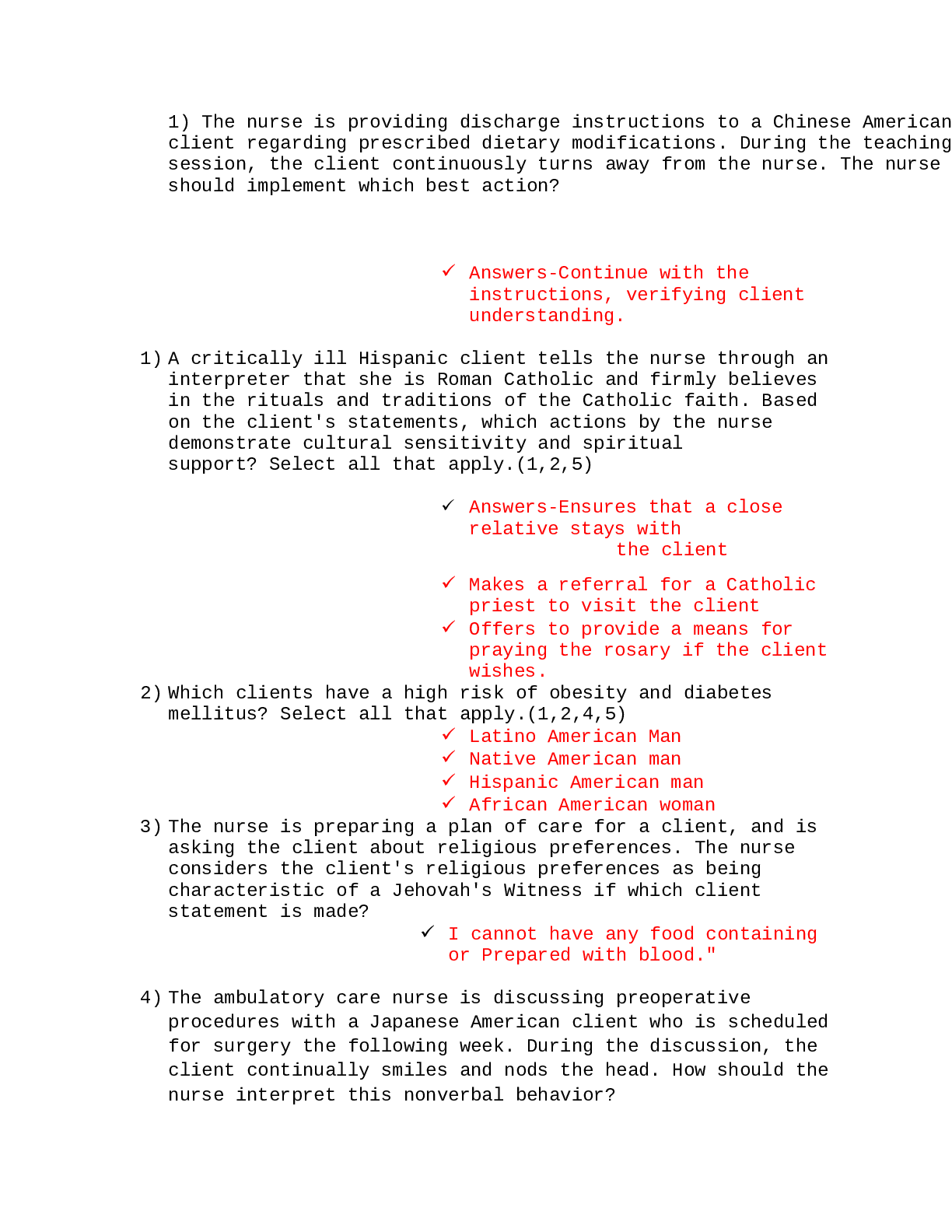
Buy this document to get the full access instantly
Instant Download Access after purchase
Buy NowInstant download
We Accept:

Reviews( 0 )
$15.00
Can't find what you want? Try our AI powered Search
150
0
Document information
Connected school, study & course
About the document
Uploaded On
Nov 08, 2022
Number of pages
183
Written in
All

Additional information
This document has been written for:
Uploaded
Nov 08, 2022
Downloads
0
Views
150