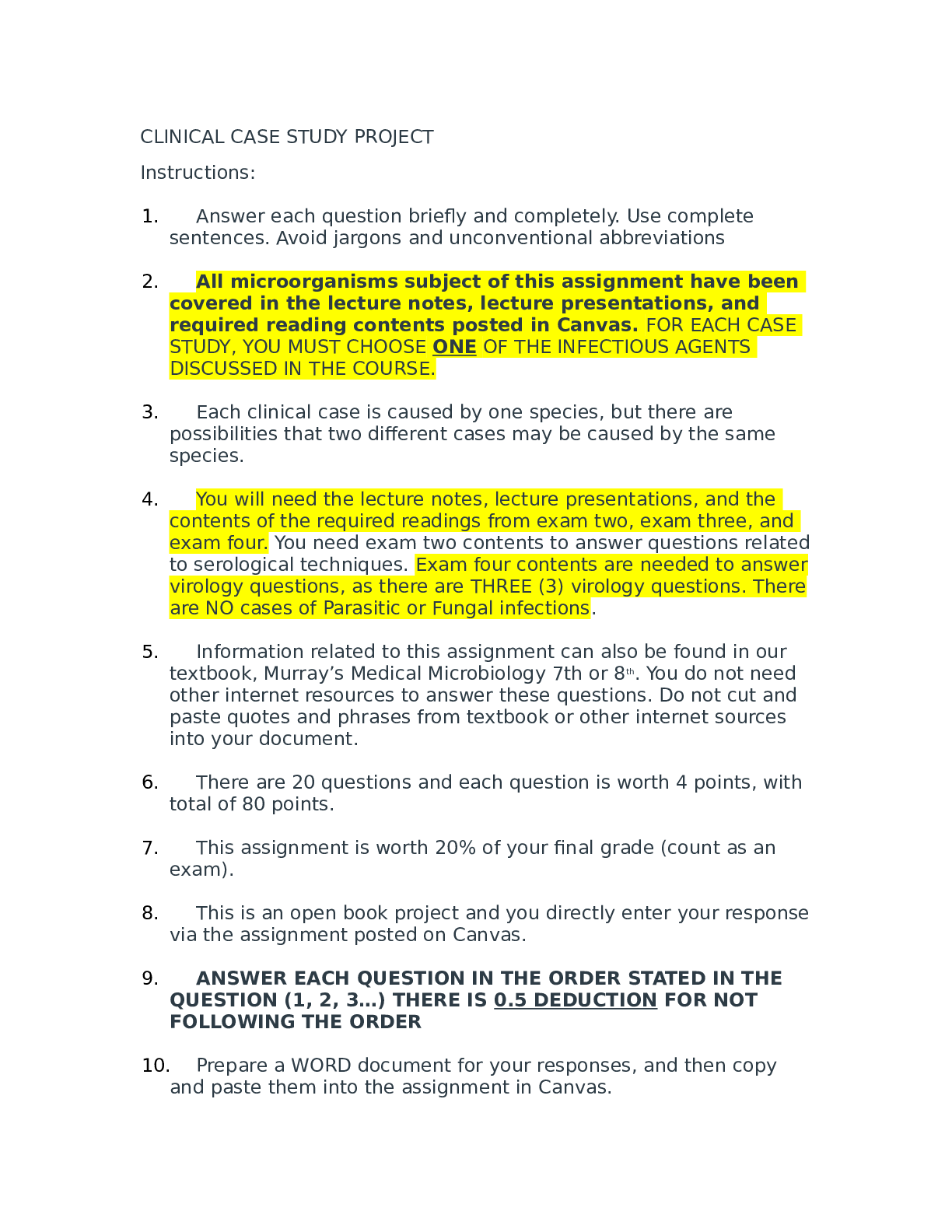
CLINICAL CASE STUDY PROJECT
Instructions:
1. Answer each question briefly and completely. Use complete
sentences. Avoid jargons and unconventional abbreviations
2. All microorganisms subject of this assignment have
...
CLINICAL CASE STUDY PROJECT
Instructions:
1. Answer each question briefly and completely. Use complete
sentences. Avoid jargons and unconventional abbreviations
2. All microorganisms subject of this assignment have been
covered in the lecture notes, lecture presentations, and
required reading contents posted in Canvas. FOR EACH CASE
STUDY, YOU MUST CHOOSE ONE OF THE INFECTIOUS AGENTS
DISCUSSED IN THE COURSE.
3. Each clinical case is caused by one species, but there are
possibilities that two different cases may be caused by the same
species.
4. You will need the lecture notes, lecture presentations, and the
contents of the required readings from exam two, exam three, and
exam four. You need exam two contents to answer questions related
to serological techniques. Exam four contents are needed to answer
virology questions, as there are THREE (3) virology questions. There
are NO cases of Parasitic or Fungal infections.
5. Information related to this assignment can also be found in our
textbook, Murray’s Medical Microbiology 7th or 8th. You do not need
other internet resources to answer these questions. Do not cut and
paste quotes and phrases from textbook or other internet sources
into your document.
6. There are 20 questions and each question is worth 4 points, with
total of 80 points.
7. This assignment is worth 20% of your final grade (count as an
exam).
8. This is an open book project and you directly enter your response
via the assignment posted on Canvas.
9. ANSWER EACH QUESTION IN THE ORDER STATED IN THE
QUESTION (1, 2, 3…) THERE IS 0.5 DEDUCTION FOR NOT
FOLLOWING THE ORDER
10. Prepare a WORD document for your responses, and then copy
and paste them into the assignment in Canvas.
11. You will have unlimited and unrestricted access to this
assignment till the due date. DO NOT PRESS SUBMIT UNTILL YOU
ARE DONE AND READY TO SUBMIT YOUR WORK. THIS ACTION IS
IRREVERSIBLE.
This assignment opens on June 6th, and it is due by midnight
Monday June 18th. Absolutely no late submission is accepted.
1. A 20-year old male student is brought by his girlfriend to the
emergency department of a local hospital. Upon physical
examination, the patient is found obtunded, has a temperature
of 39 o C, a blood pressure of 104/52 mm Hg, and a heart rate
of 148 bpm. He has a stiff neck and generalized petechial rash
with two areas of purpura. CSF is collected. The opening
pressure is 180 mm H2O. WBC’s 4300/mm3 with 91%
neutrophils, glucose is 10 mg/dl, and protein is 755 mg/dl. A
gram stain and culture of CSF is performed, with Gram stain
indicating Gram negative cocci.
1. Which organism is most likely responsible for this patient?
1. The causative agent for this case study is Neisseria meningitidis.
2. Explain your answer and list the characteristics given above that drive you to
your chosen answer.
1. Based off the age of the student one can assume he is a college student
and has contracted a meningitis infection either through Neisseria
meningitides or Streptococcus pneumoniae. Gram staining of CSF result
is more consistent with N. meningitidis. Symptoms of stiff neck,
petechial rash and purpura is consistent with this organism with the
development of inflamed spinal meninges (meningococcemia).
2. A 6-month-old girl is taken to emergency department in
January suffering from profuse watery diarrhea and vomiting.
She has had a low-grade fever for 48 hours and appears to be
dehydrated. The suspected cause of the diarrhea is an
icosahedral virus that has a double capsid and a double�stranded RNA genome. Which virus caused this disease? Is
there a vaccine available for this infection? Explain your
answer.
-Based on the timeframe, profuse watery diarrhea, low-grade fever and age the
patient is infected with Rotavirus. This virus is a frequent cause of childhood diarrhea
that can lead to death due to dehydration because of the excessive diarrhea and vomiting
experiences. Rotavirus is a icosahedral, double capsule, double-stranded RNA virus that
fits the description mentioned above. There are two currently available vaccines for the
specific viral infection.
3. Approximately 4 h after eating at a family picnic, three
people develop nausea and abdominal cramps, followed by
severe diarrhea and vomiting shortly after the onset of the
initial symptoms. None of them had fever. Within 24 h, the ill
family members have recovered from their illness.
1. Which toxin is most likely responsible for this illness?
1. Staphylococcal enterotoxin type A
2. What type of toxin is this?
1. Preformed, Heat-stable, enterotoxin
4. 6-year old Jane has been in and out of doctor’s office for the
last six month. She has been suffering from a recurring otitis
media and has been on antibiotics most of this time. Several
days ago her mother took her to the pediatrician for diarrhea.
The pediatrician prescribed new antibiotic, electrolytes, oral
rehydration, and send her home. Her condition worsened over
time. She was rushed to the emergency department suffering
from nausea, bloody diarrhea, and abdominal cramping and
pain. The attending doctor collected stool sample and send it
for laboratory analysis. She immediately discontinued the use
of antibiotics and prescribed electrolytes and oral re�hydration. She says she suspect colitis, but she will take
proper action once she receives the laboratory analysis of the
stool sample?
[Show More]
, Questions and Answers, All Correct Study Guide, Download to Score A.png)