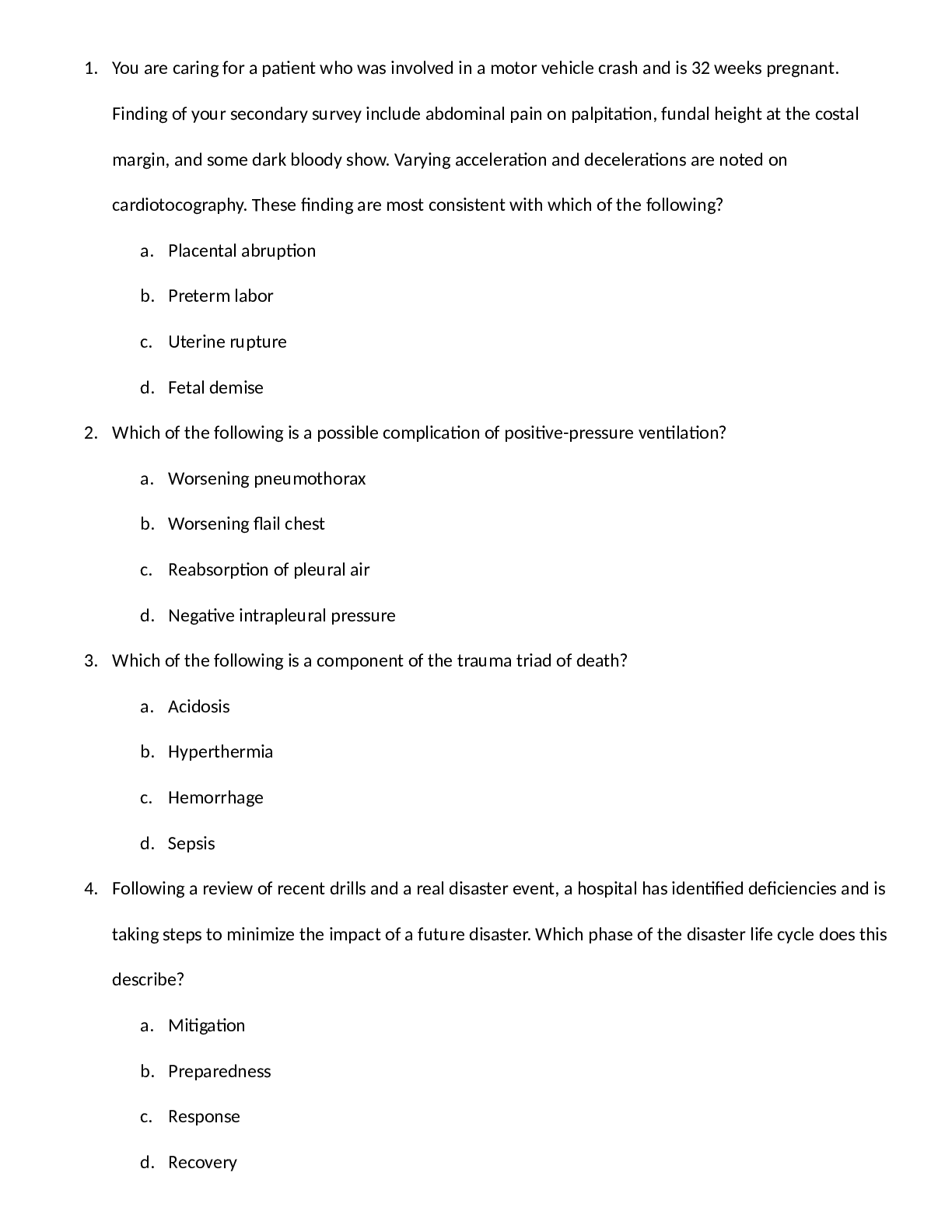
Which of the following signs is LEAST reliable for diagnosing esophageal
intubation?
a Symmetrical chest wall movement
b End tidal CO2 presence by colorimetry
c Bilateral breath sounds
d Oxygen saturation >92%
e ET
...
Which of the following signs is LEAST reliable for diagnosing esophageal
intubation?
a Symmetrical chest wall movement
b End tidal CO2 presence by colorimetry
c Bilateral breath sounds
d Oxygen saturation >92%
e ETT above carina on chest x-ray
2. Which one of the following signs necessitates a definitive airway in severe
trauma patients?
a Facial lacerations
b Repeated vomiting
c Severe maxillofacial fractures
d Sternal fracture
e GCS score of 12
3. Twenty seven patients are seriously injured in an aircraft crash at a local
airport. The principles of triage include:
a Establish a triage site within the internal perimeter of the crash site
b Treat only the most severely injured patients first
c Immediately transport all patients to the nearest hospital
d Treat the greatest number of patients in the shortest period of time
e Produce the greatest number of survivors based on available
resources
4. Which one of the following statements is correct?
a Cerebral contusions may coalesce to form an intracerebral
hematoma
b Epidural hematomas are usually seen in frontal region
c Subdural hematomas are caused by injury to the middle meningeal
artery
d Subdural hematomas typically have a lenticular shape on CT scan
e The associated brain damage is more severe in epidural hematomas
5. An 18 year old male is brought to the emergency department after having
been shot. He has one bullet wound just below the right clavicle and
another just below the costal margin in the right posterior axillary line. His
BP is 110/60 mmHg, HR is 90 bpm, and RR is 34 bpm. After ensuring a
patent airway and inserting 2 large caliber iv line, the next appropriate step
is to:
a Obtain a portable chest x-ray
b Administer a bolus of additional iv fluid
c Perform a laparotomy
d Obtain an abdominal CT scan
e Perform diagnostic peritoneal lavage
6. An 8 year old boy falls 4,5 meters (15 feet) from a tree and is brought to the
emergency department by his family. His vital signs are normal, but he
complains of left upper quadrant pain. An abdominal CT scan reveals a
moderately severe laceration of the spleen. The receiving institution does
not have 24 hour a day operating room capabilities. The most appropriate
management of this patient would be:
a Type and crossmatch for blood
b Request consultation of a pediatrician
c Transfer the patient to a trauma center
d Admit the patient to the ICU
e Prepare the patient for surgery the next day
7. A 17 year old helmeted motorcyclist is struck broadside by an automobile
at an intersection. He is unconscious at the scene with a BP of 140/90
mmHg, HR of 90 bpm, and RR of 22 bpm. His respirations are sonorous and
deep. His GCS score is 6. Immobilization of the entire patient may include
the use of all the following, except:
a Air splints
b Bolstering devices
c ...
d ...
e ...
8. A construction worker falls from a scaffold and is transferred to the
emergency department. His HR is 124 bpm and BP is 85/60 mmHg. He
complains of lower abdominal pain. After assessing the airway and chest,
immobilizing the c-spine and initiating fluid resuscitation, the next step is to
perform:
a FAST exam
b Detailed neurological exam
c Rectal exam
d Cervical spine x-ray
e Urethral catheterization
9. A 22 year old male sustains a shotgun wound to the left shoulder and chest
at close range. His BP is 80/40 mmHg and his HR is 130 bpm. After 2 liters of
crystalloid solution are rapidly infused, his BP increases to 122/84 mmHg,
and HR decreases to 100 bpm. He is tachypneic with RR of 28 bpm. On
physical examination, his breath sounds are decreased at the left upper
chest with dullness on percussion. A large caliber (36 french) tube
thoracostomy is inserted in the fifth intercostal space with the return of
200 ml of blood and no air leak. The most appropriate next step is to:
a Insert a folley catheter
b Begin to transfuse o-negative blood
c Perform thoracotomy
d Obtain a CT scan of the chest and abdomen
e Repeat the physical examination of the chest
10. Which one of the following statements concerning spine and spinal cord
trauma is true?
a A normal lateral c-spine film excludes injury
b A vertebral injury is unlikely in the absence of physical findings of a
cord injury
c A patient with a suspected spine injury requires immobilization on a
short spine
d Diaphragmatic breathing in an unconscious patient who has fallen is
a sign of spine injury
e Determination of whether a spinal cord lesion is complete or
incomplete must be made in the primary survey
11. A 20 year old athlete is involve in a motorcycle crash. When he arrives in
the emergency department, he shouts that he cannot move his legs. On
physical examination, there are no abnormalities of the chest, abdomen or
pelvis. The patient has no sensation in his legs and cannot move them, but
his arms are moving. The patient’s RR is 22 bpm, HR is 88 bpm, and BP is
80/60 mmHg. He is pale and sweaty. What is the most likely cause of this
condition?
a Neurogenic shock
b Cardiogenic shock
c Abdominal hemorrhage
d Myocardial contusion
e Hyperthermia
12. A 28 year old male is brought to the emergency department. He was
involved in a flight in which he was beaten with a wooden stick. His chest
shows multiple severe bruises. His airway is clear, RR is 22 bpm, HR is 126
bpm, and SBP is 90 mmHg. Which of the following should be performed
during the primary survey?
a GCS
b Cervical spine x-ray
c TT administration
d Blood alcohol level
e Rectal exam
13. Which one of the following statements is true regarding access in pediatric
resuscitation?
a Intraosseous access should only be considered after five
percutaneous attempts
b Cut down at the ankle is a preferred initial access technique
c Blood transfusion can be delivered through intraosseous access
d Internal jugular cannulation is the next preferred opinion when
percutaneous venous access fails
e Intraosseous cannulation should be first choice for access
14. A 23 year old male is stabbed below the right nipple. He is alert, and his
oxygen saturation is 98%. Chest tube was placed for treatment of
hemopneumothorax. BP is 90/60 mmHg after administration of 1 L of
crystalloid solution. What is the next step in treatment?
a Re-examine the chest
This study source was downloaded by 100000823742721 fr
2
b Place a left-sided chest tube
c Insert central venous catheter
d Perform CT scan of the abdomen and pelvis
e Prepare for urgent thoracotomy
15. You are treating a trauma patient and attempt a definitive airway by
intubation. However, the vocal cords are not visible. What tool would be
the most valuable for achieving successful intubation?
a Gum elastic bougie
b Lateral cervival spine x-ray
c Nasopharyngeal airway
d Oxygen
e Laryngeal mask airway
16. A 79 year old female is involved in a motor vehicle crash and presents to
the emergency department. She is on Coumadin and a beta blocker. Which
of the following statements is true concerning her management?
a The risk of subdural hemorrhage is decreased
b Absence of tachycardia indicates that the patient is
hemodynamically normal
c Non-operative management of abdominal injuries is more likely to
be successful in older adults than in younger patients
d Vigorous fluid resuscitation may be associated with
cardiorespiratory failure
e Epinephrine should be infused immediately for hypotension
17. A 22 year old male is brought by ambulance to a small community hospital
after falling from the top of a 2,4 meter (8 foot) ladder. Initially, he was
found to have a large right pneumothorax. A chest tube was inserted and
connected to an underwater seal drainage collection system with negative
pressure. A repeat AP portable chest x-ray demonstrates a residual, large
right pneumothorax. After transferring the patient to a verified trauma
center, a third chest x-ray reveals a persistent right penumothorax. The
chest tube appears to be functioning and in good position. He remains
hemodynamically normal with no signs of respiratory distress. The most
likely cause for his persistent right pneumothorax is:
a Flail chest
b Diaphragmatic injury
c Pulmonary contusion
d Esophageal perforation
e Tracheobronchial injury
18. A 22 year old female who is 6 months pregnant presents following a motor
vehicle crash. Paramedics report vaginal bleeding. What is the initial step in
her treatment?
a Assess fetal heart sounds
b Check for fetal movement
c Perform inspection of the cervix
d Ask the patient what her name is
e Insert a werdge under the patient’s right hip
19. Which of the following statements is true?
a The laryngeal mask airway is an infraglottic device
b The multilumen esophageal airway occludes the supraglottic lumen
and ventilates through the port placed distal to the vocal cords
c The nasopharyngeal airway is an ideal supraglottic device for
patients with cribiform plate fractures
d Nasotracheal tubes position a cuffed airway in the infraglottic space
e Tracheostomy tubes are placed in apneic, hypoxic patients in the
supraglottic space
20. A 40 year old male is brought to the emergency department after a fall
from a height of just over 3 meters (10 feet). His airway is clear, RR is 28
bpm, and SBP is 140 mmHg. There is equal air entry on both sides of the
chest with comparable percussion sounds bilaterally. He complains of pain
on palpation of the chest. Which intervention is most likely needed?
a Needle decompression of the chest
b Pericardiocentesis
c Pain management
d Thoracotomy
e Tube thoracotomy
21. The most common acid base disturbance encountered in injured pediatric
patients is caused by:
a Hemorrhage
b Changes in ventilation
c Renal failure
d Injudicious bicarbonate administration
e Insufficient sodium chloride administration
22. A 17 year old female is brought to the emergency department following a 2
meters (6 feet) fall onto concrete. She is unresponsive and found to have a
RR 0f 32 bpm, BP 90/60 mmHg, and HR of 68 bpm. The first step in
treatment is:
a Administering vasopressors
b Establishing iv access for drug assisted intubation
c Seeking the cause of her decreased level of consciousness
d Applying oxygen and maintaining airway
e Excluding hemorrhage as a cause of shock
23. A 25 year old male is brought to the emergency department following a bar
fight. He has an altered of conciousness, open his eyes on command,
moans without forming, discernible words, and localizes to painful stimuli.
Which one of the following statements concerning this patient is true?
a Hyperoxia should be avoided
b CT scanning is an important part of neurological assessment
c Mandatory intubation to protect his airway is required
d His GCS suggests a severe head injury
e His level of consciousness can be solely attributed to elevated blood
alcohol
24. Which one of the following statements regarding genitourinary injuries is
true?
a Urethral injuries are associated with pelvic fractures
b All patients with microscopic hematuria require evaluation of
genitourinary tract
c Patient presenting with gross hematuria and shock will have a major
renal injury as the source of hemorrhage
d Intraperitoneal bladder injuries are usually managed definitively
with a urinary catheter
e Urinary catheters should be placed in all patients with pelvic
fractures during the primary survey
25. Which one of the following physical finding does not suggest spinal cord
injury as the cause of hypotension?
a Priapism
b Bradycardia
c Distended neck veins
d Diaphragmatic breathing
e Ability to flex forearms but inability to extend them
26. Cardiac tamponade:
a Requires surgical intervention
b Is definitively managed by needle pericardiocentesis
c Is easily diagnosed by discovery of Beck’s triad in the emergency
department
d Is indicated by Kussmaul breathing
e Is most common with blunt thoracic trauma and anterior rib
fractures
27. A 6 month old infant, being held in her mother’s arms, is ejected on impact
from a vehicle that is struck head on by an oncoming car travelingat 64 kph
(40 mph). The infant arrives in the emergency department with multiple
facial injuries, is lethargic, and is in severe respiratory distress. Respiratory
supoort is not effective using a bag mask device, and her oxygen saturation
is falling. Repeated attempts at orotracheal intubation are unsuccessful.
The most appropriate procedure to perform next is:
a Perform needle cricothyroidotomy with jet insufflation
b Administer heliox and racemic epinephrine
c Perform nasotracheal intubation
d Perform surgical cricothyroidotomy
e Repeat orotracheal intubation
28. Which one of the following injuries is addressed in the
[Show More]