Evaluate patients with psychosocial health conditions
Develop differential diagnoses for patients with psychosocial health
conditions
Develop treatment plans for patients with psychosocial health conditions
Gener
...
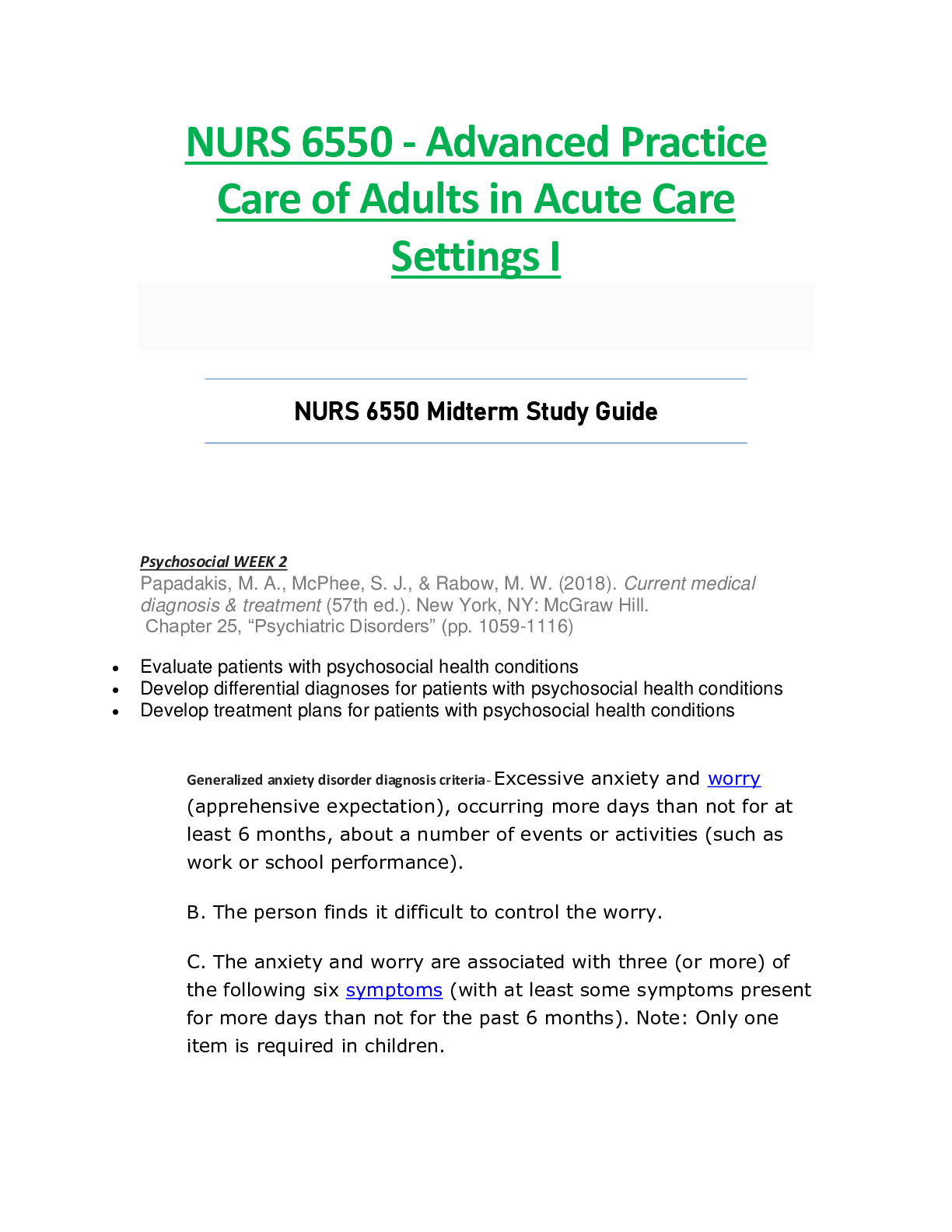
Evaluate patients with psychosocial health conditions
Develop differential diagnoses for patients with psychosocial health
conditions
Develop treatment plans for patients with psychosocial health conditions
Generalized anxiety disorder diagnosis criteria- Excessive anxiety and worry
(apprehensive expectation), occurring more days than not for at
least 6 months, about a number of events or activities (such as
work or school performance).
B. The person finds it difficult to control the worry.
C. The anxiety and worry are associated with three (or more) of
the following six symptoms (with at least some symptoms present
for more days than not for the past 6 months). Note: Only one
item is required in children.
(1) restlessness or feeling keyed up or on edge
(2) being easily fatigued
(3) difficulty concentrating or mind going blank
(4) irritability
(5) muscle tension
(6) sleep disturbance (difficulty falling or staying asleep, or
restless unsatisfying sleep)
Primary neurotransmitter in PTSD- Due to the traumatic stress of PTSD victims, the
neurotransmitters that fuel the sympathetic versus parasympathetic system get out
of balance. As a Yale University journal review states, “It has been suggested that
alterations in NE [norepinephrine], E [epinephrine], and 5-HT [5HTP] may have
relevance for symptoms commonly seen in survivors with PTSD
* PTSD diagnosis and treatment-assessing history of exposure to a perceived or actual
life threatening event, serious injury or sexual violence, symptoms lasting more than 1
month. Disturbance causes clinically significant distress or impairment in functioning
H) The disturbance is not attributable to the physiological effects of a substance or other
medical condition
DSM-5 recognizes a “with dissociative symptom” specifier when the PTSD symptoms
are accompanied by persistent or recurrent depersonalization or derealization.
The specifier “with delayed expression” should be included if the full criteria for PTSD
are not met for more than 6 months following the trauma.
The traumatic event is persistently re-experienced:
Nightmares
Intrusive thoughts of the traumatic event
Flashbacks
Marked emotional distress when exposed to traumatic reminders
Strong physiologic reaction when exposed to traumatic reminders
Treatment psychotherapy (cognitive processing, prolonged exposure therapy, eyemovement desensitizing) . SSRIs (sertraline, paroxetine) clonidine 0.1mg at bed time,
prazosin 2-10mg for nightmare, antiseizure meds for anger management (carbamazepine
400-800mg daily), clonazepam 1-4mg daily for anxiety, Trazodone 25-100mg for sleep.
Treatment of acute panic attacks- What are the medications for initial/first line
therapy- SL 0.5-1 mg alprazolam, clonazepam 0.5-1mg, antidepressants, SSRIs (sertraline 25mg/day for
1 week, then 50mg)
Inpatient treatment of depression- ECT
o What are the therapies for patient’s that won’t eat, take meds, etc.
When is serotonin norepinephrine reuptake inhibitor indicated, when is it
contraindicated? For pain neuropathy/fibromyalgia
Venlafaxine dosing, when is follow up? What are you monitoring? - Blood pressure monitoring,
arrhythmias DOSE is 150-225 mg daily. Patients should be cautioned about the concomitant
use of Venlafaxine tabletsand NSAIDs, aspirin, warfarin, or other drugs that affect
coagulation since combined use of psychotropic drugs that interfere with serotonin
reuptake and these agents has been associated with an increased risk of bleeding
(see PRECAUTIONS,Abnormal Bleeding).
Usual Adult Dose for Anxiety
Extended release:
Initial dose: 75 mg orally once a day
Maintenance dose: May increase in daily increments of 75 mg orally at intervals of no
less than 4 days
Maximum dose: 225 mg orally per day
Usual Adult Dose for Panic Disorder
Extended release:
Initial dose: 37.5 mg orally once a day
Maintenance dose: May increase dose in daily increments of 75 mg orally at intervals
of no less than 7 days
Maximum dose: 225 mg orally per day
Usual Adult Dose for Depression
Immediate release:
Initial dose: 37.5 mg orally twice a day or 25 mg orally 3 times a day
Maintenance dose: May increase in daily increments of up to 75 mg orally at intervals
of no less than 4 days
Maximum dose: (moderately depressed outpatients): 225 mg orally per day
Maximum dose (severely depressed inpatients): 375 mg orally per day
Comments:
-Daily dosage may be divided in 2 or 3 doses/day
Endogenous depression pathophysiology is best described as?
Endogenous depression. Endogenous depression (melancholia) is an
atypical sub-class of the mood disorder, major depressive disorder (clinical
depression). Endogenous depression occurs due to the presence of an
internal (cognitive, biological) stressor instead of an external (social,
environmental) stressor. No apparent outside cause.
Exogenous is caused by something (stress, some event)
Differences between panic attacks and panic disorder? Panic attacks are recurrent,
unpredicted episodes of intense surges of anxiety accompanied by marked physical manifestations. Panic
Disorder
Someone with generalized anxiety disorder (GAD) has chronic anxiety, and a tendency to become overanxious about issues which would not normally cause concern. Panic disorder is characterized by repeated
episodes of panic attacks, in which the individual is overcome by feelings of fear and dread.
What are Major Depressive disorder symptoms?- physical & cognitive symptoms, loss of
interest and pleasure(anhedonia) withdrawal from activities and guilt, poor concentration, worthlessness,
fatigue
Identify the primary neurotransmitter in PTSD
PTSD diagnosis and treatment, meds (families/common meds)?
Familiarize yourself with the side effects of Lithium- GI, tremors-treat with propranolol 20-
60mg a day, weakness, somnolence, polyuria (reduced renal response ADH) , polydipsia (increased plasma
renin concentration), thyroid, EKG changes, long term effects cogwheel rigidity, affect
Common adverse effects of atypical antipsychotics- anticholinergic side effects dry
mouth which can cause increases caloric liquid intake (wt gain & hyponatremia) blurred
vision, urinary retention, delayed gastric emptying, esophageal reflux, ileus, delirium,
acute glaucoma, sexual disturbances, and orthostatic hypotension, EKG changes
prolonged QT
Mental status changes in elderly… how do you evaluate?
Mental status changes related to UTI in elderly
Assessment of Delirium in geriatric patients- Acute onset, fluctuating course, deficits in
attention not memory.
Elders with dementia and driving – there is no gold standard assessment, consider the
severity of the dementia ( severe should not drive), consider comorbidities and
medications, ability to do IADLS, , may need to be assessed by a driver rehab specialist.
Short Confusion Assessment Method (Short CAM): what things are assessed? Acute
onset and fluctuating course, inattention and either disorganized thinking or ALOC.
Types of dementia, know differences?
Alzheimer's disease- Alzheimer's disease
Most common type of dementia; accounts for an estimated 60 to 80 percent of cases.
Symptoms: Difficulty remembering recent conversations, names or events is often an early clinical
symptom; apathy and depression are also often early symptoms. Later symptoms include impaired
communication, poor judgment, disorientation, confusion, behavior changes and difficulty speaking,
swallowing and walking.
Revised guidelines for diagnosing Alzheimer’s were published in 2011 recommending that
Alzheimer’s be considered a slowly progressive brain disease that begins well before symptoms
emerge.
Brain changes: Hallmark abnormalities are deposits of the protein fragment beta-amyloid (plaques)
and twisted strands of the protein tau (tangles) as well as evidence of nerve cell damage and death in
the brain
Vascular dementia- Vascular dementia
Previously known as multi-infarct or post-stroke dementia, vascular dementia is less common as a sole
cause of dementia than Alzheimer’s, accounting for about 10 percent of dementia cases.
Symptoms: Impaired judgment or ability to make decisions, plan or organize is more likely to be the
initial symptom, as opposed to the memory loss often associated with the initial symptoms of
Alzheimer's. Occurs from blood vessel blockage or damage leading to infarcts (strokes) or bleeding in
the brain. The location, number and size of the brain injury determines how the individual's thinking
and physical functioning are affected.
Brain changes: Brain imaging can often detect blood vessel problems implicated in vascular
dementia. In the past, evidence for vascular dementia was used to exclude a diagnosis of Alzheimer's
disease (and vice versa). That practice is no longer considered consistent with pathologic evidence,
which shows that the brain changes of several types of dementia can be present simultaneously. When
any two or more types of dementia are present at the same time, the individual is considered to have
mixed dementia
Dementia with Lewy bodies (DLB)- Dementia with Lewy bodies (DLB) back to top
Symptoms: People with dementia with Lewy bodies often have memory loss and thinking problems
common in Alzheimer's, but are more likely than people with Alzheimer's to have initial or early
symptoms such as sleep disturbances, well-formed visual hallucinations, and slowness, gait imbalance
or other parkinsonian movement features.
Brain changes: Lewy bodies are abnormal aggregations (or clumps) of the protein alpha-synuclein.
When they develop in a part of the brain called the cortex, dementia can result. Alpha-synuclein also
aggregates in the brains of people with Parkinson's disease, but the aggregates may appear in a pattern
that is different from dementia with Lewy bodies.
The brain changes of dementia with Lewy bodies alone can cause dementia, or they can be present at
the same time as the brain changes of Alzheimer's disease and/or vascular dementia, with each
abnormality contributing to the development of dementia. When this happens, the individual is said to
have mixed dementia.
Mixed dementia- Mixed dementia
In mixed dementia abnormalities linked to more than one cause of dementia occur simultaneously in
the brain. Recent studies suggest that mixed dementia is more common than previously thought.
Brain changes: Characterized by the hallmark abnormalities of more than one cause of dementia —
most commonly, Alzheimer's and vascular dementia, but also other types, such as dementia with Lewy
bodies.
Parkinson's disease- Parkinson's disease
As Parkinson's disease progresses, it often results in a progressive dementia similar to dementia with
Lewy bodies or Alzheimer's.
Symptoms: Problems with movement are common symptoms of the disease. If dementia develops,
symptoms are often similar to dementia with Lewy bodies.
Brain changes: Alpha-synuclein clumps are likely to begin in an area deep in the brain called the
substantia nigra. These clumps are thought to cause degeneration of the nerve cells that produce
dopamine.
[Show More]









.png)

.png)