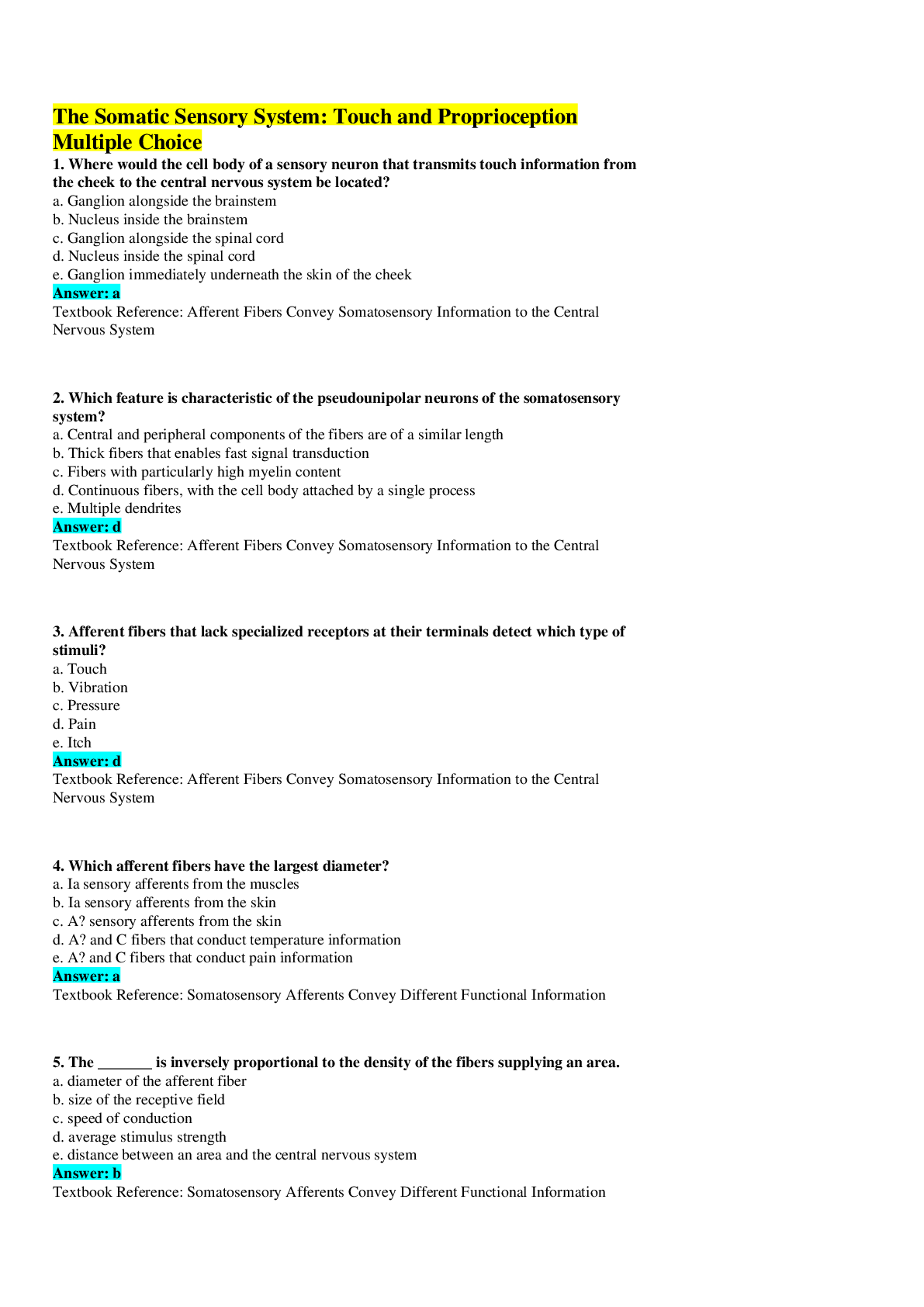
7. Rapidly adapting fibers are most likely to provide information about the _______ of a
stimulus.
a. shape
b. weight
c. texture
d. movement
e. temperature
Answer: d
Textbook Reference: Somatosensory Afferents Co
...
7. Rapidly adapting fibers are most likely to provide information about the _______ of a
stimulus.
a. shape
b. weight
c. texture
d. movement
e. temperature
Answer: d
Textbook Reference: Somatosensory Afferents Convey Different Functional Information
8. Which type of somatosensory afferents transmit information from touch mechanoreceptors to the central nervous system?
a. Ia
b. II
c. Aβ
d. Aδ
e. C
Answer: c
Textbook Reference: Somatosensory Afferents Convey Different Functional Information
9. Which afferents have the highest spatial resolution?
a. Merkel afferents
b. Meissner afferents
c. Pacinian afferents
d. Ruffini afferents
e. Pain afferents
Answer: a
Textbook Reference: Mechanoreceptors Specialized to Receive Tactile Information
10. Meissner afferents account for about _______ of the mechanosensory innervation of
the human hand.
a. 10%
b. 25%
c. 40%
d. 75%
e. 90%
Answer: c
Textbook Reference: Mechanoreceptors Specialized to Receive Tactile Information
11. Merkel afferent fibers convey information about which variable(s)?
a. Motion detection
b. Temperature
c. Proprioception
d. Shape and texture
e. Subtle vibrations
Answer: d
Textbook Reference: Mechanoreceptors Specialized to Receive Tactile Information
12. The longitudinal lanceolate endings do not respond to
a. deflection of the hair by strokes on the skin.
b. movement of air over the skin surface.
c. sensual touch.
d. gentle caress.
e. pain.
Answer: e
Textbook Reference: Mechanoreceptors Specialized to Receive Tactile Information
13. A dermatome is an area innervated by
a. fibers of the cells from a single dorsal root ganglion.
b. the axon of a single neuron.
c. fibers from one spinal cord segment.
d. fibers with similar properties.
e. fibers of the cells from a single nucleus in the brain stem.
Answer: a
Textbook Reference: Clinical Applications: Dermatomes
14. Which component of the musculoskeletal system is responsible for force-production?
a. Muscle spindle
b. Intrafusal muscle fiber
c. Extrafusal muscle fiber
d. Sensory afferents
e. Connective tissue capsule
Answer: c
Textbook Reference: Mechanoreceptors Specialized for Proprioception
[Show More]