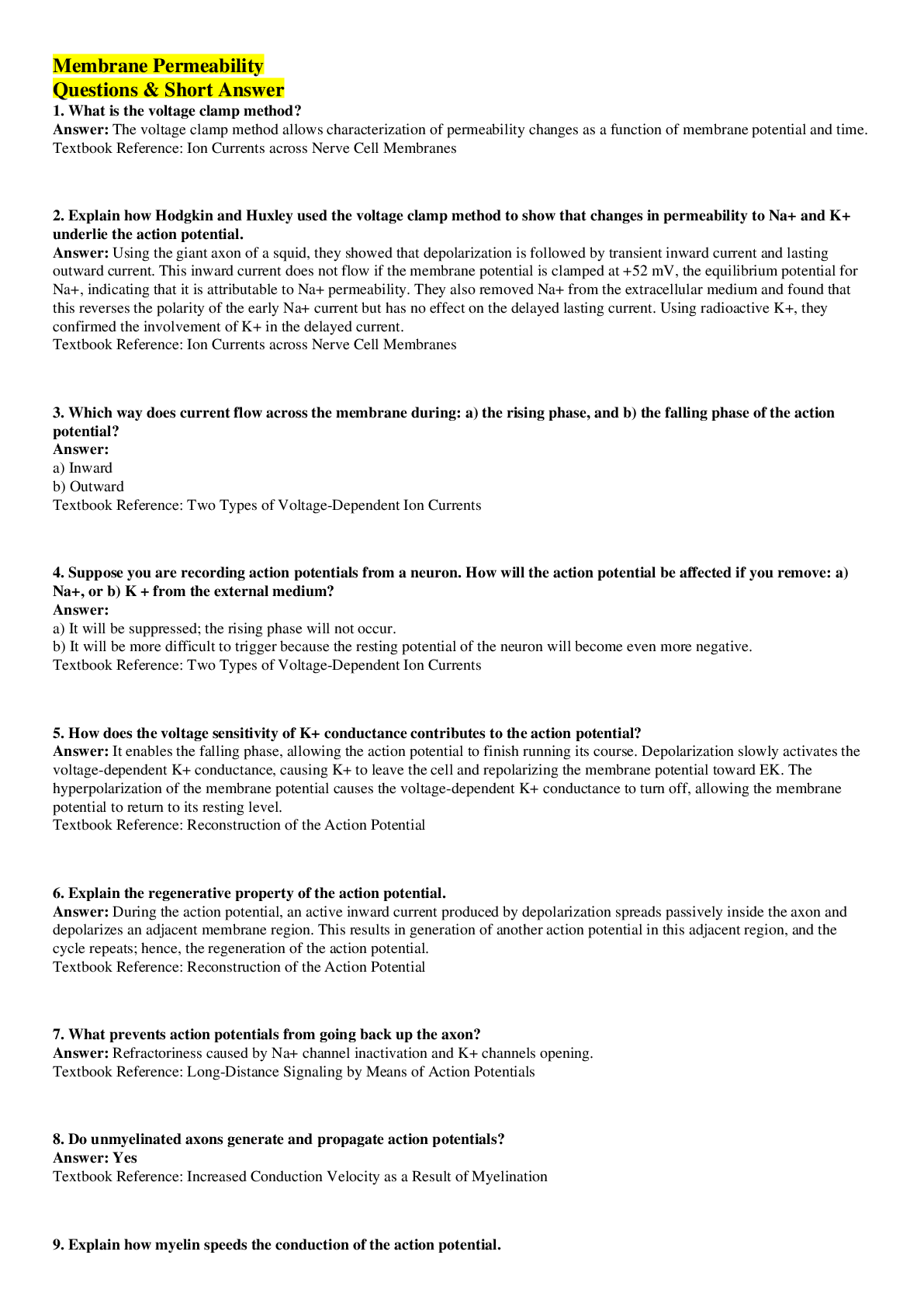
1. What is the voltage clamp method?
Answer: The voltage clamp method allows characterization of permeability changes as a function of membrane potential and time.
Textbook Reference: Ion Currents across Nerve Cell Mem
...
1. What is the voltage clamp method?
Answer: The voltage clamp method allows characterization of permeability changes as a function of membrane potential and time.
Textbook Reference: Ion Currents across Nerve Cell Membranes
2. Explain how Hodgkin and Huxley used the voltage clamp method to show that changes in permeability to Na+ and K+ underlie the action potential.
Answer: Using the giant axon of a squid, they showed that depolarization is followed by transient inward current and lasting outward current. This inward current does not flow if the membrane potential is clamped at +52 mV, the equilibrium potential for Na+, indicating that it is attributable to Na+ permeability. They also removed Na+ from the extracellular medium and found that this reverses the polarity of the early Na+ current but has no effect on the delayed lasting current. Using radioactive K+, they confirmed the involvement of K+ in the delayed current.
Textbook Reference: Ion Currents across Nerve Cell Membranes
3. Which way does current flow across the membrane during: a) the rising phase, and b) the falling phase of the action potential?
Answer:
a) Inward
b) Outward
Textbook Reference: Two Types of Voltage-Dependent Ion Currents
4. Suppose you are recording action potentials from a neuron. How will the action potential be affected if you remove: a) Na+, or b) K + from the external medium?
Answer:
a) It will be suppressed; the rising phase will not occur.
b) It will be more difficult to trigger because the resting potential of the neuron will become even more negative.
Textbook Reference: Two Types of Voltage-Dependent Ion Currents
5. How does the voltage sensitivity of K+ conductance contributes to the action potential?
Answer: It enables the falling phase, allowing the action potential to finish running its course. Depolarization slowly activates the voltage-dependent K+ conductance, causing K+ to leave the cell and repolarizing the membrane potential toward EK. The hyperpolarization of the membrane potential causes the voltage-dependent K+ conductance to turn off, allowing the membrane potential to return to its resting level.
Textbook Reference: Reconstruction of the Action Potential
[Show More]