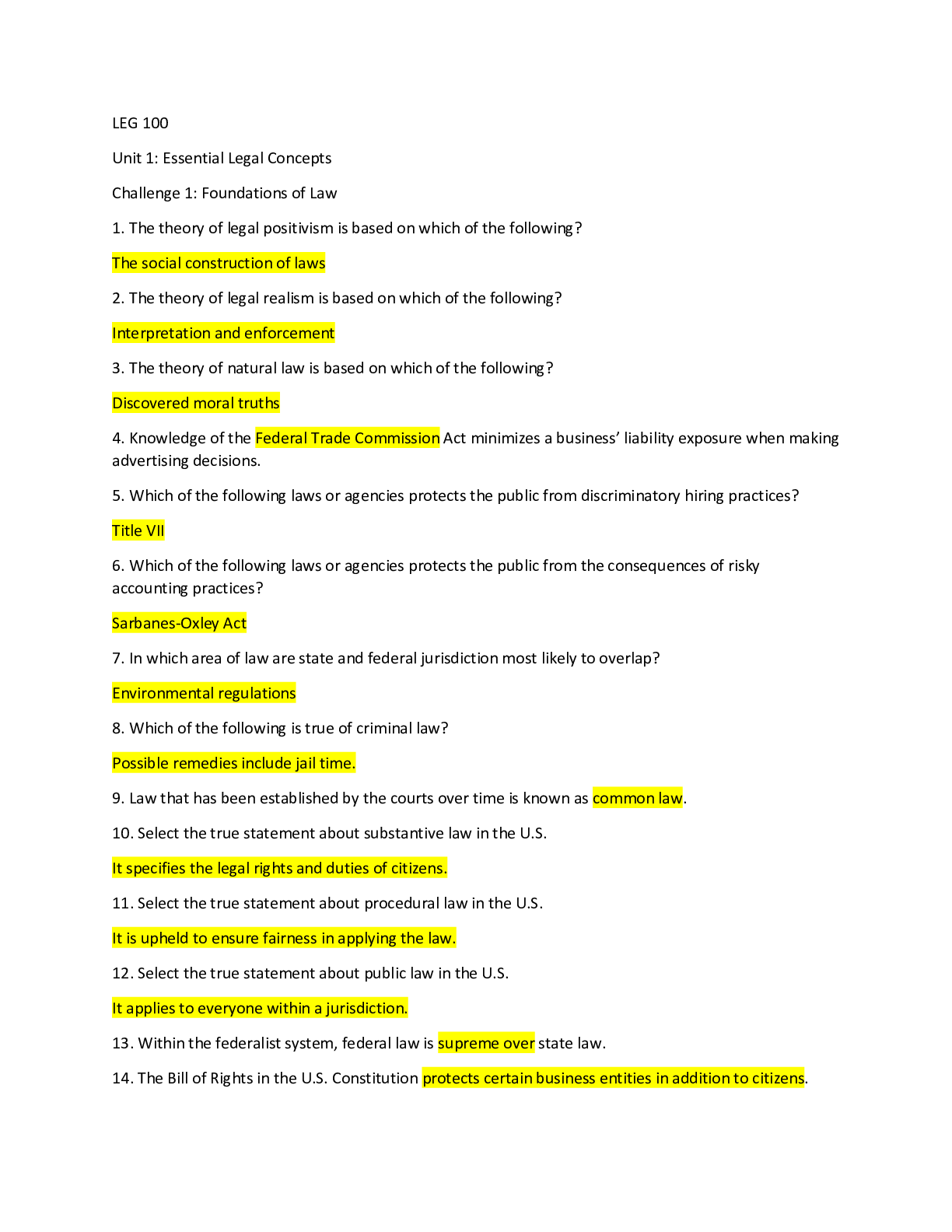
Unit 1: Essential Legal Concepts
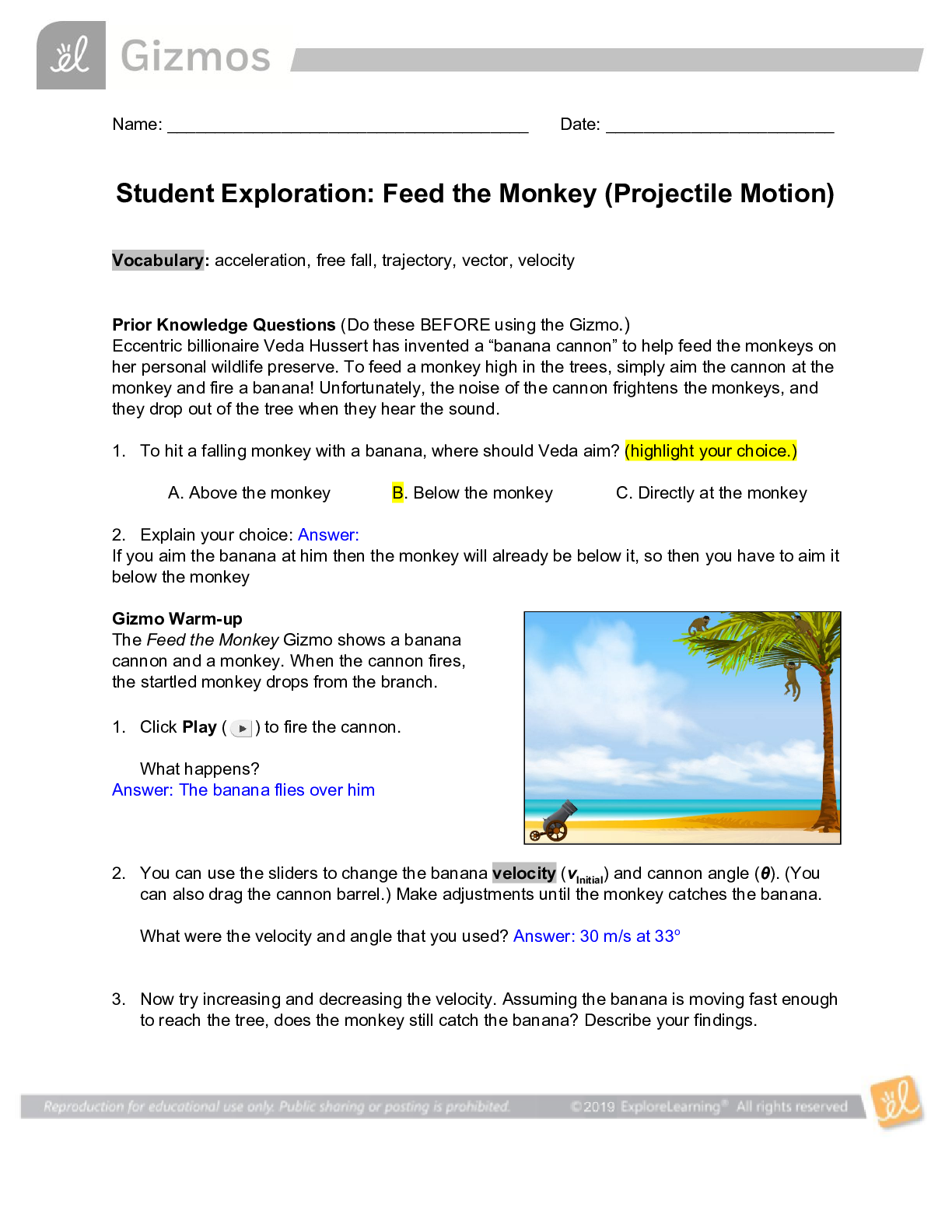
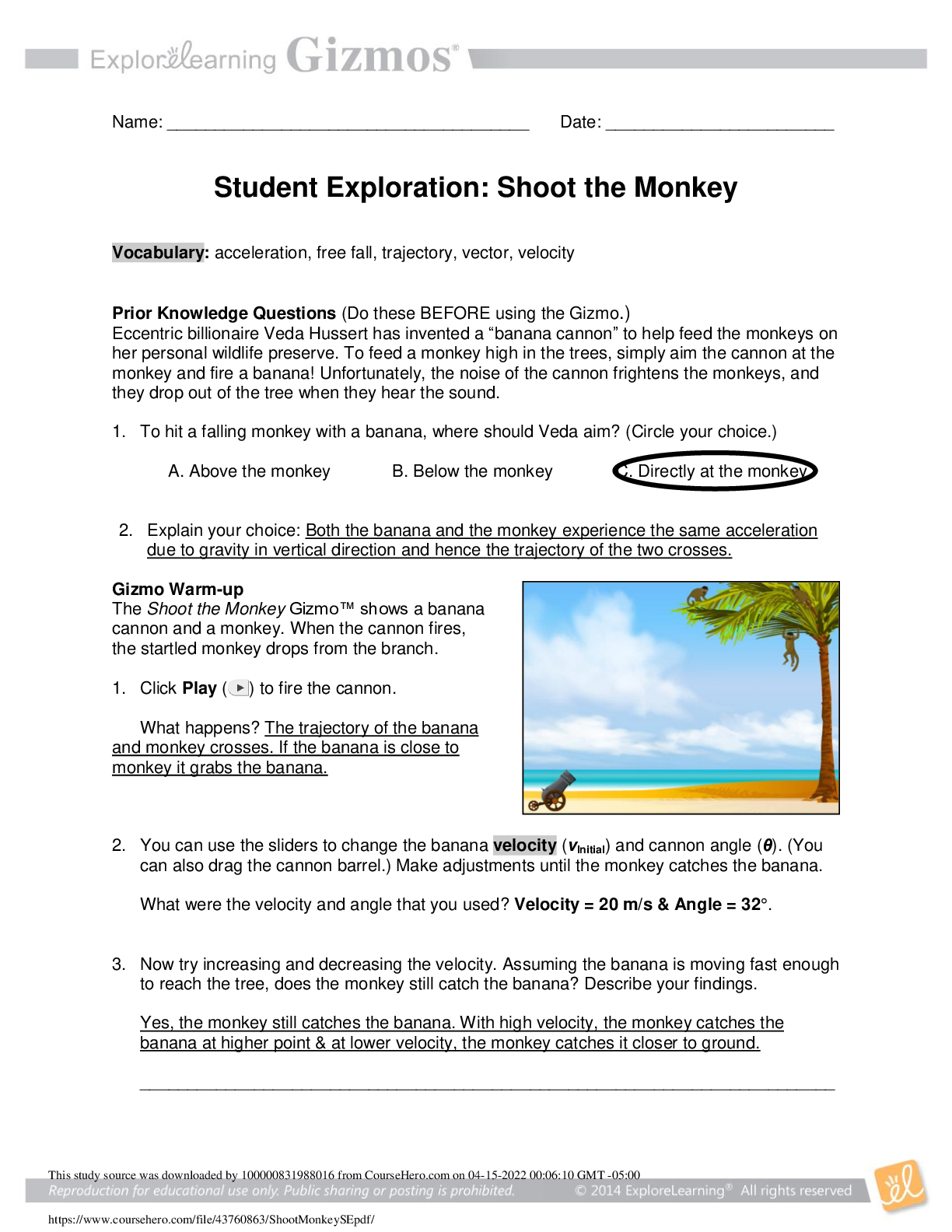
Student Exploration: Feed the Monkey (Projectile Motion) Vocabulary: acceleration, free fall, trajectory, vector, velocity Prior Knowledge Questions (Do these BEFORE using the Gizmo.) Eccentric bil ... lionaire Veda Hussert has invented a “banana cannon” to help feed the monkeys on her personal wildlife preserve. To feed a monkey high in the trees, simply aim the cannon at the monkey and fire a banana! Unfortunately, the noise of the cannon frightens the monkeys, and they drop out of the tree when they hear the sound. 1. To hit a falling monkey with a banana, where should Veda aim? (highlight your choice.) A. Above the monkey B. Below the monkey C. Directly at the monkey 2. Explain your choice: Answer: If you aim the banana at him then the monkey will already be below it, so then you have to aim it below the monkey Gizmo Warm-up The Feed the Monkey Gizmo shows a banana cannon and a monkey. When the cannon fires, the startled monkey drops from the branch. 1. Click Play ( ) to fire the cannon. What happens? Answer: The banana flies over him 2. You can use the sliders to change the banana velocity (vInitial ) and cannon angle (θ). (You can also drag the cannon barrel.) Make adjustments until the monkey catches the banana. What were the velocity and angle that you used? Answer: 30 m/s at 33 o 3. Now try increasing and decreasing the velocity. Assuming the banana is moving fast enough to reach the tree, does the monkey still catch the banana? Describe your findings. Answer: The monkey caught the banana no matter the speed Activity A: Banana catchers Get the Gizmo ready: ● Click Reset ( ). ● Set the initial velocity (vInitial ) to 26.0 m/s. Question: Where should you aim to hit the monkey with a banana? 1. Experiment: Turn on Show target line. Experiment with the Gizmo, trying several different cannon locations and launch angles. Try aiming above, below, and directly at the monkey. A. What always happens when you aim above the monkey’s head? Answer: The monkey does not catch the banana B. What always happens when you aim below the monkey’s feet? Answer: The monkey does not catch the banana C. What always happens when you aim at the monkey’s body? Answer: The monkey catches the banana 2. Predict: How do you think changing the banana velocity will affect your results? Answer: If the velocity is increased then the monkey will not catch the banana 3. Test: Click Reset. Turn on Show grid, and drag the cannon to the point (25, 0.0) on the grid. Aim the cannon at the monkey, and try vInitial values of 15.0, 20.0, 25.0, and 30.0 m/s. How did the banana velocity affect the results of the experiment? Answer: It did not affect the results of the experiment because the monkey caught the banana every time 4. Observe: Click Reset, and turn on Show path. Drag the cannon to (0.0, 16.0) so that it is at the same level as the monkey. Set vInitial to 25.0 m/s, and θ to 0.0 degrees. Click Play. The lines represent the trajectories, or paths, of the banana and monkey. The dots on the lines show positions every 0.15 seconds. Compare the dots for the banana and monkey. A. What do you notice about the height of the dots on each trajectory? Answer: It is going down. B. At any given time, what can you say about the heights of the banana and monkey? Answer: It accelerates Activity B: Velocity vectors Get the Gizmo ready: ● Click Reset, and drag the cannon to the ground. ● Turn off Show grid and Show path. ● You will need a scientific calculator for this activity. Introduction: Velocity is an example of a vector quantity because it describes the speed and direction of an object. The velocity of an object through space can be shown by two components: a horizontal component (vx ) and a vertical component (vy ). Question: How does the velocity of an object change as it flies through space? 1. Observe: Turn on Show velocity components, and set θ to 45.0 degrees. Click Play, and focus on the blue and red arrows that represent the vertical and horizontal components of the banana’s velocity. A. As the banana flies through space, what do you notice about the blue (vertical) arrow? Answer: It goes down after a certain amount of time B. As the banana flies through space, what do you notice a [Show More]
Last updated: 3 years ago
Preview 1 out of 5 pages
Buy this document to get the full access instantly
Instant Download Access after purchase
Buy NowInstant download
We Accept:

Can't find what you want? Try our AI powered Search
Connected school, study & course
About the document
Uploaded On
Apr 15, 2022
Number of pages
5
Written in
All
This document has been written for:
Uploaded
Apr 15, 2022
Downloads
0
Views
185
Scholarfriends.com Online Platform by Browsegrades Inc. 651N South Broad St, Middletown DE. United States.
We're available through e-mail, Twitter, and live chat.
FAQ
Questions? Leave a message!
Copyright © Scholarfriends · High quality services·



.png)