NR 509 Midterm Study Guide Week 3
Ch. 1
Basic and Advanced Interviewing Techniques
Basic Interviewing Techniques
● Active listening: Active listening means closely attending to what the
patient is communicating, c
...
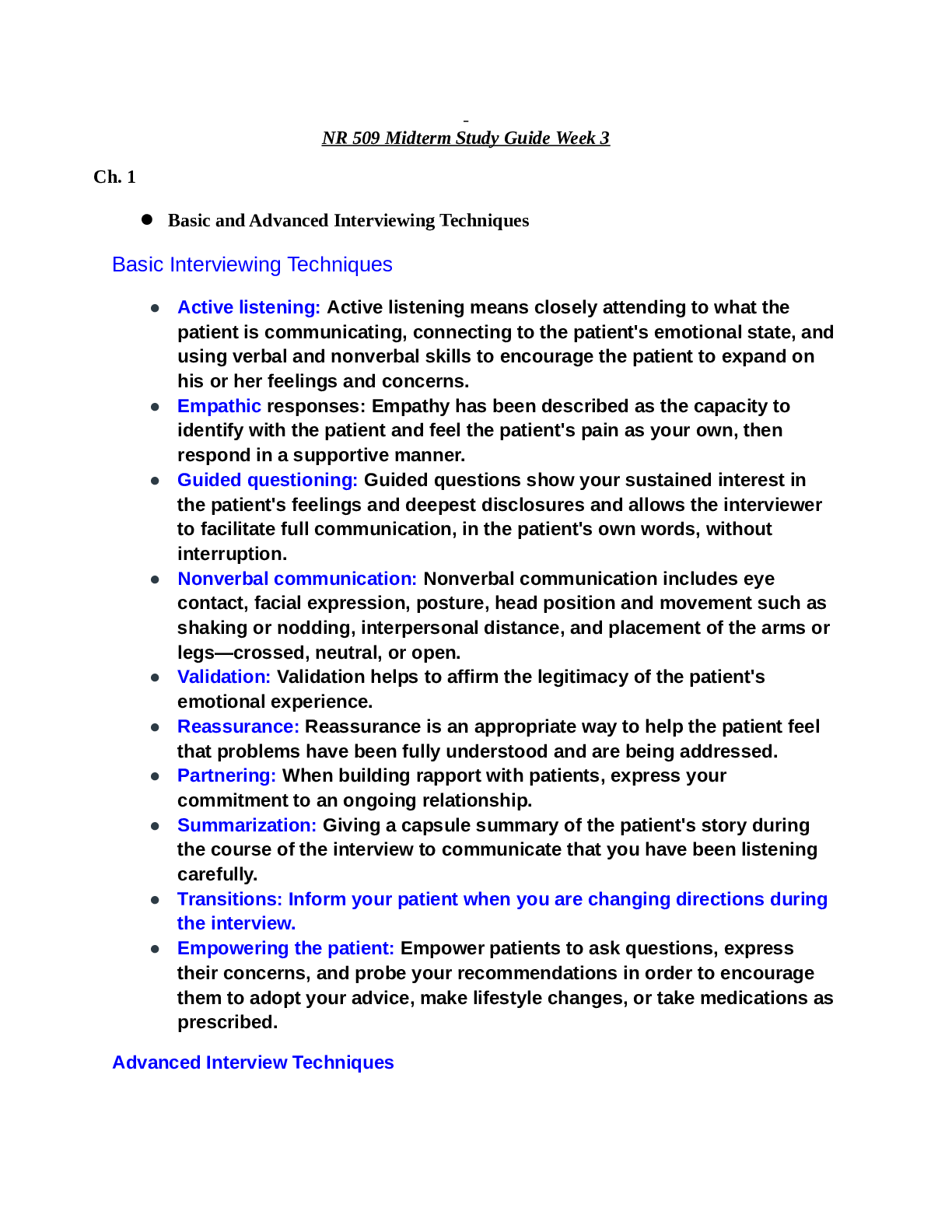
NR 509 Midterm Study Guide Week 3
Ch. 1
Basic and Advanced Interviewing Techniques
Basic Interviewing Techniques
● Active listening: Active listening means closely attending to what the
patient is communicating, connecting to the patient's emotional state, and
using verbal and nonverbal skills to encourage the patient to expand on
his or her feelings and concerns.
● Empathic responses: Empathy has been described as the capacity to
identify with the patient and feel the patient's pain as your own, then
respond in a supportive manner.
● Guided questioning: Guided questions show your sustained interest in
the patient's feelings and deepest disclosures and allows the interviewer
to facilitate full communication, in the patient's own words, without
interruption.
● Nonverbal communication: Nonverbal communication includes eye
contact, facial expression, posture, head position and movement such as
shaking or nodding, interpersonal distance, and placement of the arms or
legs—crossed, neutral, or open.
● Validation: Validation helps to affirm the legitimacy of the patient's
emotional experience.
● Reassurance: Reassurance is an appropriate way to help the patient feel
that problems have been fully understood and are being addressed.
● Partnering: When building rapport with patients, express your
commitment to an ongoing relationship.
● Summarization: Giving a capsule summary of the patient's story during
the course of the interview to communicate that you have been listening
carefully.
● Transitions: Inform your patient when you are changing directions during
the interview.
● Empowering the patient: Empower patients to ask questions, express
their concerns, and probe your recommendations in order to encourage
them to adopt your advice, make lifestyle changes, or take medications as
prescribed.
Advanced Interview Techniques
2
Determine scope of assessment: Focused vs. Comprehensive:
■ Comprehensive: Used patients you are seeing for the first
time in the office or hospital. Includes all the elements of
the health history and complete physical examination.
Is appropriate for new patients in the office or
hospital
Provides fundamental and personalized knowledge
about the patient
Strengthens the clinician–patient relationship
Helps identify or rule out physical causes related to
patient concerns
Provides a baseline for future assessments
Creates a platform for health promotion through
education and counseling
Develops proficiency in the essential skills of physical
examination
■ Focused: For patients you know well returning for routine
care, or those with specific “urgent care” concerns like sore
throat or knee pain. You will adjust the scope of your
history and physical examination to the situation at hand,
keeping several factors in mind: the magnitude and severity
of the patient’s prob- lems; the need for thoroughness; the
clinical setting—inpatient or outpatient, primary or
subspecialty care; and the time available.
[Show More]