1) A toddler is receiving an infusion of total parenteral nutrition via a Broviac
catheter. As the child plays, the I.V. tubing becomes disconnected from the
catheter. What should the LPN/LVN do first?
a. Turn off the
...
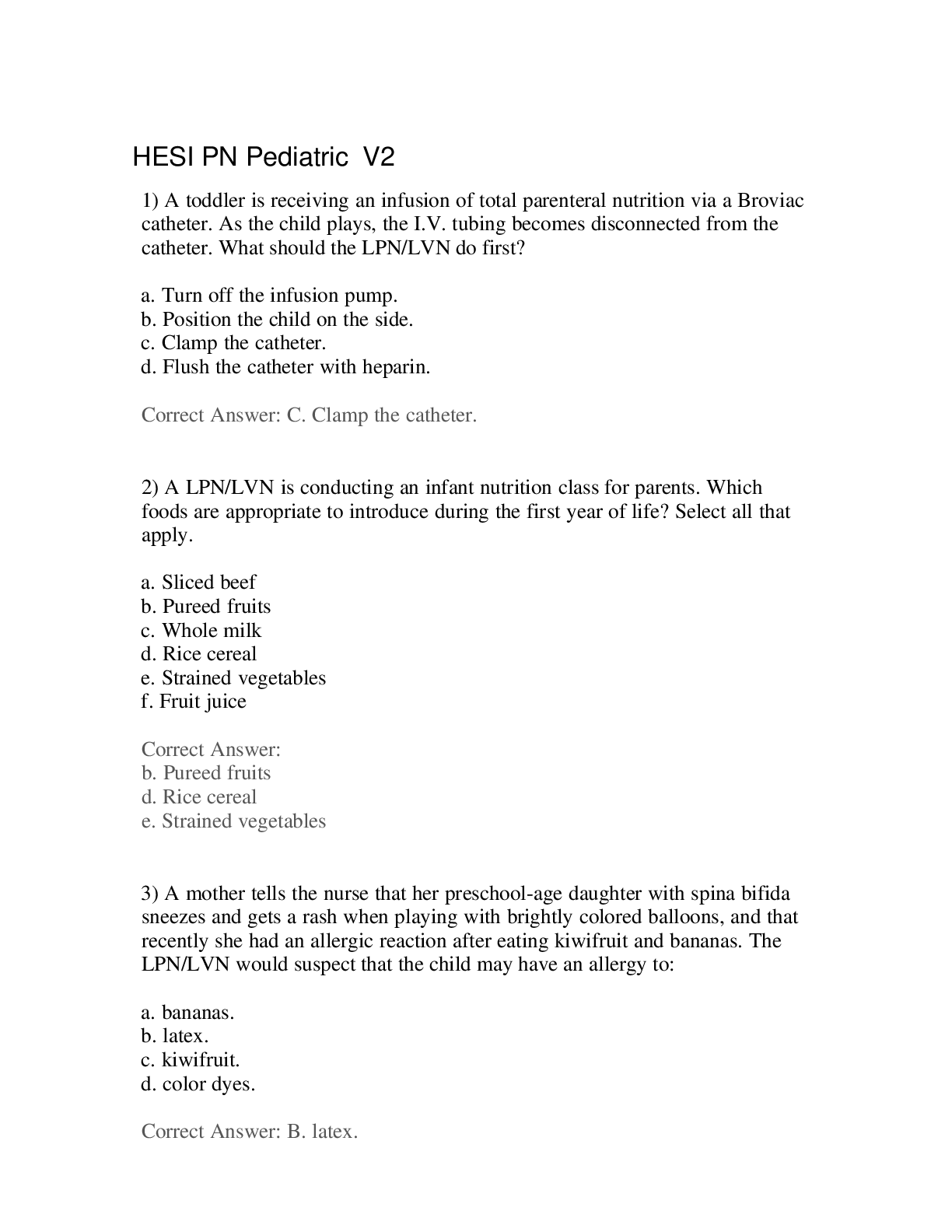
1) A toddler is receiving an infusion of total parenteral nutrition via a Broviac
catheter. As the child plays, the I.V. tubing becomes disconnected from the
catheter. What should the LPN/LVN do first?
a. Turn off the infusion pump.
b. Position the child on the side.
c. Clamp the catheter.
d. Flush the catheter with heparin.
Correct Answer: C. Clamp the catheter.
2) A LPN/LVN is conducting an infant nutrition class for parents. Which
foods are appropriate to introduce during the first year of life? Select all that
apply.
a. Sliced beef
b. Pureed fruits
c. Whole milk
d. Rice cereal
e. Strained vegetables
f. Fruit juice
Correct Answer:
b. Pureed fruits
d. Rice cereal
e. Strained vegetables
3) A mother tells the nurse that her preschool-age daughter with spina bifida
sneezes and gets a rash when playing with brightly colored balloons, and that
recently she had an allergic reaction after eating kiwifruit and bananas. The
LPN/LVN would suspect that the child may have an allergy to:
a. bananas.
b. latex.
c. kiwifruit.
d. color dyes.
Correct Answer: B. latex.
4) A LPN/LVN is developing a plan to teach a mother how to reduce her
infant's risk of developing otitis media. Which direction should the nurse
include in the teaching plan?
a. Administer antibiotics whenever the infant has a cold.
b. Place the infant in an upright position when giving a bottle.
c. Avoid getting the infant's ears wet while bathing or swimming.
d. Clean the infant's external ear canal daily.
Correct Answer: B. Place the infant in an upright position when giving a
bottle.
5) When developing a care plan for an adolescent, the nurse considers the
child's psychosocial needs. During adolescence, psychosocial development
focuses on:
a. becoming industrious.
b. establishing an identity.
c. achieving intimacy.
d. developing initiative.
Correct Answer: B. establishing an identity.
6) A LPN/LVN is planning care for a 10-year-old child in the acute phase of
rheumatic fever. Which activity is most appropriate for the nurse to schedule
in the care plan?
a. Playing ping-pong
b. Reading books
c. Climbing on play equipment in the playroom
d. Ambulating without restrictions
Correct Answer: B. Reading books
7) A LPN/LVN is assessing a severely depressed adolescent. Which finding
indicates a risk of suicide?
a. Excessive talking
b. Excessive sleepiness
c. A history of cocaine use
d. A preoccupation with death
Correct Answer: D. A preoccupation with death
8) A child is admitted with a tentative diagnosis of clinical depression. Which
assessment finding is most significant in confirming this diagnosis?
a. Irritability
b. Sadness
c. Weight gain
d. Fatigue
Correct Answer: B. Sadness
9) A child with iron deficiency anemia is ordered ferrous sulfate (Ferralyn),
an oral iron supplement. When teaching the child and parent how to
administer this preparation, the mother asks why she needs to mix the
supplement with citrus juice. Which response by the nurse is best?
a. "The vitamin C in the citrus juice helps with iron absorption."
b. "Having food and juice in the stomach helps with iron absorption."
c. "The citrus juice counteracts the unpleasant taste of the iron."
d. "There isn't a specific reason for it."
Correct Answer: A. "The vitamin C in the citrus juice helps with iron
absorption."
10) When assessing a child for impetigo, the nurse expects which assessment
findings?
a. Small, brown, benign lesions
b. Honey-colored, crusted lesions
c. Linear, threadlike burrows
d. Circular lesions that clear centrally
Correct Answer: B. Honey-colored, crusted lesions
11) A female adolescent client refuses to allow male nurses to care for her
while she's hospitalized. Which of these health care rights is this adolescent
exerting?
a. Right to competent care
b. Right to have an advance directive on file
c. Right to confidentiality of her medical record
d. Right to privacy
Correct Answer: D. Right to privacy
12) A LPN/LVN is reviewing a teaching plan with parents of an infant
undergoing repair for a cleft lip. Which instructions are the most appropriate
for the nurse to give? Select all that apply.
a. Offer a pacifier as needed.
b. Lay the infant on his back or side to sleep.
c. Sit the infant up for each feeding.
d. Loosen the arm restraints every 4 hours.
e. Clean the suture line after each feeding by dabbing it with saline solution.
f. Give the infant extra care and support.
Correct Answer:
b. Lay the infant on his back or side to sleep.
c. Sit the infant up for each feeding.
e. Clean the suture line after each feeding by dabbing it with saline solution.
f. Give the infant extra care and support.
13) A LPN/LVN notes that an infant develops arm movement before fine�motor finger skills and interprets this as an example of which pattern of
development?
a. Cephalocaudal
b. Proximodistal
c. Differentiation
d. Mass-to-specific
Correct Answer: B. Proximodistal
14) A teenage mother brings her 1-year-old child to the pediatrician's office
for a well-baby checkup. She says that her infant can't sit alone or roll over.
An appropriate response by the nurse would be:
a. "This is very abnormal. Your child must be sick."
b. "Let's see about further developmental testing."
c. "Don't worry, this is normal for her age."
d. "Maybe you just haven't seen her do it."
Correct Answer: B. "Let's see about further developmental testing."
15) Which finding in a 3-year-old child with acute renal failure requires
immediate follow-up?
a. Potassium level of 6.5 mEq/L
b. Blood pressure in right leg of 90/50 mm Hg
c. Abdominal cramps
d. No albumin in the urine
Correct Answer: A. Potassium level of 6.5 mEq/L
16) A school nurse is evaluating a 7-year-old child who is having an asthma
attack. The child is cyanotic and unable to speak, with decreased breath
sounds and shallow respirations. Based on these physical findings, the nurse
should first:
a. monitor the child with a pulse oximeter in her office.
b. prepare to ventilate the child.
c. return the child to class.
d. contact the child's parent or guardian.
Correct Answer: B. prepare to ventilate the child.
17) The mother of an 11-month-old infant reports to the nurse that her infant
sleeps much less than other children. The mother asks the nurse whether her
infant is getting sufficient sleep. What should be the nurse's initial response?
a. Reassure the mother that each infant's sleep needs are individual.
b. Ask the mother for more information about the infant's sleep patterns.
c. Instruct the mother to decrease the infant's daytime sleep to increase his
nighttime sleep.
d. Inform the mother that her infant's growth and development are appropriate
for his age, so sleep isn't a concern.
Correct Answer: B. Ask the mother for more information about the infant's
sleep patterns.
18) Which item in the care plan for a toddler with a seizure disorder should a
nurse revise?
a. Padded side rails
b. Oxygen mask and bag system at bedside
c. Arm restraints while asleep
d. Cardiorespiratory monitoring
Correct Answer: C. Arm restraints while asleep
19) A LPN/LVN observes a 2½-year-old child playing with another child of
the same age in the playroom on the pediatric unit. What type of play should
the nurse expect the children to engage in?
a. Associative play
b. Parallel play
c. Cooperative play
d. Therapeutic play
Correct Answer: B. Parallel play
20) A 14-year-old adolescent with type 1 diabetes checks his blood glucose
level at 9:00 p.m. before going to bed. It has been 4 hours since his dinner and
his regular insulin dose. His blood glucose level is 60 mg/dl, and he states that
he feels a little shaky. What should the nurse suggest?
a. A bedtime snack of an 8-oz glass of milk and graham crackers with peanut
butter
b. Going to sleep to decrease the metabolic demands on the body
c. Taking a dose of glucagon
d. Doing nothing because the glucose level is unreliable because the
adolescent measured it himself
Correct Answer:A. A bedtime snack of an 8-oz glass of milk and graham
crackers with peanut butter
21) A 13-year-old girl is being evaluated for possible Crohn's disease. The
nurse expects to prepare her for which diagnostic study?
a. Genetic testing
b. Cystoscopy
c. Myelography
d. Colonoscopy with biopsy
Correct Answer: D. Colonoscopy with biopsy
22) An infant who weighs 7.5 kg is to receive ampicillin (Omnipen) 25 mg/kg
I.V. every 6 hours. How many milligrams should the nurse administer per
dose? Record your answer using one decimal place.
Correct Answer: 187.5 milligrams
23) A 4-year-old has just returned from surgery. He has a nasogastric (NG)
tube in place and is attached to intermittent suction. The child says to the
nurse, "I'm going to throw up." What should the nurse do first?
a. Notify the physician because the child has an NG tube.
b. Immediately give the child an antiemetic I.V.
c. Irrigate the NG tube to ensure patency.
d. Encourage the mother to calm the child down.
Correct Answer: C. Irrigate the NG tube to ensure patency.
[Show More]

![Preview of [eBook] [PDF] Clinical Nursing Calculations 3rd Edition By Susan Sienkiewicz, Sandra Meg](https://browseimages.nyc3.digitaloceanspaces.com/paper-images/2025/Jul/04/4jF14r9I2025-07-04-05-586867ec3011731.png)