BIOS 242 Week 3 Quiz: MCQs & Short Answer
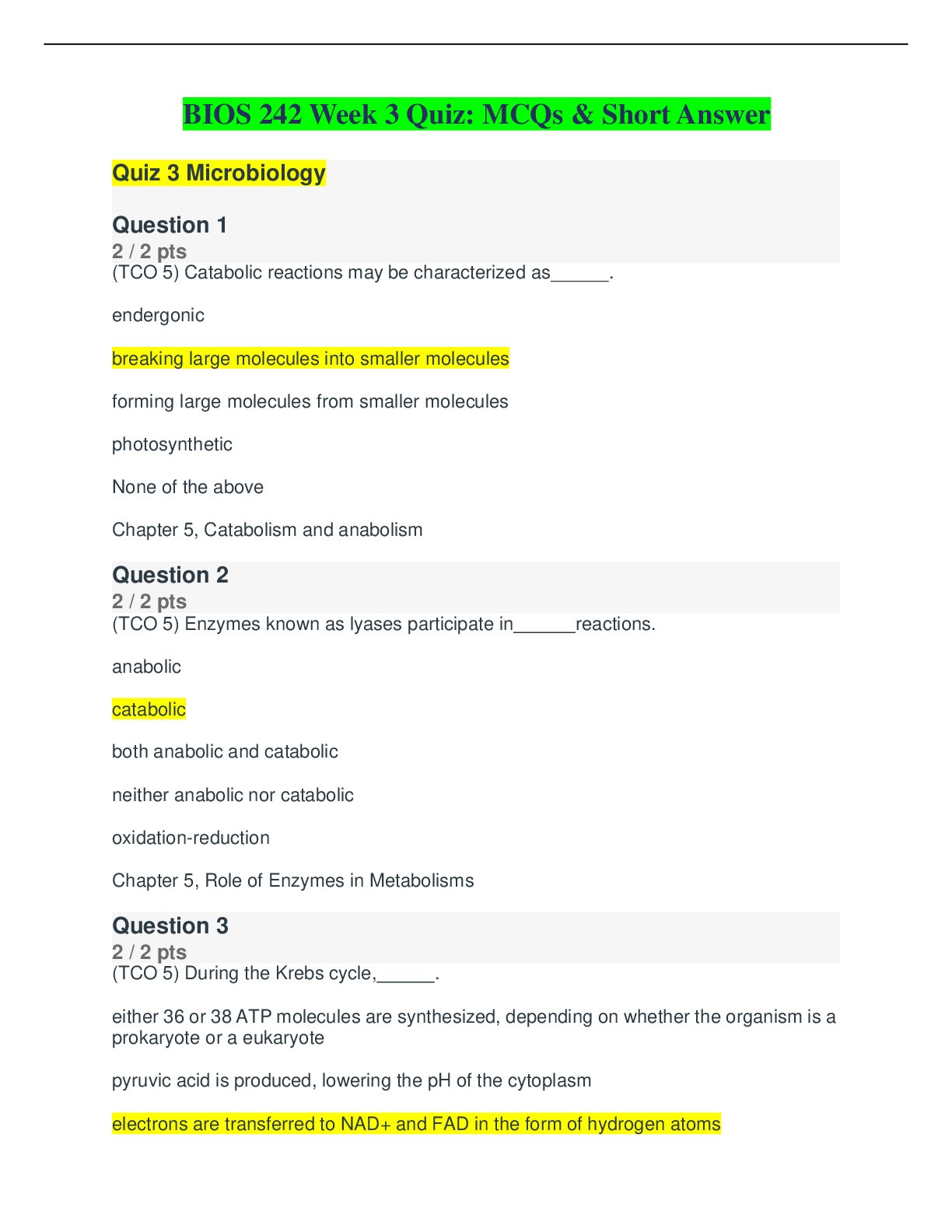
(TCO 5) Catabolic reactions may be characterized as .
endergonic
breaking large molecules into smaller molecules
forming large molecules from smaller molecules
photosyntheti
...
BIOS 242 Week 3 Quiz: MCQs & Short Answer
(TCO 5) Catabolic reactions may be characterized as .
endergonic
breaking large molecules into smaller molecules
forming large molecules from smaller molecules
photosynthetic
None of the above
Chapter 5, Catabolism and anabolism
(TCO 5) Enzymes known as lyases participate in reactions.
anabolic
catabolic
both anabolic and catabolic
neither anabolic nor catabolic
oxidation-reduction
Chapter 5, Role of Enzymes in Metabolisms
(TCO 5) During the Krebs cycle, .
either 36 or 38 ATP molecules are synthesized, depending on whether the organism is a
prokaryote or a eukaryote
pyruvic acid is produced, lowering the pH of the cytoplasm
electrons are transferred to NAD+ and FAD in the form of hydrogen atoms
Quiz 3 Microbiology
Question 1
2 / 2 ptsQuestion 5
2 / 2 pts
Question 6
2 / 2 pts
NADH and FADH2 are oxidized
ribulose 5-phosphate is produced as an intermediate
Chapter 5, The Krebs Cycle
(TCO 5) Anaerobic bacteria may use which of the following as final electron acceptors in
respiration?
Oxygen
Nitrate
Ethanol
Methane
Hydrogen sulfide
Chapter 5, Electron Transport
(TCO 6) An aligned pair of homologous chromosomes is called a .
chromatid
spindle
tetrad
coenocyte
gamete
Chapter 12, Reproduction of Eukaryotes
(TCO 6) Hyphae are associated with which of the following?
Yeasts
Question 4
2 / 2 ptsQuestion 8
2 / 2 pts
Question 7
2 / 2 pts
Algae
Molds
Protozoa
Helminths
Chapter 12, Fungus
(TCO 6) Lichens are composed of a symbiosis of fungi and which of the following?
Green algae
Cyanobacteria
Euglenoids
Cyanobacteria or green algae
Euglenoids or dinoflagellates
Chapter 12, Lichens
(TCO 7) Host specificity of a virus is due to .
particular genes that it shares with the infected cell
the presence of an envelope
differences in size between the virus and the host cell
the presence or absence of a cell wall on the host cell
interactions between viral and cellular surface molecules
Chapter 13, Characteristics of Viruses
Question 9
2 / 2 ptsQuestion 10
2 / 2 pts
Question 11
Not yet graded / 10 pts
(TCO 7) The phenomenon of transduction is associated with which of the stages of a
bacteriophage infection cycle?
Attachment
Assembly
Release
Synthesis
Entry
Chapter 13, Viral Replication
(TCO 7) The infectious particles of fungi have RNA genomes and lack a capsid. They
are therefore similar to .
bacteriophages
enveloped viruses
prions
viroids
lysogens
Chapter 13, Other Parasitic Particles
(TCO 5) Explain why fermentation is a necessary alternative to respiration in many
cells
[Show More]