Question 1 See full question
The nurse is conducting discharge teaching with a postpartum woman. What would be an
important instruction for this client?
You Selected:
Call her caregiver if lochia moves from serosa
...
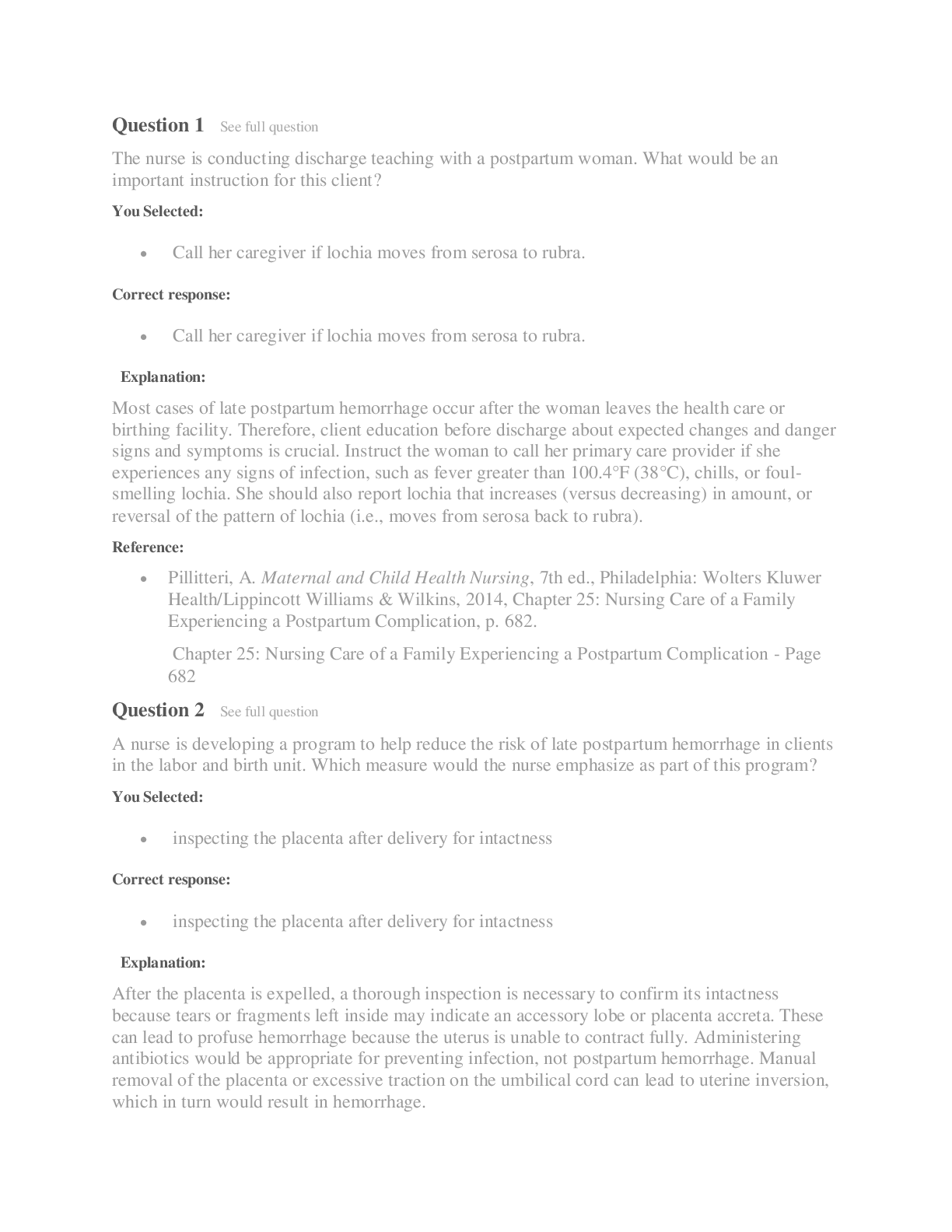
Question 1 See full question
The nurse is conducting discharge teaching with a postpartum woman. What would be an
important instruction for this client?
You Selected:
Call her caregiver if lochia moves from serosa to rubra.
Correct response:
Call her caregiver if lochia moves from serosa to rubra.
Explanation:
Most cases of late postpartum hemorrhage occur after the woman leaves the health care or
birthing facility. Therefore, client education before discharge about expected changes and danger
signs and symptoms is crucial. Instruct the woman to call her primary care provider if she
experiences any signs of infection, such as fever greater than 100.4°F (38°C), chills, or foulsmelling lochia. She should also report lochia that increases (versus decreasing) in amount, or
reversal of the pattern of lochia (i.e., moves from serosa back to rubra).
Reference:
Pillitteri, A. Maternal and Child Health Nursing, 7th ed., Philadelphia: Wolters Kluwer
Health/Lippincott Williams & Wilkins, 2014, Chapter 25: Nursing Care of a Family
Experiencing a Postpartum Complication, p. 682.
Chapter 25: Nursing Care of a Family Experiencing a Postpartum Complication - Page
682
Question 2 See full question
A nurse is developing a program to help reduce the risk of late postpartum hemorrhage in clients
in the labor and birth unit. Which measure would the nurse emphasize as part of this program?
You Selected:
inspecting the placenta after delivery for intactness
Correct response:
inspecting the placenta after delivery for intactness
Explanation:
After the placenta is expelled, a thorough inspection is necessary to confirm its intactness
because tears or fragments left inside may indicate an accessory lobe or placenta accreta. These
can lead to profuse hemorrhage because the uterus is unable to contract fully. Administering
antibiotics would be appropriate for preventing infection, not postpartum hemorrhage. Manual
removal of the placenta or excessive traction on the umbilical cord can lead to uterine inversion,
which in turn would result in hemorrhage.
[Show More]