CHM1025 Lecture 1 Notes |Brewer | 01.09.2018
• Chemistry is the study, composition, structure, properties and reactions of matter.
o Matter is anything that takes up space.
• There are many fields of chemistry inc
...
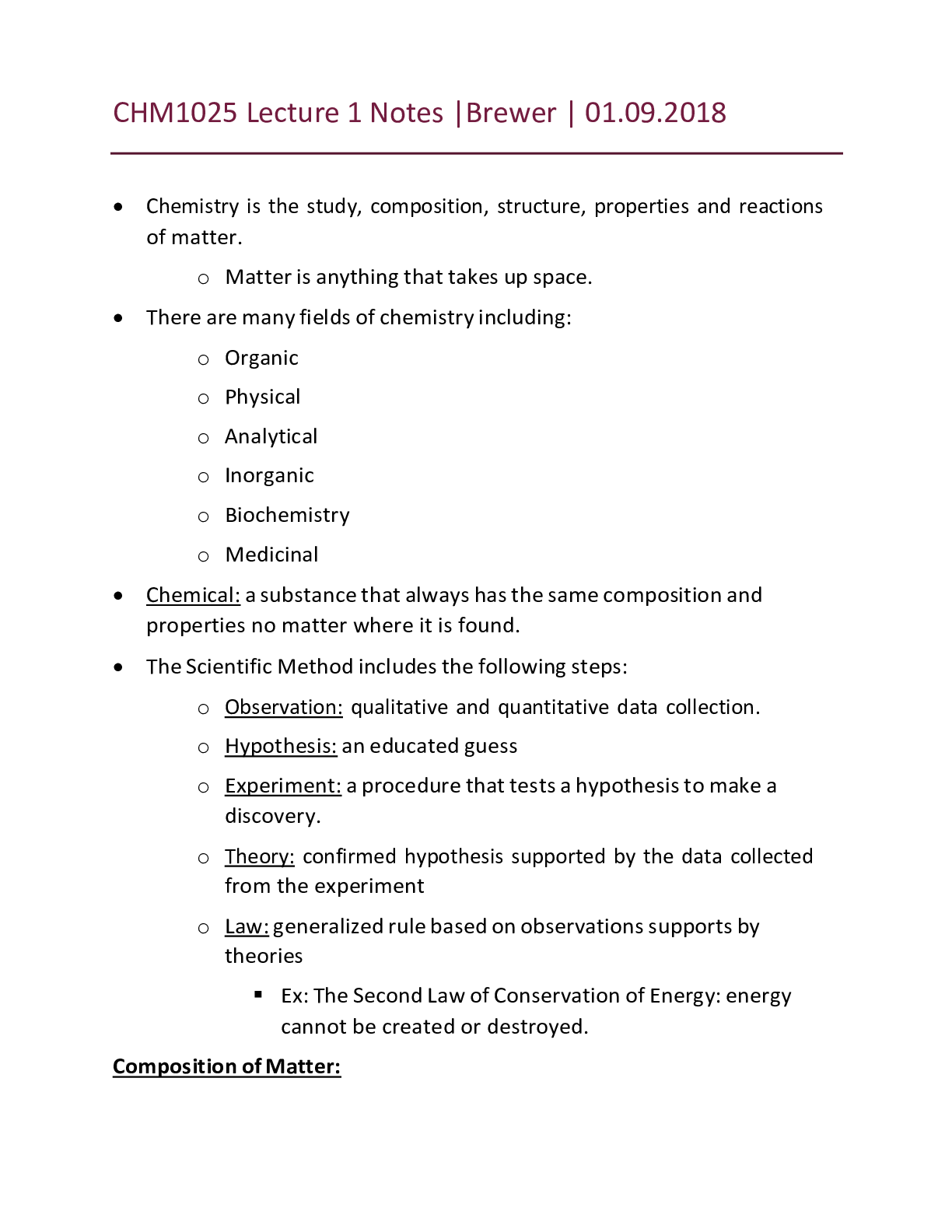
CHM1025 Lecture 1 Notes |Brewer | 01.09.2018
• Chemistry is the study, composition, structure, properties and reactions of matter.
o Matter is anything that takes up space.
• There are many fields of chemistry including:
o Organic
o Physical
o Analytical
o Inorganic
o Biochemistry
o Medicinal
• Chemical: a substance that always has the same composition and properties no matter where it is found.
• The Scientific Method includes the following steps:
o Observation: qualitative and quantitative data collection.
o Hypothesis: an educated guess
o Experiment: a procedure that tests a hypothesis to make a discovery.
o Theory: confirmed hypothesis supported by the data collected from the experiment
o Law: generalized rule based on observations supports by theories
Ex: The Second Law of Conservation of Energy: energy cannot be created or destroyed.
Composition of Matter:
• Pure Substance: matter that has a fixed/constant chemical composition. Example: Salt (NaCl – Sodium Chloride)
• Element: matter made up of only one type of materials. This substance cannot be broken down further. Each atom in a sample of an element is identical. Example: Carbon.
o Elements can be metal (shiny and good conductors) or nonmetal (dull and poor conductor). Example: Copper is a metal. Oxygen is a nonmetal.
• Compound: molecules containing atoms of two or more elements that are chemically combined in fixed proportions. Example: Salt (NaCl – Sodium Chloride).
Methods to represent elements and compounds:
• Element Symbols: shortened version of an elements formal name. Instead of Iron the symbol is Fe. The first letter is always capitalized, the second letter is lowercase.
• Chemical Formula: describes the composition of a compound using the element symbols to show the makeup and subscripts to indicate the proportions of the elements presence.
o Water – H2O: water has two hydrogen atoms and one oxygen atom. The subscript is the number 2 shown next to H.
• Mixture: two or more substances physically mixed together but NOT chemically altered.
o An example of this would be trail mix. Everything in the trail mix can be separated and the chemical composition of each item is not altered.
• Mixtures can be homogenous which is a mixture with uniform composition and distribution of substances.
o Heterogeneous mixtures do not have a uniform composition or distribution. The mixture may also be a suspension or consist of more than one phase.
Representations of Matter:
• Atom: the smallest unit of an element which retains its unique chemical properties.
• Molecule: two or more atoms chemically bound together in a discrete arrangement with fixed proportions.
Physical States of Matter:
• Solid: definite shape and definite volume. Solids have strong attractive forces. Example: a desk or cup.
• Liquid: definite volume, but no defined shape; takes the shape of its container. Moderate attractive forces. Example: water
• Gas: no definite shape or volume. Gases have weak attractive forces. Example: Oxygen or Carbon.
• Aqueous solution: substance dissolved in water as homogenous solutions. Example: soda or tea.
......................................................................continued......................................................................................
[Show More]