NURS618 - Saunders Neurological Comprehensive review
Document Content and Description Below
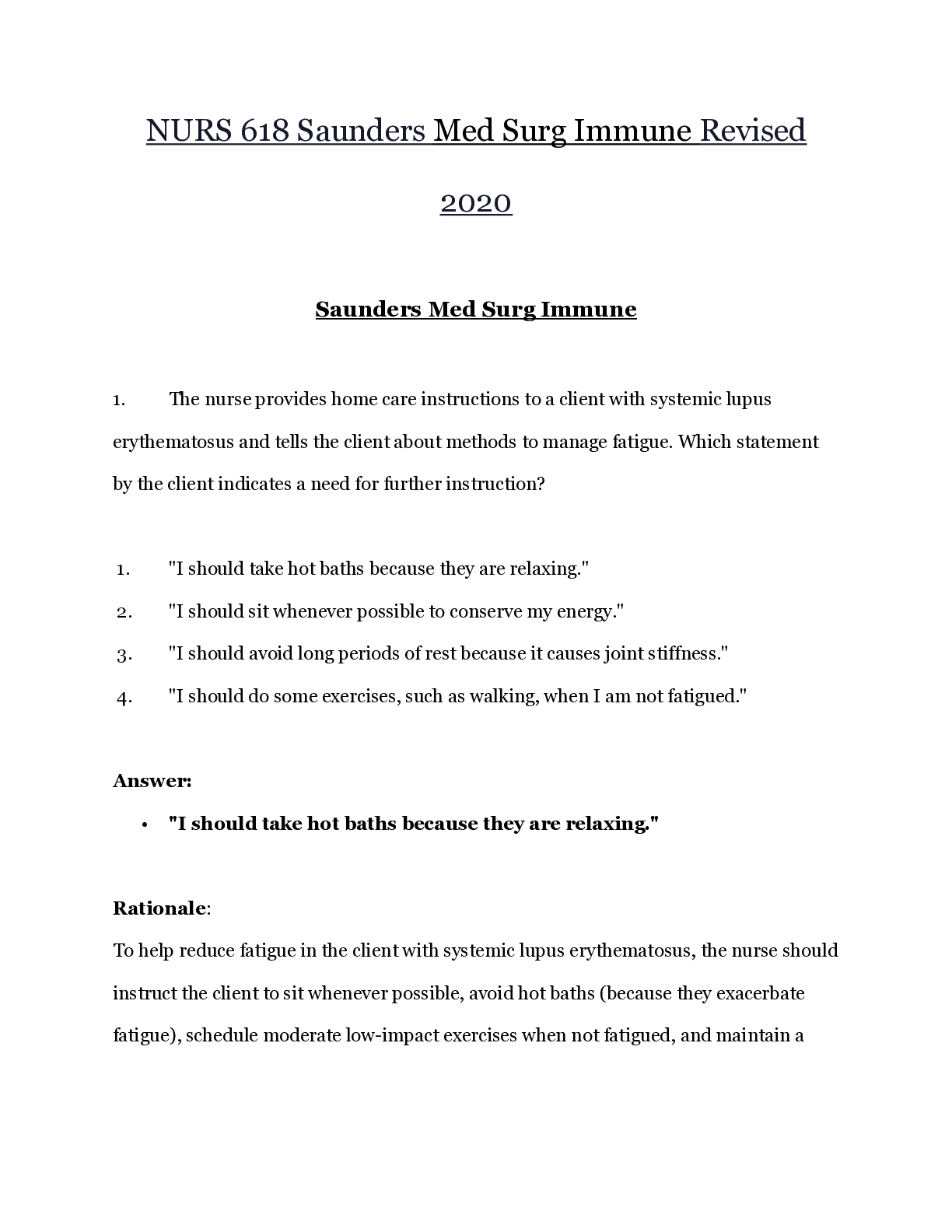
1-The nurse is assessing the motor and sensory function of an unconscious client. The nurse should use which technique to test the client's peripheral response to pain? 1. Sternal rub 2. Nail bed pr ... essure 3. Pressure on the orbital rim 4. Squeezing of the sternocleidomastoid muscle 1. Increasing temperature, increasing pulse, increasing respirations, decreasing blood pressure 2. 3. Decreasing temperature, decreasing pulse, increasing respirations, decreasing blood pressure 4. Decreasing temperature, increasing pulse, decreasing respirations, increasing blood pressure 3-A client recovering from a head injury is participating in care. The nurse determines that the client understands measures to prevent elevations in intracranial pressure if the nurse observes the client doing which activity? 1. Blowing the nose 2. Isometric exercises 3. Coughing vigorously 4. Exhaling during repositioning 1. Fluid is clear and tests negative for glucose. 2. Fluid is grossly bloody in appearance and has a pH of 6. Rationale: Nail bed pressure tests a basic motor and sensory peripheral response. Cerebral responses to pain are tested using a sternal rub, placing upward pressure on the orbital rim, or squeezing the clavicle or sternocleidomastoid muscle. 2-The nurse is caring for the client with increased intracranial pressure. The nurse would note which trend in vital signs if the intracranial pressure is rising? Increasing temperature, decreasing pulse, decreasing respirations, increasing blood pressure Rationale: A change in vital signs may be a late sign of increased intracranial pressure. Trends include increasing temperature and blood pressure and decreasing pulse and respirations. Respiratory irregularities also may occur. Rationale: Activities that increase intrathoracic and intraabdominal pressures cause an indirect elevation of the intracranial pressure. Some of these activities include isometric exercises, Valsalva's maneuver, coughing, sneezing, and blowing the nose. Exhaling during activities such as repositioning or pulling up in bed opens the glottis, which prevents intrathoracic pressure from rising. 4-A client has clear fluid leaking from the nose following a basilar skull fracture. Which finding would alert the nurse that cerebrospinal fluid is present? 3. Fluid clumps together on the dressing and has a pH of 7. 4. Fluid separates into concentric rings and tests positive for glucose. 1. Keeping the linens wrinkle-free under the client 2. Preventing unnecessary pressure on the lower limbs 3. Limiting bladder catheterization to once every 12 hours 4. Turning and repositioning the client at least every 2 hours 5. Ensuring that the client has a bowel movement at least once a week 1. Hyperreflexia 2. Positive reflexes 3. Flaccid paralysis 4. Reflex emptying of the bladder 1. Loosening restrictive clothing 2. Restraining the client's limbs 3. Removing the pillow and raising padded side rails 4. Positioning the client to the side, if possible, with the head flexed forward 5. Keeping the curtain around the client and the room door open so when help arrives they can quickly enter to assist Rationale: Leakage of cerebrospinal fluid (CSF) from the ears or nose may accompany basilar skull fracture. CSF can be distinguished from other body fluids because the drainage will separate into bloody and yellow concentric rings on dressing material, called a halo sign. The fluid also tests positive for glucose. 5-A client with a spinal cord injury is prone to experiencing autonomic dysreflexia. The nurse should include which measures in the plan of care to minimize the risk of occurrence? Select all that apply. Rationale: The most frequent cause of autonomic dysreflexia is a distended bladder. Straight catheterization should be done every 4 to 6 hours (catheterization every 12 hours is too infrequent), and urinary catheters should be checked frequently to prevent kinks in the tubing. Constipation and fecal impaction are other causes, so maintaining bowel regularity is important. Ensuring a bowel movement once a week is much too infrequent. Other causes include stimulation of the skin from tactile, thermal, or painful stimuli. The nurse administers care to minimize risk in these areas. 6-The nurse is evaluating the neurological signs of a client in spinal shock following spinal cord injury. Which observation indicates that spinal shock persists? Rationale: Resolution of spinal shock is occurring when there is return of reflexes (especially flexors to noxious cutaneous stimuli), a state of hyperreflexia rather than flaccidity, and reflex emptying of the bladder. 7-The nurse is caring for a client who begins to experience seizure activity while in bed. Which actions should the nurse take? Select all that apply. Rationale: Nursing actions during a seizure include providing for privacy, loosening restrictive clothing, removing the pillow and raising padded side rails in the bed, and placing the client on one side with the head flexed forward, if possible, to allow the tongue to fall forward and facilitate drainage. The limbs are never restrained because the strong muscle contractions could cause the client harm. If the client is not in bed when seizure activity begins, the nurse lowers the client to the floor, if possible; protects the head from injury; and moves furniture that may injure the client. 8-The nurse is assigned to care for a client with complete right-sided hemiparesis from a stroke (brain attack). Which characteristics are associated with this condition? Select all that apply. 1. The client is aphasic. 2. The client has weakness on the right side of the body. 3. The client has complete bilateral paralysis of the arms and legs. 4. The client has weakness on the right side of the face and tongue. 5. The client has lost the ability to move the right arm but is able to walk independently. 6. The client has lost the ability to ambulate independently but is able to feed and bathe himself or herself without assistance. Rationale: Hemiparesis is a weakness of one side of the body that may occur after a stroke. It involves weakness of the face and tongue, arm, and leg on one side. These clients are also aphasic: unable to discriminate words and letters. They are generally very cautious and get anxious when attempting a new task. Complete bilateral paralysis does not occur in hemiparesis. The client with right-sided hemiparesis has weakness of the right arm and leg and needs assistance with feeding, bathing, and ambulating. 9-The nurse has instructed the family of a client with stroke (brain attack) who has homonymous hemianopsia about measures to help the client overcome the deficit. Which statement suggests that the family understands the measures to use when caring for the client? 1. "We need to discourage him from wearing eyeglasses." 2. "We need to place objects in his impaired field of vision." 3. "We need to approach him from the impaired field of vision." 4. "We need to remind him to turn his head to scan the lost visual field." 1. Gets angry with family if they interrupt a task 2. Experiences bouts of depression and irritability 3. Has difficulty with using modified feeding utensils 4. Consistently uses adaptive equipment in dressing self Rationale: Homonymous hemianopsia is loss of half of the visual field. The client with homonymous hemianopsia should have objects placed in the intact field of vision, and the nurse also should approach the client from the intact side. The nurse instructs the client to scan the environment to overcome the visual deficit and does client teaching from within the intact field of vision. The nurse encourages the use of personal eyeglasses, if they are available. [Show More]
Last updated: 3 years ago
Preview 1 out of 56 pages

Buy this document to get the full access instantly
Instant Download Access after purchase
Buy NowInstant download
We Accept:

Also available in bundle (2)
Click Below to Access Bundle(s)
NURS618 - Saunders Neurological Comprehensive reviews
This bundle includes 11 Saunders Comprehensive reviews for NCLEX 1, 3, 4 - and reviews for the following topics: Neurological; Immune; Integumentary; Skin Integumentary; Neuro; Endocrine; Musculoskele...
By Senpai 4 years ago
$35.5
11
NURS618 - Saunders Neurological Comprehensive reviews
This bundle includes 11 Saunders Comprehensive reviews for NCLEX 1, 3, 4 - and reviews for the following topics: Neurological; Immune; Integumentary; Skin Integumentary; Neuro; Endocrine; Musculoskele...
By Senpai 4 years ago
$35.5
11
Reviews( 0 )
$9.50
Can't find what you want? Try our AI powered Search
Document information
Connected school, study & course
About the document
Uploaded On
Aug 18, 2021
Number of pages
56
Written in
All

Additional information
This document has been written for:
Uploaded
Aug 18, 2021
Downloads
0
Views
212






 JN21.png)