To use this document, first read the Instructions and FAQs. This document is made available by the Howard Hughes
Medical Institute. Using this document, you agree to use this document in accordance with the Terms of Use
...
To use this document, first read the Instructions and FAQs. This document is made available by the Howard Hughes
Medical Institute. Using this document, you agree to use this document in accordance with the Terms of Use.
INTRODUCTION
The short film The Origin of Species: Lizards in an Evolutionary Tree introduces the anole lizards of the Caribbean.
For well over 20 years, scientists have studied these lizards to understand how the different anole species and
their traits have evolved. In this activity, you will examine the results from a different experiment that included a
predator of anoles.
PART 1: Observations and Hypothesis
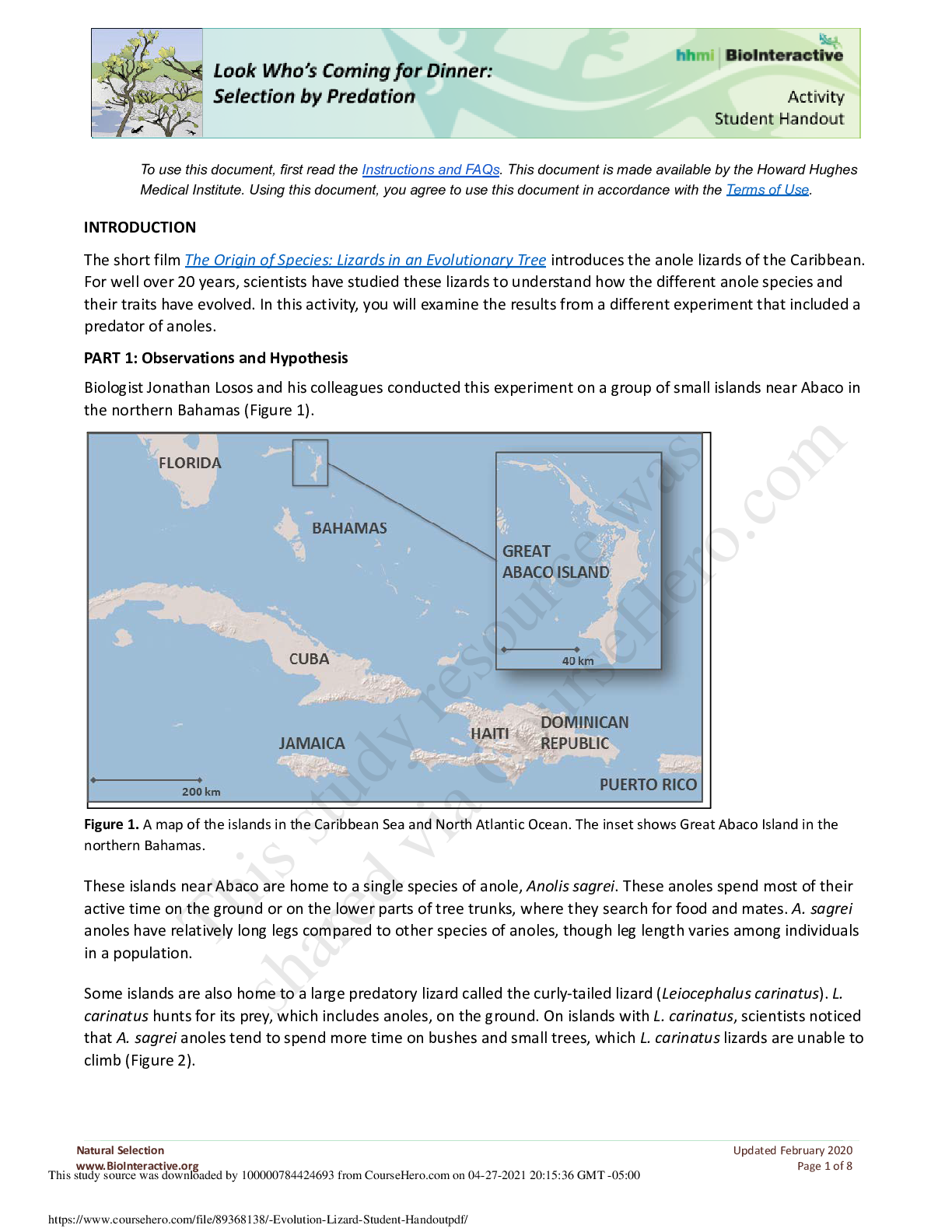
Biologist Jonathan Losos and his colleagues conducted this experiment on a group of small islands near Abaco in
the northern Bahamas (Figure 1).
Figure 1. A map of the islands in the Caribbean Sea and North Atlantic Ocean. The inset shows Great Abaco Island in the
northern Bahamas.
These islands near Abaco are home to a single species of anole, Anolis sagrei. These anoles spend most of their
active time on the ground or on the lower parts of tree trunks, where they search for food and mates. A. sagrei
anoles have relatively long legs compared to other species of anoles, though leg length varies among individuals
in a population.
Some islands are also home to a large predatory lizard called the curly-tailed lizard (Leiocephalus carinatus). L.
carinatus hunts for its prey, which includes anoles, on the ground. On islands with L. carinatus, scientists noticed
that A. sagrei anoles tend to spend more time on bushes and small trees, which L. carinatus lizards are unable to
climb (Figure 2).
Natural Selection Updated February 2020
www.BioInteractive.org Page 1 of 8
This study source was downloaded by 100000784424693 from CourseHero.com on 04-27-2021 20:15:36 GMT -05:00
https://www.coursehero.com/file/89368138/-Evolution-Lizard-Student-Handoutpdf/
This study resource was
shared via CourseHero.comLook Who’s Coming to Dinner: Selection by Predation
Figure 2. Illustrations of where A. sagrei anoles spend their time on different islands. On islands without the predator L.
carinatus (left panel), the anoles stay mostly on the ground. On islands with L. carinatus (right panel), the anoles are
found mostly on twigs and branches.
1. Based on these initial observations, formulate a hypothesis about how the predatory lizard L. carinatus
affects where A. sagrei anoles live. Explain your reasoning.
Lizard will survive better in island with less predators
PART 2: Hypothesis and Experiment
Losos and his colleagues hypothesized that the presence of the curly-tailed lizard, L. carinatus, causes A.
sagrei anoles to live mostly above the ground, on small branches and bushes. Is this similar to the hypothesis
you formulated in Part 1?
The scientists also hypothesized that, over many generations, the anoles living above the ground, on the small
branches and bushes, would evolve features different from those of the anoles living on the ground.
How would you test these two hypotheses? Here is the experiment Losos and his colleagues conducted:
● They identified 12 small islands in the Bahamas with A. sagrei but not L. carinatus. Remember that on islands
without L. carinatus, the anoles live mostly on the ground or on the lower parts of tree trunks. They only
occasionally climb higher branches and bushes in this case.
● On each island, the scientists counted and marked all A. sagrei anoles and noted where they were found
(i.e., on the ground or on branches/bushes). By marking these individuals, the scientists could track the
initial populations of anoles over the course of the experiment.
● On six of the islands, the experimental islands, the scientists then introduced L. carinatus, which preys on
anoles. They added one L. carinatus lizard for every seven A. sagrei anoles to ensure equal proportions on all
the experimental islands. The six remaining islands without L. carinatus served as control islands.
● The scientists planned to return to each island every six months to monitor the anole populations over
several generations. (One generation for A. sagrei is about 12 months.) During their visits, the scientists
recorded how many anoles had survived and where the anoles were found (i.e., on the ground or on
branches/bushes). The scientists also collected data on the anoles’ hindlimb lengths.
[Show More]