Mr. Carlini has heard that Medicare prescription drug plans are only offered through private
companies under a program known as Medicare Advantage (MA), not by the government. He
likes Original Medicare and does not
...
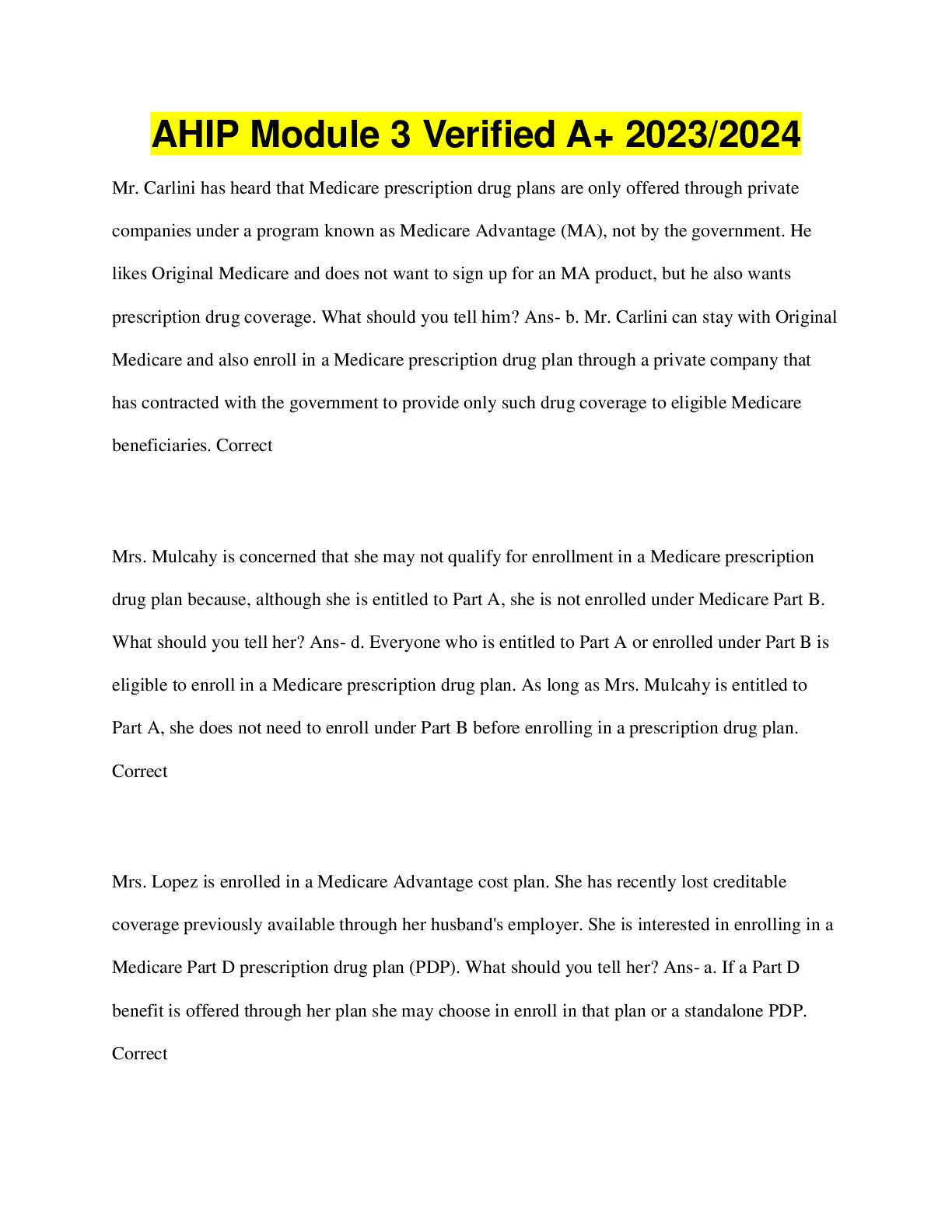
Mr. Carlini has heard that Medicare prescription drug plans are only offered through private
companies under a program known as Medicare Advantage (MA), not by the government. He
likes Original Medicare and does not want to sign up for an MA product, but he also wants
prescription drug coverage. What should you tell him? Ans- b. Mr. Carlini can stay with Original
Medicare and also enroll in a Medicare prescription drug plan through a private company that
has contracted with the government to provide only such drug coverage to eligible Medicare
beneficiaries. Correct
Mrs. Mulcahy is concerned that she may not qualify for enrollment in a Medicare prescription
drug plan because, although she is entitled to Part A, she is not enrolled under Medicare Part B.
What should you tell her? Ans- d. Everyone who is entitled to Part A or enrolled under Part B is
eligible to enroll in a Medicare prescription drug plan. As long as Mrs. Mulcahy is entitled to
Part A, she does not need to enroll under Part B before enrolling in a prescription drug plan.
Correct
Mrs. Lopez is enrolled in a Medicare Advantage cost plan. She has recently lost creditable
coverage previously available through her husband's employer. She is interested in enrolling in a
Medicare Part D prescription drug plan (PDP). What should you tell her? Ans- a. If a Part D
benefit is offered through her plan she may choose in enroll in that plan or a standalone PDP.
Correct
Which of the following statements about Medicare Part D are correct?
I. Part D plans must enroll any eligible beneficiary who applies regardless of health status except
in limited circumstances.
II. Private fee-for-service (PFFS) plans are not required to use a pharmacy network but may
choose to have one.
III. Beneficiaries enrolled in a MA-Medical Savings Account (MSA) plan may only obtain Part
D benefits through a standalone PDP.
IV. Beneficiaries enrolled in a MA-PPO may obtain Part D benefits through a standalone PDP or
through their plan. Ans- b. I, II, and III only Correct
All plans must cover at least the standard Part D coverage or its actuarial equivalent. What costs
would a beneficiary incur for prescription drugs in 2019 under the standard coverage? Ans- c.
Standard Part D coverage would require payment of an annual deductible, 25% cost-sharing up
to the coverage gap, a portion of costs for both generics and brand-name drugs in the coverage
gap, and co-pays or co-insurance after the coverage gap. Correct
Mrs. Andrews was preparing a budget for next year because she takes quite a few prescription
drugs, she will reach the coverage gap, and wants to be sure she has enough money set aside for
those months. She received assistance calculating her projected expenses from her daughter who
is a pharmacist, but she doesn't think the calculations are correct because her out-of-pocket
expenses would be lower than last year. She calls to ask if you can help. What might you tell
her? Ans- d. It would not be unusual for her costs to be a bit less because the Bipartisan Budget
Act of 2018 moved up the date for closing the so-called "donut hole" for brand name drugs to
2019. Correct
Mr. Jacob understands that there is a standard Medicare Part D prescription drug benefit, but
when he looks at information on various plans available in his area, he sees a wide range in what
they charge for deductibles, premiums and cost sharing. How can you explain this to him? Ans�a. Medicare Part D drug plans may have different benefit structures, but on average, they must
all be at least as good as the standard model established by the government. Correct
Ms. Edwards is enrolled in a Medicare Advantage plan that includes prescription drug plan
(PDP) coverage. She is traveling and wishes to fill two of her prescriptions that she has lost.
How would you advise her? Ans- d. She may fill prescripti
[Show More]