Mr. Jacob understands that there is a standard Medicare Part D prescription drug benefit, but
when he looks at information on various plans available in his area, he sees a wide range in what
they charge for deductib
...
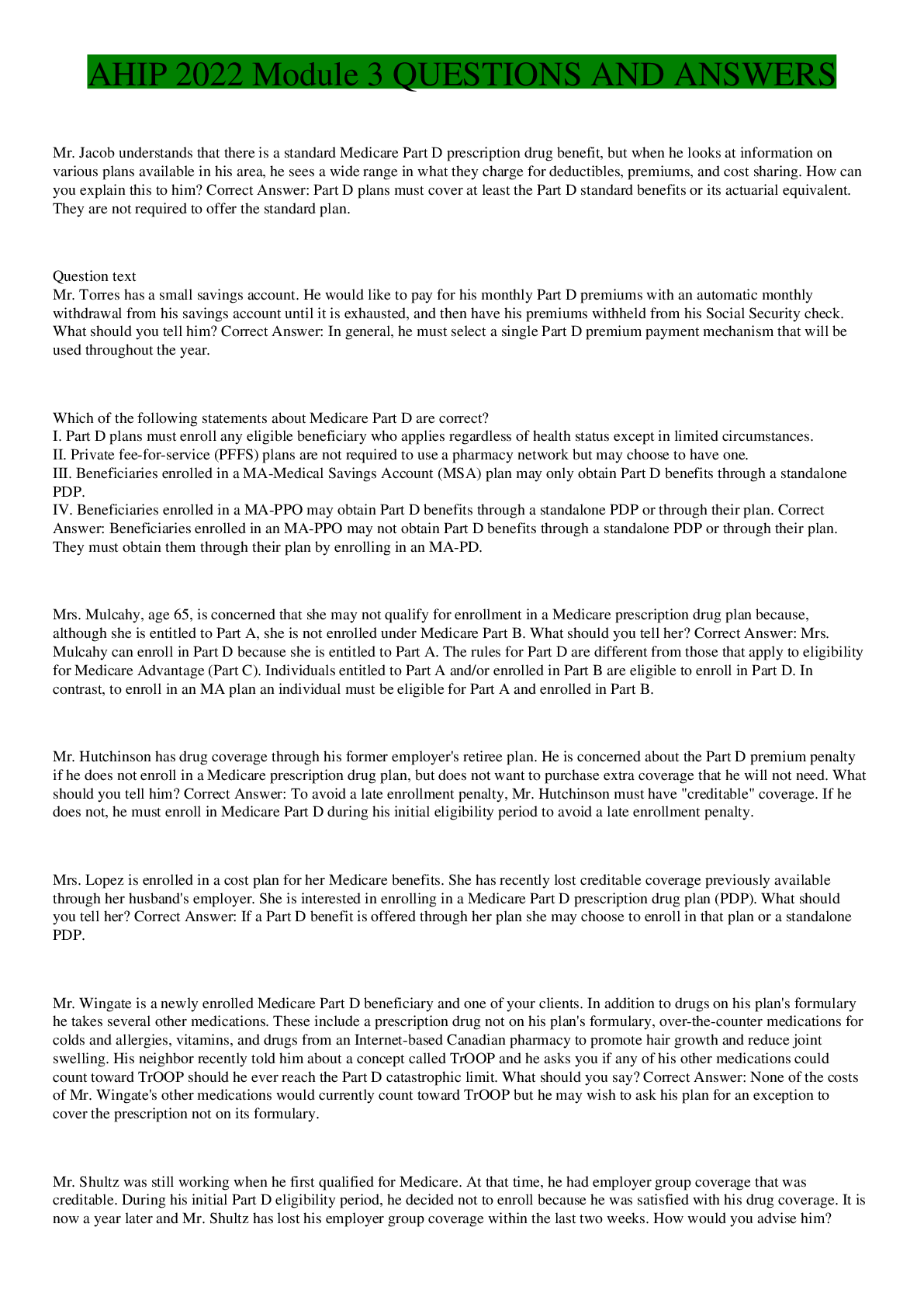
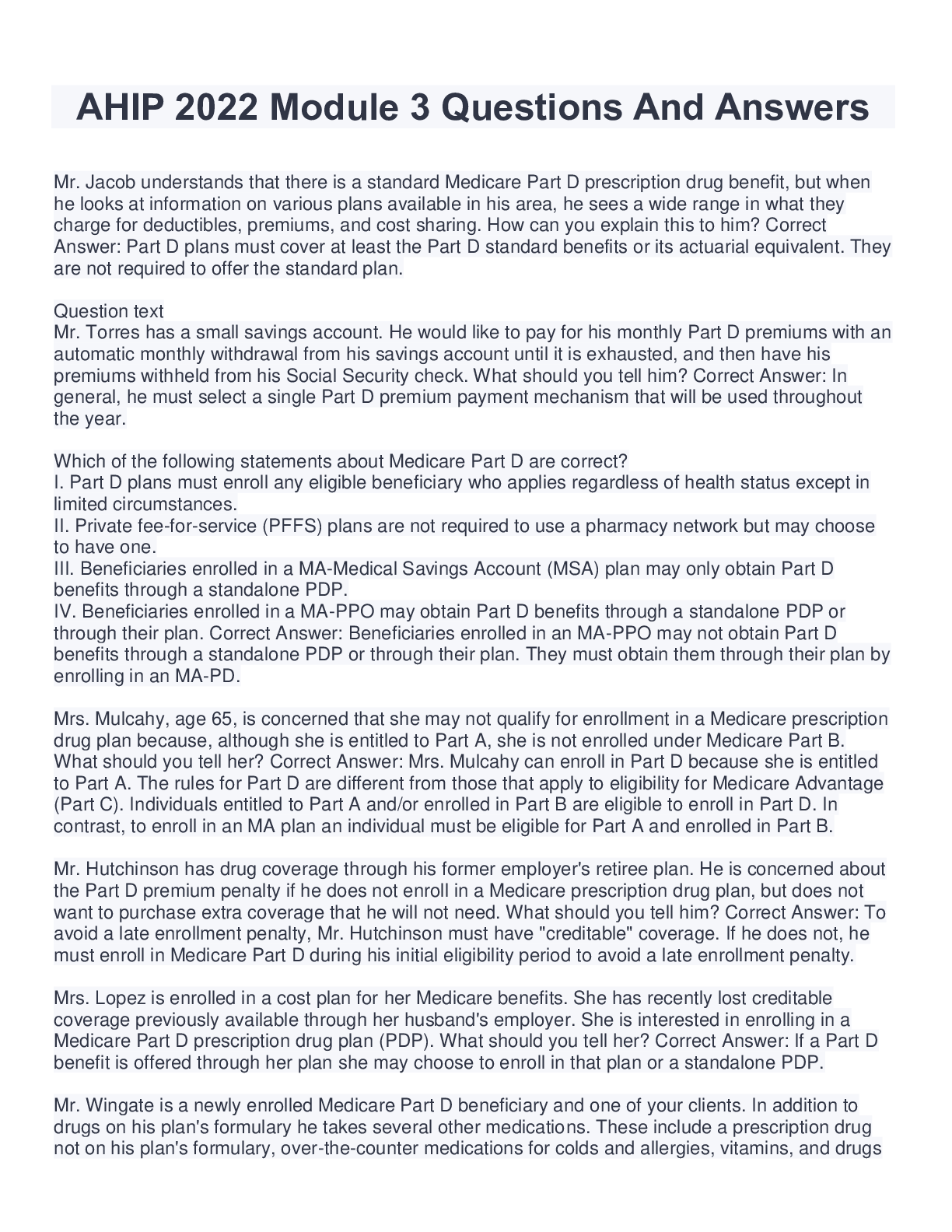
Mr. Jacob understands that there is a standard Medicare Part D prescription drug benefit, but
when he looks at information on various plans available in his area, he sees a wide range in what
they charge for deductibles, premiums, and cost sharing. How can you explain this to him? AnsPart D plans must cover at least the Part D standard benefits or its actuarial equivalent. They are
not required to offer the standard plan.
Question text
Mr. Torres has a small savings account. He would like to pay for his monthly Part D premiums
with an automatic monthly withdrawal from his savings account until it is exhausted, and then
have his premiums withheld from his Social Security check. What should you tell him? Ans- In
general, he must select a single Part D premium payment mechanism that will be used
throughout the year.
Which of the following statements about Medicare Part D are correct?
I. Part D plans must enroll any eligible beneficiary who applies regardless of health status except
in limited circumstances.
II. Private fee-for-service (PFFS) plans are not required to use a pharmacy network but may
choose to have one.
III. Beneficiaries enrolled in a MA-Medical Savings Account (MSA) plan may only obtain Part
D benefits through a standalone PDP.
IV. Beneficiaries enrolled in a MA-PPO may obtain Part D benefits through a standalone PDP or
through their plan. Ans- Beneficiaries enrolled in an MA-PPO may not obtain Part D benefits
through a standalone PDP or through their plan. They must obtain them through their plan by
enrolling in an MA-PD.
Mrs. Mulcahy, age 65, is concerned that she may not qualify for enrollment in a Medicare
prescription drug plan because, although she is entitled to Part A, she is not enrolled under
Medicare Part B. What should you tell her? Ans- Mrs. Mulcahy can enroll in Part D because she
is entitled to Part A. The rules for Part D are different from those that apply to eligibility for
Medicare Advantage (Part C). Individuals entitled to Part A and/or enrolled in Part B are eligible
to enroll in Part D. In contrast, to enroll in an MA plan an individual must be eligible for Part A
and enrolled in Part B.
Mr. Hutchinson has drug coverage through his former employer's retiree plan. He is concerned
about the Part D premium penalty if he does not enroll in a Medicare prescription drug plan, but
does not want to purchase extra coverage that he will not need. What should you tell him? AnsTo avoid a late enrollment penalty, Mr. Hutchinson must have "creditable" coverage. If he does
not, he must enroll in Medicare Part D during his initial eligibility period to avoid a late
enrollment penalty.
Mrs. Lopez is enrolled in a cost plan for her Medicare benefits. She has recently lost creditable
coverage previously available through her husband's employer. She is interested in enrolling in a
Medicare Part D prescription drug plan (PDP). What should you tell her? Ans- If a Part D benefit
is offered through her plan she may choose to enroll in that plan or a standalone PDP.
Mr. Wingate is a newly enrolled Medicare Part D beneficiary and one of your clients. In addition
to drugs on his plan's formulary he takes several other medications. These include a prescription
drug not on his plan's formulary, over-the-counter medications for colds and allergies, vitamins,
and drugs from an Internet-based Canadian pharmacy to promote hair growth and reduce joint
swelling. His neighbor recently told him about a concept called TrOOP and he asks you if any of
his other medications could count toward TrOOP should he ever reach the Part D catastrophic
limit. What should you say? Ans- None of the costs of Mr. Wingate's other medications would
currently count toward TrOOP but he may wish to ask his plan for an exception to cover the
prescription not on its formulary.
Mr. Shultz was still working when he first qualified for Medicare. At that time, he had employer
group coverage that was creditable. During his initial Part D eligibility period, he decided not to
enroll because he was satisfied with his drug coverage. It is now a year later and Mr. Shultz has
lost his employer group coverage within the last two weeks. How would you advise him? AnsMr. Schultz should enroll in a Part D plan before he has a 63-day break in coverage in order to
avoid a premium penalty.
Mr. Bickford did not quite qualify for the extra help low-income subsidy under the Medicare Part
D Prescription Drug program and he is wondering if there is any other option he has for
obtaining help with his considerable drug costs. What should you tell him? Ans- He could check
with the manufacturers of his medications to see if they offer an assistance program to help
people with limited means to obtain the medications they need. Alternatively, he could check to
see whether his state has a pharmacy assistance program to help him with his expenses.
Mrs. Quinn has just turned 65, is in excellent health and has a relatively high income. She uses
no medications and sees no reason to spend money on a Medicare prescription drug plan if she
does not need the coverage. She currently does not have creditable coverage. What could you tell
her about the implications of such a decision? Ans- If she does not sign up for a Medicare
prescription drug plan as soon as she is eligible to do so, and if she does sign up at a later date,
her premium will be permanently increased by 1% of the national average premium for every
month that she was not covered.
Ms. Edwards is enrolled in a Medicare Advantage plan that includes prescription drug plan
(PDP) coverage. She is traveling and wishes to fill two of the prescriptions that she has lost. How
would you advise her? Ans- She may fill prescriptions for covered drugs at non-network
pharmacies, but likely at a higher cost than paid at an in-network pharmacy.
Mr. Zachow has a condition for which three drugs are available. He has tried two but had an
allergic reaction to them. Only the third drug works for him and it is not on his Part D plan's
formulary. What could you tell him to do? Ans- Mr. Zachow has a right to request a formulary
exception to obtain coverage for his Part D drug. He or his physician could obtain the
standardized request form on the plan's website, fill it out, and submit it to his plan.
What types of tools can Medicare Part D prescription drug plans use that affect the way their
enrollees can access medications? Ans- P
[Show More]