Ferries Team Simulation Report
Introduction
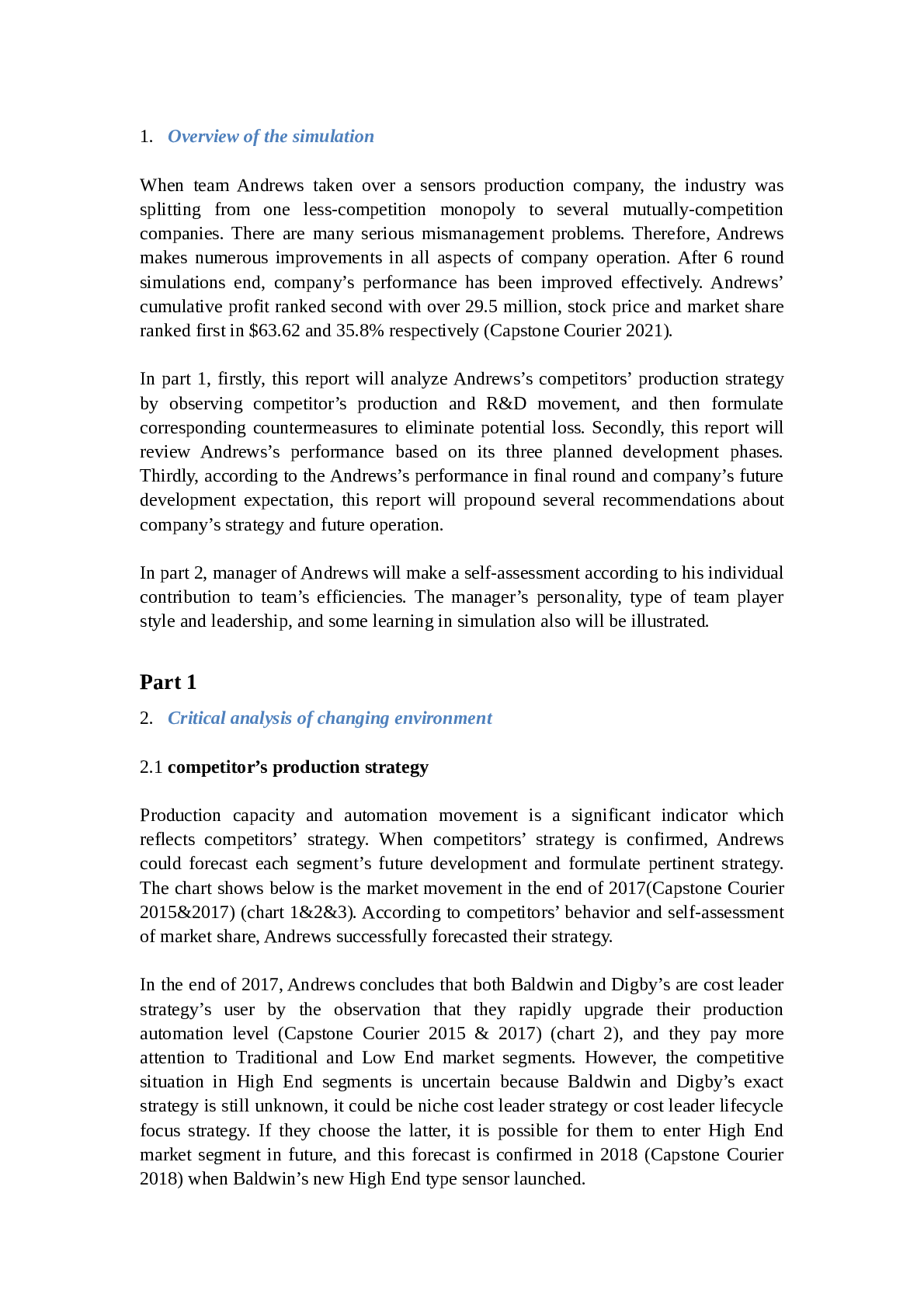
The purpose of the business simulation is to engage students in a dynamic competition to
turn struggling companies into successful and profitable enterprises. While workin
...
Ferries Team Simulation Report
Introduction
The purpose of the business simulation is to engage students in a dynamic competition to
turn struggling companies into successful and profitable enterprises. While working on
simulation, students focus on different business elements. The whole performance is based on a
strategy that students use while taking decisions, and they have to take many decisions according
to situation analysis. By working in teams, participants in Capsim's business simulations
enhance their business knowledge and judgment by making decisions that shape a company's
future one that needs a clear path to fulfill consumer expectations and boost its financial
performance.
Our company, ferries, has to compete with four other companies engaged in the sensor
industry in five different segments. We completed eight rounds, and, in every round, we used a
year-end report to build a product portfolio and managing cost. In this paper, we are explaining
the experience and learnings of working on Capsim business simulation. We would like to use
Gibbs's reflective cycle to reflect upon our business simulation journey across the semester.
3
Practice Round 1
(Selection of Strategy)
Description:
In our first class, we were introduced to Capsim software. This application is an outstanding
practice for MBA students to experience how businesses make decisions and make strategies to
do well. For working on Capsim, we created a group of five members, and then we planned to
create an account, and once everyone opened their account, we had a lot of discussions. Since
any of our team members did not use this software before, we were struggling to familiarize
themselves with this new software. For working on Capsim, we choose Ferries; after selecting
the company, we come to know about departments Research and development, Marketing,
Production, and Finance. For taking decisions for a practice round, we closely followed the
"ideal criteria" provided in the capsim guide for updating our sensors. Digby wanted to focus
more on low- and high-tech areas. As per the learning, we choose a differentiation strategy.
While implementing this strategy, we increased the area of present segments. Due to this, we
made a huge focus on Feat rather than focusing on each element. As everyone in our team was
scared to take the decision and nobody was sure about which strategy will work and which will
not work.
[Show More]





.png)

.png)