NURSING > STUDY GUIDE > NURS 6630 MIDTERM EXAM STUDY GUIDE (All)
NURS 6630 MIDTERM EXAM STUDY GUIDE
Document Content and Description Below
Non-compliant patients
Neurotransmitters- are chemical messengers that allow signals to cross synapses to
transmit information from a nerve cell or neuron to a target cell. Nerve transmitters
coordinate behavor
...
[Show More]
Last updated: 3 years ago
Preview 1 out of 14 pages
Instant download

Buy this document to get the full access instantly
Instant Download Access after purchase
Reviews( 0 )
Document information
Connected school, study & course
About the document
Uploaded On
May 19, 2022
Number of pages
14
Written in
All

Additional information
This document has been written for:
Uploaded
May 19, 2022
Downloads
0
Views
228
Document Keyword Tags
Recommended For You
Get more on STUDY GUIDE »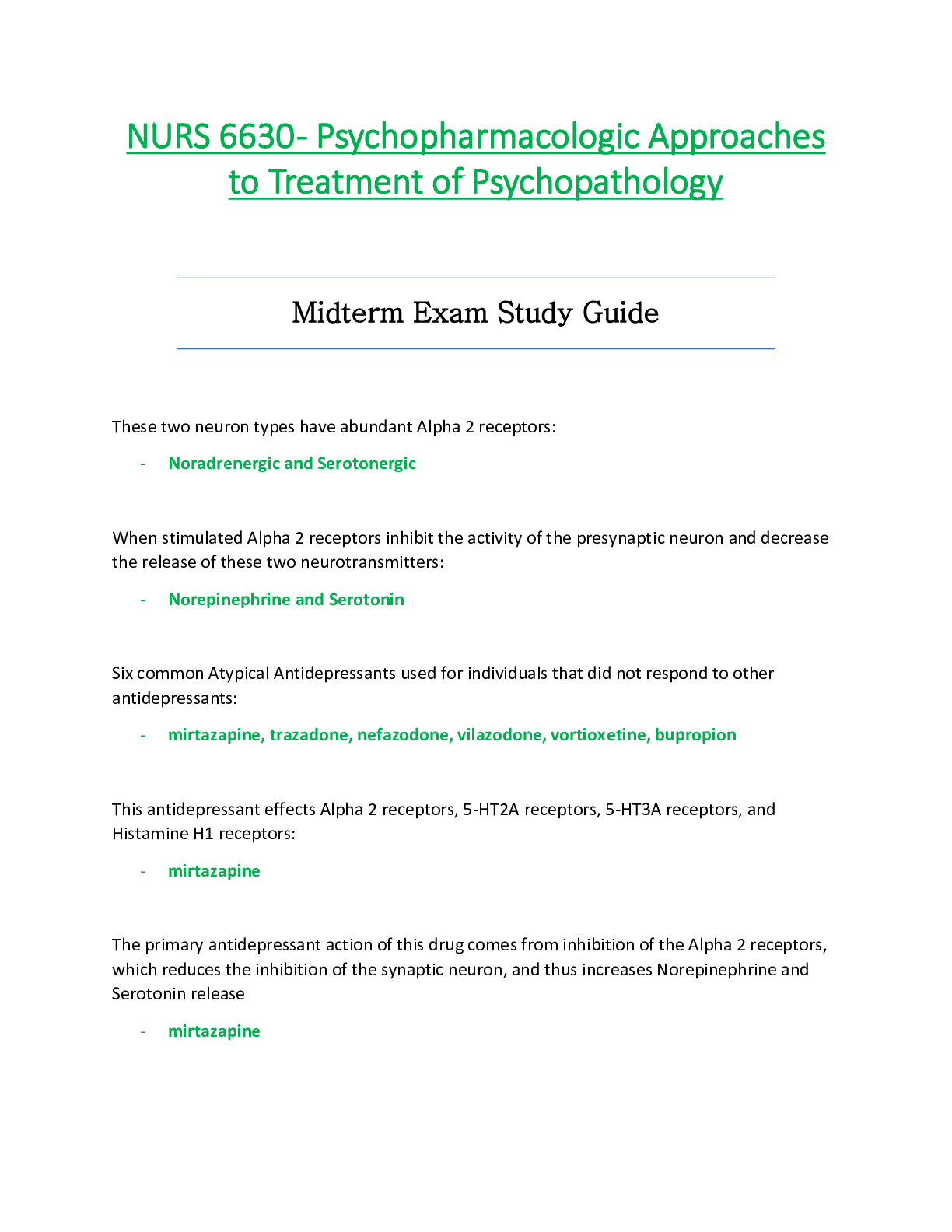
$10.5
22 Pages
NURS 6630 / NURS6630 Midterm Exam Study Guide : Psychopharmac...

$15
39 Pages
Walden University, Psychopharmacology, NURS 6630 Midterm Exam...

$10
17 Pages
NURS 6630 Final Exam Attempt Score 73/75 | Walden University

$12
14 Pages
NURS 6630 / NURS6630: Psychopharmacologic Approaches to Treatm...
$10.5
17 Pages
NURS 6630 / NURS6630: Midterm Exam Latest Update Walden Univer...

$20
22 Pages
Walden University - NURS 6630 midterm | NURS-6630N Midterm Exa...
$15
26 Pages
NURS 6630N-5- VERSION 5 Week 11 Final Exam (August 2021) SCORE...

$11
15 Pages
NURS-6630C-7/NURS-6630N-7-Approaches to Treatment Latest Grade...
$16.5
82 Pages
(Solution) NURS 6630 Week 10 Assignment: Assessing and Treati...
.png)
$14
4 Pages
Walden University NURS 6630 Therapy And Treatment of a Bipolar...
$12
2 Pages
Nurs 6630 week 5 discussion PTSD and the Thompson Family Case...

$10
37 Pages
CHIM NCE Health Information Management Practice Exam 1 – Ver...
$14.5
345 Pages
Complete Test Bank For Community Public Health Nursing Promoti...

$105.5
996 Pages
ATI TEAS 7 | 4 Versions for Reading, Math, Science, English, A...
More related documents below




![Preview of Leadership ATI Study Guide 149 Terms [A+ GUIDE]](https://www.scholarfriends.com/storage/Leadership ATI Study Guide.png)



