Leadership Study Guide
MANAGEMENT OF CARE (47)
1) Managing Client Care: Prioritizing Postoperative Client Needs
Prioritize systemic before local (“life before limb”).
› Prioritizing interventions for a client in s
...
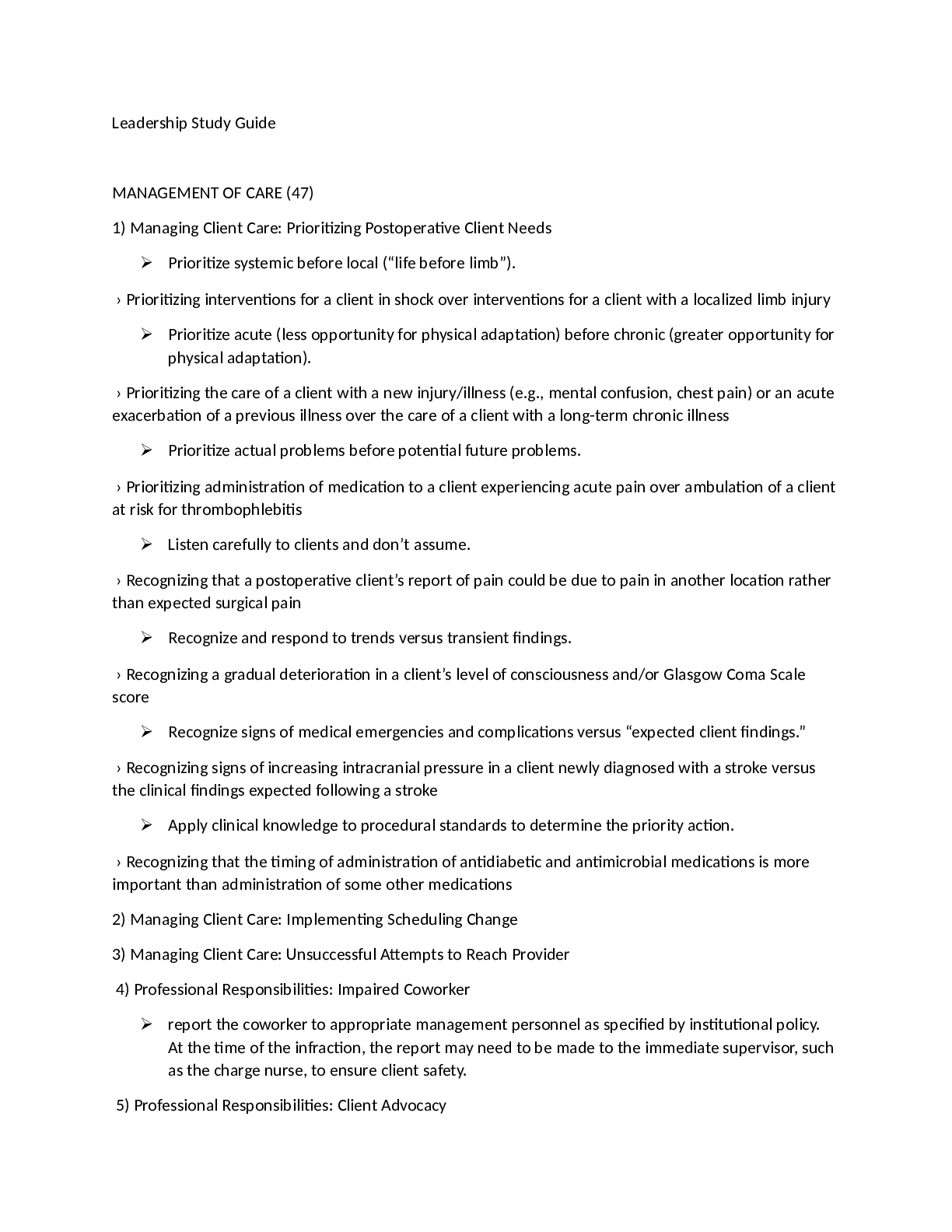
Leadership Study Guide
MANAGEMENT OF CARE (47)
1) Managing Client Care: Prioritizing Postoperative Client Needs
Prioritize systemic before local (“life before limb”).
› Prioritizing interventions for a client in shock over interventions for a client with a localized limb injury
Prioritize acute (less opportunity for physical adaptation) before chronic (greater opportunity for
physical adaptation).
› Prioritizing the care of a client with a new injury/illness (e.g., mental confusion, chest pain) or an acute
exacerbation of a previous illness over the care of a client with a long-term chronic illness
Prioritize actual problems before potential future problems.
› Prioritizing administration of medication to a client experiencing acute pain over ambulation of a client
at risk for thrombophlebitis
Listen carefully to clients and don’t assume.
› Recognizing that a postoperative client’s report of pain could be due to pain in another location rather
than expected surgical pain
Recognize and respond to trends versus transient findings.
› Recognizing a gradual deterioration in a client’s level of consciousness and/or Glasgow Coma Scale
score
Recognize signs of medical emergencies and complications versus “expected client findings.”
› Recognizing signs of increasing intracranial pressure in a client newly diagnosed with a stroke versus
the clinical findings expected following a stroke
Apply clinical knowledge to procedural standards to determine the priority action.
› Recognizing that the timing of administration of antidiabetic and antimicrobial medications is more
important than administration of some other medications
2) Managing Client Care: Implementing Scheduling Change
3) Managing Client Care: Unsuccessful Attempts to Reach Provider
4) Professional Responsibilities: Impaired Coworker
report the coworker to appropriate management personnel as specified by institutional policy.
At the time of the infraction, the report may need to be made to the immediate supervisor, such
as the charge nurse, to ensure client safety.
5) Professional Responsibilities: Client Advocacy
ensuring that they are properly informed, that their rights are respected, and that they are
receiving the proper level of care.
Advocacy is one of the most important roles of the nurse, especially when clients are unable to
speak or act for themselves.
As an advocate, the nurse ensures that the client has the information he needs to make
decisions about health care.
Nurses must act as advocates even when they disagree with clients’ decisions
The nursing profession also has a responsibility to support and advocate for legislation that
promotes public policies that protect clients as consumers and create a safe environment for
their care.
As advocates, nurses must ensure that clients are informed of their rights and have adequate
information on which to base health care decisions.
Nurses must be careful to assist clients with making health care decisions and not direct or
control their decisions.
Nurses may need to mediate on the client’s behalf when the actions of others are not in the
client’s best interest or changes need to be made in the plan of care.
Situations in which nurses may need to advocate for clients or assist them to advocate for
themselves include: ◯ End-of-life decisions ◯ Access to health care ◯ Protection of client
privacy ◯ Informed consent ◯ Substandard practice
6) Professional Responsibilities: Responding to Client Fears
Educate patient, provide information, and make referrals as needed
7) Coordinating Client Care: Findings to Report to Provider
Assessment data integral to changes in client status
Recommendations for changes in the plan of care
Clarification of orders
8) Managing Client Care: Appropriate Resources for Staff Development
9) Professional Responsibilities: HIPAA Violation
Become familiar with facility policies about the use of social media, and adhere to them.
Avoid disclosing any client health information online.
Be sure no one can overhear conversations about a client when speaking on the telephone.
Do not take or share photos or videos of a client.
Remember to maintain professional boundaries when interacting with clients online.
Never post a belittling or offensive remark about a client, employer, or coworker.
Report any violations of facility social media policies to the nurse manager
10) Managing Client Care: Recognizing Appropriate LPN Delegation
LPNS CAN:
monitoring client findings
reinforcement of client teaching from a standard care plan
trach care
suctioning
checking NG tube patency
administering enteral feeds
urinary catheterization
medication administration (excluding IV)
LPNS CANNOT:
maintain blood or blood components, hang solution for TPN
-cancer therapeutic meds like chemo or anti-neoplastic agents
-experimental meds
-solutions in a line that does not terminate in a peripheral vein
-iv piggyback
-D/C a central venous, arterial or any other line that does not terminate in a peripheral vein
-do anything with PCA
-Change arterial tubing, venous line or any line that does not terminal in peripheral vein
11) Professional Responsibilities: Risk for Breach of Client Confidentiality
12) Professional Responsibilities: Reporting Abuse
nurses are mandated to report any suspicion of abuse following facility policy
13) Maintaining a Safe Environment: Strategies for Cost Containment
Using all levels of personnel to their fullest when making assignments.
Providing necessary equipment and properly charging clients.
Returning uncontaminated, unused equipment to the appropriate department for credit.
Using equipment properly to prevent wastage.
Providing training to staff unfamiliar with equipment.
Returning equipment (IV, kangaroo pumps) to the proper department (central service, central
distribution) as soon as it is no longer needed.
This action will prevent further cost to clients
14) Managing Client Care: Responding to Staff Complaint
Typical steps of the grievance process include: Formal presentation of the complaint(s) using the
proper chain of command, Formal hearing if the issue is not resolved at a lower level,
Professional mediation if a solution is not reached during a formal hearing
15) Managing Client Care: Using Time Appropriately
What must be done immediately (administration of analgesic or antiemetic, assessment of
unstable client)? What must be done by a specific time to ensure client safety, quality care, and
compliance with facility policies and procedures (medication administration, vital signs, blood
glucose monitoring)? What must be done by the end of the shift (ambulation of the client,
discharge and/or discharge teaching, dressing change)? ◯ What can be delegated?
Time management involves using time-saving strategies and avoiding time wasters
› Documenting nursing interventions as soon as possible after completion to facilitate accurate
and thorough documentation
› Grouping activities that are to be performed on the same client or are in close physical
proximity to prevent unnecessary walking
› Estimating how long each activity will take and planning accordingly
› Mentally envisioning the procedure to be performed and ensuring that all equipment has been
gathered prior to entering the client’s room
› Taking time to plan care and taking priorities into consideration
› Delegating activities to other staff when client care workload is beyond what can be handled by
one nurse
› Enlisting the aid of other staff when a team approach would be more efficient than an
individual approach
› Completing more difficult or strenuous tasks when energy level is high
› Avoiding interruptions and graciously but assertively saying “no” to unreasonable or poorly
timed requests for help
› Setting a realistic standard for completion of care and level of performance within the
constraints of assignment and resources
Time initially spent developing a plan will save time later and help to avoid management by
crisis. ◯ Set goals and plan care based on established priorities and thoughtful utilization of
resources. ◯ Complete one client care task before beginning the next, starting with the highest
priority task. ◯ Reprioritize remaining tasks based on continual reassessment of client care
needs. ◯ At the end of the day, perform a time analysis and determine if time was used wisely.
16) Suicide: Priority Action for Client who is Depressed
Assess for thought or feelings of harming himself or others
17) Managing Client Care: Appropriate AP Delegation
activities of daily living (ADLs)
Bathing
Grooming
Dressing
Toileting
Ambulating
Feeding (without swallowing precautions)
Positioning
Bed making
Specimen collection
Intake and output (I&O)
Vital signs (on stable clients
18) Managing Client Care: Appropriate Assignment for an LPN
Monitoring client findings (as input to the RN’s ongoing assessment of the client) ›
Reinforcement of client teaching from a standard care plan ›
Tracheostomy care ›
Suctioning ›
Checking nasogastric tube patency
› Administration of enteral feedings
› Insertion of a urinary catheter
› Medication administration (excluding intravenous medications in several states)
19) Professional Responsibilities: Identifying Battery
Intentional and wrongful physical contact with a person that involves an injury or offensive
contact (restraining a client and administering an injection against his wishes)
physical contact without a person’s consent
20) Managing Client Care: Appropriate Task for Assistive Personnel
activities of daily living (ADLs)
Bathing
Grooming
Dressing
Toileting
Ambulating
Feeding (without swallowing precautions)
Positioning
Bed making
Specimen collection
Intake and output (I&O)
Vital signs (on stable clients
21) Coordinating Client Care: Client who has Anorexia Nervosa
22) Managing Client Care: Appropriate Tasks for LPN
Monitoring client findings (as input to the RN’s ongoing assessment of the client) ›
Reinforcement of client teaching from a standard care plan ›
Tracheostomy care ›
Suctioning ›
Checking nasogastric tube patency
› Administration of enteral feedings
› Insertion of a urinary catheter
› Medication administration (excluding intravenous medications in several states)
23) Professional Responsibilities: Priority Intervention as Client Advocate
As advocates, nurses must e
[Show More]