History of Present Problem:
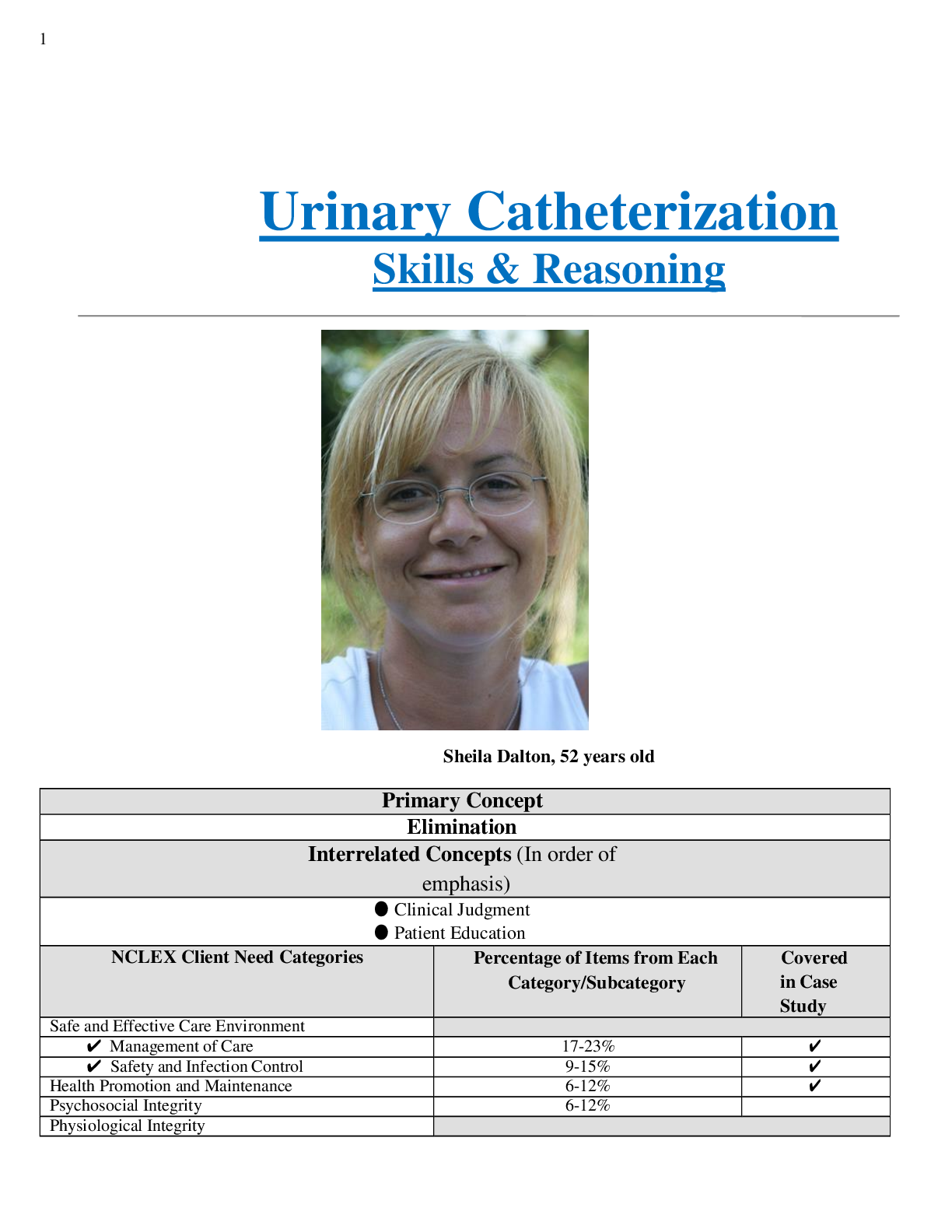
Sheila Dalton is a 52-year-old Caucasian female who has a history of chronic low back pain. She had a posterior spinal fusion of L4-S1 yesterday and is postoperative day (POD) #1. Her pain is
...
History of Present Problem:
Sheila Dalton is a 52-year-old Caucasian female who has a history of chronic low back pain. She had a posterior spinal fusion of L4-S1 yesterday and is postoperative day (POD) #1. Her pain is controlled at 2/10 and requires hydromorphone 0.5-1 mg IV every 4 hours. She is able to stand and sit in a chair with assistance. Her indwelling urinary catheter was discontinued six hours ago and she has not voided since the catheter was removed. Sheila is tolerating oral fluids and has had an oral intake of 1000 mL in the past eight hours.
Current Complaint:
Two hours later, Sheila puts on her call light and states that she is having moderate pain/pressure above her pubic bone that she has not had before.
What data from the story and current complaint do you NOTICE as RELEVANT and why is it clinically significant?
(Reduction of Risk Potential/Health Promotion and Maintenance)
RELEVANT Data-Patient Story: Clinical Significance:
n Female and had an indwelling urinary catheter
Postoperative day (POD) #1.
Had oral intake of 1000mL in past 8 hours but has not voided since catheter removal 6 hours ago It is important for the nurse to take into consideration the possibility of the patient developing a UTI because catheters are the most common factor associated with new onset UTIs in the hospital. About half of patients with indwelling catheters become infected within 1 week of catheter insertion. Also, being a female increases the chances of a UTI as well because the shorter urethra in women helps bacteria ascend from the perineal area to the bladder. Therefore, the nurse should continuously monitor the patients for signs and symptoms of a urinary tract infection even after removal of the urinary catheter.
Certain surgeries increase the risk for urinary retention which may contribute to her lack of urination. Also, surgeries put patients at risk for infection, therefore the nurse should monitor for any signs.
The patient should be drinking more fluids to help expel the possible bacteria that may have ascended to the bladder from the urinary catheter. And it will be important for the nurse to note that the patient has not voided in the past 8 hours. The nurse should note that urinary retention can commonly be caused by surgery considering that she is 1-day post op.
Also, if bacteria sits in the bladder for long periods of time due to urinary retention, the bacteria can multiply and increase the risk of developing a UTI. She should also recognize that a difficulty in initiating urine stream and urine retention are common symptoms of a urinary tract infection and there should monitor input and output.
RELEVANT Data-Current Complaint: Clinical Significance:
Moderate pain/pressure above her pubic bone that she has not had before Suprapubic tenderness may be due to urinary retention or be a sign of a possible urinary tract infection, kidney stones, appendicitis, or interstitial cystitis. The nurse should make note of this and consider the possible causes while continuing to gather more data on the patient’s condition.
Nursing Assessment Begins:
Current VS: Most Recent VS: Current WILDA:
T: 99.4 (oral) T: 98.9 (oral) Words: pressure/ache
P: 90 (reg) P: 72 (reg) Intensity: 8/10
R: 20 (reg) R: 18 (reg) Location: lower abdomen/suprapubic
BP: 152/82 BP: 138/80 Duration: ongoing the past hour
O2 sat: 95% room air O2 sat: 96% room air Aggravate: nothing
Alleviate: nothing
Current Assessment:
GENERAL
APPEARANCE: Appears restless and appears uncomfortable, tense body posture in bed
RESP: Breath sounds clear with equal aeration bilaterally, nonlabored respiratory effort
CARDIAC: Pink, warm & dry, no edema, heart sounds regular with no abnormal beats, pulses
strong, equal with palpation at radial/pedal/post-tibial landmarks
NEURO: Alert & oriented to person, place, time, and situation (x4)
GI: Lower suprapubic area tender and firm to palpation, bowel sounds active and
audible per auscultation in all four quadrants
GU: No urine output since indwelling urinary catheter discontinued six hours ago
SKIN: Skin integrity intact, 5 cm lateral incision down the lumbar spine with 4 steri- strips intact, 4 x 4 gauze dressing dry, intact with scant amount of serosanguineous drainage, no odor, edges well approximated, surrounding tissue
without redness
..................................................................................CONTINUED.............................................................
[Show More]