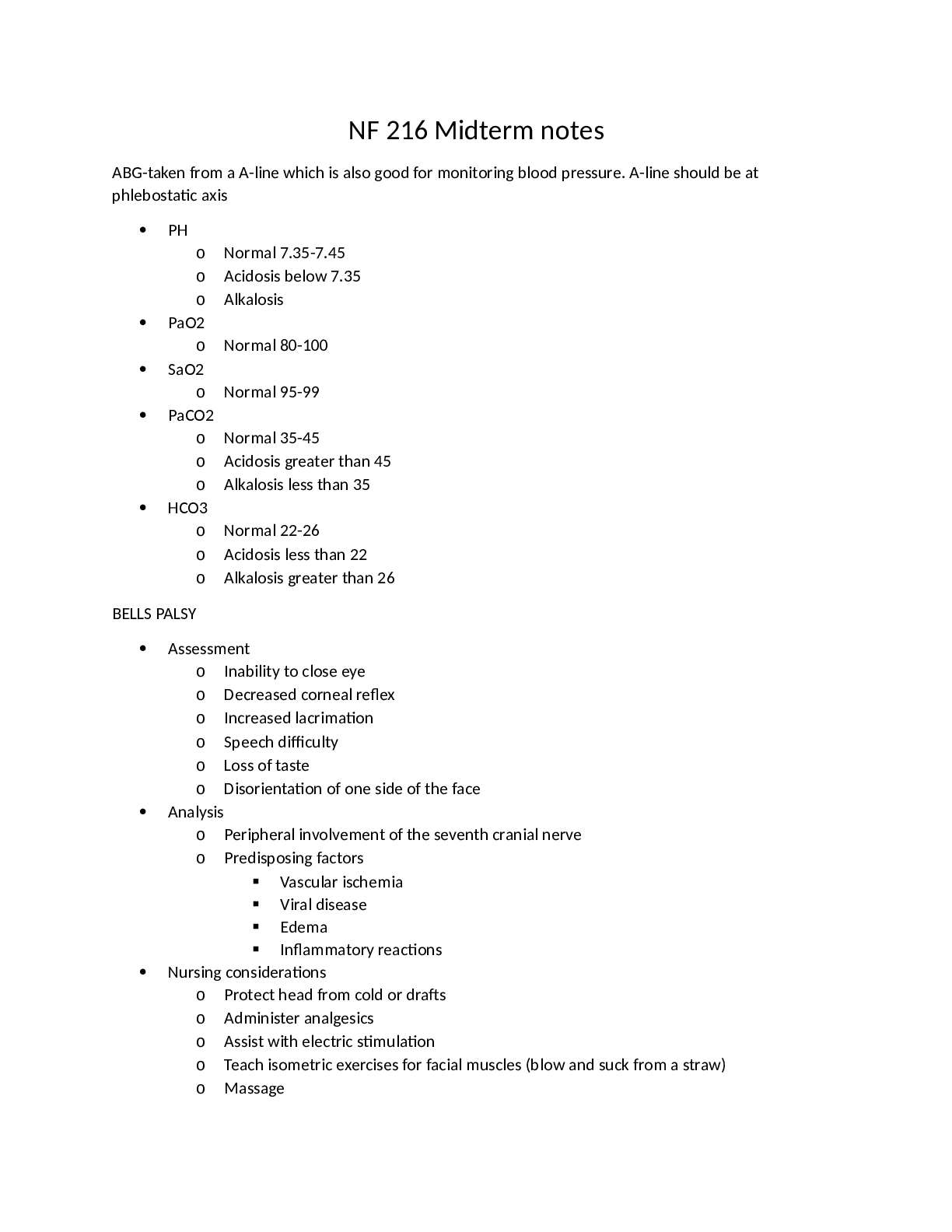
NF 216 Midterm notes
ABG-taken from a A-line which is also good for monitoring blood pressure. A-line should be at phlebostatic axis
• PH
o Normal 7.35-7.45
o Acidosis below 7.35
o Alkalosis
• PaO2
o Normal 80-1
...
NF 216 Midterm notes
ABG-taken from a A-line which is also good for monitoring blood pressure. A-line should be at phlebostatic axis
• PH
o Normal 7.35-7.45
o Acidosis below 7.35
o Alkalosis
• PaO2
o Normal 80-100
• SaO2
o Normal 95-99
• PaCO2
o Normal 35-45
o Acidosis greater than 45
o Alkalosis less than 35
• HCO3
o Normal 22-26
o Acidosis less than 22
o Alkalosis greater than 26 BELLS PALSY
• Assessment
o Inability to close eye
o Decreased corneal reflex
o Increased lacrimation
o Speech difficulty
o Loss of taste
o Disorientation of one side of the face
• Analysis
o Peripheral involvement of the seventh cranial nerve
o Predisposing factors
▪ Vascular ischemia
▪ Viral disease
▪ Edema
▪ Inflammatory reactions
• Nursing considerations
o Protect head from cold or drafts
o Administer analgesics
o Assist with electric stimulation
o Teach isometric exercises for facial muscles (blow and suck from a straw)
o Massage
o Warm packs
URINARY ELIMINATION
• Assessment
o Color-yellow
o Consistency-clear, transparent
o Specific gravity-1.010 to 1.030
o pH-4.5 to 8
o 24 hour production is 1,000 to 2,000. 50ml per hour or 1 mL/kg/hr
o BUN normal 10-20 or 3.6 to 7.1
o Creatinine normal 0.7 to 1.4 or 62-124
• Definitions
o Anuria-total urinary output less than 100 mL/24 hours
o Oliguria-total urinary output 100-400 mL/24 hours
o Polyuria-total urinary output greater than 2000 mL/hours
o Dysuria-painful or difficult voiding
• Predisposing factors
o Bedrest
o Tumors
o Prostatic hypertrophy, anticholinergic medications
o Decreased bladder tone-previous use of indwelling catheter or childbirth
o Cancer
o Neurogenic-CVA, spinal injuries
o Calculi
o Stress
o Urinary tract infection BRACHYTHERAPY
o Internal radiation like cesium, radium and gold
o Seal source like cesium is mechanically position source of radioactive material place in the body cavity or tumor
o Lead container and long handled forceps in room in the event of dislodged source
o Save all dressings, bed linens until the source is removed then discard dressings and liens as usual
o Urine, feces not radioactive
o Do not stand close or in line with radioactive source
o Client on bedrest while implant is in place
o Position of source verified by radiography
o Unsealed source of radiation-unsealed liquid given orally or instilled in the body cavity
o All body fluids contaminated
o Greatest danger from body fluids during first 24-96 hours
o Nursing care
o Assign client to private room
o Place caution radioactive material sign on door
o Wear dosimeter film badge at all times when interacting with client. Offers not protection but measures amount of exposure. Each nurse has an individual badge
o Do not assign a pregnant nurse to client
o Rotate staff caring for client. Limit close contact to 30 minutes per 8-hour shift
o Organize tasks so limited time is spent in client’s room
o Limit visitors
o Encourage client to do own care
o Provide shield in room
o Use antiemetics for nausea
o Consider body image like alopecia-loss of hair
o Provide comfort measures, analgesics for pain
o Provide good nutrition
o Skin care
o Avoid use of soaps and powders
o Wear cotton, loose fitting clothing
o Mouth care
o Stomatitis-develops 5-14 days after chemo begins
o Symptoms-erythema, ulcers, bleeding
o Rinse with saline or chlorhexidine. Avoid hard-bristled toothbrush, dental floss, lemon glycerin swabs.
o Avoid hot or spicy foods
o Topical antifungals and anesthetics
o Hair care
o Alopecia commonly seen, alters body image
o Assist with wig or hair piece
o Scarves, hats
o Nutritional changes
o Anorexia, nausea and vomiting commonly seen with chemo
o Malabsorption and cachexia (wasting) common
o Make meals appealing to senses
o Conform diet to client preference and nutritional needs
o Small frequent meals, high calorie, high protein
o Encourage fluids but limit at mealtimes
o Perform oral hygiene and provide relief of pain before meals
o Neutropenia precautions-prevent infection among clients with immunosuppression. Absolute neutrophil count less than or equal to 1000 cells
o Assess skin every 8 hours. Auscultate breath sounds, presence of cough, sore throat, check temp every 4 hours, report if higher than 101. Monitor CBC and differential daily
o Private room when possible
o Thorough hand washing
o Allow no staff with cold or sore throat to care for client
o No fresh flowers or standing water
o Clean room daily
o Low microbial diet. No fresh salads, unpeeled fresh fruits and vegetables.
o Deep breathe every 4 hours
o Meticulous body hygiene
o Inspect IV site
o Pain relief-three step ladder
o Mild pain-nonnarcotic medication like acetaminophen along with antiemetics, antidepressants and glucocorticoids
o For moderate pain-weak narcotics like codeine and nonnarcotic are used
o For severe pain-strong narcotics like morphine are used
o Give pain medication on regularly scheduled basis, preventative approach, additional analgesics given for breakthrough pain
o Activity level
o Alternate rest and activity
o Maintain normal lifestyle
o Psychosocial issues
o Encourage participation in self-care and decision making
o Provide referral to support groups, organizations
o Hospice care
CANCER
o Assessment
o Change in bowel, bladder habits
o A sore that does not heal
o Unusual bleeding or discharge
o Thickening or a lump in the breast or elsewhere
o Indigestion or difficulty in swallowing
o Obvious change in a wart or mole
o Nagging cough or hoarseness
o Risk factors
o Immunosuppression
o Advancing age
o Genetic predisposition
o Causative factors
o Radiation
o Chronic irritation
o Food additive-nitrates
o Asbestos
o Stilbesterol
o Smoking
o Alcohol
o Epstein Barr virus
o Burkitt’s lymphoma
o Stress
o Classifications
o Carcinoma-epithelial tissue
o Sarcoma-connective tissue
o Lymphoma-lymphoid tissue
o Leukemia-blood forming tissue. WBC and platelets
o Plan
o Avoid excessive intake of animal fat
o Avoid nitrates
o Decrease intake of red meat
o Limit alcohol
o Increase intake of bran, broccoli, cauliflower brussels sprouts, cabbage and foods high in vitamin A and C
o Chemotherapy
o Teletherapy (radiation)-like cobalt
o Leave radiology markings intact on skin
o Avoid creams, lotions, deodorants and or perfumes unless Rx
o Use lukewarm water to cleanse area
o Assess skin for redness, cracking
o Administer antiemetics for nausea, analgesics for pain
o Observe skin, mucous membranes and hair follicles for adverse effects
o No hot water bottle, tape. Don’t expose area to cold or sunlight
o Wear cotton clothing GASTRIC CANCER
o Description
o Malignant growth of the mucosal cells in the inner lining f the stomach with invasion to the muscle and beyond in advanced disease
o No single causative agent has been identified but it is believed that H. pylori and a diet of smoke, highly salted, processed or spiced foods have carcinogenic effects. Other risk factors include smoking, alcohol and nitrate ingestion and a history of gastric ulcers
o Complications include hemorrhage, obstruction, metastasis and dumping syndrome
o The goal of treatment is to remove the tumor and provide a nutritional program
o Assessment
o Early
▪ Indigestion
▪ Abdominal discomfort
▪ Full feeling
▪ Epigastric, back or retrosternal pain
o Late
▪ Weakness and fatigue
▪ Anorexia and weight loss
▪ Nausea and vomiting
▪ A sensation of pressure in the stomach
▪ Dysphagia and obstructive symptoms
▪ Iron deficiency anemia
▪ Ascites
▪ Palpable epigastric mass
o Interventions
▪ Monitor vital signs
▪ Monitor hemoglobin and hematocrit and administer blood transfusion as prescribed
▪ Monitor weight
▪ Assess nutritional status, encourage small bland, easily digestible meals with vitamin and mineral supplements
▪ Administer pain mediation as prescribed
▪ Prepare the client for chemotherapy or radiation therapy
▪ Prepare the client for surgical resection of the tumor as prescribed
o Post op
▪ Monitor vital signs
▪ Fowler’s position for comfort
▪ Administer analgesics and antiemetics
▪ Monitor I and O.
▪ Maintain NPO status as prescribed for 1 to 3 days until peristalsis returns. Assess for bowel sounds
▪ Electrolyte replacement and parenteral nutrition
▪ Monitor nasogastric suction. Following gastrectomy, drainage from the nasogastric tube is normally bloody for 24 hours changes to brown tinged and
then is yellow or clear
▪ Do not irrigate or remove the NG tube, but assist the PCP with irrigation or removal
▪ Advance the diet from NPO to sips of clear water to 6 small bland meals a day
▪ Monitor for complications such as hemorrhage, dumping syndrome, diarrhea, hypoglycemia, and vitamin B12 def.
PANCREATIC CANCER
o Most pancreatic tumors are highly malignant, rapidly growing adenocarcinomas originating from the epithelium of the ductal system.
o Pancreatic cancer is associated with increased age, a history of diabetes mellitus, alcohol use, history of previous pancreatitis, smoking, ingestion of a high fat diet and exposure to environmental chemicals
o Symptoms usually do not occur until the tumor is large, therefore the prognosis is poor
o Endoscopic retrograde cholangiopancreatography for visualization of the pancreatic duct and biliary system and collection of tissue and secretions may be done
o Assessment
o Nausea and vomiting
o Jaundice
o Unexplained weight loss
o Clay colored stools
o Glucose intolerance
o Abd pain
o Interventions
o Radiation
o Chemo
o Whipple procedure, which involves a pancreaticoduodenectomy with removal of the distal third of the stomach, pancreatojejunostomy, gastrojejunostomy and choledochojejunostomy
o Post op care measure and complications are similar to those for the care of a client with pancreatitis and the client following gastric surgery. Monitor blood glucose levels for transient hyperglycemia or hypoglycemia resulting from surgical manipulation of the pancreas.
LUNG CANCER
o Description
o Malignant tumor of the bronchi and peripheral lung tissue
o Common target for metastasis from other organs
o Assessment
o Cough
o Wheezing, dyspnea
o Hoarseness
o Hemoptysis, blood-tinged or purulent sputum
o Chest pain
o Anorexia and weight loss
o Weakness
o Diminisher or absent breath sounds, respiratory changes
o Interventions
o monitor for hemoptysis
o monitor for tracheal deviation
o place in a Fowler’s position
o administer bronchodilators
o provide a high calorie, high protein, high vitamin diet
o nonsurgical interventions
o radiation therapy may be prescribed for localized intrathoracic lung cancer and for palliation of hemoptysis, obstructions, dysphagia, superior vena cava syndrome and pain.
o Chemotherapy may be prescribed for treatment of nonresectable tumors or as adjuvant therapy
o Surgical interventions
o Laser therapy
▪ To relieve endobronchial obstruction
o Thoracentesis and pleurodesis
▪ To remove pleural fluid and relieve hypoxia
o Thoracotomy-opening into the thoracic cavity, with pneumonectomy
▪ Surgical removal of 1 entire lung
o Thoracotomy with lobectomy
▪ Surgical removal of 1 lobe of the lung for tumors confined to a single lobe
o Thoracotomy with segmental resection
▪ Surgical remove of a lobe segment
HEART DISEASE
o Angina pectoris
o Chest pain cause by myocardial ischemia
o Quick or slow in onset
o Indications
▪ Retrosternal chest pain that radiates usually to the left shoulder and upper arm and proceed down the arm into the fingers
▪ May also radiate to right shoulder, neck, jaw or epigastrium
▪ Usually lasts less than 5 minutes
▪ May describe pain as mild or moderate in severity as squeezing, burning, aching or bursting pressure.
▪ May say pain is like gas, indigestion or heartburn
▪ Dyspnea, pallor, palpitations, dizziness and diaphoresis
▪ Pain that is aggravated buy activity and relieved by rest and nitro
o Interventions
▪ Medications
• Antiplatelet agents
• Vasodilators
• Beta blockers
• Calcium channel blockers
▪ Pain relief
• Nitrates given sublingually
▪ Teach about nitro purpose and appropriate usage
▪ Encourage control of modifiable risk factors such as high cholesterol, smoking, hypertension, diabetes mellitus, obesity, lack of exercise and stress
o CAD
o Most prevealent form of cardiovascular disease in adults
o Non-modifiable risk factors
▪ Age
▪ Gender
▪ Family history of heart disease
o Modifiable
▪ Smoking
▪ Hypertension
▪ Elevated serum cholesterol levels
▪ Inactivity
▪ Obesity
▪ Diabetes mellitus
o Atherosclerosis causes ischemia which results in angina, myocardial infarction and sudden cardiac death
o Focus is to prevent disease by modifying modifiable risk factors
o Ineffective endocarditis
o Infection of heart lining and valves
o Signs and symptoms
▪ Fever
▪ Malaise
▪ Back and joint pain
▪ Splinter hemorrhages under fingernails and toenails
▪ Petechiae in conjunctiva and mucous membranes
▪ Heart murmur
o Care
▪ IV antibiotics for 4-6 weeks may need surgery for heart valve replacement
o Cardiomyopathy
o Disease of the heart muscle which can lead to heart failure, dysrhythmias and death
o Most common form is dilated cardiomyopathy, significant dilation of the ventricles without hypertrophy of the muscle
o Other form includes restrictive, arrhythmogenic right ventricular
o Indications
▪ Signs of symptoms of heart failure
o Tamponade
o Excessive fluid accumulates in the pericardium causing decreased venous return to heart which decreases cardiac output causing compression of the heart
o Cardinal signs
▪ Decreased systolic blood pressure
▪ Narrowing pulse pressure
▪ Increased venous pressure
▪ Muffled heart tones
o Caused by penetrating injuries, metastasis, cardiac surgery, advance heart failure
o Treatment
▪ Removal of the fluid in the pericardial sac
o Care
▪ Assess for pulses paradoxus-systolic blood pressure is lower during inhalation than exhalation
▪ Hemodynamic status
▪ Assist with pericardiocentesis
BLOOD PRESSURE
[Show More]