1
Shawna reads a scatterplot that displays the relationship between the number of cars owned per household and the average number of citizens who have health insurance in neighborhoods across the country. The plot show
...
1
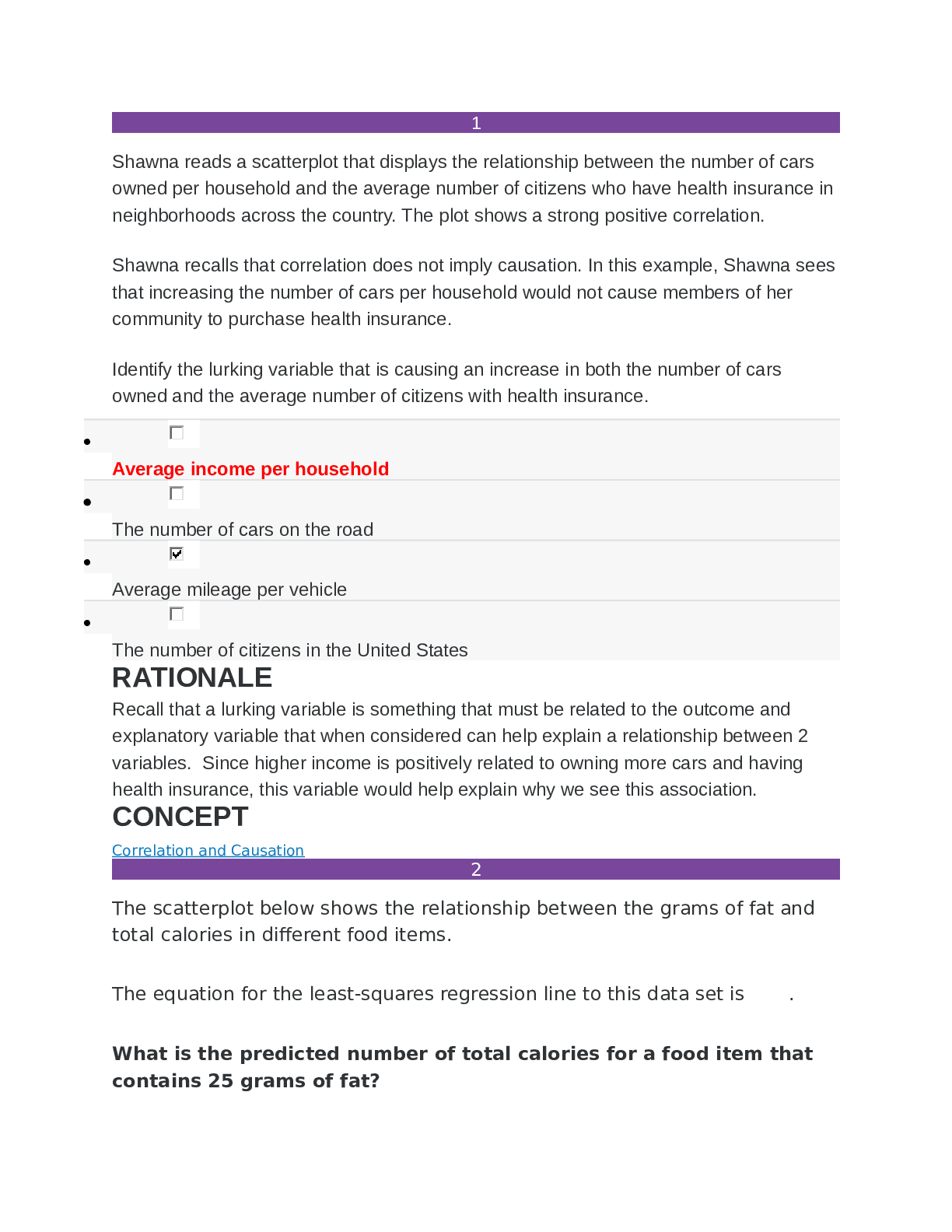
Shawna reads a scatterplot that displays the relationship between the number of cars owned per household and the average number of citizens who have health insurance in neighborhoods across the country. The plot shows a strong positive correlation.
Shawna recalls that correlation does not imply causation. In this example, Shawna sees that increasing the number of cars per household would not cause members of her community to purchase health insurance.
Identify the lurking variable that is causing an increase in both the number of cars owned and the average number of citizens with health insurance.
RATIONALE
Recall that a lurking variable is something that must be related to the outcome and explanatory variable that when considered can help explain a relationship between 2 variables. Since higher income is positively related to owning more cars and having health insurance, this variable would help explain why we see this association.
CONCEPT
Correlation and Causation
2
The scatterplot below shows the relationship between the grams of fat and total calories in different food items.
The equation for the least-squares regression line to this data set is .
What is the predicted number of total calories for a food item that contains 25 grams of fat?
•
RATIONALE
In order to get the predicted calories when the grams of fat is equal to 25, we simply substitute the value 25 in our equation for x. So we can note that:
CONCEPT
Predictions from Best-Fit Lines
3
John, the owner of an ice-cream parlor, collects data for the daily sales of ice cream with respect to the daily temperature.
If John were to create a scatterplot, all of the following will be characteristics of correlation EXCEPT .
RATIONALE
If we recall that correlation gives us a sense of the strength and direction of a linear association, it doesn't say exactly how much x is related to y. We don't use it to make prediction. This is what a regression line can be used for.
CONCEPT
Correlation
4
For a set of data, x is the explanatory variable. Its mean is 8.2, and its standard deviation is 1.92.
For the same set of data, y is the response variable. Its mean is 13.8, and its standard deviation is 3.03.
The correlation was found to be 0.223.
Select the correct slope and y-intercept for the least-squares line.
RATIONALE
We first want to get the slope. We can use the formula:
To then get the intercept, we can solve for the y-intercept by using the following formula:
We know the slope, , and we can use the mean of x and the mean of y for the variables and to solve for the y-intercept, .
CONCEPT
Finding the Least-Squares Line
5
Which of the following scatterplots shows a correlation affected by non-linearity?
RATIONALE
Recall that correlation is for linear association, so if a graph shows curvature, then it would not be adequately captured by using correlation. This plot clearly shows a non- linear graph.
CONCEPT
Cautions about Correlation
6
Jesse takes two data points from the weight and feed cost data set to calculate a slope, or average rate of change. A hamster weighs half a pound and costs $2 per week to feed, while a Labrador Retriever weighs 62.5 pounds and costs $10 per week to feed.
Using weight as the explanatory variable, what is the slope of a line between these two points? Answer choices are rounded to the nearest hundredth.
•
$6.25 / lb.
•
$0.13 / lb.
RATIONALE
In order to get slope, we can use the formula: .
Using the information provided, the two points are: (0.5 lb., $2) and (62.5 lb., $10). We can note that:
CONCEPT
Linear Equation Algebra Review
7
Data for price and thickness of soap is entered into a statistics software package and results in a regression equation of ŷ = 0.4 + 0.2x.
What is the correct interpretation of the slope if the price is the response variable and the thickness is an explanatory variable?
RATIONALE
When interpreting the linear slope, we generally substitute in a value of 1. So we can note that, in general, as x increases by 1 unit the slope tells us how the outcome changes. So for this equation we can note as x (thickness) increases by 1 cm, the outcome (price) will increase by $0.20 on average.
CONCEPT
Interpreting Intercept and Slope
8
Thomas was interested in learning more about the salary of a teacher. He believed as a teacher increases in age, the annual earnings also increases. The age (in years) is plotted against the earnings (in dollars) as shown below.
Using the best-fit line, approximately how much money would a 45- year-old teacher make?
RATIONALE
To get a rough estimate of the salary of a 45 year-old, we go to the value of 45 on the horizontal axis and then see where it falls on the best-fit line. This looks to be about
$50,000.
CONCEPT
Best-Fit Line and Regression Line
9
A correlation coefficient between average temperature and ice cream sales is most likely to be .
between 1 and 2
•
between –1 and –2
•
between 0 and –1
RATIONALE
In general as temperature increases, tastes for ice cream goes up. So the correlation should be positive, which would be between 0 and 1.
CONCEPT
Positive and Negative Correlations
10
Which of the following is a guideline for establishing causality?
RATIONALE
Recall that correlation is not sufficient alone to assess causality, however it is necessary. So for something to be causal, it must have a strong association.
CONCEPT
Establishing Causality
11
Which of the following statements is TRUE?
If the two variables of a scatterplot are strongly related, this condition implies causation between the two variables.
•
Only a correlation equal to 0 implies causation.
RATIONALE
Recall that correlation doesn't imply causation. Causation is a direct change in one variable causing a change in some outcome. Correlation is simply a measure of association. It is required for causation, but alone does not mean something is causal. Additional information is required to know something is causal, like seeing the association validated in an experimental design.
CONCEPT
Correlation and Causation
12
Raoul lives in Minneapolis and he is planning his spring break trip. He creates the scatterplot below to assess how much his trip will cost.
Which answer choice correctly indicates the explanatory and response variables for the scatterplot?
RATIONALE
The explanatory variable is what is along the horizontal axis, which is distance. The response variable is along the vertical axis, which is cost.
CONCEPT
Explanatory and Response Variables
13
Which of the following scatterplots shows an outlier in the y- direction?
RATIONALE
To have an outlier in the y-direction the outlier must be in the range of x data but outside the range of y-data. This outlier is outside of the data in the y direction, lying below all of the data.
CONCEPT
Outliers and Influential Points
14
A bank manager declares, with help of a scatterplot, that the number of health insurances sold may have some association with the number of inches it snows.
How many policies were sold when it snowed 2 to 4 inches?
RATIONALE
In order to find the total number of policies between 2 and 4 inches, we must add the three values of 10 in that interval.
At 2 inches, there were 100 policies. At 3 inches, there were 110 policies. At 4 inches, there were 140 policies.
So the total is 100 + 110 + 140 = 350 policies.
CONCEPT
Scatterplot
15
Shawna finds a study of American men that has an equation to predict weight (in pounds) from height (in inches): ŷ = -210 + 5.6x. Shawna's dad’s height is 72 inches and he weighs 182 pounds.
What is the residual of weight and height for Shawna's dad?
RATIONALE
Recall that to get the residual, we take the actual value - predicted value. So if the actual height of 72 inches and the resulting actual weight is 182 pounds, we simply need the predicted weight. Using the regression line, we can say:
The predicted weight is 193.2 pounds. So the residual is:
CONCEPT
Residuals
16
For the plot below the value of r2 is 0.7783.
Which of the following sets of statements is true?
RATIONALE
The coefficient of determination measures the percent of variation in the outcome, y, explained by the regression. So a value of 0.7783 tells us the regression with distance,
x, can explain about 77.8% of the variation in cost, y. We can also note that r = .
CONCEPT
Coefficient of Determination/r^2
17
The scores of the quizzes of five students in both English and Science are:
For English, the mean is 6.4 and the standard deviation is 2.0. For Science, the mean is 7 and the standard deviation is 1.6.
Using the formula below or Excel, find the correlation coefficient, r, for this set of scores. Answer choices are rounded to the nearest hundredth.
RATIONALE
In order to get the correlation, we can use the formula:
Correlation can be quickly calculated by using Excel. Enter the values and use the function "=CORREL(".
CONCEPT
Correlation
18
This scatterplot shows the performance of an electric motor using the variables speed of rotation and voltage.
Select the answer choice that accurately describes the data's form, direction, and strength in the scatterplot.
•
Form: The data points are arranged in a curved line.
Direction: The voltage increases as the speed of rotation increases. Strength: The data points are far apart from each other.
•
Form: The data points are arranged in a curved line.
Direction: The speed of rotation increases with an increase in voltage. Strength: The data points are far apart from each other.
•
Form: The data points appear to be in a straight line.
Direction: The voltage increases as the speed of rotation increases. Strength: The data points are closely concentrated.
•
Form: The data points appear to be in a straight line.
Direction: The speed of rotation increases with an increase in voltage. Strength: The data points are closely concentrated.
RATIONALE
If we look at the data, it looks as if a straight line captures the relationship, so the form is linear. The slope of the line is positive, so it is increasing. Finally, since the dots are closely huddled around each other in a linear fashion, it looks strong.
CONCEPT
Describing Scatterplots
[Show More]