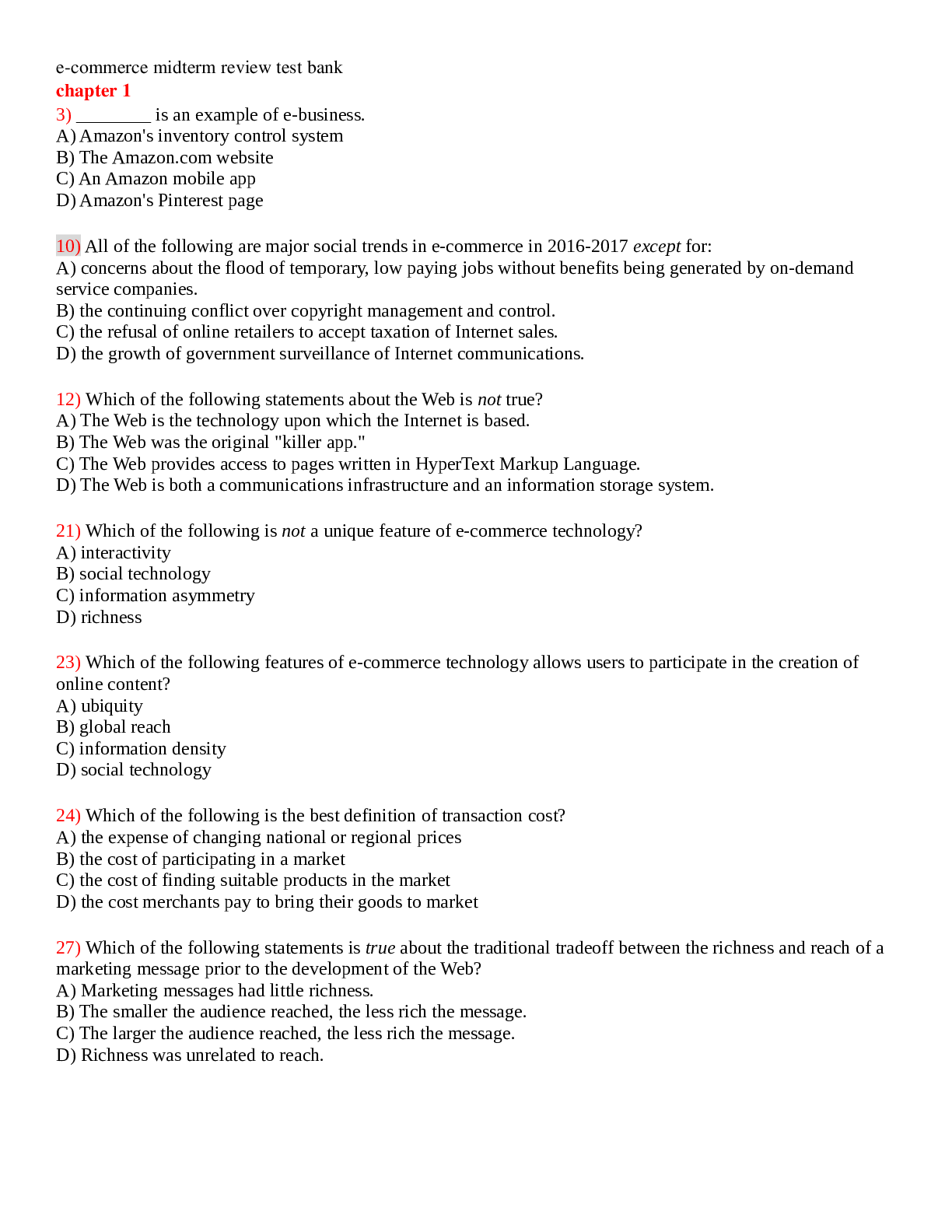
chapter 1
3) ________ is an example of e-business.
A) Amazon's inventory control system
B) The Amazon.com website
C) An Amazon mobile app
D) Amazon's Pinterest page
10) All of the following are major social trends
...
chapter 1
3) ________ is an example of e-business.
A) Amazon's inventory control system
B) The Amazon.com website
C) An Amazon mobile app
D) Amazon's Pinterest page
10) All of the following are major social trends in e-commerce in 2016-2017 except for:
A) concerns about the flood of temporary, low paying jobs without benefits being generated by on-demand
service companies.
B) the continuing conflict over copyright management and control.
C) the refusal of online retailers to accept taxation of Internet sales.
D) the growth of government surveillance of Internet communications.
12) Which of the following statements about the Web is not true?
A) The Web is the technology upon which the Internet is based.
B) The Web was the original "killer app."
C) The Web provides access to pages written in HyperText Markup Language.
D) The Web is both a communications infrastructure and an information storage system.
21) Which of the following is not a unique feature of e-commerce technology?
A) interactivity
B) social technology
C) information asymmetry
D) richness
23) Which of the following features of e-commerce technology allows users to participate in the creation of
online content?
A) ubiquity
B) global reach
C) information density
D) social technology
24) Which of the following is the best definition of transaction cost?
A) the expense of changing national or regional prices
B) the cost of participating in a market
C) the cost of finding suitable products in the market
D) the cost merchants pay to bring their goods to market
27) Which of the following statements is true about the traditional tradeoff between the richness and reach of a
marketing message prior to the development of the Web?
A) Marketing messages had little richness.
B) The smaller the audience reached, the less rich the message.
C) The larger the audience reached, the less rich the message.
D) Richness was unrelated to reach.
29) The costs incurred by merchants changing product prices (such as the costs of reentering prices into
computer systems) are referred to as:
A) subscription costs.
B) fixed costs.
C) menu costs.
D) variable costs.
30) Which of the following refers to any disparity in relevant market information among parties in a
transaction?
A) information asymmetry
B) unfair competitive advantage
C) imperfect competition
D) dynamic pricing
32) The total number of users or customers an e-commerce business can obtain is called:
A) ubiquity.
B) interactivity.
C) reach.
D) information density.
33) Which of the following refers to the complexity and content of a message?
A) richness
B) reach
C) information density
D) interactivity
35) Ubiquity lowers the cognitive energy required to transact in a marketspace. T or F
38) Cost transparency refers to the ease with which consumers can find out the variety of prices in a market.
T or F
45) Business-to-consumer (B2C) e-commerce in the United States:
A) has grown at double-digit rates between 2010 and 2016.
B) has less revenue than C2C e-commerce.
C) now constitutes over 50% of the overall U.S. retail market.
D) is growing more slowly as it confronts its own fundamental limitations.
47) Which of the following is an example of B2B e-commerce?
A) Airbnb
B) Facebook
C) Groupon
D) Go2Paper
48) Which of the following is an example of C2C e-commerce?
A) Amazon
B) Groupon
C) Craigslist
D) Go2Paper
50) The size of the B2B market in 2017 was estimated at:
A) $670 million.
B) $6.7 billion.
C) $670 billion.
D) $6.7 trillion.
53) Which of the following describes the basic web policy of large firms during the Invention period?
A) Integrate social networks and the mobile platform with website marketing.
B) Emphasize the necessity of the Web to generate profits.
C) Use the Web to sell complex goods and services online.
D) Maintain a basic, static website depicting the firm's brand.
54) All of the following are considered a precursor to e-commerce except:
A) the development of the smartphone.
B) Baxter Healthcare's PC-based remote order entry system.
C) the French Minitel.
D) the development of Electronic Data Interchange (EDI) standards.
55) Which of the following was the first large-scale digitally enabled transaction system in the B2C arena?
A) Telex
B) the Baxter Healthcare system
C) the French Minitel
D) EDI
56) In which year was e-commerce said to have begun?
A) 1983
B) 1985
C) 1995
D) 2001
57) Which of the following is a characteristic of e-commerce during the Invention period?
A) mobile technology
B) earnings and profit emphasis
C) disintermediation
D) extensive government surveillance
59) Which of the following is not a characteristic of a perfect competitive market?
A) Price, cost, and quality information are equally distributed.
B) A nearly infinite set of suppliers compete against one another.
C) Customers have access to all relevant information worldwide.
D) It is highly regulated.
60) All of the following were visions expressed during the early years of e-commerce except:
A) a nearly perfect information marketspace.
B) friction-free commerce.
C) disintermediation.
D) fast follower advantage.
62) The early years of e-commerce were driven by all of the following factors except:
A) an emphasis on exploiting traditional distribution channels.
B) a huge infusion of venture capital funds.
C) an emphasis on quickly achieving very high market visibility.
D) visions of profiting from new technology.
65) Which of the following is a characteristic of the Reinvention phase of e-commerce?
A) massive proliferation of dot-com start-ups
B) widespread adoption of broadband networks
C) rapid growth of search engine advertising
D) expansion of e-commerce to include services as well as goods
66) Which of the following is a characteristic of the Consolidation phase of e-commerce?
A) predominance of pure online strategies
B) emphasis on revenue growth versus profits
C) brand extension and strengthening becomes more important than creating new brands
D) shift to a technology-driven approach
69) Which of the following is an example of an e-commerce first mover that failed?
A) Etsy
B) eToys
C) eBay
D) E*Trade
70) Which of the following refers to the practice of researching a product online before purchasing it at a
physical store?
A) zooming
B) grazing
C) showrooming
D) webrooming
78) All of the following are issues facing Pinterest except:
A) copyright infringement.
B) inability to retain users.
C) spam.
D) scams.
80) Which business application is associated with the technological development of local area networks and
client/server computing?
A) transaction automation (e.g., payroll)
B) desktop automation (e.g., word processing)
C) industrial system automation (e.g., supply chain management)
D) workgroup automation (e.g., document sharing)
84) Which of the following statements is not true?
A) No one academic perspective dominates research about e-commerce.
B) Economists take a purely technical approach to e-commerce.
C) There are two primary approaches to e-commerce: behavioral and technical.
D) Management scientists are interested in e-commerce as an opportunity to study how business firms can
exploit the Internet to achieve more efficient business operations.
chapter 2
1) ________ and ________ are typically the most easily identifiable aspects of a company's business model.
A) Market strategy; market opportunity
B) Value proposition; revenue model
C) Competitive advantage; competitive environment
D) Revenue model; market opportunity
2) All of the following use a subscription revenue model for music except:
A) Spotify.
B) eHarmony.
C) Rhapsody.
D) Pandora.
3) Which element of the business model addresses what a firm provides that other firms cannot?
A) competitive environment
B) competitive advantage
C) market strategy
D) value proposition
5) Which of the following represent Amazon's primary value proposition(s)?
A) personalization and customization
B) selection and convenience
C) reduction of price discovery cost
D) management of product delivery
7) Which of the following is an example of the subscription revenue model?
A) Scribd
B) eBay
C) E*Trade
D) Twitter
8) Stickiness is an important attribute for which of the following revenue models?
A) advertising revenue model
B) subscription revenue model
C) transaction fee revenue model
D) affiliate revenue model
10) Which of the following is an example of the affiliate revenue model?
A) Scribd
B) eBay
C) L.L. Bean
D) MyPoints
11) Which of the following involves a company giving away a certain level of product or services without
charge, but then charging a fee for premium levels of the product or service?
A) advertising revenue model
B) subscription revenue model
C) freemium strategy
D) transaction fee revenue model
12) Which of the following is not a significant influence on a company's competitive environment?
A) how many competitors are active
B) the market share of each competitor
C) the availability of supportive organizational structures
D) how competitors price their products
13) All of the following would be considered a direct competitor of Priceline except:
A) Travelocity.
B) Expedia.
C) Orbitz.
D) ESPN.
14) The existence of many competitors in any one market segment may indicate:
A) an untapped market niche.
B) the market is saturated.
C) no one firm has differentiated itself within that market.
D) a market that has already been tried without success.
18) A ________ specifically details how you plan to find customers and sell your product.
A) sales analysis
B) business plan
C) competitive strategy
D) market strategy
19) Which of the following was not able to successfully implement a freemium business model?
A) Pandora
B) Dropbox
C) LinkedIn
D) Baremetrics
23) Which of the following statements about Foursquare is not true?
A) Foursquare combines a social network business model with location-based technology.
B) Foursquare has struggled to find profitability.
C) Foursquare's business model raises significant privacy concerns.
D) In 2016, Foursquare decided to refocus its effort on developing a subscription-based revenue model.
27) The use of a company's competitive advantage to penetrate surrounding markets is known as ________.
A) market strategy
B) differentiation
C) leverage
D) focus
32) Asymmetries enable some firms to have an edge over others. T or F
42) An example of a company using the content provider model is:
A) Priceline.
B) Rhapsody.
C) Dell.
D) eBay.
48) Which of the following is not considered a portal?
A) Yahoo
B) MSN
C) Amazon
D) AOL
50) The basic value proposition of community providers is:
A) they offer a fast, convenient one-stop site where users can focus on their most important concerns and
interests.
B) they offer consumers valuable, convenient, time-saving, and low cost alternatives to traditional service
providers.
C) they create a digital electronic environment for buyers and sellers to meet, agree on a price, and transact.
D) they increase customers' productivity by helping them get things done faster and with less expense.
54) In the ________ business model, a web-based business builds a digital environment in which buyers and
sellers can meet, display products, search for products, and establish prices.
A) market creator
B) community provider
C) e-tailer
D) portal
60) ________ create and sell access to digital markets.
A) E-distributors
B) Portals
C) E-procurement firms
D) Market creators
61) Which of the following may offer its customers value chain management software?
A) e-distributors
B) e-procurement companies
C) exchanges
D) community providers
63) TheSeam is an example of a(n):
A) private industrial network.
B) exchange.
C) industry consortium.
D) e-distributor.
67) Which business strategy involves implementing a new, more efficient set of business processes that other
firms cannot yet obtain?
A) strategy of cost competition
B) scope strategy
C) customer intimacy strategy
D) focus/market niche strategy
69) Which of the following is not a primary activity in a firm value chain?
A) outbound logistics
B) finance/accounting
C) operations
D) after-sales service
70) A ________ is a networked business ecosystem that coordinates a firm's suppliers, distributors, and delivery
firms with its own production needs using an Internet-based supply chain management system.
A) value chain
B) value system
C) value web
D) business strategy
71) If you wished to leverage the ubiquitous nature of the Web to differentiate your product, you would:
A) enable individual customization of the product by consumers.
B) implement a strategy of commoditization.
C) adopt a strategy of cost competition.
D) develop a scope strategy to compete within a narrower market segment.
73) ________ technologies are technologies that enable the incremental improvement of products and services.
A) Sustaining
B) Differentiating
C) Disruptive
D) Commodity
76) Scale economies are efficiencies that result from flattening the hierarchy of an organization.
T or F
77) A company's strong linkages with its customers decreases switching costs.
T or F
Chapter 3
1) During which period of time did the Institutionalization phase of Internet development take place?
A) 1950-1960
B) 1961-1974
C) 1975-1995
D) 1995-through the present
2) Which of the following occurred during the Commercialization phase of Internet development?
A) The fundamental building blocks of the Internet were realized in actual hardware and software.
B) Personal computers were invented.
C) The Domain Name System (DNS) was introduced.
D) NSF privatized the operation of the Internet's backbone.
7) The Transport Layer of TCP/IP is responsible for which of the following?
A) placing packets on and receiving them from the network medium
B) addressing, packaging, and routing messages
C) providing communication with the application by acknowledging and sequencing the packets to and from the
application
D) providing a variety of applications with the ability to access the services of the lower layers
8) The Internet Layer of TCP/IP is responsible for which of the following?
A) placing packets on and receiving them from the network medium
B) addressing, packaging, and routing messages
C) providing communication with the application by acknowledging and sequencing the packets to and from the
application
D) providing a variety of applications with the ability to access the services of the lower layers
12) Which of the following is not an advantage of client/server computing over centralized mainframe
computing?
A) It is easy to expand capacity by adding servers and clients.
B) Each client added to the network increases the network's overall capacity and transmission speeds.
C) Client/server networks are less vulnerable, in part because the processing load is balanced over many
powerful smaller computers rather than concentrated in a single huge computer.
D) There is less risk that a system will completely malfunction because backup or mirror servers can pick up
the slack if one server goes down.
14) Which of the following protocols is used to send mail to a server?
A) IMAP
B) FTP
C) HTTP
D) SSL
15) Where does TLS operate within TCP/IP?
A) between the Internet Layer and the Transport Layer
B) between the Transport Layer and the Application Layer
C) between the Network Interface Layer and the Transport Layer
D) between the Internet Layer and the Application Layer
17) ________ is used to allow remote login on another computer.
A) Telnet
B) FTP
C) HTTP
D) SSL
18) ________ is a utility program that allows you to check the connection between your client and a TCP/IP
network.
A) Ping
B) Telnet
C) Tracert
D) Finger
19) Which of the following technologies has enabled the Internet to grow exponentially to support millions of
users, without overloading the network architecture?
A) fiber optics
B) Wi-Fi
C) IPv6
D) client/server computing
[Show More]






.png)