STRUCTURE AND FUNCTION OF THE CV AND
LYMPHATIC SYSTEMS
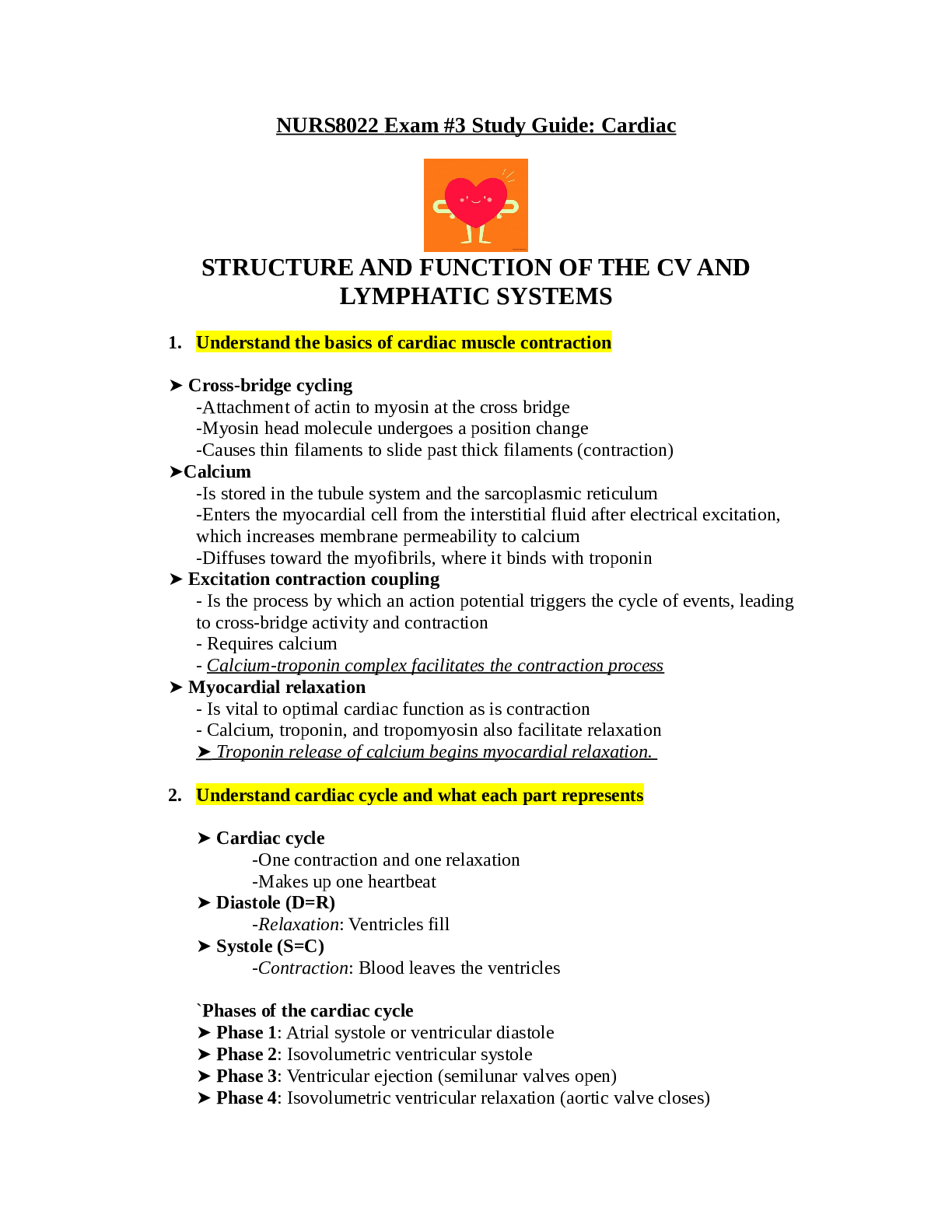
1. Understand the basics of cardiac muscle contraction
➤ Cross-bridge cycling
-Attachment of actin to myosin at the cross bridge
-Myosin head molecule undergoes
...
STRUCTURE AND FUNCTION OF THE CV AND
LYMPHATIC SYSTEMS
1. Understand the basics of cardiac muscle contraction
➤ Cross-bridge cycling
-Attachment of actin to myosin at the cross bridge
-Myosin head molecule undergoes a position change
-Causes thin filaments to slide past thick filaments (contraction)
➤Calcium
-Is stored in the tubule system and the sarcoplasmic reticulum
-Enters the myocardial cell from the interstitial fluid after electrical excitation,
which increases membrane permeability to calcium
-Diffuses toward the myofibrils, where it binds with troponin
➤ Excitation contraction coupling
- Is the process by which an action potential triggers the cycle of events, leading
to cross-bridge activity and contraction
- Requires calcium
- Calcium-troponin complex facilitates the contraction process
➤ Myocardial relaxation
- Is vital to optimal cardiac function as is contraction
- Calcium, troponin, and tropomyosin also facilitate relaxation
➤ Troponin release of calcium begins myocardial relaxation.
2. Understand cardiac cycle and what each part represents
➤ Cardiac cycle
-One contraction and one relaxation
-Makes up one heartbeat
➤ Diastole (D=R)
-Relaxation: Ventricles fill
➤ Systole (S=C)
-Contraction: Blood leaves the ventricles
`Phases of the cardiac cycle
➤ Phase 1: Atrial systole or ventricular diastole
➤ Phase 2: Isovolumetric ventricular systole
➤ Phase 3: Ventricular ejection (semilunar valves open)
➤ Phase 4: Isovolumetric ventricular relaxation (aortic valve closes)➤ Phase 5: Passive ventricular filling (mitral and tricuspid valves open)
Atrial contraction – deoxygenated blood travels from the atria (top) to the
ventricles through the AV valves (triscupid & mitral)
Isovolumetric contraction – pressure from the outside of the heart
squeezes, closes the valves
Ventricular ejection – cont pressure makes the deoxygenated blood get
pumped out form the right side of heart to the pulmonary veins to the
lungs to get them oxygenated
Isovolumetric relaxation – release of the blood to the lungs
Atrial filling – oxygenated blood fills the atria
Ventricular filling, AV valves open, allowing oxygenated blood to enter
the heart, L side pumps it all to the body
Right Heart Function Left Heart Function
Pumps blood through the lungs
*pulmonary circulation
Pumps oxygenated blood through the
systemic circulation
Delivers blood to the lungs for oxygenation Delivers metabolic waste products to the
lungs, kidneys, & live
[Show More]