ECE355 Week 3 quiz
Question 1
0 / 1 pts
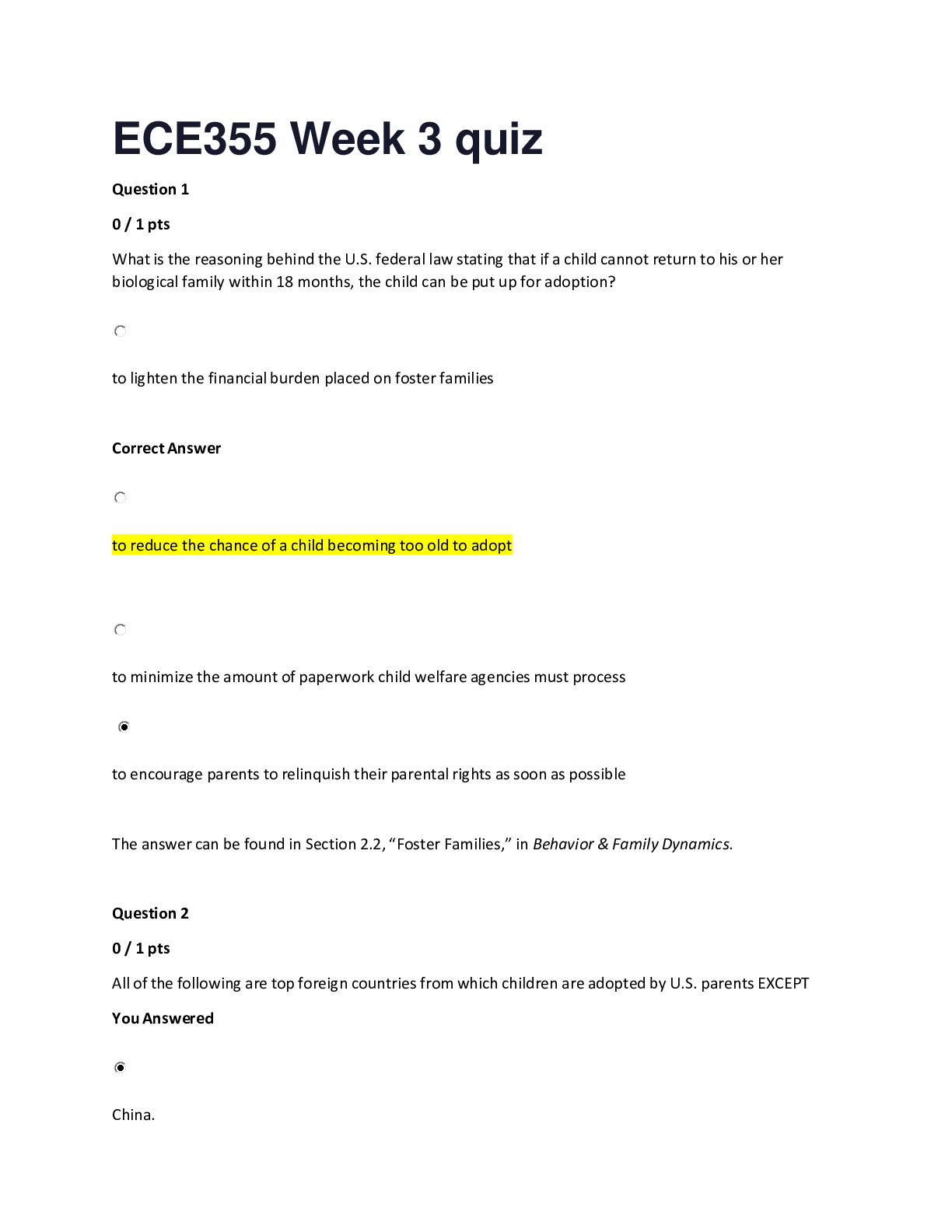
What is the reasoning behind the U.S. federal law stating that if a child cannot return to his or her biological family within 18 months, the child can be put up for adoption?
...
ECE355 Week 3 quiz
Question 1
0 / 1 pts
What is the reasoning behind the U.S. federal law stating that if a child cannot return to his or her biological family within 18 months, the child can be put up for adoption?
to lighten the financial burden placed on foster families
to reduce the chance of a child becoming too old to adopt
to minimize the amount of paperwork child welfare agencies must process
to encourage parents to relinquish their parental rights as soon as possible
The answer can be found in Section 2.2, “Foster Families,” in Behavior & Family Dynamics.
Question 2
0 / 1 pts
All of the following are top foreign countries from which children are adopted by U.S. parents EXCEPT
You Answered
China.
Ethiopia.
South Korea.
Panama.
The answer can be found in Section 2.3, “Adoptive Families,” in Behavior & Family Dynamics.
Question 3
1 / 1 pts
From 2000 to 2008, the largest segment of immigrants to the United States came from .
Europe
Asia
Canada
Latin America
The answer can be found in 6.2, “Changing Views on American Culture,” in Behavior & Family Dynamics.
Question 4
1 / 1 pts
Which of the following groups had the highest percentage of children living with two married parents in 2013?
White
Black
Hispanic
Asian
The answer can be found in Section 2.1, “Single-Parent Families,” in Behavior & Family Dynamics.
Question 5
1 / 1 pts
Mr. Jones is a sixth-grade teacher. Which of the following is NOT a good way for him to support the healthy racial, ethnic, and gender identity development of his students?
respect, acknowledge, and include each child’s home language in the classroom
focus on celebrating a single racial, ethnic, or cultural heritage
encourage his students to befriend people of other cultures, races, and ethnicities
plan activities that challenge stereotypes and assumptions about groups of people
The answer can be found in Section 6.3, “The Intersection of Family and Culture,” in Behavior & Family Dynamics.
Question 6
0 / 1 pts
What percentage of U.S. unmarried teen mothers currently place their children for adoption?
2%–3%
You Answered
4%–5%
6%–7%
8%–9%
The answer can be found in Section 2.5, “Teen Parent Families,” in Behavior & Family Dynamics.
Question 7
1 / 1 pts
Which of the following characteristics is NOT true of teen mothers and teen fathers?
They tend to be ethnic or racial minorities.
Their families tend to be low income.
They tend to do poorly in school.
Their own parents tended to be overprotective.
The answer can be found in Section 2.5, “Teen Parent Families,” in Behavior & Family Dynamics.
Question 8
0 / 1 pts
In 2011 what percentage of teachers in the United States were both White and female?
You Answered
37%
51%
68%
84%
The answer can be found in Section 6.2, “Changing Views on American Culture,” in Behavior & Family Dynamics.
Question 9
1 / 1 pts
What metaphor is used to describe the United States as a place where immigrants from around the world maintain their unique language, values, and cultural traditions while coming together to form a new and diverse society?
melting pot
soup kettle
salad bowl
crock pot
The answer can be found in Section 6.2, “Changing Views on American Culture,” in Behavior & Family Dynamics.
Question 10
1 / 1 pts
Which of the following best conveys the reasoning behind closed adoptions?
to protect children and birth mothers from social stigma
to prevent adopted children from finding out they were adopted
to reduce the number of adopted children returned to orphanages
to facilitate placing children in foster homes instead of orphanages
The answer can be found in Section 2.3, “Adoptive Families,” in Behavior & Family Dynamics. Quiz Score: 6 out of 10
[Show More]




 Summer 2022.png)