NUR 242 • Burns Study Guide • Adil
Page 1 — Brunner & Suddarth 15e Ch 57 framework
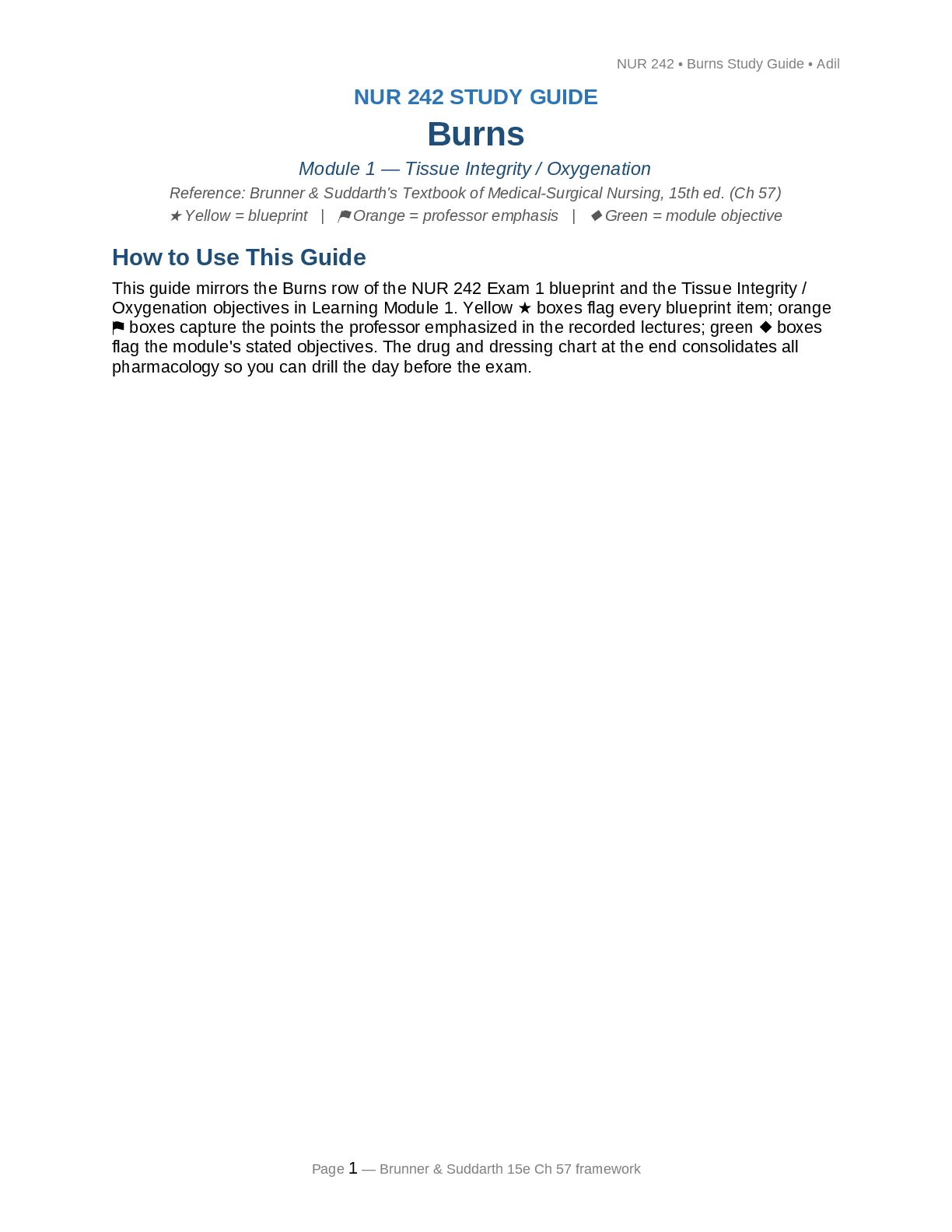
NUR 242 STUDY GUIDE
Burns
Module 1 — Tissue Integrity / Oxygenation
Reference: Brunner & Suddarth's Textbook of Medical-Surgical Nur
...
NUR 242 • Burns Study Guide • Adil
Page 1 — Brunner & Suddarth 15e Ch 57 framework
NUR 242 STUDY GUIDE
Burns
Module 1 — Tissue Integrity / Oxygenation
Reference: Brunner & Suddarth's Textbook of Medical-Surgical Nursing, 15th ed. (Ch 57)
★ ⚑ ◆ Yellow = blueprint | Orange = professor emphasis | Green = module objective
How to Use This Guide
This guide mirrors the Burns row of the NUR 242 Exam 1 blueprint and the Tissue Integrity /
Oxygenation objectives in Learning Module 1. Yellow boxes flag every blueprint item; orange ★
⚑ ◆ boxes capture the points the professor emphasized in the recorded lectures; green boxes
flag the module's stated objectives. The drug and dressing chart at the end consolidates all
pharmacology so you can drill the day before the exam.NUR 242 • Burns Study Guide • Adil
Page 2 — Brunner & Suddarth 15e Ch 57 framework
0. Professor's Lecture Highlights
Distilled from the recorded burn lectures. Read this section the morning of the exam — every
callout below is something the professor said directly.
0.1 Burn Shock Has Two Mechanisms
⚑ HIGH-YIELD: Burn shock is hypovolemic + distributive — overlapping
• First mechanism = HYPOVOLEMIC. Capillary leak begins seconds after the burn. Fluid
shifts out of vessels into the interstitium → "third spacing."
• Second mechanism = DISTRIBUTIVE. Acute lung injury and systemic mediators cause
vasodilation → BP drops further.
• Either way, BP drops and the patient looks like a hypovolemic shock patient. Treat with
fluids first, then address vasodilation if needed.
• Two complications to watch for in this chapter: DIC and ARDS.
0.2 Two Ways A Burn Patient Loses Fluid
⚑ HIGH-YIELD: "You lose fluid two ways — absolute and relative"
• ABSOLUTE loss: when the skin is gone, water EVAPORATES off the wound — true loss
from the body.
• RELATIVE loss: capillaries become leaky → fluid shifts to interstitial space (third
spacing). Water didn't leave the body but it's not in cells or vessels — "as good as gone"
for cellular activity.
• The patient's weight at the ER includes that third-spaced fluid, so it's NOT their dry weight
— Parkland formula numbers are estimates only.
0.3 Severity Has 4 Factors
⚑ HIGH-YIELD: Memorize this 4-part list
• DEPTH — how many layers of skin were burned (superficial, partial, full, deep fullthickness).
• TBSA — % of body surface burned (calculated by Rule of Nines).
• LOCATION — face/neck/upper chest = inhalation injury; hands/feet/perineum/major joints
= functional disability + transfer to burn center.
• COMORBIDITIES — very young (mostly water → evaporates → die quickly), very old
(poor turgor + chronic disease), diabetics, HF, CKD all worsen prognosis.
0.4 ABA Terminology — No More "Degrees"
⚑ HIGH-YIELD: American Burn Association uses thickness, not degrees
• Old: 1st / 2nd / 3rd / 4th degree.
• Current: SUPERFICIAL → PARTIAL THICKNESS → FULL THICKNESS → DEEP FULL
THICKNESS.
• Brunner 15e Box 57-1 / Table 57-1 is the source for the descriptions.
• Prof said: "I'll grab the test options both from Table 57-1 and the paragraphs that follow."NUR 242 • Burns Study Guide • Adi
[Show More]


.png)
.png)






![Preview of Mark Klimek Audio Lectures [PDF] Cardiac Medications, Cardiac rhythms, Chest tubes, Newbor](https://www.scholarfriends.com/storage/Lecture_3_Cardiac_Medications__Cardiac_rhythms__Chest_tubes__Newborn_Heart_Defects__Isolation_Precau.png)

