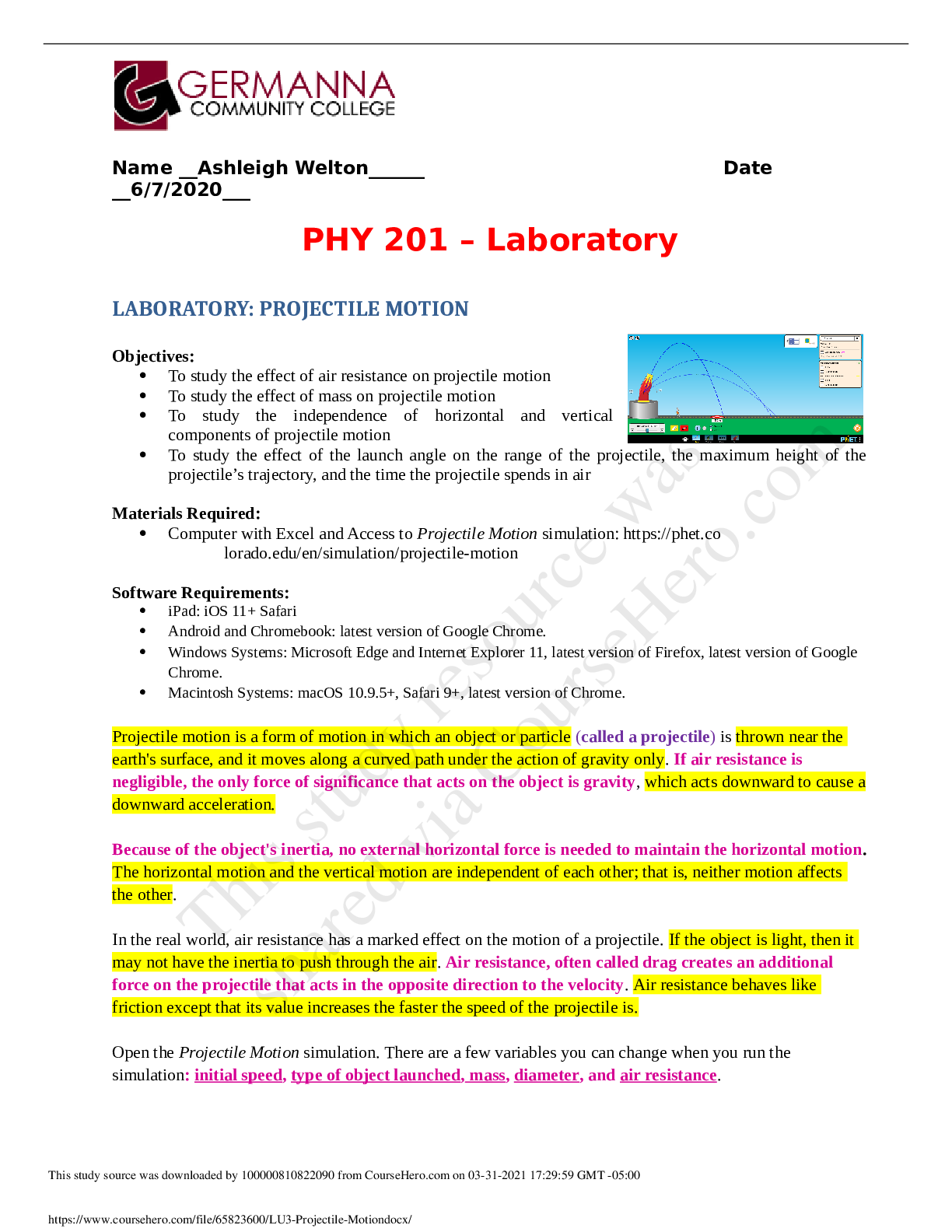
Name __ Date
__6/7/2020___
PHY 201 – Laboratory
LABORATORY: PROJECTILE MOTION
Objectives:
• To study the effect of air resistance on projectile motion
• To study the effect of mass on projectile motion
• To study
...
Name __ Date
__6/7/2020___
PHY 201 – Laboratory
LABORATORY: PROJECTILE MOTION
Objectives:
• To study the effect of air resistance on projectile motion
• To study the effect of mass on projectile motion
• To study the independence of horizontal and vertical
components of projectile motion
• To study the effect of the launch angle on the range of the projectile, the maximum height of the
projectile’s trajectory, and the time the projectile spends in air
Materials Required:
• Computer with Excel and Access to Projectile Motion simulation: https://phet.co
lorado.edu/en/simulation/projectile-motion
Software Requirements:
• iPad: iOS 11+ Safari
• Android and Chromebook: latest version of Google Chrome.
• Windows Systems: Microsoft Edge and Internet Explorer 11, latest version of Firefox, latest version of Google
Chrome.
• Macintosh Systems: macOS 10.9.5+, Safari 9+, latest version of Chrome.
Projectile motion is a form of motion in which an object or thrown near the
earth's surface, and it moves along a curved path under the action of gravity only. which acts downward to cause a
downward acceleration.
The horizontal motion and the vertical motion are independent of each other; that is, neither motion affects
the other.
In the real world, air resistance has a marked effect on the motion of a projectile. If the object is light, then it
may not have the inertia to push through the air.
Air resistance behaves like
friction except that its value increases the faster the speed of the projectile is.
Open the Projectile Motion simulation. There are a few variables you can change when you run the
simulation
In this simulation, the author uses the word “range” to describe the horizontal component of the displacement
of a projectile when the vertical component of the displacement of the projectile is zero or not.
Here are a few tips on how to use the simulation:
• The tape measure can be moved and dragged to measure heights and distances.
• The cannon has crosshairs to mark the initial location (initial y position and x position) of the projectile.
This location can be adjusted by dragging the pedestal.
• The cannon can be pivoted to change the launching (firing) angle, θ.
• To fire the cannon, press , and to erase the projectile’s path, press .
• Measure the time, range, and height of the projectile along its path by placing on the path.
Activity 1: Air Resistance in Projectile Motion
The effect air resistance has on a projectile will be examined, to determine under what circumstances the air
resistance can be ignored. There are several factors we can change in this simulation that can help us answer
this question. We will focus on the physical attributes of our projectile. Namely, its mass, its size, and its
launch speed. Whenever the trajectory of the projectile fired in the absence of air resistance is almost
overlapping the trajectory when air resistance is present, we can claim that air resistance has little to no effect
on the trajectory. For a constant launching angle, use the simulation to fill out Table 1 below.
Table 1: The Effect of Air Resistance
Firin
g#
Air
Resistanc
e
Initial Speed
( m/s )
Mass
( kg
)
Diameter
( m )
Path Different?
( Y / N )
1. As the velocity of a projectile increases, does the trajectory with air resistance get closer to or further
from the trajectory ignoring air resistance?
2
2. As the mass of a projectile increases, does the trajectory with air resistance get closer to or further
from the trajectory ignoring air resistance?
3. As the size of a projectile increases, does the trajectory with air resistance get closer to or further
from the trajectory ignoring air resistance?
4. Based on these questions, under what circumstances can air resistance be ignored?
Activity 2: Effect of Mass on Projectile Motion
If air resistance is negligible, fire different objects with the to
investigate how the mass of an object affects its motion through the air.
Table 2: Effect of Mass on Projectile
Object
Fired
Initial Speed
( m/s )
Angle
(
degrees
)
Range
( m )
Maximum
Height
( m )
Time
( s )
cannonball 15 45 29.22 13.73 2.75
golf ball 15 45 29.22 13.73 2.75
football 15 45 29.22 13.73 2.75
pumpkin 15 45 29.22 13.73 2.75
piano 15 45 29.22 13.73 2.75
car 15 45 29.22 13.73 2.75
Mass (I tested different masses for each object!) Diameter
Cannonball: 17.6kg 0.18m
Golf ball: 0.05kg 0.04m
Football: 0.41 kg 0.17m
Pumpkin: 5.0 kg 0.37m
Piano: 400 kg 2.2m
Car: 2000kg 2.0m
Conclusion: Everything including the range, maximum height, and time resulted in being the same
for all of the objects fired. Therefore, the mass of an object had no effect on its motion through
the air.
3
/
5. How does the mass of a projectile launched horizontally affect the range travelled by the projectile,
the maximum height of the projectile’s trajectory, and the time the projectile spends in air?
Activity 3: Trajectory in Projectile Motion
If air resistance is negligible, a projectile experiences only one force: gravity. Because it acts vertically, we
expect a projectile to accelerate vertically. Since there is no force acting in the horizontal direction, the
horizontal component of the velocity of a projectile should not change. To test this statement, launch a
pumpkin horizontally from a height in the air at different speeds and check to see how the range and time
spent in air are affected. Click and drag the wheel of the cannon to raise the cannon to be 10.0 m in the air.
Use the simulation to fill out Table 3.
Table 3: Horizontally Launched Projectile
Firin
g#
Initial Speed
( m/s )
Angle
(
degrees
)
Horizontal
Distance
( m )
Height
( m )
Time
( s )
6. How does the initial speed of a projectile launched horizontally affect the range of the projectile?
7. How does the initial speed of a projectile launched horizontally affect the height the projectile falls
through?
8. How does the initial speed of a projectile launched horizontally affect the time the projectile spends in
air?
4
If a projectile is launched at some angle, it will start with both horizontal and vertical components of velocity.
We can study how the launching angle affects the trajectory. Set the cannon back at ground level. Pick an
object, and for a constant initial speed use the simulation to fill out Table 4.
Table 4: Projectiles Launched at a Positive Angle
Firin
g#
Initial Speed
( m/s )
Angle
(degree
)
x-component of
initial
vel15.1ocity
( m/s )
Range
( m )
Maximum
Height
( m )
Time
(s)
9. Rank your angles above from smallest to largest x-component of their velocities. Is there a direct
relationship between the x-velocity of a projectile and its range?
10. How is the maximum height the projectile achieves affected by the launch angle?
5
11. At what angle should an object be launched to get a maximum range? You may want to refer to the
range equation and what you know about the sine function.
12. Analyzing the data in Table 4, you may notice that certain launch angles result in the same range. Is
there any mathematical relationship between the angles? If so, what is it?
References:
PHET contributors: M. Dubson, W. Adams, N. Borowicz, C. Bires, S. Stanhope, J. Scruggs, J. Mullins. CC-BY license, PhET Interactive Simulations, University of
Colorado Boulder, http://phet.colorado.edu https://phet.colorado.edu/en/simulation/projectile-motion
6
R=
v
20
sin 2θ
g
This study source was downloaded by 100000810822090 from CourseHero.com on 03-31-2021 17:29:59 GMT -05:00
[Show More]
.png)