ADOLESCENT DEVELOPMENT UNIT 1 EXAM! QUESTIONS & ANSWERS
adolescence - ANSWER-the stage of development that begins with puberty and ends when individuals
make the transition into adult roles, roughly speaking, from abo
...
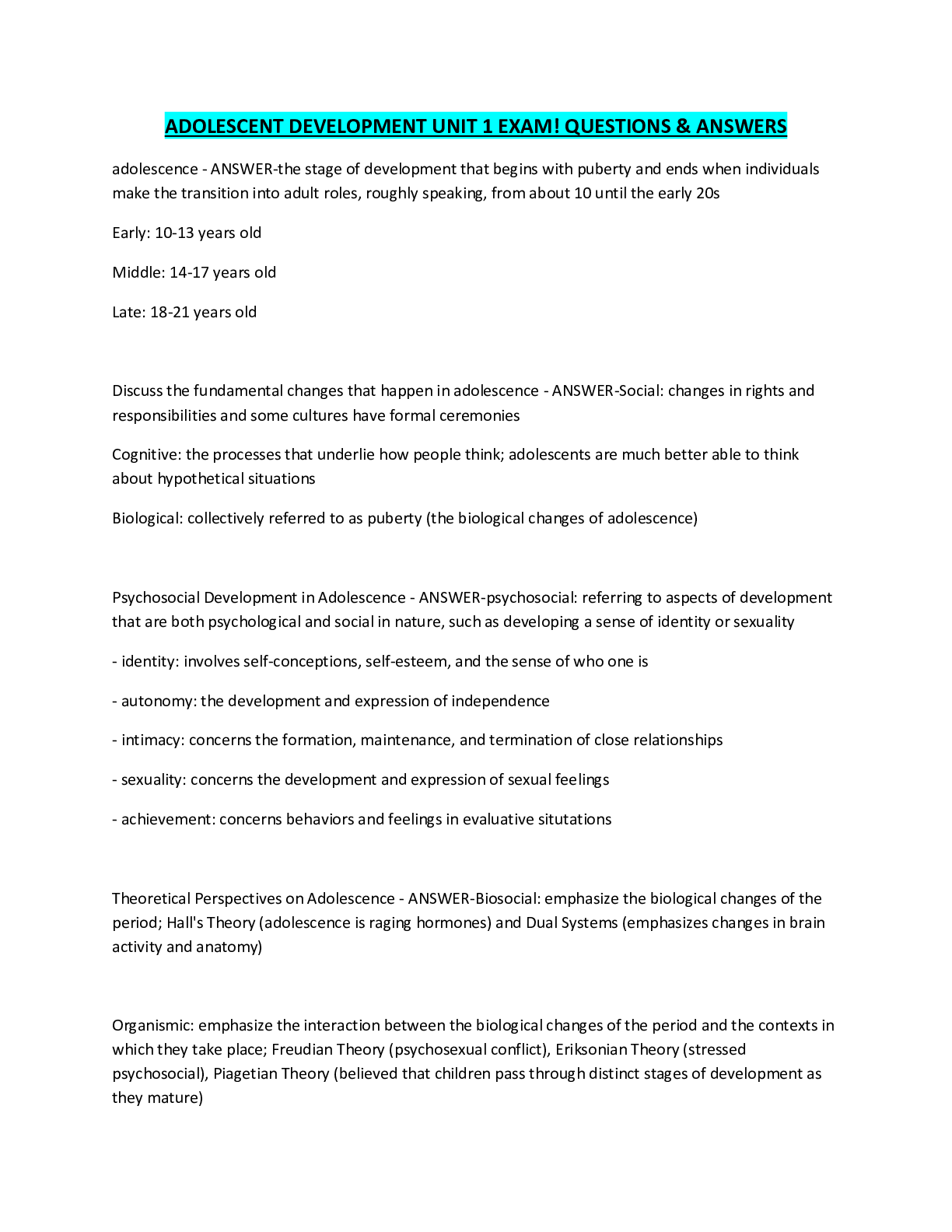
ADOLESCENT DEVELOPMENT UNIT 1 EXAM! QUESTIONS & ANSWERS
adolescence - ANSWER-the stage of development that begins with puberty and ends when individuals
make the transition into adult roles, roughly speaking, from about 10 until the early 20s
Early: 10-13 years old
Middle: 14-17 years old
Late: 18-21 years old
Discuss the fundamental changes that happen in adolescence - ANSWER-Social: changes in rights and
responsibilities and some cultures have formal ceremonies
Cognitive: the processes that underlie how people think; adolescents are much better able to think
about hypothetical situations
Biological: collectively referred to as puberty (the biological changes of adolescence)
Psychosocial Development in Adolescence - ANSWER-psychosocial: referring to aspects of development
that are both psychological and social in nature, such as developing a sense of identity or sexuality
- identity: involves self-conceptions, self-esteem, and the sense of who one is
- autonomy: the development and expression of independence
- intimacy: concerns the formation, maintenance, and termination of close relationships
- sexuality: concerns the development and expression of sexual feelings
- achievement: concerns behaviors and feelings in evaluative situtations
Theoretical Perspectives on Adolescence - ANSWER-Biosocial: emphasize the biological changes of the
period; Hall's Theory (adolescence is raging hormones) and Dual Systems (emphasizes changes in brain
activity and anatomy)
Organismic: emphasize the interaction between the biological changes of the period and the contexts in
which they take place; Freudian Theory (psychosexual conflict), Eriksonian Theory (stressed
psychosocial), Piagetian Theory (believed that children pass through distinct stages of development as
they mature)
Learning: emphasizes the ways in which patterns of behavior are acquired through reinforcement and
punishment or through observation and imitation; behaviorism (emphasize the process of
reinforcement and punishment) and social learning theory (emphasizes the ways adolescents learn how
to behave)
Sociological: emphasize the ways in which adolescents, as a group, are treated by society; adolescent
marginality (difference in power between adult and adolescents) and intergenerational conflict
(inevitable tension between adolescents and adults due to different attitudes, values, beliefs)
Historical/Anthropological: some argue that adolescence is entirely a social invention and
anthropologists argue societies vary based on the way they view adolescence
Endocrine system in puberty - ANSWER-- interaction between hypothalamus, pituitary gland and
gonads:
•
Hypothalamus
- structure in the brain that monitors sex and eating
•
Pituitary Gland
- endocrine gland that involves growth and regulates other glands, including hormones
•
Gonads
- testes in males; ovaries in females
Hypothalamus inhibits the pituitary gland unless sex hormone levels fall below a set point ==> pituitary
gland signals the gonads to release more sex hormones ==> gonads release sex hormones (loop)
Producing, regulating, and circulating hormones
Feedback loop - set point of hormones
HPG Axis; when puberty occurs, a lot of set points of hormones change ⇒ body is regulating hormones
→ moody
Hypothalamus inhibits pituitary gland from releasing hormones when it releases too much
HPG Axis is active before birth and then quiets and then awakens during puberty
Triggers of Puberty - ANSWER-HPG axis is active before birth, but relatively quiet during childhood ⇒
reawakens during puberty and begins the increase in kisspeptin (a brain chemical believed to trigger the
onset of puberty)
Leptin: a protein produced by the fat cells that may play a role in the onset of puberty through its impact
on kisspeptin (stimulates kisspeptin); regulates hunger and appetite
--> puberty starts earlier for overweight children
Melatonin: a hormone secreted by the brain that contributes to sleepiness and that triggers the onset of
puberty through its impact on kisspeptin (suppresses kisspeptin)
==> lower melatonin levels = faster puberty
Genes predisopose you to go through puberty at a particular age, but more fat cells + more light
exposure → earlier puberty
Environmental & Biological Triggers: who you are surrounded by, the more sexually mature people you
are around, light/melatonin (lots of light, less melatonin = earlier puberty; light can be artificial light
too), body fat, who you live with (females), living with a step-father or older non-biological male =
earlier puberty; modern medicine made periods earlier (secular trend of puberty)
Genes: predisposed to having puberty at a certain age
What is the role of hormones on puberty? -
[Show More]