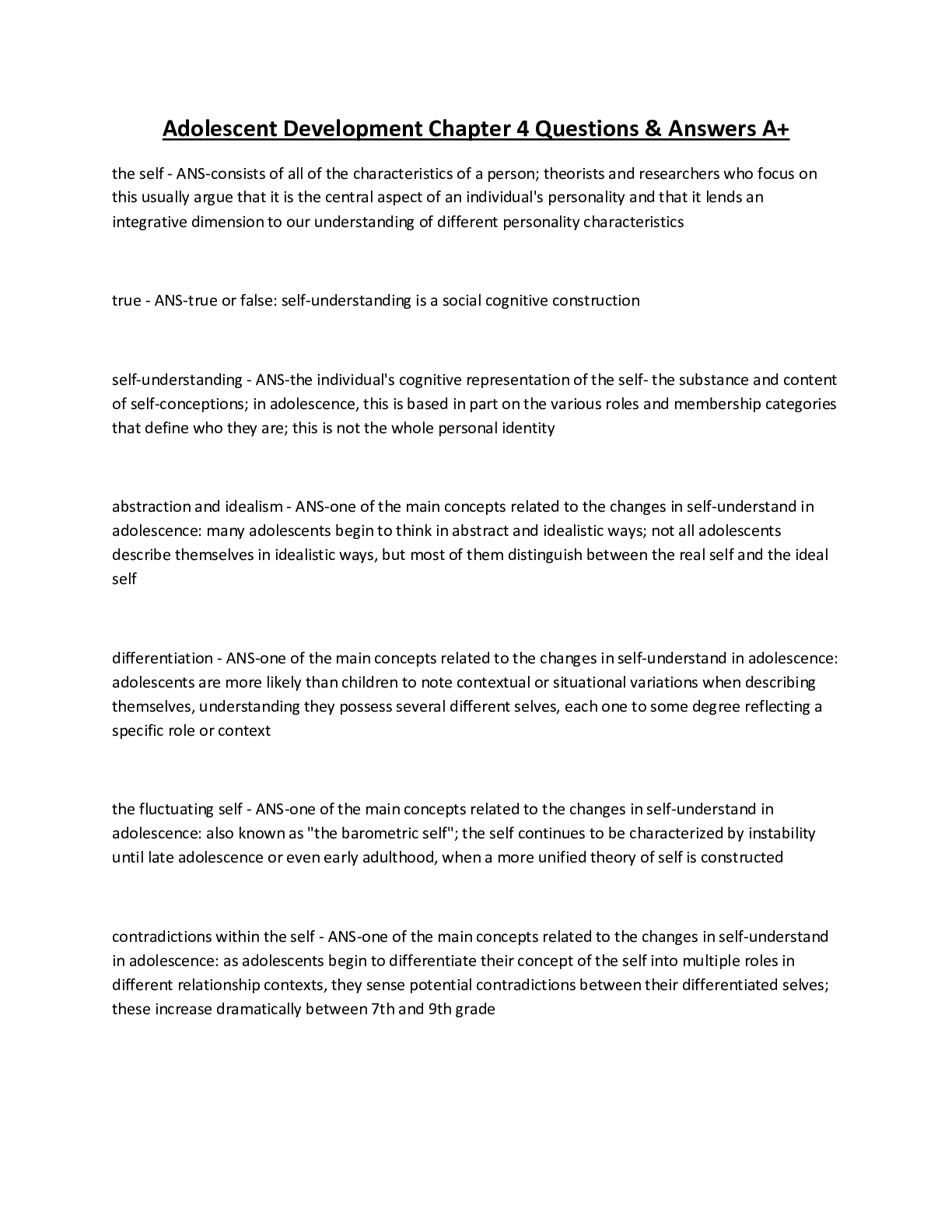
Adolescent Development Chapter 4 Questions & Answers A+
the self - ANS-consists of all of the characteristics of a person; theorists and researchers who focus on
this usually argue that it is the central aspect of an
...
Adolescent Development Chapter 4 Questions & Answers A+
the self - ANS-consists of all of the characteristics of a person; theorists and researchers who focus on
this usually argue that it is the central aspect of an individual's personality and that it lends an
integrative dimension to our understanding of different personality characteristics
true - ANS-true or false: self-understanding is a social cognitive construction
self-understanding - ANS-the individual's cognitive representation of the self- the substance and content
of self-conceptions; in adolescence, this is based in part on the various roles and membership categories
that define who they are; this is not the whole personal identity
abstraction and idealism - ANS-one of the main concepts related to the changes in self-understand in
adolescence: many adolescents begin to think in abstract and idealistic ways; not all adolescents
describe themselves in idealistic ways, but most of them distinguish between the real self and the ideal
self
differentiation - ANS-one of the main concepts related to the changes in self-understand in adolescence:
adolescents are more likely than children to note contextual or situational variations when describing
themselves, understanding they possess several different selves, each one to some degree reflecting a
specific role or context
the fluctuating self - ANS-one of the main concepts related to the changes in self-understand in
adolescence: also known as "the barometric self"; the self continues to be characterized by instability
until late adolescence or even early adulthood, when a more unified theory of self is constructed
contradictions within the self - ANS-one of the main concepts related to the changes in self-understand
in adolescence: as adolescents begin to differentiate their concept of the self into multiple roles in
different relationship contexts, they sense potential contradictions between their differentiated selves;
these increase dramatically between 7th and 9th grade
possible self - ANS-an important aspect of the ideal or imagined self is this; what individuals might
become, what they would like to become, and what they are afraid of becoming; includes both what
they hope to be and what they fear of becoming
maladjustment, psychologically - ANS-some argue that a discrepancy between the real and ideal selves
is a sign of ___, while other argue that it is ___ healthy, leading balance to an adolescent's perspective
and motivation
direct, avoided - ANS-the attributes of the future positive self can ___ an adolescents' positive actions
and the attributes of the future negative self can identify behaviors to be ___
false, least - ANS-adolescents are most likely to show their ___ selves with classmates and romantic or
dating situations; they are ___ likely to show their false selves with close friends
emerging adults - ANS-during this period of life, self-understanding becomes more integrative, with the
disparate parts of the self pieced together more systematicallly; they may detect inconsistencies in their
earlier self-descriptions as they attempt to construct a general theory of self
self-awareness - ANS-an aspect of self-understanding that becomes especially important in emerging
and early adulthood; how much an emerging adult is aware of his or her psychological makeup,
including strengths and weaknesses; many individuals do not have a very good awareness of their
psychological makeup and skills, as well as the causes of their weaknesses
unconscious, conscious - ANS-in adolescence, self-understanding involves greater recognition that the
self includes ___ as well as ___ components
[Show More]
.png)