CIS 321 Final Exam A+ GRADED
Question 1.1. (TCO 2) What is feasibility? List and briefly discuss three kinds of feasibility. (Points : 24)
Question 2.2. (TCO 4) What are some of the criteria deem
...
CIS 321 Final Exam A+ GRADED
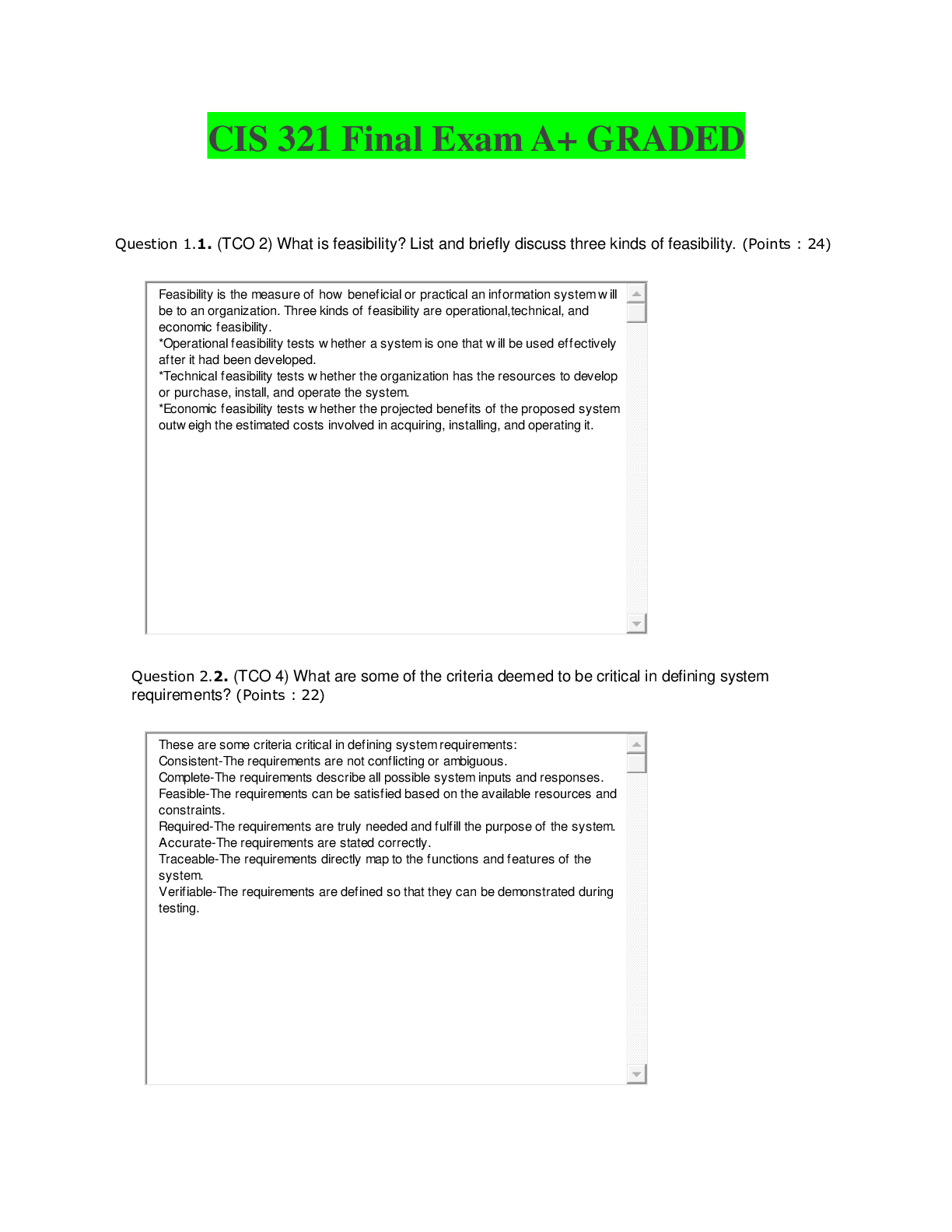
Question 1.1. (TCO 2) What is feasibility? List and briefly discuss three kinds of feasibility. (Points : 24)
Question 2.2. (TCO 4) What are some of the criteria deemed to be critical in defining system requirements? (Points : 22)
Question 3.3. (TCO 6) What does a physical DFD represent? How does the physical data flow line differ from the logical data flow line? Give an example. (Points : 22)
Question 4.4. (TCO 8) You need to create a user-friendly GUI that enters data about new employees. The employees must be categorized by department (marketing, accounting, sales, or manufacturing) and also by whether they are full-time or part-time employees. Each employee's pay is based on how many years of experience they have, multiplied by a base rate. How would you make the GUI appear user-friendly in its design, look, and ease of use? Consider the type of input controls you would use to make inputting data easier. What data would you not have the user enter in any way? (Points : 22)
Question 5.5. (TCO 10) Please use an example to illustrate the process of converting a non-2NF record to 2NF. (Points : 22)
Question 6.6. (TCO 12) What is the main difference between alpha and beta testing? (Points : 22)
Question 7.7. (TCO 13) What are some benefits and potential problems in using an abrupt cut-over conversion and in using a parallel conversion strategy? (Points : 22)
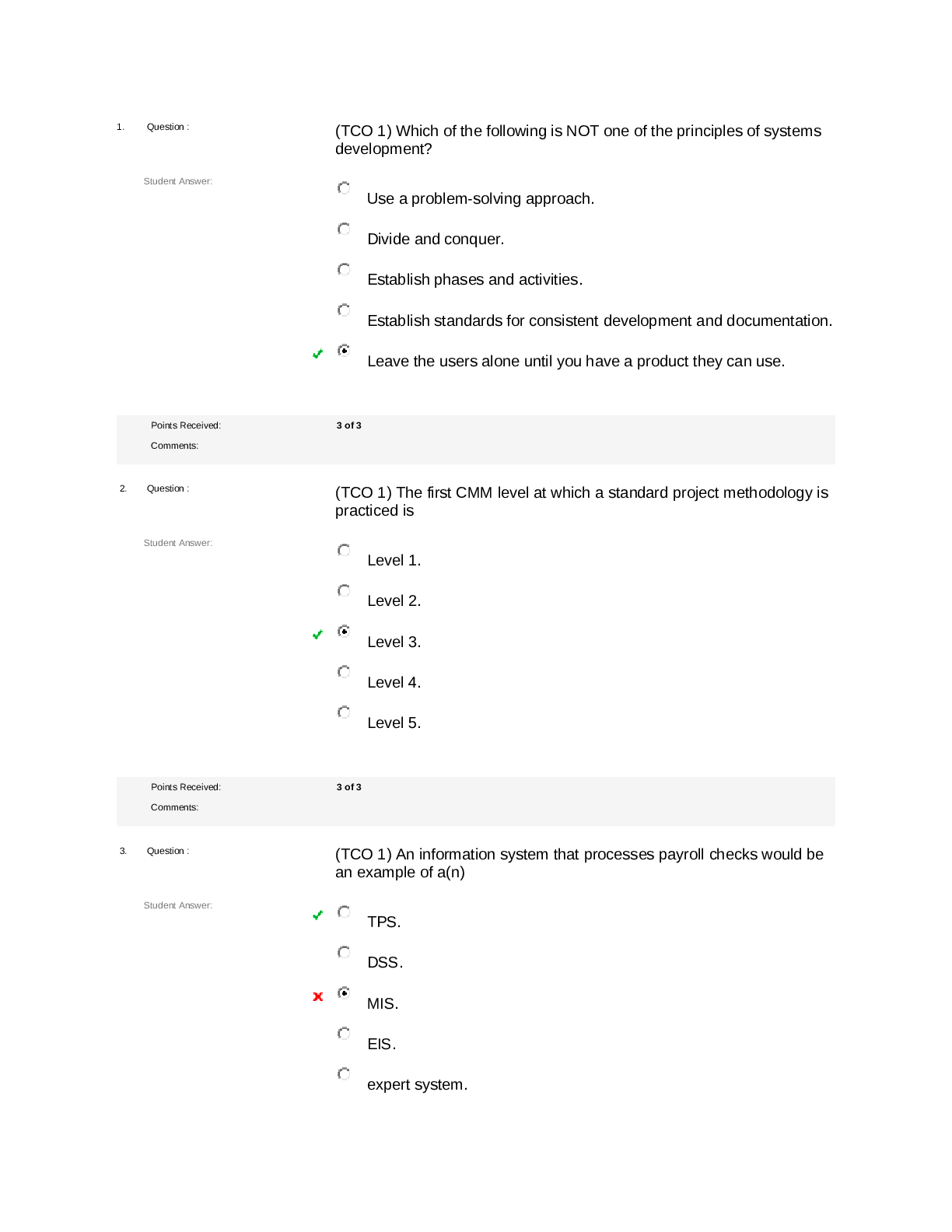
Question 1.1. (TCO 8) Which of the following input methods could best be used to enter a patient's health record into a hospital’s computer system? (Points : 4)
Touch screen
Optical mark
Smart cards
Keyboard
Biometric
Question 2.2. (TCO 6) How do you name the data flow in which the same data travels to two or more different locations? (Points : 4)
Diverging data flow
Exploding data flow
Partitioned data flow
Decomposed data flow
Question 3.3. (TCO 7) Structured English includes which of the following as a construct? (Points : 4)
A sequence of simple declarative sentences
Use of action verbs in the declarative sentences to indicate the appropriate action for the sentence
A conditional or decision structure
A repetitive or iterative structure
All of the above
Question 4.4. (TCO 10) The EmployeeID field in an employee table cannot be left blank. This is an example of (Points : 4)
referential integrity.
domain integrity.
key integrity.
logical integrity.
schema integrity.
Question 5.5. (TCO 10) No two records in an employee table can have the same value for EmployeeID. This is an example of (Points : 4)
key integrity.
domain integrity.
logical integrity.
referential integrity.
schema integrity.
Question 6.6. (TCO 9) A true entity (Points : 4)
must have only one instance.
must have the same cardinality and degree.
must have a recursive relationship.
must have many possible instances.
All of the above
Question 7.7. (TCO 9) The data model for a single information system is usually called (Points : 4)
the enterprise data model.
the logical data model.
the application data model.
the physical data model.
None of the above
Question 8.8. (TCO 10) What column is a good candidate to be the primary key?
This refers to (Points : 4)
referential integrity.
domain integrity.
key integrity.
data integrity.
None of the above
Question 9.9. (TCO 12) A system acceptance test addresses which level(s) of acceptance testing? (Points : 4)
Validation testing
Verification testing
Audit testing
Unit testing
A, B, and C
Question 10.10. (TCO 12) Who is responsible for system testing? (Points : 4)
The programmer assigned to develop the program or function
Systems analysts, IS operations staff
All of the above
None of the above
Question 11.11. (TCO 13) Which installation strategy converts one site before the others? (Points : 4)
Abrupt cut-over
Parallel conversion
Location conversion
Staged conversion
Both C and D
Question 12.12. (TCO 10) In the relationship between U.S. cities and U.S. states, the state entity would be (Points : 4)
the child.
the parent.
nonspecific.
subtype.
supertype.
Question 13.13. (TCO 12) Which kind of validation testing might lead to rescheduling some processing to other parts of the day? (Points : 4)
Systems performance
Peak workload processing
Human engineering
Methods and procedures
Backup and recovery
Question 1.1. (TCO 2) Which kind of feasibility can be impacted by how the working environment of end users will change given the proposed system? (Points : 4)
Operational feasibility
Technical feasibility
Schedule feasibility
Legal feasibility
Cultural or political feasibility
Question 2.2. (TCO 2) Which of the following tools provides a ranking of candidate systems? (Points : 4)
System proposal
Candidate systems matrix
Time value of money
Feasibility analysis matrix
None of the above
Question 3.3. (TCO 1) The people who use or are affected by the information system on a regular basis, capturing, validating, entering, responding to, storing, and exchanging data and information, are (Points : 4)
system users.
system analysts.
system builders.
system owners.
None of the above
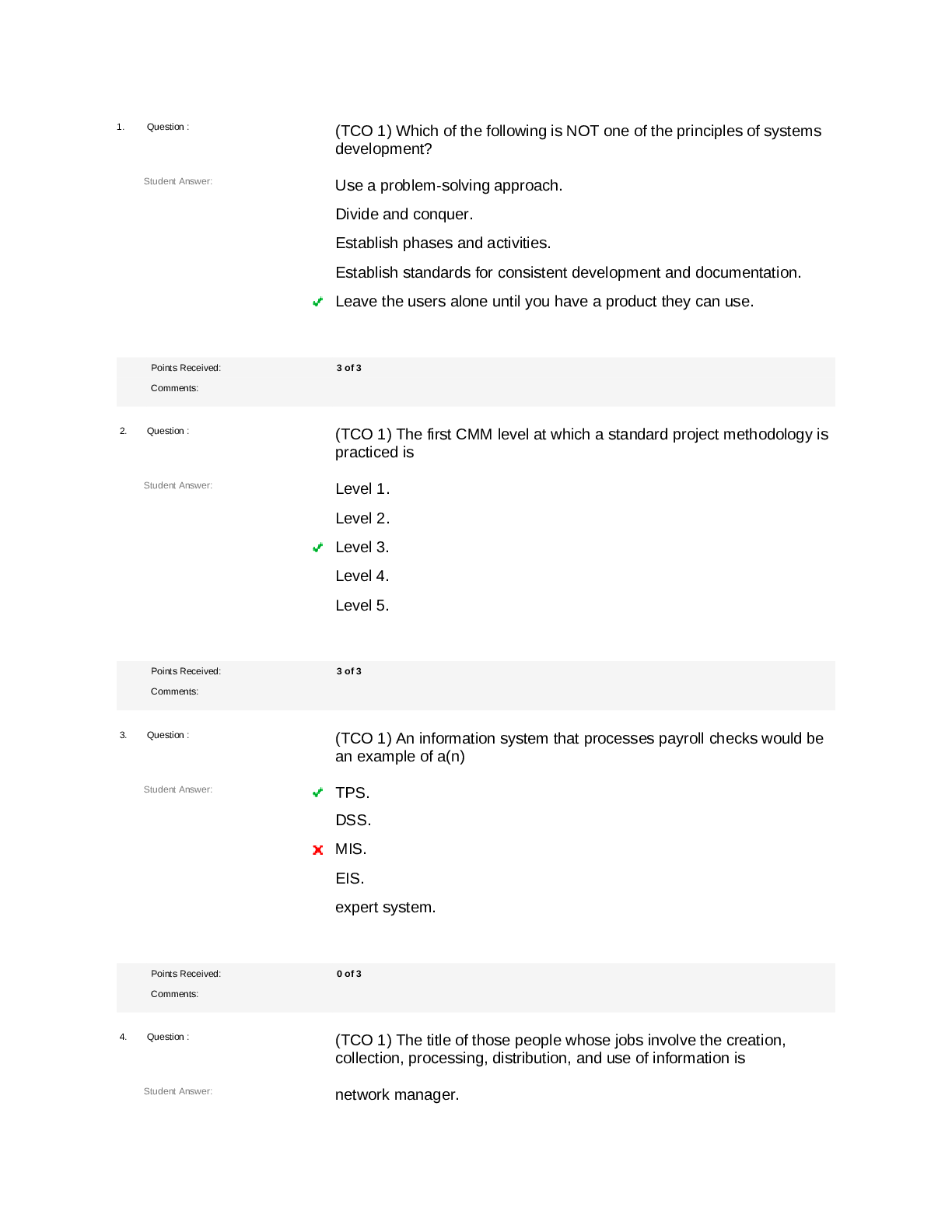
Question 4.4. (TCO 1) The term used to describe those people whose jobs involve the creation, collection, processing, distribution, and use of information is (Points : 4)
an information worker.
a network manager.
a systems owner.
a systems designer.
None of the above
Question 5.5. (TCO 4) Which of the following is something you should NOT do during an interview? (Points : 4)
Be courteous
Listen carefully
Be patient
Use jargon
None of the above
Question 6.6. (TCO 4) The process of collecting a representative sample of documents, forms, and records is known as (Points : 4)
sampling.
prototyping.
modeling.
patterning.
None of the above
Question 7.7. (TCO 2) To determine operational feasibility, each of the following questions should be considered except (Points : 4)
“Will the new system result in a workforce reduction?”
“Will users be involved in planning the new system?”
“Will the system be able to handle future transactions?”
“Will the new system require training for users?”
Question 8.8. (TCO 3) A narrative description of the work to be performed as part of a project is a (Points : 4)
statement of work.
scope statement.
project definition.
project overview.
All of the above
Question 9.9. (TCO 6) Which of the following emphasizes the drawing of pictorial system models to document the technical or implementation aspects of a new system? (Points : 4)
Joint application development
Rapid application development
Model-driven design
Both rapid application development and joint application design
None of the above
Question 10.10. (TCO 6) What is the source for the physical DFD? (Points : 4)
Child DFD
Context DFD
External entity
Internal entity
Question 11.11. (TCO 5) A tool that depicts the flow of data through a system and the work or processing performed by that system is known as a(n) (Points : 4)
entity relationship diagram.
data flow diagram.
decomposition, structure diagram.
use case diagram.
None of the above
Question 12.12. (TCO 5) A process (Points : 4)
is a common word used to describe almost any orderly arrangement of ideas or constructs.
is comprised of many systems and subsystems.
is only performed by computer software.
is work performed on, or in response to, incoming data flows or conditions.
None of the above
Question 13.13. (TCO 8) Which of the following reports categorizes information for managers who do not want to wade through the details? (Points : 4)
Detailed
Exception
External
Summary
None of the above
[Show More]


.png)
.png)

.png)

.png)
.png)
.png)
.png)
 (1).png)
.png)
 (1).png)
.png)

.png)