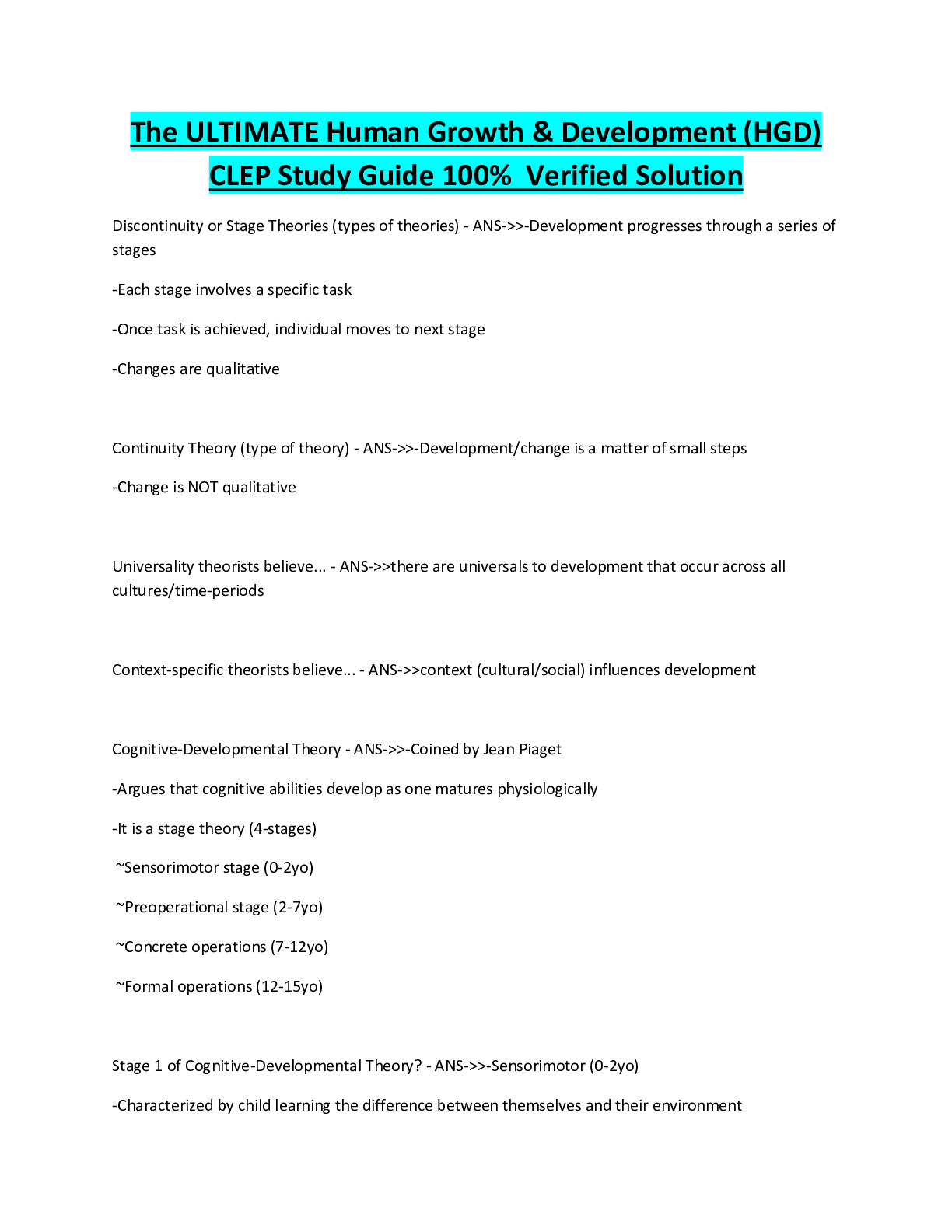
The ULTIMATE Human Growth & Development (HGD)
CLEP Study Guide 100% Verified Solution
Discontinuity or Stage Theories (types of theories) - ANS->>-Development progresses through a series of
stages
-Each stage invol
...
The ULTIMATE Human Growth & Development (HGD)
CLEP Study Guide 100% Verified Solution
Discontinuity or Stage Theories (types of theories) - ANS->>-Development progresses through a series of
stages
-Each stage involves a specific task
-Once task is achieved, individual moves to next stage
-Changes are qualitative
Continuity Theory (type of theory) - ANS->>-Development/change is a matter of small steps
-Change is NOT qualitative
Universality theorists believe... - ANS->>there are universals to development that occur across all
cultures/time-periods
Context-specific theorists believe... - ANS->>context (cultural/social) influences development
Cognitive-Developmental Theory - ANS->>-Coined by Jean Piaget
-Argues that cognitive abilities develop as one matures physiologically
-It is a stage theory (4-stages)
~Sensorimotor stage (0-2yo)
~Preoperational stage (2-7yo)
~Concrete operations (7-12yo)
~Formal operations (12-15yo)
Stage 1 of Cognitive-Developmental Theory? - ANS->>-Sensorimotor (0-2yo)
-Characterized by child learning the difference between themselves and their environment
Stage 2 of Cognitive-Developmental Theory? - ANS->>-Preoperational (2-7yo)
-Characterized by: egocentrism, rigid thought, semi-logical reasoning, limited social cognition
Stage 3 of Cognitive-Developmental Theory? - ANS->>-Concrete Operations (7-12yo)
-Characterized by: individual can consider other viewpoints, can perform transformations (reversibility,
inversion, reciprocity, conservation), can group items into categories, make inferences about reality,
inductive reasoning (generalizing), increased quantitative skills
Stage 4 of Cognitive-Developmental Theory? - ANS->>-Formal Operations (12-15yo)
-Characterized by: higher ordered and critical thinking, logical, abstract, hypothetical capabilities,
inductive reasoning, deductive reasoning, able to anticipate verbal cues, can perform an experiment
(hypothesis, isolate variables, cause-and-effect)
Jean Piaget and "Adaptation" (learning) - ANS->>Individual encounters a new stimulus -> disequilibrium
of individual -> accommodation (adjusting prior knowledge) -> assimilation (putting new and old
information together) -> understanding that which is new... (learning...)
Learning Theorists believe... - ANS->>-that environment influences learning (nurture), and
developmental change is the product of learning
-ie. Pavlov, Watson, Skinner, Bandura
Classical Conditioning - ANS->>-Ivan Pavlov
-"Learning takes place when reflexive behavior (salivating) comes under control of a novel stimulus (bell)
in the environment"
Unconditioned Stimulus?
Unconditioned Response?
Conditioned Stimulus?
Conditioned Response? - ANS->>-stimulus that automatically elicits a response (steak)
-automatic response to UCS (salivating)
-paired with UCS to generate response (steak & bell)
-response that results from CS (salivating at bell)
IRT Classical Conditioning...
"Generalization"?
"Discrimination"?
"Extinction"? - ANS->>-CR is elicited by stimuli similar to CS (alike to bell)
-CR is only elicited by CS (bell)
-Unlearning of the CR
Classical Conditioning of Emotional Responses - ANS->>-John Watson
-Through experience we learn to associate new environmental stimuli with reflexive emotional
responses
-Conditioned fear into Little Albert using a loud noise (UCS) and a rate (CS); later, little albert would be
fearful of just rat...
Operant Conditioning - ANS->>-B.F. Skinner
-Learning is controlled by stimuli and our interaction with it, but our behavior is influenced by
consequences (reward, punishment)
-Positive reinforcement = rewarding behavior (candy)
-Negative reinforcement = removing an undesirable consequence to promote good behavior (letting a
kid out of timeout if they agree to not be disruptive)
Social Cognitive Theory - ANS->>-Albert Bandura
-Changes in behavior don't result from just conditioning, but also from observing and modeling
[Show More]