Analogue to Digital Definition
Transforms continuous signals into discrete values
Analogue to Digital Measurement Chain
Read Sensor
Amplification & Conditioning
Conversion
Processing
LSB & Signal Jump
...
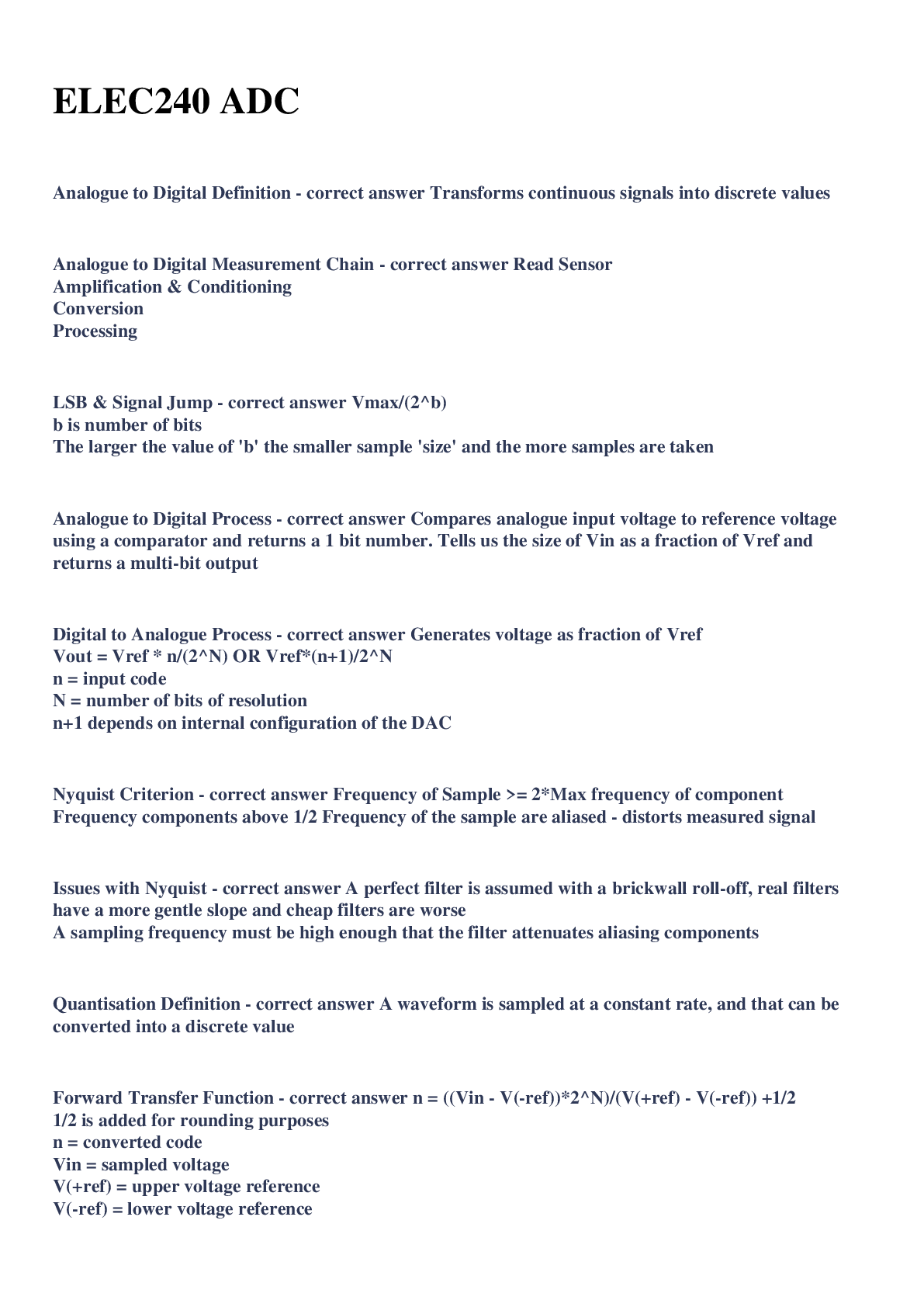
Analogue to Digital Definition
Transforms continuous signals into discrete values
Analogue to Digital Measurement Chain
Read Sensor
Amplification & Conditioning
Conversion
Processing
LSB & Signal Jump
Vmax/(2^b)
b is number of bits
The larger the value of 'b' the smaller sample 'size' and the more samples are taken
Analogue to Digital Process
Compares analogue input voltage to reference voltage using a comparator and returns a 1 bit number. Tells us the size of Vin as a fraction of Vref and returns a multi-bit output
Digital to Analogue Process
Generates voltage as fraction of Vref
Vout = Vref n/(2^N) OR Vref(n+1)/2^N
n = input code
N = number of bits of resolution
n+1 depends on internal configuration of the DAC
Nyquist Criterion
Frequency of Sample >= 2*Max frequency of component
Frequency components above 1/2 Frequency of the sample are aliased - distorts measured signal
Issues with Nyquist
A perfect filter is assumed with a brickwall roll-off, real filters have a more gentle slope and cheap filters are worse
A sampling frequency must be high enough that the filter attenuates aliasing components
Quantisation Definition
A waveform is sampled at a constant rate, and that can be converted into a discrete value
Forward Transfer Function
n = ((Vin - V(-ref))*2^N)/(V(+ref) - V(-ref)) +1/2
1/2 is added for rounding purposes
n = converted code
Vin = sampled voltage
V(+ref) = upper voltage reference
V(-ref) = lower voltage reference
N = number of bits of resolution
Inverse Transfer Function
What range of voltages V(in_min) to V(in_max) does n represent
Vin(max_min) = ((n+/- 1/2)/2^N)*(V(+ref)-V(-ref))+V(-ref)
+1/2 for in_max
-1/2 for in_min
Flash Conversion
Multi-level comparator to compare Vin to a variety of voltages. Outputs of 0/1 are used
needs 2^N resistors
needs 2^(n-1) comparators
maximum error - 1 bit
Ramp ADC
A counter counts up values which increments the voltage at the same rate. This voltage is then compared to an input voltage using a comparator, if it's higher then the counter resets and if the value is lower the counter continues counting
Successive Approximation
Using a binary search and a DAC, the SA register sets all input bits for the DAC to 0 and starts with MSB, increasing the voltage successively
Set next input bit for DAC to 1
Wait for stabilisation
If DAC output is smaller than input then set bit to 1, else set to 0
Move on to the next MSB
Linearity
How well the transition voltages lie on a straight line
Differential Linearity
Measure the equality of the step size
Conversion Time
Time between start of conversion and generation of result
Conversion Rate
Inverse of conversion time
Why would you need a sample and hold device
Some converters need the input analog signal to be held at a steady rate if conversion takes a long timer
Sampling may als need to be done (e.g. peak capture)
[Show More]