NR 341 EKG Interpretation 50 Questions with Answers,100% CORRECT
Document Content and Description Below
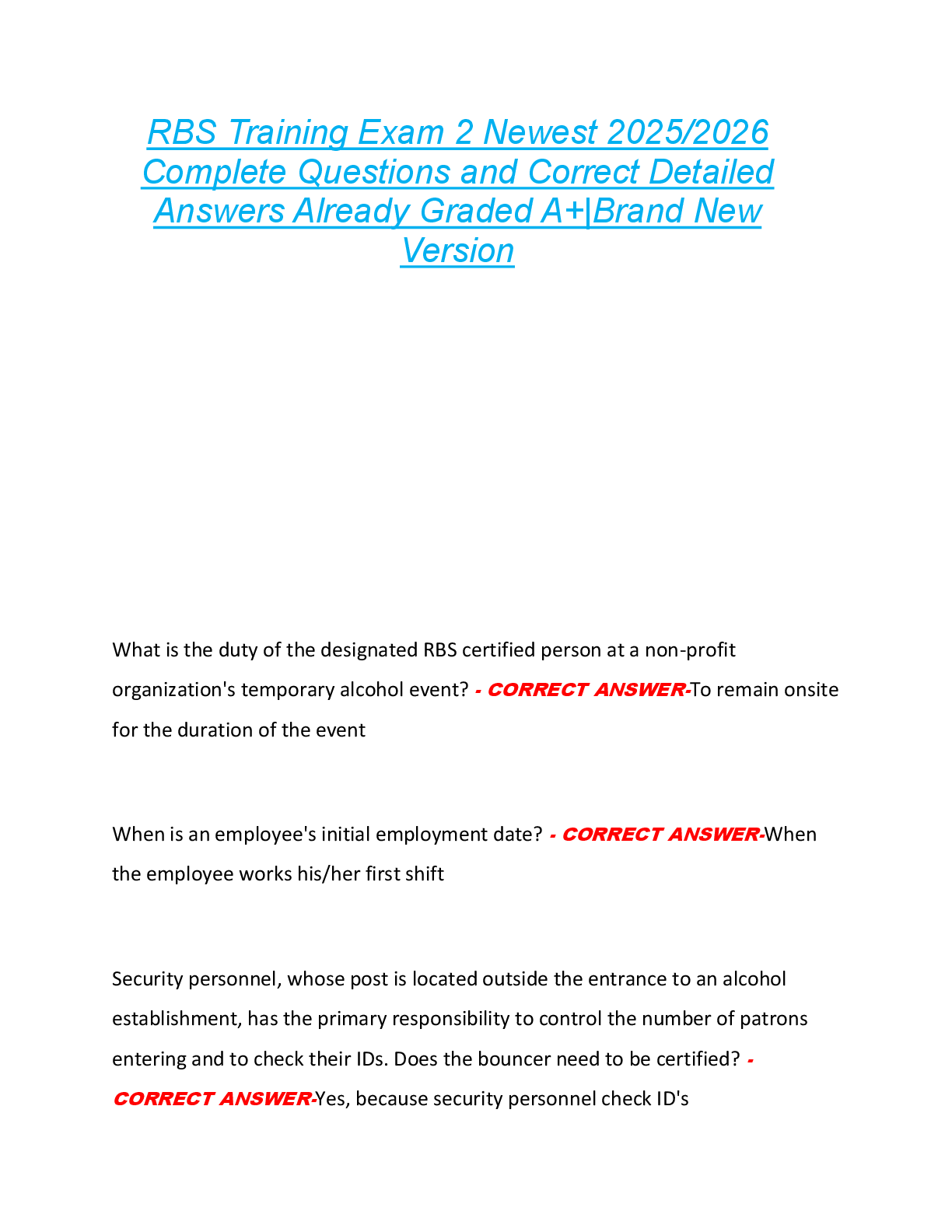
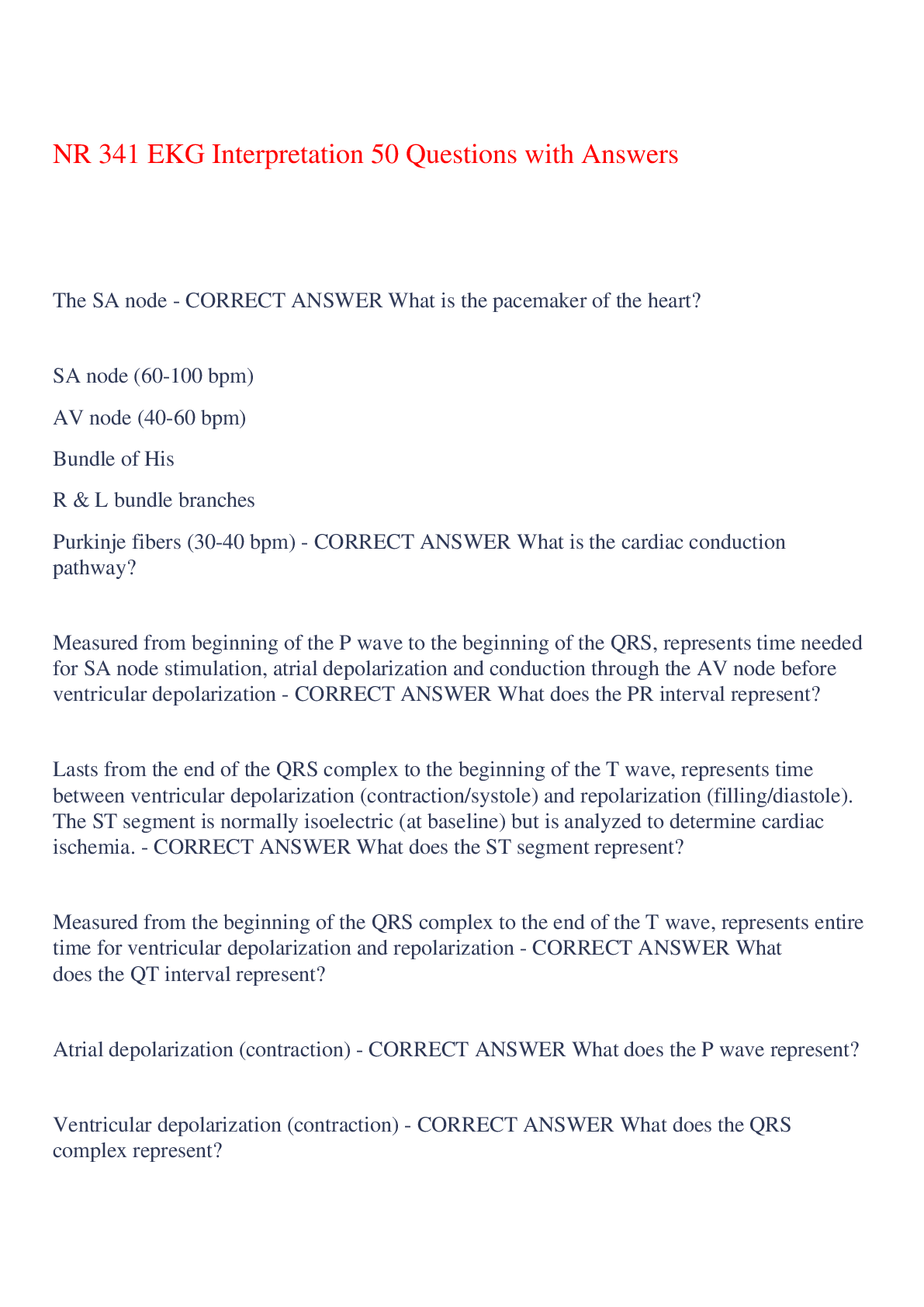
NR 341 EKG Interpretation 50 Questions with Answers The SA node - CORRECT ANSWER What is the pacemaker of the heart? SA node (60-100 bpm) AV node (40-60 bpm) Bundle of His R & L bundle br ... anches Purkinje fibers (30-40 bpm) - CORRECT ANSWER What is the cardiac conduction pathway? Measured from beginning of the P wave to the beginning of the QRS, represents time needed for SA node stimulation, atrial depolarization and conduction through the AV node before ventricular depolarization - CORRECT ANSWER What does the PR interval represent? Lasts from the end of the QRS complex to the beginning of the T wave, represents time between ventricular depolarization (contraction/systole) and repolarization (filling/diastole). The ST segment is normally isoelectric (at baseline) but is analyzed to determine cardiac ischemia. - CORRECT ANSWER What does the ST segment represent? Measured from the beginning of the QRS complex to the end of the T wave, represents entire time for ventricular depolarization and repolarization - CORRECT ANSWER What does the QT interval represent? Atrial depolarization (contraction) - CORRECT ANSWER What does the P wave represent? Ventricular depolarization (contraction) - CORRECT ANSWER What does the QRS complex represent? Ventricular repolarization (relaxation) - CORRECT ANSWER What does the T wave represent? 120-200 ms - CORRECT ANSWER What is the normal PR interval length? 0.36-0.44 seconds - CORRECT ANSWER What is the normal QT interval length? 5-150 ms - CORRECT ANSWER What is the normal ST segment length? Take the number of "big boxes" between neighboring QRS complexes, and divide this into 300. The result will be approximately equal to the rate. Although fast, this method only works for regular rhythms. - CORRECT ANSWER How do you calculate HR using the rule of 300? (300/6) = 50 bpm - CORRECT ANSWER What is the HR? (300/~4) = ~75 bpm - CORRECT ANSWER What is the HR? (300/1.5) = 200 bpm - CORRECT ANSWER What is the HR? -6 second method: 7 x 10 = 70 bpm -Big block method: 300/4 = 75 bpm -Small block method: 1500/20 = 75 bpm - CORRECT ANSWER What is the HR? -Regular rate -One P wave for every QRS complex -Symmetry between the P/QRS/T waves - CORRECT ANSWER What are characteristics of sinus arrhythmias? Normal sinus rhythm (rate is 60-100) - CORRECT ANSWER What rhythm is represented on this EKG strip? Sinus bradycardia - CORRECT ANSWER What rhythm is represented on this EKG strip? Sinus tachycardia - CORRECT ANSWER What rhythm is represented on this EKG strip? -Beat originates in the atria, not in the SA node -P wave looks irregular -The atrial rate is usually fast -There may be multiple P waves for every QRS -The heart rate may be irregular - CORRECT ANSWER What are the characteristics of atrial arrhythmias? Atrial flutter - CORRECT ANSWER What rhythm is represented on this EKG strip? Atrial flutter - CORRECT ANSWER What rhythm is represented on this EKG strip? Atrial fibrillation (irregularly irregular rhythm with no p waves) - CORRECT ANSWER What rhythm is represented on this EKG strip? Atrial fibrillation - CORRECT ANSWER What rhythm is represented on this EKG strip? Atrial tachycardia - CORRECT ANSWER What rhythm is represented on this EKG strip? A patient with atrial fibrillation is at an increased risk of experiencing blood clots. The patient should be placed on coumadin. - CORRECT ANSWER What is a serious complication of atrial fibrillation? What is the intervention? 1st degree AV block -PR interval constant and all impulses are conducted - CORRECT ANSWER What rhythm is represented on this EKG strip? 2nd degree AV block type 1 -Longer PR interval, finally no QRS complex - CORRECT ANSWER What rhythm is represented on this EKG strip? 2nd degree AV block type 2 -Constant PR interval; AV node intermittently conducts no impulse - CORRECT ANSWER What rhythm is represented on this EKG strip? 3rd degree AV block -AV node conducts no impulse; no association between P waves and QRS complex. - CORRECT ANSWER What rhythm is represented on this EKG strip? An inherited condition where the person has an extra electrical pathway between the upper and lower chambers of the heart. This causes a rapid heartbeat. Characterized by an up-sloping of the QRS. - CORRECT ANSWER What is Wolf-Parkinson-White? Ventricular fibrillation *This is a medical emergency! - CORRECT ANSWER What rhythm is represented on this EKG strip? -Management depends on cause and symptoms -Atropine (anticholinergic, blocks parasympathetic stimulation to increase heart rate): 0.5mg IVP indicated for symptomatic bradycardia - CORRECT ANSWER What is the pharmacologic management for sinus bradycardia? -Treatment based on severity of symptoms -Synchronized cardioversion - CORRECT ANSWER How do you manage sinus tachycardia? -Caused by nicotine, caffeine, alcohol, anxiety -Treating underlying cause - CORRECT ANSWER What is premature atrial complex typically caused by? How do you treat it? -Associated with overexertion, emotional stress, stimulants (tobacco, caffeine) -Also with rheumatic heart disease, digitalis toxicity, CAD, cor pulmonale -Heart rate >150 bpm, often with hypotension, palpitations, dyspnea, angina - CORRECT ANSWER What is SVT associated with? -Vagal stimulation (Valsalva ("bearing down"), carotid massage, coughing) -IV adenosine (Short half life of ~10 mins; Brief period of asystole common) - CORRECT ANSWER What is the treatment for SVT? Supraventricular tachycardia - CORRECT ANSWER What rhythm is represented on this EKG strip? »Medications to slow ventricular response (calcium channel blockers, beta blockers) »Electrical cardioversion (to convert back to sinus rhythm) »Radiofrequency ablation (pathway destroyed) »Anticoagulation (increased stroke risk) - CORRECT ANSWER What is the treatment for atrial flutter? -Treatment depends on cause, pattern and duration -Rhythm control vs rate control -Anticoagulation ( due to increased thrombus risk, particularly arterial) »Initial-IV Heparin, weight based enoxaparin BID »Long term oral-warfarin (Coumadin), dabigatran, apixaban -Left atrial appendage closure - CORRECT ANSWER What is the treatment for atrial fibrillation? -Defibrillation is initial action of choice - CORRECT ANSWER How do you treat pulseless ventricular tachycardia? -Cardioversion (tx of choice for VT in a symptomatic pt). -Antiarrhythmics (amiodarone, lidocaine). - CORRECT ANSWER What is the treatment for v tach with a pulse? Ventricular tachycardia - CORRECT ANSWER What rhythm is represented on this EKG strip? DEFIBRILLATION FIRST, CPR, ACLS - CORRECT ANSWER What is the treatment for vfib? -CPR, ACLS, IV epinephrine, underlying cause - CORRECT ANSWER What is the treatment for ventricular asystole, pulseless electrical activity, and idioventricular rhythm? »Hypoxia »Hypovolemia »Hydrogen ion (acid/base imbalance) »Hypo or hyper glycemia »Hypo or hyper kalemia »Hyperthermia »Trauma »Toxins »Tamponade (cardiac) »Tension pneumothorax »Thrombus (coronary or pulmonary) - CORRECT ANSWER What are the ventricular asystole causes? •Used to treat tachy-dysrhythmias by delivering an electrical current that depolarizes a critical mass of myocardial cells - CORRECT ANSWER What is cardioversion and defibrillation used for? False: defibrillation is not used for patients who are conscious or have a pulse - CORRECT ANSWER True or false: you can use a defibrillator on a patient who is conscious Moderate or conscious sedation - CORRECT ANSWER What type of sedation is used for cardioversion [Show More]
Last updated: 2 years ago
Preview 1 out of 6 pages
Buy this document to get the full access instantly
Instant Download Access after purchase
Buy NowInstant download
We Accept:

Reviews( 0 )
$9.00
Can't find what you want? Try our AI powered Search
Document information
Connected school, study & course
About the document
Uploaded On
Jul 09, 2023
Number of pages
6
Written in
All

Additional information
This document has been written for:
Uploaded
Jul 09, 2023
Downloads
0
Views
45