Chapter 7- J&B Driver/ Operator 30 Questions with Answers,100% CORRECT
Document Content and Description Below
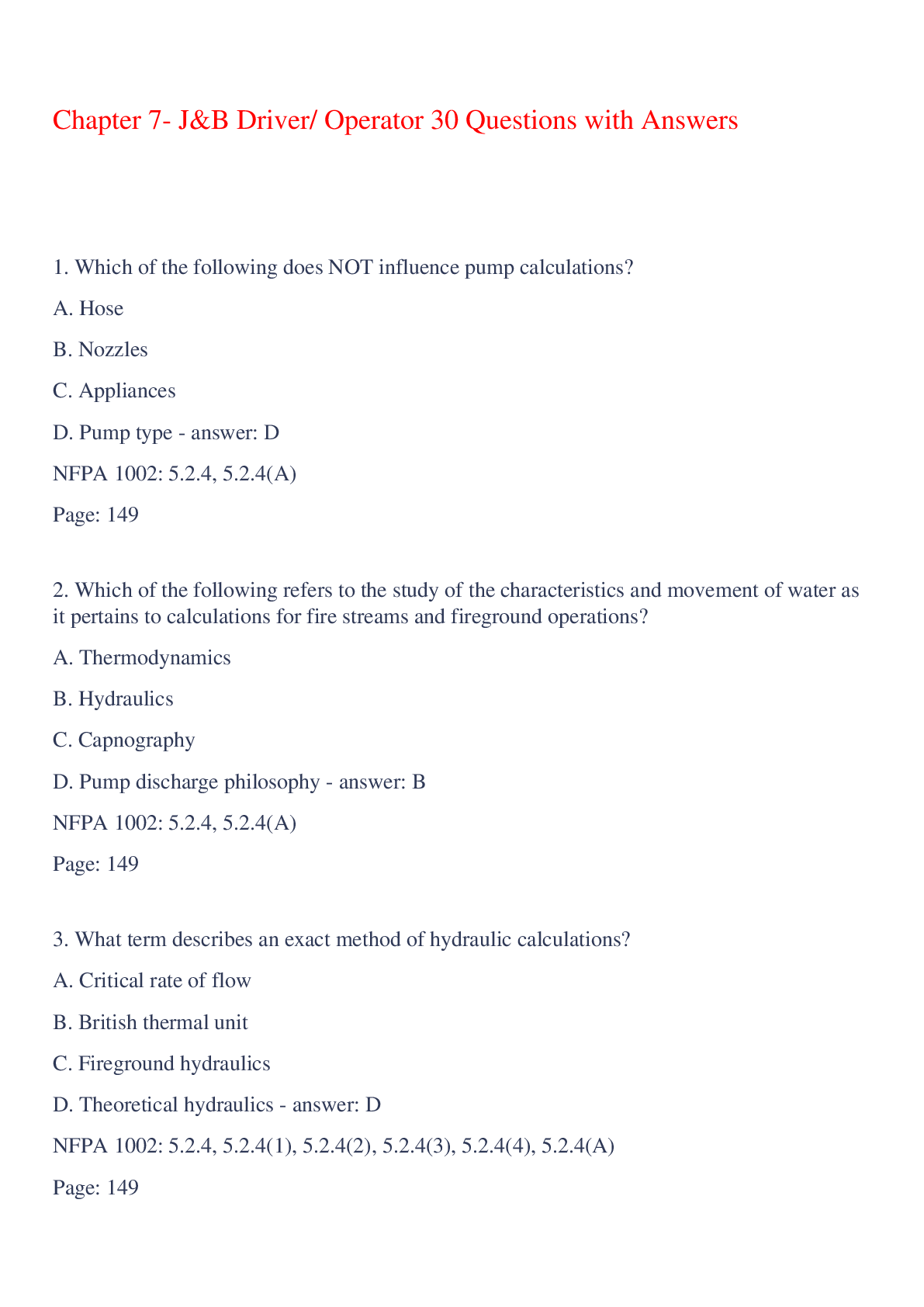
Chapter 7- J&B Driver/ Operator 30 Questions with Answers 1. Which of the following does NOT influence pump calculations? A. Hose B. Nozzles C. Appliances D. Pump type - answer: D NFPA 100 ... 2: 5.2.4, 5.2.4(A) Page: 149 2. Which of the following refers to the study of the characteristics and movement of water as it pertains to calculations for fire streams and fireground operations? A. Thermodynamics B. Hydraulics C. Capnography D. Pump discharge philosophy - answer: B NFPA 1002: 5.2.4, 5.2.4(A) Page: 149 3. What term describes an exact method of hydraulic calculations? A. Critical rate of flow B. British thermal unit C. Fireground hydraulics D. Theoretical hydraulics - answer: D NFPA 1002: 5.2.4, 5.2.4(1), 5.2.4(2), 5.2.4(3), 5.2.4(4), 5.2.4(A) Page: 149 4. What term describes a less-exact, user-friendly method of hydraulic calculations? A. Critical rate of flow B. British thermal unit C. Fireground hydraulics D. Theoretical hydraulics - answer: C NFPA 1002: 5.2.4, 5.2.4(1), 5.2.4(2), 5.2.4(3), 5.2.4(4), 5.2.4(A) Page: 149 5. What term refers to the sufficient flow applied to overcome the heat generated by the fire? A. Critical rate of flow B. British thermal unit C. Fireground hydraulics D. Theoretical hydraulics - answer: A NFPA 1002: 5.2.4, 5.2.4(1), 5.2.4(2), 5.2.4(3), 5.2.4(4), 5.2.4(A) Page: 150 6. What is the basic formula for determining pump discharge pressure (PDP)? A. PDP = NP + FL B. PDP = psi + kPa C. PDP = NP + kpa D. PDP = FL + kpa - answer: A NFPA 1002: 5.2.4, 5.2.4(A) Page: 150 7. ____________ refers to the pressure required at the nozzle to deliver the fire stream and flow rate for which the nozzle was designed. A. Pump discharge pressure B. Nozzle pressure C. Flow rate D. Friction loss - answer: B NFPA 1002: 5.2.4, 5.2.4(A) Page: 150 8. Which of the following formulas is used to determine nozzle reaction in smooth-bore nozzles? A. NR = 1.57 × d × NP B. NR = 1.57 × d × HL × NP C. NR = 1.57 × d² × NP D. NR = 1.57 × d × 3.1416 - answer: C NFPA 1002: 5.2.4, 5.2.4(A) Page: 152 9. Which of the following formulas is used to determine nozzle reaction in fog nozzles? A. NR = 0.0505 × gpm × d² B. NR = 0.0505 × d² × √NP C. NR = 0.0505 × gpm × HL D. NR = 0.0505 × gpm × √NP - answer: D NFPA 1002: 5.2.4, 5.2.4(A) Page: 152 10. Friction loss is measured in: A. psi. B. kPa. C. psi or kPa. D. gpm. - answer: C NFPA 1002: 5.2.4, 5.2.4(1), 5.2.4(2), 5.2.4(3), 5.2.4(4), 5.2.4(A) Page: 156 11. Which of the following is NOT one of the four laws governing how friction loss behaves? A. Provided all conditions are equal, friction loss will vary in direct proportion to the diameter of the hose. B. For a given velocity, the friction loss in the hose is approximately the same no matter what the pressure may be. C. For the same discharge, provided all conditions are equal, friction loss will vary according to the diameter of the hose. D. In the same size hose, friction loss varies approximately as the square of the velocity. - answer: A NFPA 1002: 5.2.4, 5.2.4(A) Page: 155 12. What is the correct formula used for calculating friction loss in its simplest form? A. FL = Q2 + Q B. FL = Q2 × L C. FL = Q2 × C D. FL = C × Q2 × L - answer: D NFPA 1002: 5.2.4, 5.2.4(1), 5.2.4(2), 5.2.4(3), 5.2.4(4), 5.2.4(A) Page: 156 13. What is the term for opening a discharge just enough to deliver the desired pressure when operating multiple lines with different required pressures? A. Gating a valve B. Regulating the line C. Pressure reduction D. Governing the discharge - answer: A NFPA 1002: 5.2.4, 5.2.4(1), 5.2.4(2), 5.2.4(3), 5.2.4(4), 5.2.4(A) Page: 157 14. ________ is pressure lost when the nozzle is above the pump. A. Elevation gain B. Elevation pressure C. Pump pressure D. Elevation loss - answer: D NFPA 1002: 5.2.4, 5.2.4(1), 5.2.4(2), 5.2.4(3), 5.2.4(4), 5.2.4(A) Page: 161 15. ________ is pressure gained when the nozzle is below the pump? A. Elevation gain B. Elevation pressure C. Pump pressure D. Elevation loss - answer: A NFPA 1002: 5.2.4, 5.2.4(1), 5.2.4(2), 5.2.4(3), 5.2.4(4), 5.2.4(A) Page: 161 16. What is the elevation pressure when the nozzle is on the 11th floor? A. 110 psi (770 kPa) B. 120 psi (840 kPa) C. 50 psi (350 kPa) D. 60 psi (420 kPa) - answer: C NFPA 1002: 5.2.4, 5.2.4(1), 5.2.4(2), 5.2.4(3), 5.2.4(4), 5.2.4(A) Page: 162 17. What is the common appliance loss for an elevated master stream and monitor? A. 25 psi (175 kPa) B. 10 psi (70 kPa) C. 75 psi (525 kPa) D. 70 psi (490 kPa) - answer: A NFPA 1002: 5.2.4, 5.2.4(1), 5.2.4(2), 5.2.4(3), 5.2.4(4), 5.2.4(A) Page: 163 18. The two fundamental formulas for determining total pressure loss are ________ and _________. A. PDP = NP + FL; FL = Q2 L + AL + EP B. PDP = NP + FL; FL = (C × Q2 × L) + AL + EP C. PDP = NP + FL; FL = (C × Q2 × L) + EP D. PDP = NP + FL; FL = (C × Q2 + AL) + EP - answer: B NFPA 1002: 5.2.4, 5.2.4(1), 5.2.4(2), 5.2.4(3), 5.2.4(4), 5.2.4(A) Page: 164 19. Using the split flow method, calculate the friction loss for the following example: A pumper is supplying 1200 gallons/min (4500 L/min) through three 2½-inch (64-mm) lines that are 300 ft (90 m) long to a Siamese connection. What is the friction loss to the Siamese connection? A. 96 psi (640 kPa) B. 107 psi (740 kPa) C. 50 psi (345 kPa) D. 33 psi (230 kPa) - answer: A NFPA 1002: 5.2.4, 5.2.4(1), 5.2.4(2), 5.2.4(3), 5.2.4(4), 5.2.4(A) Page: 171 20. As a general rule, a driver/operator should not exceed a pump discharge pressure of ________ when supplying water to a standpipe system. A. 100 psi (700 kPa) B. 150 psi (1050 kPa) C. 200 psi (1400 kPa) D. 250 psi (1750 kPa) - answer: C NFPA 1002: 5.2.4, 5.2.4(1), 5.2.4(2), 5.2.4(3), 5.2.4(4), 5.2.4(A) Page: 175 21. A pumper supplying an elevated master stream is on the hydrant, supplying one 5-inch (127-mm) line that is 200 ft (60 m) long to the inlet of the ladder extended 80 ft (24.3 m) vertically; it is equipped with a 1½-inch (38-mm) smooth-bore master stream tip flowing 600 gallons/min (2271 L/min). What is the pump discharge pressure? A. 291 psi (2037 kPa) B. 171 psi (1197 kPa) C. 151 psi (1041 kPa) D. 121 psi (847 kPa) - answer: C NFPA 1002: 5.2.4, 5.2.4(1), 5.2.4(2), 5.2.4(3), 5.2.4(4), 5.2.4(A) Page: 174 22. Determine the pump discharge pressure for supplying a prepiped elevated master stream through 200 ft (60 m) of 4-inch (102-mm) hose, where the aerial is raised to 80 ft (24 m) and has a 2-inch (50-mm) tip rated at 80 psi (550 kPa). A. 145 psi (1015 kPa) B. 174 psi (1218 kPa) C. 181 psi (1267 kPa) D. 190 psi (1330 kPa) - answer: D NFPA 1002: 5.2.4, 5.2.4(1), 5.2.4(2), 5.2.4(3), 5.2.4(4), 5.2.4(A) Page: 174 23. What are installed on standpipe risers where the static pressure exceeds 175 psi (1225 kPa)? A. Flow meter B. Riser control C. Discharge valve gauge D. Pressure regulating valve - answer: D NFPA 1002: 5.2.4, 5.2.4(1), 5.2.4(2), 5.2.4(3), 5.2.4(4), 5.2.4(A) Page: 178 24. To determine the head pressure, divide the height of the column in feet by _______ (metric height in meters divided by ______). A. 2.31; 9.812 B. 0.434; 1.845 C. 1.5; 6.375 D. 3.345; 14.215 - answer: A NFPA 1002: 5.2.4, 5.2.4(1), 5.2.4(2), 5.2.4(3), 5.2.4(4), 5.2.4(A) Page: 178 25. Lakes and streams require pulling a draft and are considered _________ water sources. A. dynamic B. static C. real D. natural - answer: B NFPA 1002: 5.2.4, 5.2.4(1), 5.2.4(2), 5.2.4(3), 5.2.4(4), 5.2.4(A) Page: 180 26. What is the net pump discharge pressure (NPDPpps) if you are pumping a pump discharge pressure of 170 psi (1190 kPa) and you have 50 psi (350 kPa) of pressure coming in from a hydrant? A. 220 psi (1540 kPa) B. 170 psi (1190 kPa) C. 120 psi (840 kPa) D. 130 psi (910 kPa) - answer: C NFPA 1002: 5.2.4, 5.2.4(1), 5.2.4(2), 5.2.4(3), 5.2.4(4), 5.2.4(A) Page: 180 27. Using the hand method of calculation, calculate the pump discharge pressure for 200 ft (60 m) of 2½-inch (64-mm) hose flowing 250 gallons/min (950 L/min) through a fog nozzle up a hill with an elevation of 40 ft (12 m). A. 115 psi (805 kPa) B. 125 psi (875 kPa) C. 135 psi (945 kPa) D. 145 psi (1015 kPa) - answer: D NFPA 1002: 5.2.4, 5.2.4(1), 5.2.4(2), 5.2.4(3), 5.2.4(4), 5.2.4(A) Page: 185 28. Using the subtract 10 method, calculate the pump discharge pressure for 300 ft (90 m) of 2½-inch (64-mm) hose with a 1-inch (25-mm) smooth-bore tip flowing 200 gallons/min (750 L/min) with a nozzle pressure of 50 psi (345 kPa). A. 74 psi (518 kPa) B. 70 psi (490 kPa) C. 66 psi (462 kPa) D. 62 psi (434 kPa) - answer: A NFPA 1002: 5.2.4, 5.2.4(1), 5.2.4(2), 5.2.4(3), 5.2.4(4), 5.2.4(A) Page: 187 29. Using the Q formula, calculate the pump discharge pressure for Engine 1, which is on a hydrant and is supplying 600 ft (183 m) of 5-inch (127-mm) hose to Engine 2, which is pumping 1200 gallons/min (4543 L/min). A. 76 psi (532 kPa) B. 90 psi (630kPa) C. 105 psi (735 kPa) D. 127 psi (889 kPa) - answer: B NFPA 1002: 5.2.4, 5.2.4(1), 5.2.4(2), 5.2.4(3), 5.2.4(4), 5.2.4(A) Page: 188 30. Determine how many additional lines can be opened when the hydrant static pressure on the pump intake gauge is 80 psi (560 kPa), the driver flows several attack lines with a total flow of 300 gallons/min (1135 L/min), and the residual pressure drops to 70 psi (490 kPa). A. None B. One C. Two D. Three - answer: C NFPA 1002: 5.2.4, 5.2.4(1), 5.2.4(2), 5.2.4(3), 5.2.4(4), 5.2.4(A) Page: 189 [Show More]
Last updated: 2 years ago
Preview 1 out of 9 pages
Buy this document to get the full access instantly
Instant Download Access after purchase
Buy NowInstant download
We Accept:

Reviews( 0 )
$8.50
Can't find what you want? Try our AI powered Search
Document information
Connected school, study & course
About the document
Uploaded On
Jul 09, 2023
Number of pages
9
Written in
All

Additional information
This document has been written for:
Uploaded
Jul 09, 2023
Downloads
0
Views
48