*NURSING > AQA QUESTION and MARK SCHEMES > NUR 641E final Exam Advanced for the Nurse Educator with Complete Solutions (All)
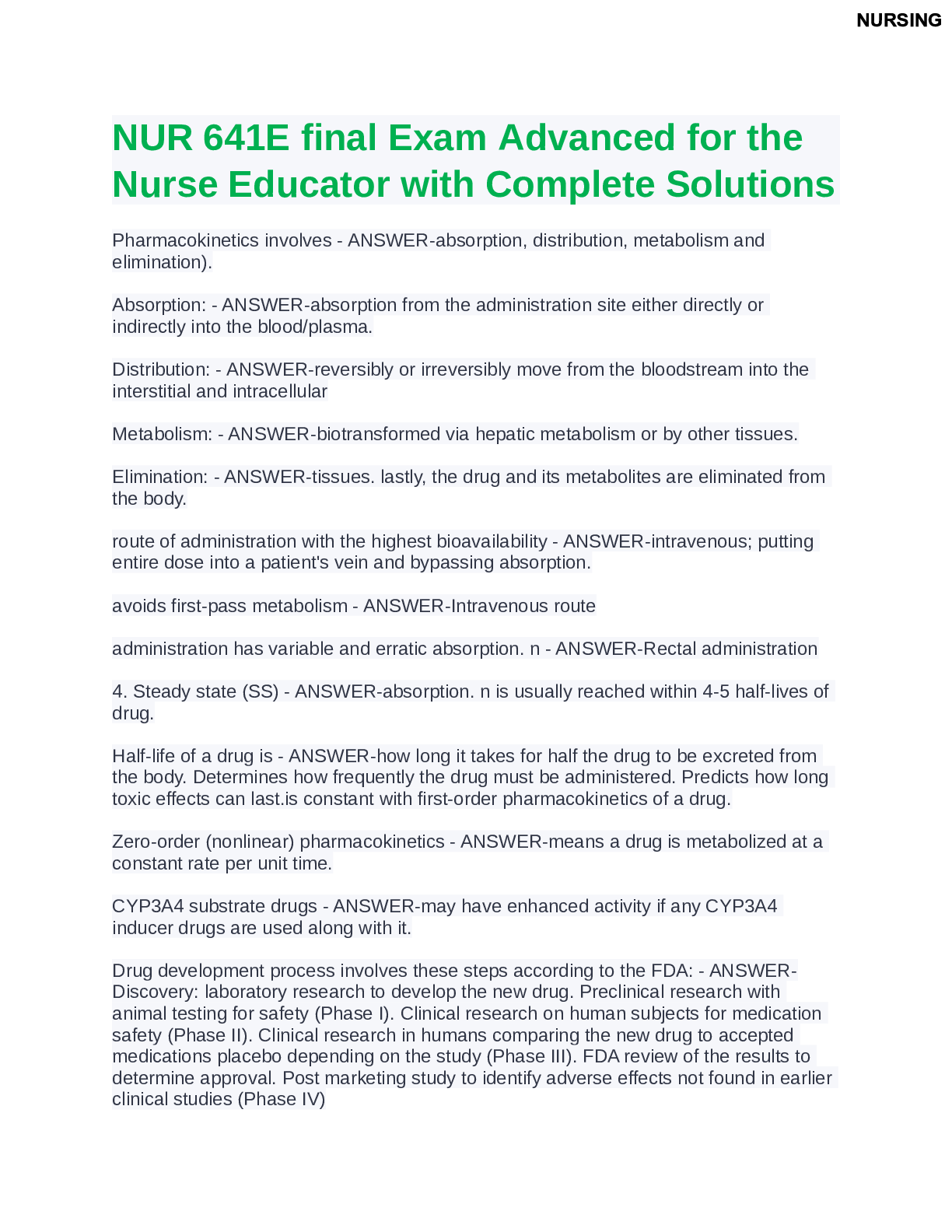
NUR 641E final Exam Advanced for the Nurse Educator with Complete Solutions
Document Content and Description Below
NUR 641E final Exam Advanced for the Nurse Educator with Complete Solutions. VERIFIED Pharmacokinetics involves - ANSWER-absorption, distribution, metabolism and elimination). Absorption: - ANSWER ... -absorption from the administration site either directly or indirectly into the blood/plasma. Distribution: - ANSWER-reversibly or irreversibly move from the bloodstream into the interstitial and intracellular Metabolism: - ANSWER-biotransformed via hepatic metabolism or by other tissues. Elimination: - ANSWER-tissues. lastly, the drug and its metabolites are eliminated from the body. route of administration with the highest bioavailability - ANSWER-intravenous; putting entire dose into a patient's vein and bypassing absorption. avoids first-pass metabolism - ANSWER-Intravenous route administration has variable and erratic absorption. n - ANSWER-Rectal administration 4. Steady state (SS) - ANSWER-absorption. n is usually reached within 4-5 half-lives of drug. Half-life of a drug is - ANSWER-how long it takes for half the drug to be excreted from the body. Determines how frequently the drug must be administered. Predicts how long toxic effects can last.is constant with first-order pharmacokinetics of a drug. Zero-order (nonlinear) pharmacokinetics - ANSWER-means a drug is metabolized at a constant rate per unit time. CYP3A4 substrate drugs - ANSWER-may have enhanced activity if any CYP3A4 inducer drugs are used along with it. Drug development process involves these steps according to the FDA: - ANSWERDiscovery: laboratory research to develop the new drug. Preclinical research with animal testing for safety (Phase I). Clinical research on human subjects for medication safety (Phase II). Clinical research in humans comparing the new drug to accepted medications placebo depending on the study (Phase III). FDA review of the results to determine approval. Post marketing study to identify adverse effects not found in earlier clinical studies (Phase IV) NURSING 2. Medication safety organizations - ANSWER-The Institute for Safe Medication Practices (ISMP) The Institute of Medicine (IOM) The Joint Commission The National Coordinating Council for Medication Error Reporting and Prevention (NCC MERP) Food and Drug Administration (FDA) Safe Use Initiative Two basic type of ADRS: - ANSWER-pharmacological and idiosyncratic. 85% to 90% of ADRS - ANSWER-are pharmacological. Adverse drug reactions are usually preventable, - ANSWER-frequently occur in a hospital or nursing home setting, and include medication errors, adverse drug effects, and allergic idiosyncratic type reactions. ADRS are not commonly reported; - ANSWER-the FDA does not mandate that ADRS be reported. Polypharmacy - ANSWER-involves using multiple health care providers for care, using multiple medications, and using several pharmacies prescription filling. Angiotensin converting enzyme inhibitors (ACEIS): - ANSWER-lisinopril, captopril, enalapril, ramipril, benazepril, fosinopril. ACEIS reduce blood pressure enzyme. - ANSWER-by suppressing the release of angiotensin-converting enzyme. Important side effects of ACE inhibitors - ANSWER-Important include cough and angioedema; discontinue the ACEI if angioedema occurs. Angiotensin II receptor blocking agents (ARBS): - ANSWER-Icandesartan (Atacand), eprosartan (Teveten), irbesartan (Avapro), losartan (Cozaar), telmisartan (Micardis) and valsartan (Diovan). ARBS reduce blood pressure - ANSWER-by blocking angiotensin II receptors. Essential (primary) hypertension - ANSWER-Essential (primary) accounts for 90% of cases; secondary hypertension may caused by chronic renal failure. Nitroglycerin - ANSWER-Nitroglycerin is a nitrate drug that can be administered IV, SL, a topical ointment and as a transdermal patch. Nitrates are contraindicated - ANSWER-with PDE-5 inhibitors (e.g., sildenafil and vardenafil) Amiodarone is the antiarrhythmic - ANSWER-Of choice when there is coexisting heart failure; can cause thyroid and pulmonary toxicity. [Show More]
Last updated: 2 years ago
Preview 1 out of 16 pages
Buy this document to get the full access instantly
Instant Download Access after purchase
Buy NowInstant download
We Accept:

Reviews( 0 )
$12.00
Can't find what you want? Try our AI powered Search
Document information
Connected school, study & course
About the document
Uploaded On
Jun 26, 2023
Number of pages
16
Written in
All

Additional information
This document has been written for:
Uploaded
Jun 26, 2023
Downloads
0
Views
74