Applied Science > EXAM > BTEC Applied Science Unit 1 Biology questions and answers (All)
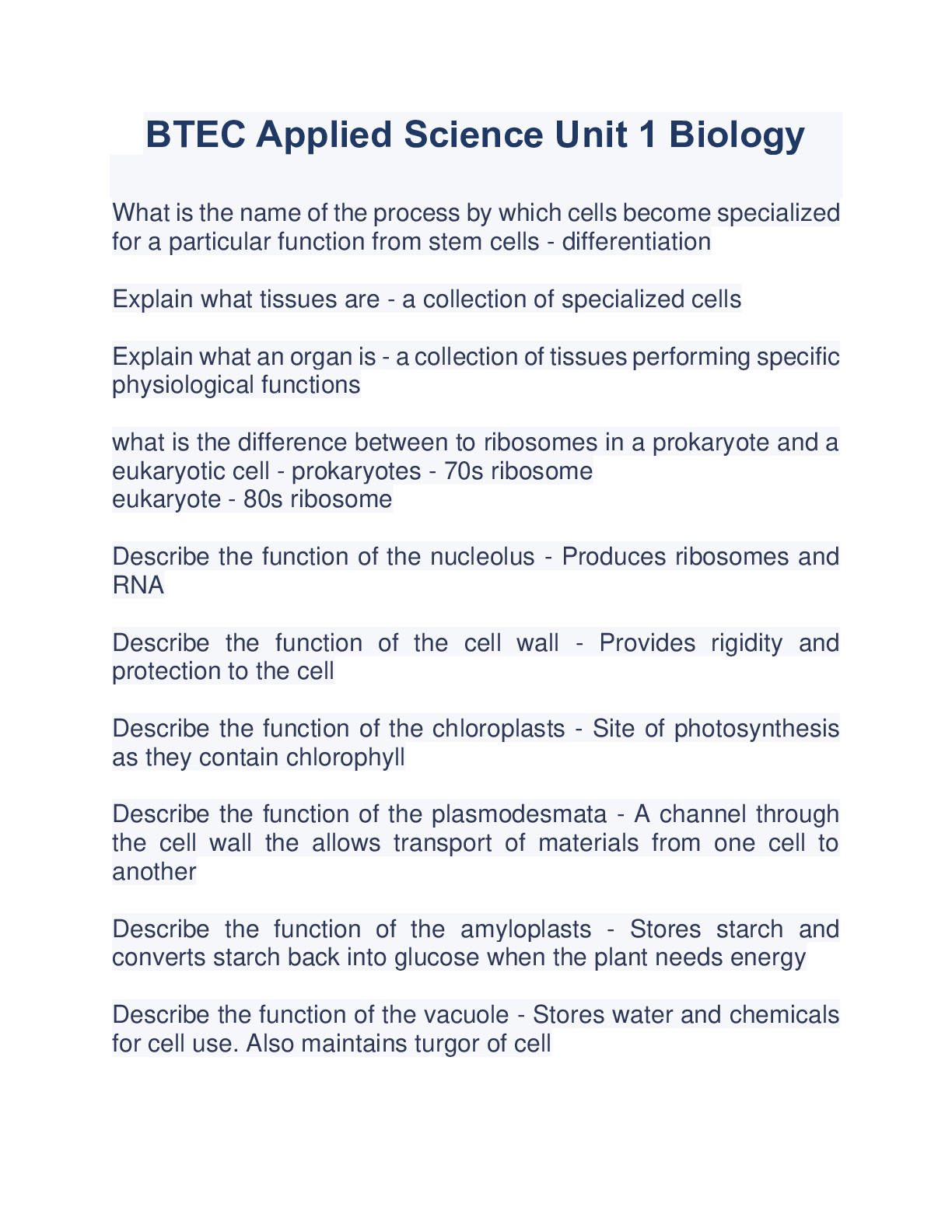
1. What is the name of the process by which cells become specialized for a particular function from stem cells - differentiation 2. Explain what tissues are - a collection of specialized cells 3. Ex ... plain what an organ is - a collection of tissues performing specific physiological functions 4. What is the difference between to ribosomes in a prokaryote and a eukaryotic cell - prokaryotes - 70s ribosome eukaryote - 80s ribosome 5. Describe the function of the nucleolus - Produces ribosomes and RNA 8. Describe the function of the plasmodesmata - A channel through the cell wall the allows transport of materials from one cell to another 9. Describe the function of the amyloplasts - Stores starch and converts starch back into glucose when the plant needs energy 10. Describe the function of the vacuole - Stores water and chemicals for cell use. Also maintains turgor of cell 11. Describe the function of the tonoplasts - Membrane the surrounds the vacuole. Protects the vacuole, isolates it from harmful substances and controls water flow in and out of the vacuole 12. Why are gram positive bacteria more susceptible to antibiotics? - Permeable cell wall whereas gram negative bacteria have a semi-permeable cell wall 13. Describe the adaptations found in a palisade cell - Closely packed together Chloroplasts Large vacuole 14. Explain why the palisade cell has a large amount of chloroplasts - To absorb lots of light for photosynthesis 7. Describe the function of the chloroplasts - Site of photosynthesis as they contain chlorophyll 8. Describe the function of the plasmodesmata - A channel through the cell wall the allows transport of materials from one cell to another 9. Describe the function of the amyloplasts - Stores starch and converts starch back into glucose when the plant needs energy 10. Describe the function of the vacuole - Stores water and chemicals for cell use. Also maintains turgor of cell 11. Describe the function of the tonoplasts - Membrane the surrounds the vacuole. Protects the vacuole, isolates it from harmful substances and controls water flow in and out of the vacuole 12. Why are gram positive bacteria more susceptible to antibiotics? - Permeable cell wall whereas gram negative bacteria have a semi-permeable cell wall 13. Describe the adaptations found in a palisade cell - Closely packed together Chloroplasts Large vacuole 14. Explain why the palisade cell has a large amount of chloroplasts - To absorb lots of light for photosynthesis 15. Explain why palisade cells are closely packed together - To form a continuous layer in the leaf 16. Explain why palisade cells have a large vacuole - To maintain turgor (pushes against the cell wall to maintain rigid shape) 17. Describe the adaptations of a root hair cell - Root hair shape Large vacuole Thin cellulose walls Cell membrane channels mitochondria 18. Explain why root hair cells have an elongated section known as the root hair - Increased surface area for maximum movement of water into the cell 19. Explain why root hair cells have a large vacuole - Contains cell sap with low water potential to encourage water into the cell 20. Explain why root hair cells have thin cellulose walls - Encourage movement of water and minerals into the cell. Short distance for osmosis and diffus [Show More]
Last updated: 2 years ago
Preview 1 out of 6 pages
Buy this document to get the full access instantly
Instant Download Access after purchase
Buy NowInstant download
We Accept:
Can't find what you want? Try our AI powered Search
Connected school, study & course
About the document
Uploaded On
Jun 18, 2023
Number of pages
6
Written in
All
This document has been written for:
Uploaded
Jun 18, 2023
Downloads
0
Views
88
Scholarfriends.com Online Platform by Browsegrades Inc. 651N South Broad St, Middletown DE. United States.
We're available through e-mail, Twitter, Facebook, and live chat.
FAQ
Questions? Leave a message!
Copyright © Scholarfriends · High quality services·