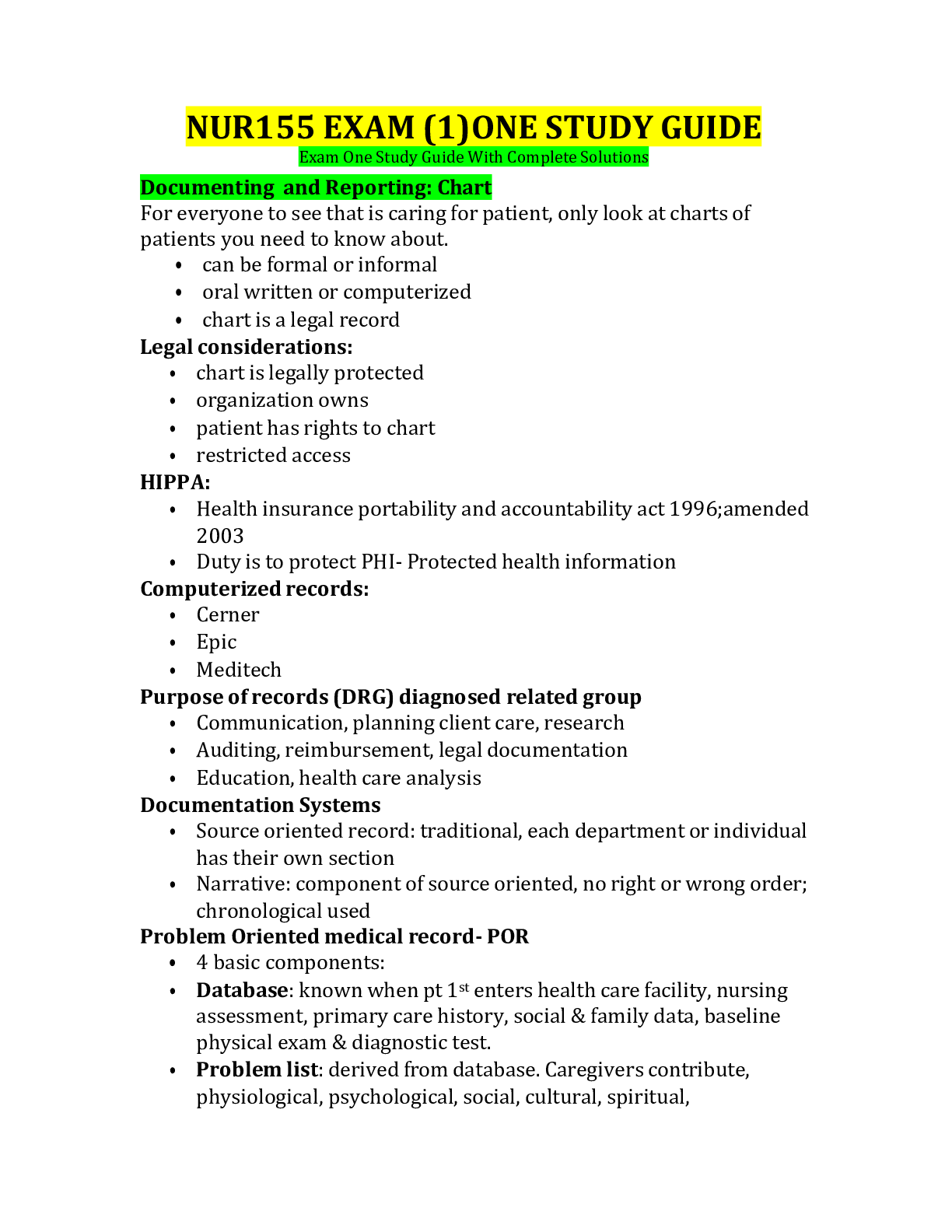
NUR155 EXAM (1)ONE STUDY GUIDE
Exam One Study Guide With Complete Solutions
Documenting and Reporting: Chart
For everyone to see that is caring for patient, only look at charts of patients you need to know about.
• c
...
NUR155 EXAM (1)ONE STUDY GUIDE
Exam One Study Guide With Complete Solutions
Documenting and Reporting: Chart
For everyone to see that is caring for patient, only look at charts of patients you need to know about.
• can be formal or informal
• oral written or computerized
• chart is a legal record
Legal considerations:
• chart is legally protected
• organization owns
• patient has rights to chart
• restricted access
HIPPA:
• Health insurance portability and accountability act 1996;amended 2003
• Duty is to protect PHI- Protected health information
Computerized records:
• Cerner
• Epic
• Meditech
Purpose of records (DRG) diagnosed related group
• Communication, planning client care, research
• Auditing, reimbursement, legal documentation
• Education, health care analysis
Documentation Systems
• Source oriented record: traditional, each department or individual has their own section
• Narrative: component of source oriented, no right or wrong order;
chronological used
Problem Oriented medical record- POR
• 4 basic components:
• Database: known when pt 1st enters health care facility, nursing assessment, primary care history, social & family data, baseline physical exam & diagnostic test.
• Problem list: derived from database. Caregivers contribute, physiological, psychological, social, cultural, spiritual,
development, and environmental needs. Medical problems, diagnoses, surgical procedures, symptoms; nurse diagnoses. (ex impaired mobility, urinary incontinence).
• Plan of Care- Initial list of orders or plan of care.
• Progress notes- chart entry’s made by ALL Health care professionals involved in patients care. SOAP or SOAPIER- Subjective- obtained from client, Objective-information measured or observed (vital signs, lab, x-ray). Assessment- conclusions drawn subjective and objective from data (clients condition and level of progress). Plan- plan designed to resolve stated problem. I- intervention, E- evaluation, R- revision.
PIE- Problems Interventions Evaluation
• Consists or patient flow sheets and progress notes
DAR- Data Action Response
• Focus charting- intended to make patient concerns and strengths the focus of care
CBE- Charting by Exception
• Only abnormal or significant findings, exceptions to the norms recorded. 3 key elements: Flow sheets (vitals, head and face assessment) Standards of care- unconscious patient oral care q4h. Beside access chart forms- all flow sheets kept at patients bedside for immediate recording.
*Guidelines for recording
• Date/ time
• Legibility
• Permanence-Ink
• Accepted terminology
• Signature, Accuracy and completeness
*SBAR
• S- situation- state your name, unit, patient name, briefly state problem
• B- background- admission diagnoses, medical history, summary
of tx to date, code status
• A- assessment- vital signs, pain scale, change from prior assessment
• R- recommendation- what you would like done, ask provider wants to order test or meds, if they want to be notified for any reason, no improvement when you should call.
• I- introduction
Health Promotion vs Protection
Holism- emphasizes on whole person understand how one are relates to another, relationship to external environment and others. (appetite, rest, energy level, activities, family, relationship)
Promotion
• No disease process- a way of thinking
• Positive approach to wellness
Protection
• Already sick
• Stop potential health occurrence or insults to health
Homeostasis
• Self regulating- body monitor-healthy person
• Compensatory- counter balancing abnormal conditions for person
• Feedback systems- Negative; inhibits change Positive; stimulates change.
• Input- material enters system (food) Throughput-
transformation(digested food) Output- information given out ( energy, nutrients, urine, feces)
MASLOW- needs theorist- (5 levels) Kalish added 6th to Maslows
( Stimulation- under physiological – sex, manipulation, exploration, activity)
1. Physiological needs- food, clothing, shelter, comfort, self preservation
2. Safety-security- avoidance of risks, harm and pain
3. Love & belonging- companionship, acceptance, love, affection, group membership
4. Self esteem- responsibility, self respect, recognition, accomplishment, competence
5. Self actualization- reaching potential, independence, creativity, self expression
Various levels of prevention
• Primary prevention-focus on health promotion, protection against disease, precedes disease, applied to generally healthy
individual or groups (immunization, nutrition, stress management, exercise, poison control, injury prevention)
• Secondary prevention-early detection of disease, intervention and health maintenance. (screening, dental checkups, self examinations, nursing assessments and care provided)
• Tertiary prevention- begins after illness, when defect or disability is fixed, or stabilized. Restore to optimum level of functioning (support groups, teaching to identify or prevent complications, physical or occupational therapy)
Nursing interventions/ interventions
• Promotion, programs, facilitator, advocate, teach, coordinate.
• Model behavior, assist, reinforce, guide and educate
Non-adherence:
• Ask questions to understand what is going on why the may be non-adherence; are you having side effects, do you think medication is helping, tools to remind you, someone to help you w/ medications, how many times per day, how many pills, storage requirements, interfere with lifestyle, able to follow dosing instructions, how many doses have you missed in past 3 days????
• Demonstrate care, reinforce and encourage health behaviors,
use aids to teach reinforcement, establish a therapeutic relationship with patient
[Show More]
.png)


.png)


