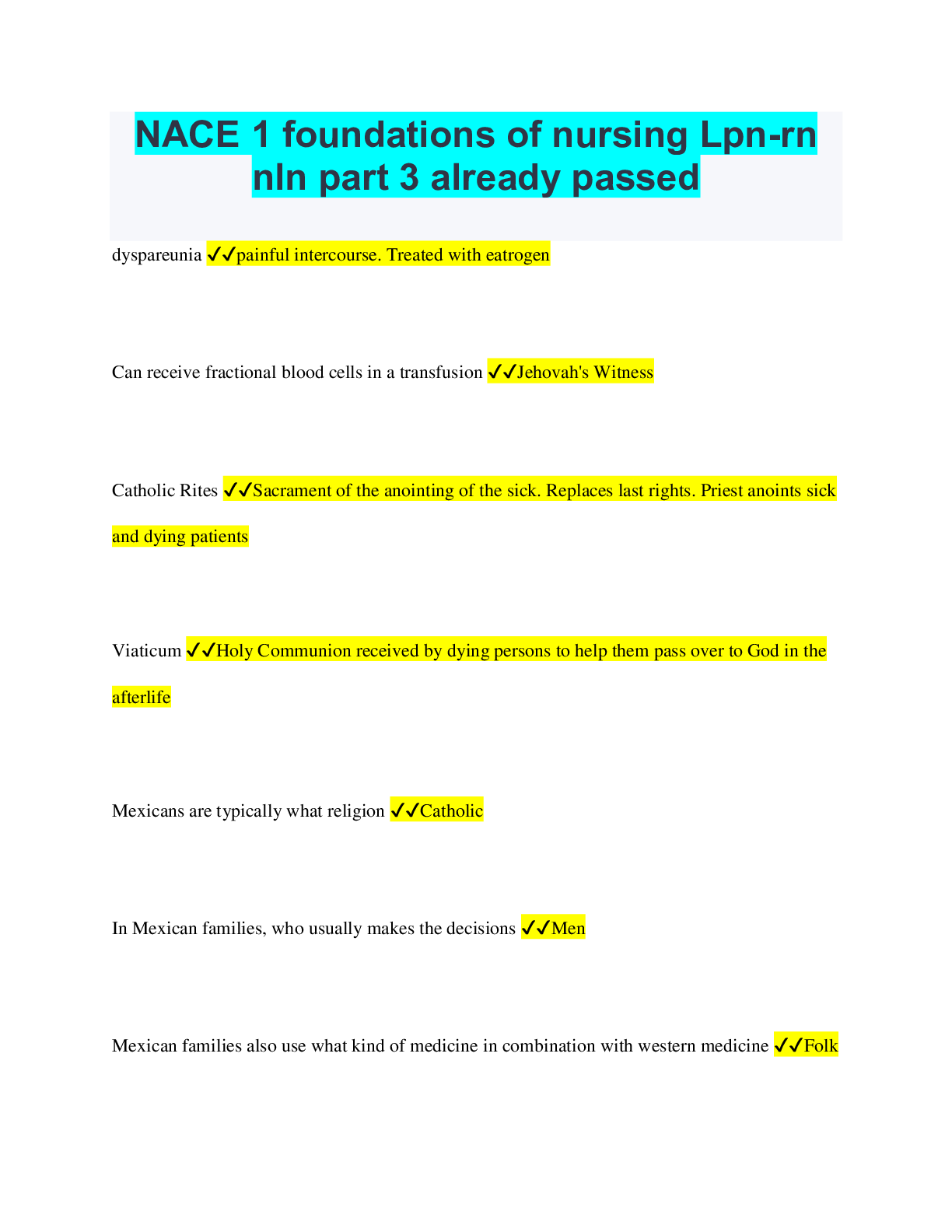
NACE 1 foundations of nursing Lpn-rn nln part 3 already passed
Document Content and Description Below
NACE 1 foundations of nursing Lpn-rn
nln part 3 already passed
dyspareunia ✔✔painful intercourse. Treated with eatrogen
Can receive fractional blood cells in a transfusion ✔✔Jehovah's Witne
...
ss
Catholic Rites ✔✔Sacrament of the anointing of the sick. Replaces last rights. Priest anoints sick
and dying patients
Viaticum ✔✔Holy Communion received by dying persons to help them pass over to God in the
afterlife
Mexicans are typically what religion ✔✔Catholic
In Mexican families, who usually makes the decisions ✔✔Men
Mexican families also use what kind of medicine in combination with western medicine ✔✔Folk
Middle easterners prefer to be ———- from men and women ✔✔Segregated
In middle eastern families, who makes the decisions ✔✔Men
Middle eastern people eat ———— or kosher meals ✔✔Vegetarian
In asian cultures, disagreeing is ✔✔Impolite
ASIAN family's May hide ✔✔Illness
Low self esteem is common among ✔✔Adults
People who can not come to terms with aging/disease have low ✔✔Self worth
Use what kind of approach to help people with low self worrh ✔✔Interdisciplinary team
Sensory overload usually happens in the _______ when cortisol levels are high ✔✔Afternoon
kublar-ross stages of grief ✔✔Denial, anger, bargaining, depression, acceptance
Jung's Theory of Individualism ✔✔as a person ages, the shift of focus goes from extroversion to
introversion.
Jung's theory of personality ✔✔personal unconscious and collective unconscious (including
archetypes) as well as a persons psyche and ego develop their person
At this age, people begin to question their values, beliefs and attainments ✔✔Middle age
sympathetic nervous system ✔✔the division of the autonomic nervous system that arouses the
body, mobilizing its energy in stressful situations. Fight or flight.
parasympathetic nervous system ✔✔the division of the autonomic nervous system that calms the
body, conserving its energy
Erikson's Psychosocial Theory ✔✔stage theory of psychosocial development, lifespan consists
of eight dilemmas that must be solved correctly in order to solve the next dilemma
Trust vs. Mistrust ✔✔Birth to 1 year
Autonomy vs. Shame and Doubt ✔✔1-3 years
Initiative vs. Guilt ✔✔3-6 years
Industry vs. Inferiority ✔✔6-12 years
identiy vs role confusion ✔✔ages 13-18
intamacy vs isolation ✔✔early adulthood
generitivity vs stagnation ✔✔Middle age
Ego Integrity vs. Despair ✔✔65-death
Pecks middle age tasks and outcomes ✔✔Tasks: Valuing wisdom vs physical power. Socializing
vs sexualizing. Cathectic flexibility vs cath Eric impoverishment. Mental flexibility vs mental
rigidity.
Outcomes: negative outcomes leads to weak relationships, inflexibility and resistance to change.
Positive outcomes lead to strong relationships, flexibility and adaptability to change
Pecks older adults tasks and outcomes ✔✔Tasks: ego differentiation vs work role preoccupation.
Body transcendence vs body preoccupation. Ego transcendence vs ego preoccupation.
Outcomes: Negative outcomes leads to feelings of loss of identity after retirement, depression,
inability to accept bodily functional changes and fear of death. Positive outcomes lead to
meaningful life after retirement, acceptance of bodily changes, acceptance of death and feelings
that life was food
Bandura's Social Learning Theory ✔✔Learning occurs when we observe other people and model
their behavior
Bandura's Social Cognitive Theory ✔✔behavior, environment, and cognition are the key factors
in development
four conditions for observational learning ✔✔1)pay attention
2)retention
3)motivation for subject/learner
4)potential for reproduction
CDSS (Clinical Decision Support System) ✔✔Interactive software that helps physicians
CPOE (Computerized Physician Order Entry) ✔✔Application used by physicians and other
health care providers to enter patient care information. Also provides support tools that result in
improved care and patient outcomes. Used for ordering medications.
EMR (electronic medical record) ✔✔an electronic document that contains patient health
information, gathered from different sources
SOAP ✔✔subjective, objective, assessment, plan
PIE ✔✔Problem, intervention, evaluation
DAR ✔✔Data, action, response
Discharge plan should begin ✔✔On admission
expressive language disorder ✔✔a disorder involving a limited vocabulary and difficulty using
tense correctly, recalling words, or producing sentences of the length and complexity that would
be expected of a child of that age
Mixed Receptive-Expressive Language Disorder ✔✔A communication disorder in which the
individual has difficulty understanding and expressing certain kinds of words or phrases, such as
directions, or, in more severe forms, basic vocabulary or entire sentences.
phonological disorder ✔✔a difficulty in speech sound production resulting in multiple speech
sound errors ultimately involving the sound system of a language; also used to describe
articulation disorder
Stuttering ✔✔a speech disorder that disrupts the flow of words with repeated or prolonged
sounds and involuntary pauses. Usually onset at 2-7 years. Sometimes associated with tics,
blinking, or other motor movement
Dysarthria ✔✔slurred speech or difficulty forming words. Unrelated to intelligence. Should age
appropriate vocabulary, normal tones, face the patient. Face the patient so you can observe facial
expressions and gestures.
Yes or no questions are best with ✔✔Dysarthria
Asphasia ✔✔The loss of ability to use and or understand written and spoken language because
of damage to the speech center of the brain caused by brain tumors, injury or stroke.
global asphasia ✔✔Inability to understand the spoken word or to speak/write. May understand
gestures. Use pictures.
Broca's aphasia ✔✔An aphasia associated with damage to the Broca's area of the brain,
demonstrated by the impairment in producing understandable speech. Use pictures, face patient
and speech slowly and clearly
Wernicke's aphasia ✔✔condition resulting from damage to Wernicke's area, causing the affected
person to be unable to understand language. Use gestures. Patient may be able to wrjte
Festinger's Cognitive Dissonance Theory ✔✔Proposes that people change their attitudes to
reduce the cognitive discomfort created by inconsistencies between their attitudes and their
behavior
Howard Giles accommodation theory ✔✔- Suggests we adjust our speech to accommodate the
person we are addressing
- Convergence ~ when we use language to resemble that used by those around us
- upward = making your accent
more refined
- downwards = making your accent
more regional
- Divergence ~ when we use language to distance ourselves from others
Cultivation Theory ✔✔idea that long-term immersion in a media environment leads to
"cultivation," or enculturation, into shared beliefs about the world
Groupthink ✔✔the mode of thinking that occurs when the desire for harmony in a decisionmaking group overrides a realistic appraisal of alternatives
Pharmacokinetics ✔✔The process by which drugs are absorbed, distributed within the body,
metabolized, and excreted. What the body does to the drugs
Pharmadynamics ✔✔assesses the biochemical and physiological effects of the drug on the body
at various doses, at molecular level. What the drugs do to the body
Volume of distribution ✔✔amount of drug in body/plasma drug concentration. Rate at which the
drug passes into the tissue
drug elimination ✔✔accomplished by excretion into urine and/or by inactivation by enzymes in
the liver
Drug half-time ✔✔5 half times for complete elimination
Drug recovery time ✔✔The time it takes for the person to awaken
Effect site equilibration ✔✔Time between dosing and clinical effect. Time it takes for circulation
to deliver drug to site of action.
anticoagulants avoid ✔✔Vitamin k
ACE inhibitors avoid ✔✔Potassium
Antibiotics avoid ✔✔Milk
Antifungals avoid ✔✔Milk
Anti-histamines/depressants/anxieties avoid ✔✔Alcohol
Potassium sparing diuretics avoid ✔✔Potassium
Polypharmacy ✔✔The use of multiple medications on a regular basis.
thrombolytics (dissolve blood clots) ✔✔-ase
A1C normal ✔✔<6
Humalog ✔✔fast acting insulin
Diuretics ✔✔medications that reduce fluid volume in the body through urine (furosemide-lasix. -
ide)
Nitrates ✔✔Vasodilation (nitroglycerin)
Antimycobacterials ✔✔Treats TB (Isoniazid)
Antiviral ✔✔acting to make a virus ineffective (ribavirin)
Antiplatelet ✔✔used to prevent clotting (aspirin)
Vasodilators ✔✔relax and expand the blood vessels (pietal)
antilipidemic ✔✔a drug given to lower certain types of lipids or fats in the blood (Lipitor or
Zocor, -statin)
anticoagulant ✔✔prevents blood clotting (lovenox)
Glycoprotein IIb/IIIa inhibitors ✔✔∙Administered through an intrevenous injection or IV
infusion during hospitalization.
∙Oral form is associated with increased mortality.
*∙used in treating patients who have unstable angina, certain types of heart attacks.*
*∙potent platelet inhibitors.*
∙platelets to adhere to abnormal surfaces and aggregate is mediated by surface membrane
glycoprotien (GP) receptors.
reduces hypertension ✔✔-lol
inotropic agents ✔✔medications that change the force of cardiac muscle contractions (digoxin)
Potassium sparing diuretics ✔✔Spironolactone (Aldactone)
Selective Serotonin Reuptake Inhibitors (SSRIs) ✔✔antidepressant drugs that achieve their
agonistic effect on serotonin by selectively blocking its reuptake (citalopram)
immunosuppressant ✔✔medication to block certain actions of immune system; used to prevent
rejection of transplanted organ
Hemaglobin values ✔✔12-18
Hematocrit values ✔✔37-52%
WBC values ✔✔4,500-11,000. Viral- lower. Infection 10,000+
Bacteriostatic ✔✔inhibits growth of bacteria
Bacteriocidal ✔✔kills bacteria
antineoplastic drugs ✔✔agents that prevent the development, maturation, or spread of cancer
cells
Anticonvulsants ✔✔prevent or control seizures (tegretol, cerebrix, gabapentin -tal)
Proton Pump Inhibitors ✔✔decrease the amount of acid produced by the stomach (ranitidine,
cimetidine)
seratonin antagonists ✔✔N/V (Ondansetron-Zofran)
informed consent ✔✔An ethical principle requiring that research participants be told enough to
enable them to choose whether they wish to participate.
Beneficience ✔✔Doing good or causing good to be done; kindly action
Nonmaleficence ✔✔duty to do no harm
[Show More]
Last updated: 2 years ago
Preview 1 out of 15 pages


.png)







.png)