Sophia Macroeconomics Milestone 4 - Questions, Answers & Concept
$ 15

2022-2023 ASVAB Arithmetic Reasoning and Mathematics
Geology > QUESTIONS & ANSWERS > ESS 101 INTRO TO GEOLOGY - University of Washington _ Laboratory 4: Volcanoes, Plutons, and IgneousR (All)
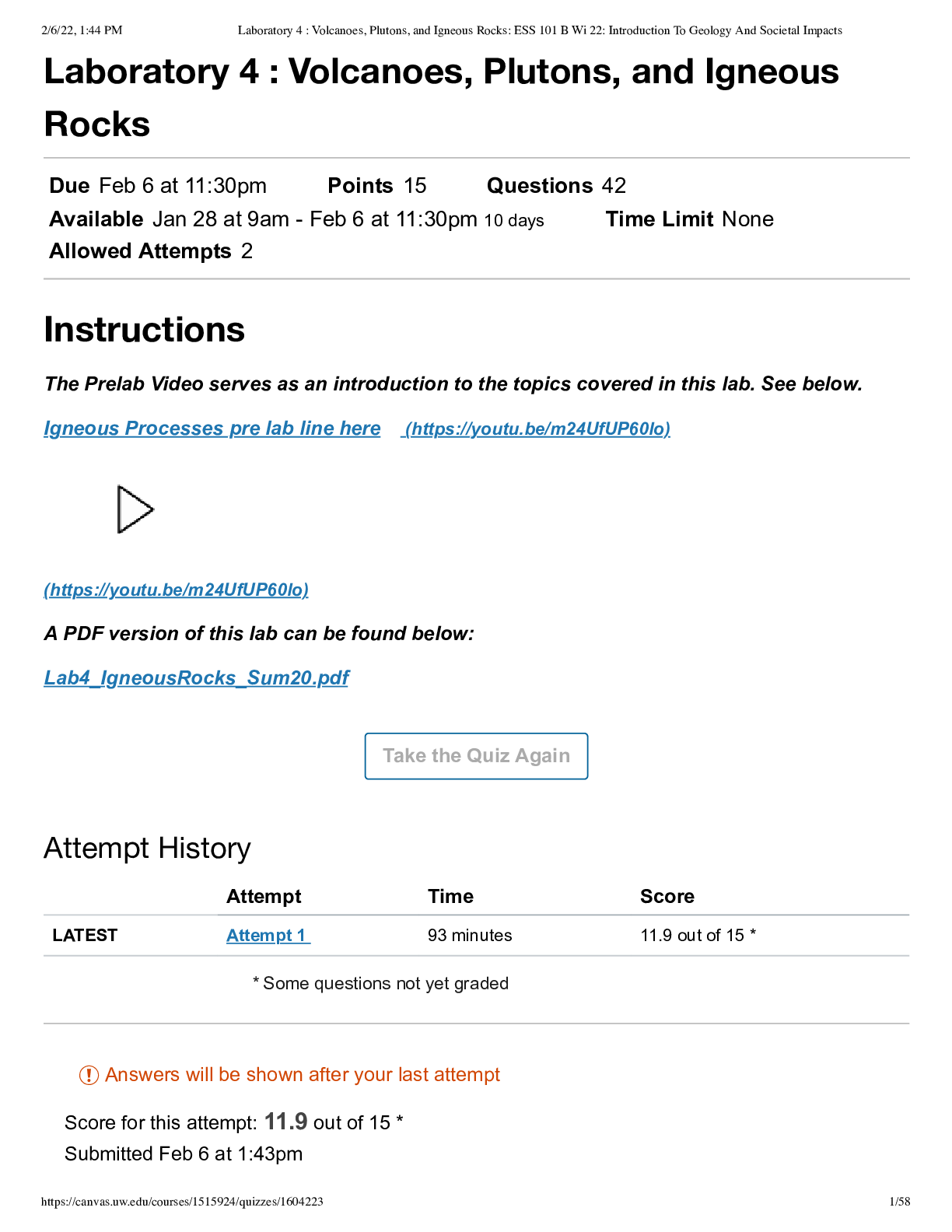
ESS 101 INTRO TO GEOLOGY - University of Washington _ Laboratory 4: Volcanoes, Plutons, and IgneousRocks. Fall 2022. Score for this attempt: 11.9 out of 15. Igneous rocks form when magma cools, either ... slowly underground or rapidly at earth’s surface (i.e. near volcanoes). Magma cooling processes affect the size of crystals in igneous rocks. Bigger crystals form in slow-cooling, underground magma chambers, and smaller crystals form in fast-cooling lava flows/eruptions. To recognize eight common igneous minerals, and nine common igneous rocks. Mafic rocks are usually dark-colored and felsic rocks are usually light-colored. The viscosity of lavas relates to their silica content. Felsic (or silica-rich) lavas are more viscous than mafic (or silica-poor) lavas that flow like rivers. Lava viscosity affects the shape of volcanoes. Introduction Igneous rocks form when liquid rock cools and crystallizes. Liquid rock is called magma when underground and lava when on the surface. Igneous rocks have different chemical and physical characteristics depending on what they are made out of and how or where they formed. Like using paleomagnetic stripes to understand tectonic movement, geologists can use other information recorded in igneous rocks to study earth’s history. In this lab, we will examine several different igneous rocks, and we will explore the various conditions under which they formed. Igneous rocks are classified by mineral composition and by mineral grain texture. This classification2/6/22, 1:44 PM Laboratory 4 : Volcanoes, Plutons, and Igneous Rocks: ESS 101 B Wi 22: Introduction To Geology And Societal Impacts https://canvas.uw.edu/courses/1515924/quizzes/1604223 3/58 system is interpretive, because these characteristics imply something about the source of the magma and the conditions under which the rock formed. Chemical composition. The mineralogy of an igneous rock is related to the chemical composition of the cooling parent magma from which it forms. For example, a magma that is mostly Si, Fe, Mg, Al, Ca, and O, a common composition for mantle melts, is likely to form olivine, a mineral made out of Si, Fe, Mg, and O and plagioclase, a mineral made out of Si, Al, Ca, and O. The chemical ingredients in the melt turn into the minerals in the rock. Texture. The sizes and arrangement of the minerals in an igneous rock is known as texture. In this case, texture is not how the rock feels but how it looks. Igneous rock texture relates to the cooling environment in which the rock formed. The same melt composition can form very different rocks depending on the cooling rate. Slow cooling inside the earth forms large (greater than about a quarter of a millimeter) crystals, which slowly, over thousands of years grow together to form intrusive, or plutonic, rocks. Volcanic eruptions result in rapid magma cooling (seconds to days), and the formation of igneous rocks with small grains (often too small to see with your eyes). During a volcanic eruption, magma does not have enough time to solidify before it reaches the surface. The rocks that form at the surface during a volcanic eruption cool rapidly and are called extrusive or volcanic rocks. A. Igneous Rock Composition2/6/22, 1:44 PM Laboratory 4 : Volcanoes, Plutons, and Igneous Rocks: ESS 101 B Wi 22: Introduction To Geology And Societal Impacts https://canvas.uw.edu/courses/1515924/quizzes/1604223 4/58 99% of the total bulk of most igneous rocks is made up of only eight elements: silicon (Si) sodium (Na) oxygen (O) aluminum (Al) magnesium (Mg) calcium (Ca) iron (Fe) potassium (K) Most of these elements occur in the crystal structures of eight minerals, which constitute over 95% of the volume of all common igneous rocks. Therefore, these minerals are of paramount importance in the study of igneous rocks. Below is a list of the common igneous rock-forming minerals, along with their diagnostic properties and chemical formulas: [Show More]
Last updated: 2 years ago
Preview 1 out of 58 pages
Buy this document to get the full access instantly
Instant Download Access after purchase
Buy NowInstant download
We Accept:

Can't find what you want? Try our AI powered Search
Connected school, study & course
About the document
Uploaded On
Apr 17, 2023
Number of pages
58
Written in
All
This document has been written for:
Uploaded
Apr 17, 2023
Downloads
0
Views
145
Scholarfriends.com Online Platform by Browsegrades Inc. 651N South Broad St, Middletown DE. United States.
We're available through e-mail, Twitter, Facebook, and live chat.
FAQ
Questions? Leave a message!
Copyright © Scholarfriends · High quality services·