Statistics > EXAM > Summary 1ZM31 Multivariate Data Analysis by Hair Questions and Answers -2023 (All)
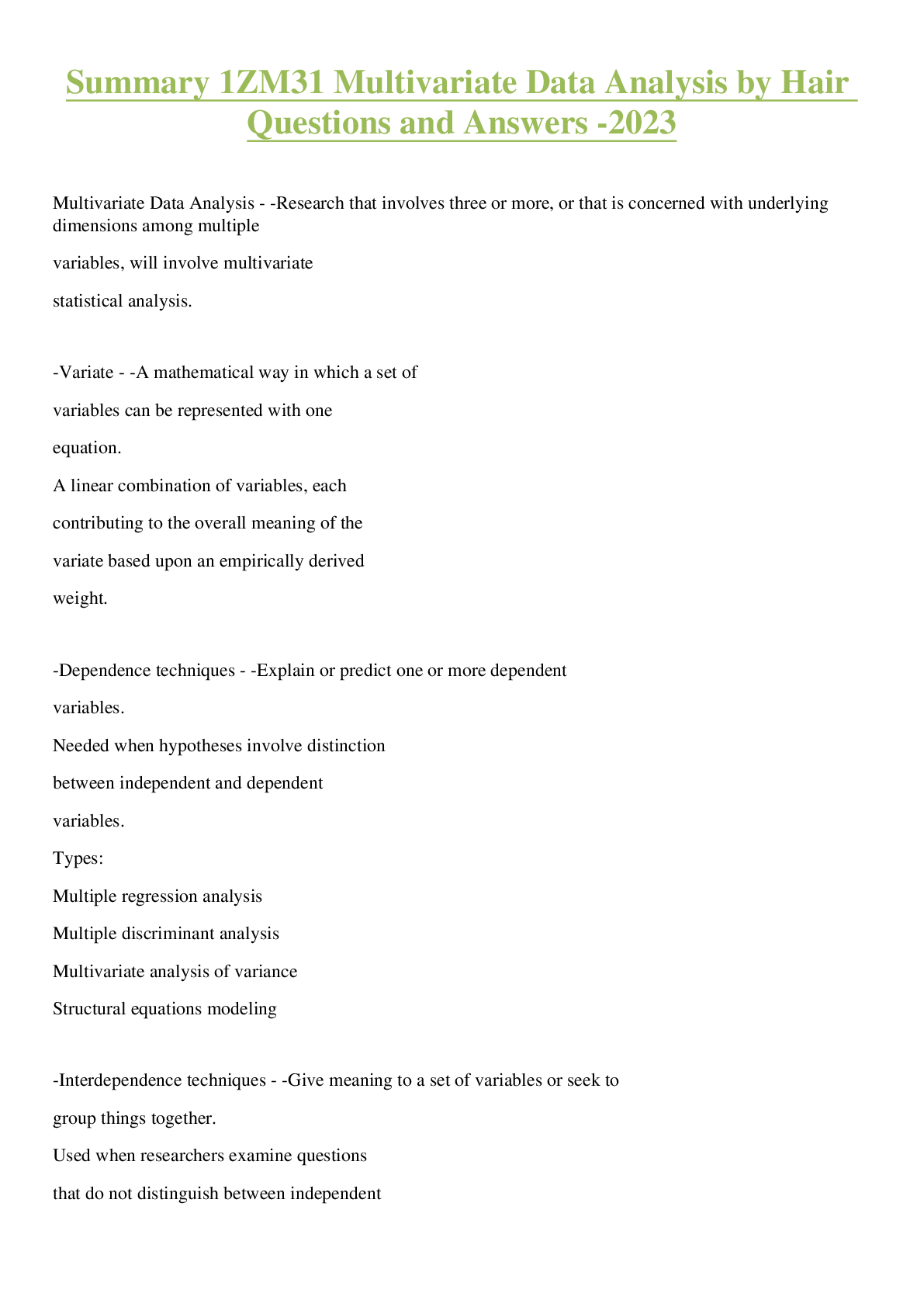
Summary 1ZM31 Multivariate Data Analysis by Hair Questions and Answers -2023
Document Content and Description Below
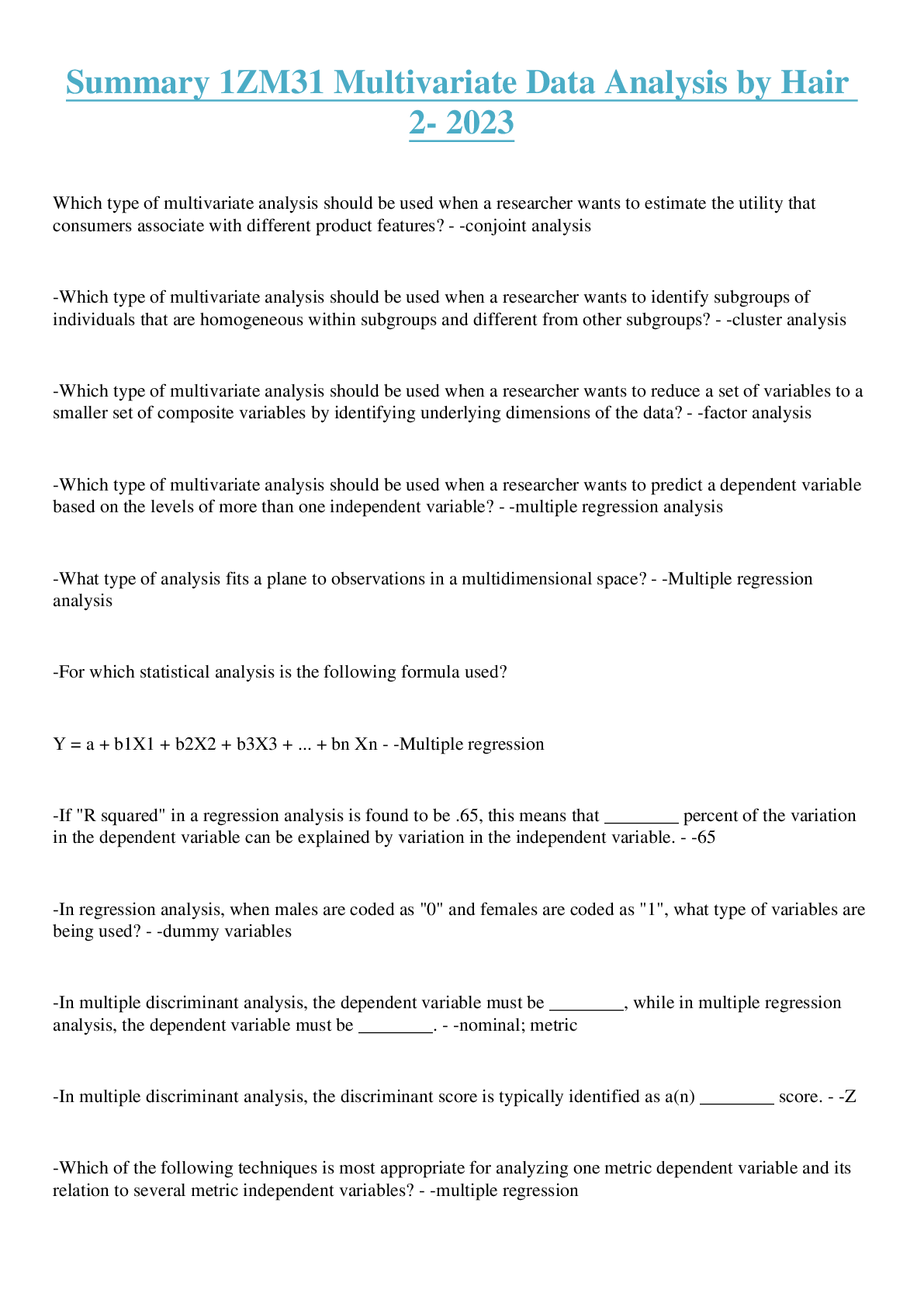
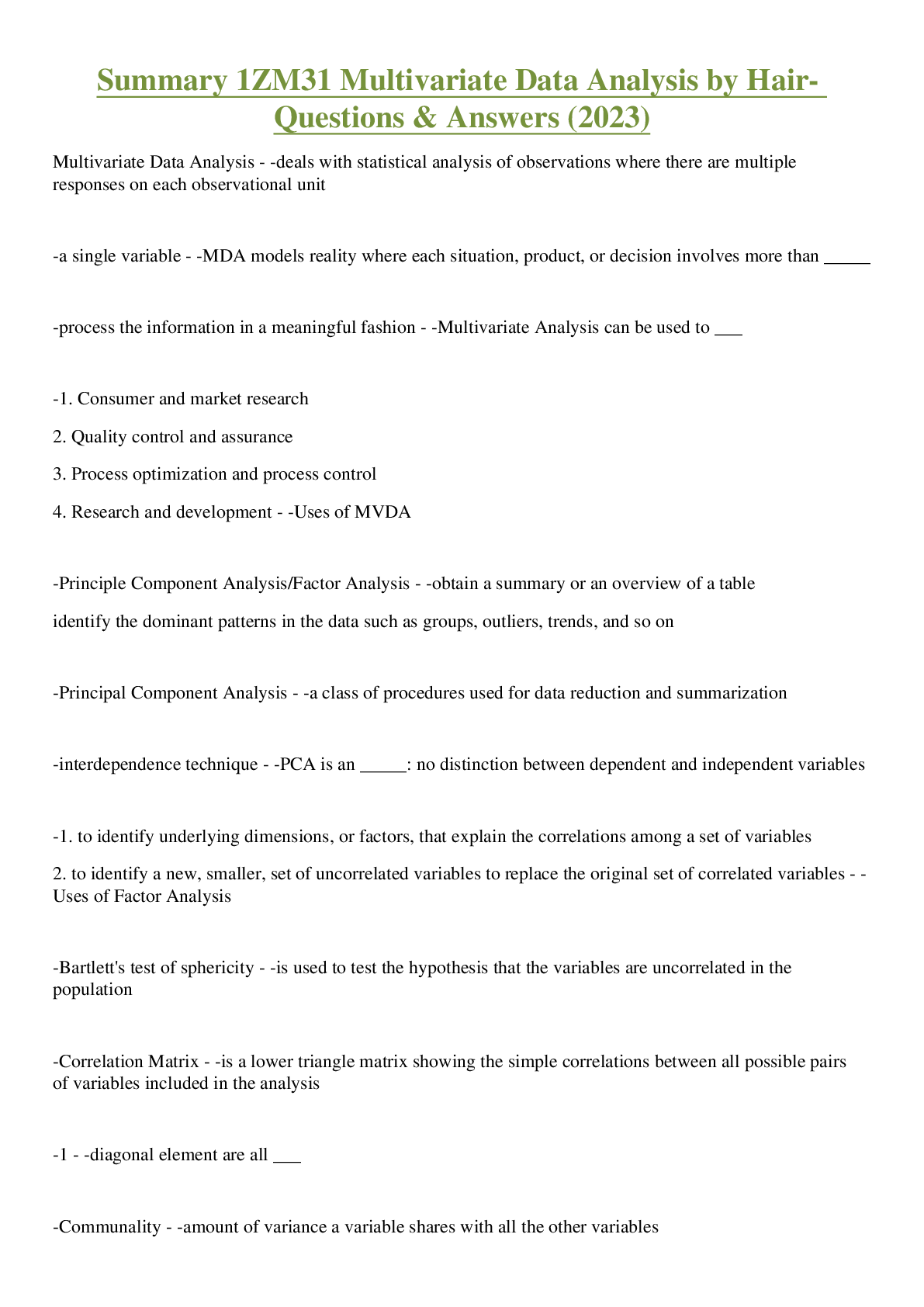
Multivariate Data Analysis - -Research that involves three or more, or that is concerned with underlying dimensions among multiple variables, will involve multivariate statistical analysis. -Vari ... ate - -A mathematical way in which a set of variables can be represented with one equation. A linear combination of variables, each contributing to the overall meaning of the variate based upon an empirically derived weight. -Dependence techniques - -Explain or predict one or more dependent variables. Needed when hypotheses involve distinction between independent and dependent variables. Types: Multiple regression analysis Multiple discriminant analysis Multivariate analysis of variance Structural equations modeling -Interdependence techniques - -Give meaning to a set of variables or seek to group things together. Used when researchers examine questions that do not distinguish between independent and dependent variables. Types: Factor analysis Cluster analysis Multidimensional scaling -Nominal and ordinal scales are - -nonmetric -Interval and ratio scales are - -metric -General linear model - -A way of explaining and predicting a dependent variable based on fluctuations (variation) from its mean due to changes in independent variables -Multiple regression analysis - -An analysis of association in which the effects of two or more independent variables on a single, intervalscaled dependent variable are investigated simultaneously -Dummy variable - -The way a dichotomous (two group) independent variable is represented in regression analysis by assigning a 0 to one group and a 1 to the other. -R2 in Multiple Regression - -The coefficient of multiple determination in multiple regression indicates the percentage of variation in Y explained by all independent variables -MANOVA - -A multivariate technique that predicts multiple continuous dependent variables with multiple categorical independent variables. -Discriminant analysis - -A statistical technique for predicting the probability that an object will belong in one of two or more mutually exclusive categories, based on several independent variables -Factor analysis - -Statistically identifies a reduced number of factors from a larger number of measured variables Types: Exploratory (EFA) —performed when the researcher is uncertain about how many factors may exist among a set of variables Confirmatory (CFA)—performed when the researcher has strong theoretical expectations about the factor structure before performing the analysis. -Factor loading - -Indicates how strongly a measured variable is correlated with a factor. -Rule of parsimony - -an explanation involving fewer components is better than one involving many more. -Creating composite scales with factor results - -When a clear pattern of loadings exists, the researcher may take a simpler approach by summing the variables with high loadings and creating a summated scale. -Communality - -A measure of the percentage of a variable's variation that is explained by the factors. A relatively high communality indicates that a variable has much in common with the other variables taken as a group. Communality for any variable is equal to the sum of the squared loadings for that variable [Show More]
Last updated: 2 years ago
Preview 1 out of 4 pages
Buy this document to get the full access instantly
Instant Download Access after purchase
Buy NowInstant download
We Accept:

Reviews( 0 )
$9.50
Can't find what you want? Try our AI powered Search
Document information
Connected school, study & course
About the document
Uploaded On
Apr 06, 2023
Number of pages
4
Written in
All

Additional information
This document has been written for:
Uploaded
Apr 06, 2023
Downloads
0
Views
127